KeepKarlsruheBoring: collective agendas, boredom and maintenance
Víctor Fancelli Capdevila
Gulaschprogrammiernacht 24 (GPN24) · Day 3 · ZKM Kubus
Overview
In a world increasingly dominated by centralized platforms for event discovery, Víctor Fancelli Capdevila's GPN24 talk, "KeepKarlsruheBoring: collective agendas, boredom and maintenance," presents a compelling case for community-driven, federated alternatives. The presentation delves into the genesis and operational philosophy behind "Keep Karlsruhe Boring," a local event agenda project born out of a perceived lack of accessible information about happenings in the German city of Karlsruhe. Far from being a mere technical showcase, the talk highlights the profound impact of combining simple, open-source technology with dedicated community engagement to address a common urban challenge: the struggle to find out "what's going on."
Key moments
- 0:00 Origin of Keep Karlsruhe Boring: addressing local boredom
- 2:00 Existing local calendars: limitations for flexible event publishing
- 4:00 Gancio: the federated, anonymous event platform chosen
- 6:00 Simple technical setup and unique bug resolution strategy
- 8:00 Strategies for populating events and easy user onboarding
- 10:00 Diverse community contributions and moderation philosophy
- 12:00 Dream Wild: future ideas for spreading event information
- 13:00 Sustainable funding model: lottery and local engagement
KeepKarlsruheBoring: collective agendas, boredom and maintenance
Speakers: Víctor Fancelli Capdevila
Conference: GPN24
YouTube: https://www.youtube.com/watch?v=KMJ7Nm5_tys
Overview
In a world increasingly dominated by centralized platforms for event discovery, Víctor Fancelli Capdevila's GPN24 talk, "KeepKarlsruheBoring: collective agendas, boredom and maintenance," presents a compelling case for community-driven, federated alternatives. The presentation delves into the genesis and operational philosophy behind "Keep Karlsruhe Boring," a local event agenda project born out of a perceived lack of accessible information about happenings in the German city of Karlsruhe. Far from being a mere technical showcase, the talk highlights the profound impact of combining simple, open-source technology with dedicated community engagement to address a common urban challenge: the struggle to find out "what's going on."
Fancelli Capdevila, an individual with a background in arts and cultural institutions, initiated the project not as a tech expert but as an ordinary citizen seeking to connect with his local environment. His journey underscores that building effective digital infrastructure for communities doesn't require advanced technical prowess but rather a commitment to open standards, collaborative tools, and a willingness to engage directly with people. The "Keep Karlsruhe Boring" initiative leverages Gancio, an open-source event management software, and the ActivityPub protocol to create a federated network of local agendas, demonstrating a practical model for digital autonomy and decentralized information sharing.
The significance of this talk extends beyond local event listings. It offers a blueprint for how communities can reclaim control over their digital spaces, fostering local engagement and resisting the gravitational pull of commercial platforms. By focusing on low-barrier technology, transparent processes, and the paramount importance of non-technical community work, Fancelli Capdevila illustrates how collective boredom can be a powerful catalyst for innovative, sustainable, and truly local digital commons.
Background
▶ Watch: Origin of Keep Karlsruhe Boring: addressing local boredom (0:00)
The premise of "Keep Karlsruhe Boring" stems from a common urban dilemma: the perception of a city being "boring" often isn't due to a lack of activity, but rather a failure of communication and information centralization. Víctor Fancelli Capdevila, having moved from the vibrant city of Barcelona to Karlsruhe, initially encountered this feeling of boredom. However, his experience as part of various groups and collectives revealed a different truth: events were happening, but the information was fragmented across disparate channels, making it difficult for individuals to discover and participate. This observation led to the core idea: "It would be fantastic to have a collective agenda."
The challenge, as recognized by the XKCD comic, is the tendency to create yet another siloed solution when attempting to centralize information. Fancelli Capdevila explored existing local initiatives to avoid this pitfall. One notable example was Kalender auf who.org, a well-established calendar primarily for left-wing politics and subculture, heavily supported by the cultural center Beth. This calendar uses Laut.de, an open-source software developed in Stuttgart, which at the time was not federated with ActivityPub (though work was underway). Its primary model involved registered collectives publishing events, which offered a degree of centralization but lacked the flexibility Fancelli Capdevila sought for individual artists or less formal groups.
Another inspiration came from the Barcelona Convocala instance, which directly confronted the "three plus one problem": events scattered across different platforms, lack of communication between collectives, and the individual struggle to maintain an agenda. Their focus was explicitly on avoiding commercial platforms and simplifying the event submission process, emphasizing a "safety date" for initial announcements, with details added later. This model resonated deeply with the "Keep Karlsruhe Boring" vision, particularly its use of Gancio, an open-source software originating from a hack lab in Torino, known for its focus on demonstrations and anonymity, and crucially, its ActivityPub federation. The project also federated with culture.social, a Mastodon instance also running Gancio, further validating the federated approach. These existing efforts provided a crucial foundation, demonstrating both the need for and the viability of a decentralized, community-managed event infrastructure.
Key Findings
▶ Watch: Gancio: the federated, anonymous event platform chosen (4:00)
The primary finding of the "Keep Karlsruhe Boring" project is the profound efficacy of combining simple, open-source technology with intensive community engagement to create a vital local information hub. Fancelli Capdevila emphatically states that the technical barrier to entry is extremely low, stressing, "trust yourself, try it, and it will work." The project's success hinges not on complex engineering, but on accessible tools and a collaborative spirit.
A crucial insight is that technical maintenance constitutes a mere fraction of the overall effort. Fancelli Capdevila estimates that 99% of the work involved in running "Keep Karlsruhe Boring" is non-technical. This includes:
- Event creation and contribution gathering: Actively populating the agenda, especially with repeating events to build a stable base.
- Dissemination and outreach: Informing people about the platform and its purpose.
- Onboarding: Simplifying the process for new contributors, often through a "2-minute smartphone speech" that demystifies event submission.
- Moderation: Developing clear, community-agreed guidelines (e.g., "no nothing things" against discrimination, and the more nuanced "not boring things" for event relevance).
- Community building: Fostering diverse contributions, from "color department" volunteers to individuals specializing in specific event types like "algo rhythm."
The project demonstrates that federation via ActivityPub is a powerful mechanism for expanding reach and sharing information without centralizing control. By federating with other Gancio instances like culture.social and drawing inspiration from Barcelona Convocala, "Keep Karlsruhe Boring" taps into a broader network, allowing events to be shared and discovered across multiple platforms. This decentralized model contrasts sharply with commercial platforms, offering greater digital sovereignty to local communities.
Finally, the talk highlights the importance of adaptability and a pragmatic approach to challenges. The anecdote of the "strange bug" that mysteriously disappeared, leading to a "toast to the people of support" rather than panic, exemplifies a resilient and community-oriented problem-solving philosophy. This low-stress approach to technical issues further reinforces the idea that such projects are fundamentally about people and collaboration, not just code.
Technical Deep Dive
▶ Watch: Strategies for populating events and easy user onboarding (8:00)
The technical backbone of "Keep Karlsruhe Boring" is Gancio, an open-source event management software. Developed by a hack lab in Torino, Gancio was initially designed with a focus on facilitating demonstrations and ensuring anonymity, which led to a minimalist interface and a streamlined event submission process. Its simplicity is a key factor in its adoption, making it approachable for non-technical users. The software is widely used, with instances spread across Italy, Spain, and France, including prominent ones like Barcelona Convocala and Madrid Convocala.
A critical feature of Gancio, and central to the "Keep Karlsruhe Boring" project, is its ability to federate through ActivityPub. ActivityPub is a decentralized social networking protocol, part of the Fediverse, which allows different independent servers (instances) to communicate and share content. In the context of "Keep Karlsruhe Boring," this means that events posted on their instance can be automatically shared with and discovered on other federated Gancio instances, such as culture.social, a Mastodon instance that also runs Gancio. This cross-instance sharing eliminates the need for manual cross-posting and significantly amplifies the reach of local events without relying on a single, centralized database. The speaker notes the "really great" ability to share events with culture.social due to this federation.
For hosting, the project chose Uberspace, an independent German hosting provider. This decision was driven by three main factors:
- Available documentation: Uberspace provides extensive and clear guides, making it accessible for users with varying technical skills.
- Do-it-yourself approach: It aligns with the project's ethos of community empowerment and self-reliance.
- Flexible price model: As an experimental, community-driven project, cost-effectiveness and scalability were important considerations. The total annual cost for Uberspace, including the domain, is approximately 150 euros, with a recommendation for a small extra budget.
The technical maintenance of the Gancio instance has proven to be remarkably straightforward. Fancelli Capdevila highlights that updates, which occur roughly every six months, typically involve "four commands, literally." This low maintenance overhead is crucial for a volunteer-run project, freeing up time for community engagement rather than complex system administration. The project encountered a "strange bug" at one point, which was resolved by simply communicating with Uberspace support and, eventually, the bug "just disappear[ed]" without a clear explanation, leading to a pragmatic, humorous approach to such occurrences.
While the core interface of Gancio is simple, other instances have explored customizations. The speaker mentions Devin C say Z and Brick Board as examples of Gancio instances that "changed the interface quite a lot," making "small changes but giving more life to the agenda." This flexibility in customization allows communities to tailor the user experience to their specific needs while still benefiting from the core federated functionality. Future technical aspirations include developing a chatbot to query event data and an automated printing system to generate zines of upcoming events for physical distribution, showcasing the creative potential when open-source tools are in the hands of an engaged community.
Demo / Proof of Concept
▶ Watch: Diverse community contributions and moderation philosophy (10:00)
The entire "Keep Karlsruhe Boring" project itself serves as the living demo and proof of concept for the ideas presented in the talk. While no live, interactive demonstration of the software's features was performed during the GPN24 presentation, the existence and ongoing operation of the KeepKarlsruheBoring.de website, as explicitly mentioned by the speaker, embodies the successful implementation of a community-driven, federated event agenda.
This real-world instance demonstrates several key aspects:
- Viability of Open Source: It proves that Gancio, a relatively simple open-source software, can effectively power a functioning local event platform. The website is a tangible output of the software's capabilities.
- ActivityPub Federation in Action: The project's ability to federate with other Gancio instances, such as
culture.social, illustrates the practical benefits of the ActivityPub protocol. Events posted on "Keep Karlsruhe Boring" are shared across the Fediverse, expanding their reach without centralized control. This interoperability is a core feature that the project actively utilizes. - Low Technical Barrier: The operational status of the website, maintained by a small group of volunteers with limited technical expertise, directly validates the speaker's claim that technical skills are not the primary bottleneck. The ease of installation (documented by Uberspace) and maintenance (four commands for updates) are continuously proven by the platform's sustained uptime.
- Community Engagement: The content on the "Keep Karlsruhe Boring" website—the diverse range of events, from flea markets to dance gatherings and "algo rhythm" sessions—is a direct result of successful community onboarding and contribution. The platform is not merely a technical exercise but a vibrant reflection of local life, populated by engaged citizens and organizations.
In essence, the talk is a case study of a successful project rather than a step-by-step software demo. The "demo" is the continuous, active operation of "Keep Karlsruhe Boring" as a functional, federated hub that addresses the problem of fragmented local information, making a tangible difference in how residents discover and engage with their city.
Defensive Implications
▶ Watch: Sustainable funding model: lottery and local engagement (13:00)
While "Keep Karlsruhe Boring" is not a talk about cybersecurity vulnerabilities or traditional "defensive" measures, it carries profound defensive implications for communities seeking to maintain digital autonomy and resilience in an increasingly centralized online world. The project offers a robust defense strategy against the monopolization of local information by commercial platforms and the erosion of community control over its own data.
Firstly, by establishing a federated, open-source event agenda, communities are actively defending against the lock-in effects and data exploitation inherent in proprietary platforms. Commercial event sites often harvest user data for advertising, dictate terms of service, and can unilaterally change their offerings or even cease operations, leaving communities without their accumulated information. "Keep Karlsruhe Boring" demonstrates how Gancio and ActivityPub empower local groups to own their data and infrastructure, ensuring long-term access and control. This is a defense of digital sovereignty at the local level.
Secondly, the emphasis on low-barrier technology and decentralized maintenance acts as a defense against reliance on external technical expertise or large corporate budgets. The project's success with Uberspace and simple update procedures shows that communities can build and sustain their own digital commons without needing a dedicated IT department. This fosters technical self-reliance and reduces vulnerability to external pressures or resource constraints. It's a defense against the "tech gatekeepers" who often make digital tools inaccessible or unaffordable for grassroots initiatives.
Thirdly, the project's approach to moderation and community building serves as a defense against the polarization and toxicity often found on large social media platforms. By defining clear "red lines" (e.g., against discrimination) and fostering open discussion on content relevance ("not boring things"), communities can cultivate a healthier, more inclusive digital space. This is a defense of community values and social cohesion within the digital realm.
Finally, the aspiration for physical extensions like printing zines or organizing lotteries for funding represents a defense against the purely digital realm's limitations. It connects the online agenda back to the physical community, reinforcing local ties and providing sustainable, independent funding models. This holistic approach defends against the purely virtual existence of many online platforms, grounding the digital tool in the real-world needs and activities of the community it serves. In essence, "Keep Karlsruhe Boring" is a manifesto for communities to defend their right to self-organize, self-inform, and self-govern their digital presence.
Key Takeaways
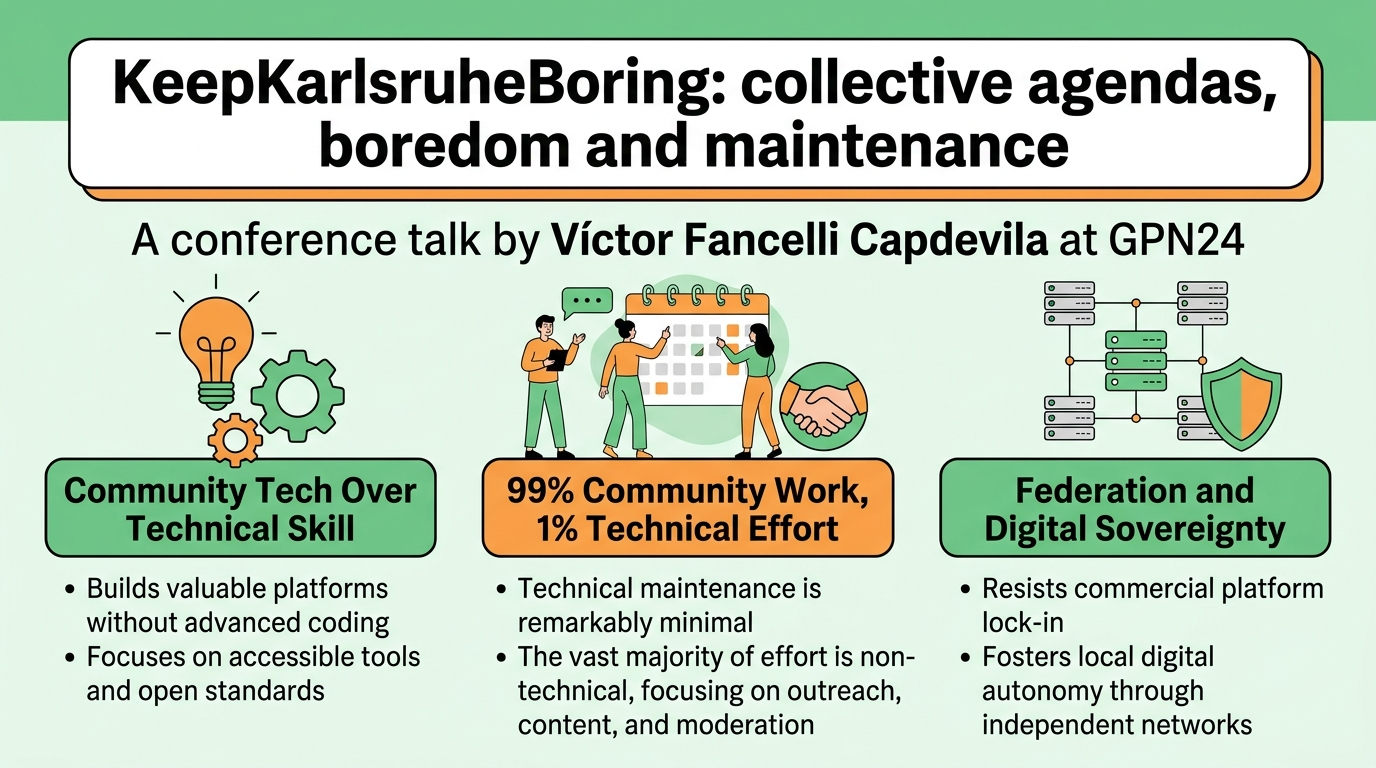
- Simplicity is Key to Adoption: Building effective community digital infrastructure does not require advanced technical skills. Tools like Gancio with straightforward interfaces and Uberspace with clear documentation lower the barrier to entry, empowering non-technical individuals to create and maintain valuable platforms.
- Community Work Trumps Technical Effort: The vast majority (99%) of the effort in running a successful community project like "Keep Karlsruhe Boring" is non-technical, focusing on outreach, onboarding, content generation, and moderation. Technical setup and maintenance can be surprisingly minimal.
- Federation for Digital Sovereignty: Utilizing protocols like ActivityPub allows communities to share information across independent instances, creating a decentralized network that resists commercial platform lock-in and fosters local digital autonomy.
- Pragmatic Problem Solving: Adopting a flexible and resilient attitude towards technical challenges, such as unexpected bugs, reduces stress and allows community efforts to focus on their core mission rather than getting bogged down by minor technical glitches.
- Empowerment Through Local Engagement: Projects like "Keep Karlsruhe Boring" demonstrate how addressing a seemingly simple problem (finding local events) through open-source, community-driven means can significantly enhance local engagement, foster creativity, and build stronger community ties.
- Sustainable Funding Models Are Crucial: Creative and community-centric funding ideas, such as local lotteries with contributions from participating organizations, are essential for ensuring the long-term independence and viability of such initiatives.
About the Speaker(s)
Víctor Fancelli Capdevila is the speaker behind the "KeepKarlsruheBoring" project. His professional background is rooted in the arts and cultural sector. He previously worked at ZKM (Center for Art and Media Karlsruhe) and the HFG (Hochschule für Gestaltung Karlsruhe), both prominent institutions in Karlsruhe's cultural landscape. Currently, he is associated with the Fine Arts Academy in Karlsruhe.
Originally from Barcelona, Fancelli Capdevila freely chose to move to Karlsruhe, a decision he notes often prompts questions due to Barcelona's reputation as a vibrant city contrasting with Karlsruhe's perceived "boring" image. This personal experience of adjusting to a new city and initially finding it difficult to discover local activities was the direct catalyst for initiating the "Keep Karlsruhe Boring" project. He emphasizes that he is "not so much into" technology but is capable of reading documentation, highlighting his approach as a community organizer and facilitator rather than a hardcore developer. His motivation is deeply personal, stemming from a desire to connect people with the rich, albeit sometimes hidden, cultural life of his adopted city.
Reviews
Dr. Zero (Offensive Security Researcher) — SOLID
Honest community-infrastructure talk that delivers exactly what it promises: a replicable playbook for running a local federated event calendar with minimal tech overhead. Not novel, not deep, but useful if you're in the target audience of hackerspace organizers wondering whether to spin up Gancio.
Heather Calloway (CISO) — OUT OF SCOPE
This is a community organizing talk about building a local event calendar using federated open-source tools. It's not a security talk. No relevance to enterprise security programs, risk management, or defensive operations.