User-Centric Product Management in Open Source
Rosanna Sibora
Gulaschprogrammiernacht 24 (GPN24) · Day 3 · ZKM Medientheater
Overview
In her compelling GPN24 talk, "User-Centric Product Management in Open Source," Rosanna Sibora, a seasoned product leader, confronts the common anxieties and misconceptions surrounding user research and product management within the open-source community. She challenges the notion that these practices are exclusive to large, well-funded organizations, demonstrating how even small, resource-constrained open-source projects can effectively integrate user-centricity into their development workflows. Sibora's core message is an urgent call for open-source initiatives to shift from being solely engineering-driven to genuinely user-focused, thereby unlocking greater user adoption and ensuring long-term sustainability.
Key moments
- 0:00 Introduction and vision for open source adoption
- 3:10 Product Manager role: delivering problems, not solutions
- 6:30 Myth 1 debunked: User research in less than half a day
- 9:30 Favorite questions for user interviews
- 12:00 Myth 2: Feature requests vs. true user needs
- 15:00 Actionable steps for user-centric open source development
- 16:30 Q&A: How to handle contradictory user research results
User-Centric Product Management in Open Source
Speakers: Rosanna Sibora
Conference: GPN24
YouTube: https://www.youtube.com/watch?v=qV_l3pSzlZM
Overview
In her compelling GPN24 talk, "User-Centric Product Management in Open Source," Rosanna Sibora, a seasoned product leader, confronts the common anxieties and misconceptions surrounding user research and product management within the open-source community. She challenges the notion that these practices are exclusive to large, well-funded organizations, demonstrating how even small, resource-constrained open-source projects can effectively integrate user-centricity into their development workflows. Sibora's core message is an urgent call for open-source initiatives to shift from being solely engineering-driven to genuinely user-focused, thereby unlocking greater user adoption and ensuring long-term sustainability.
Sibora champions a pragmatic approach, aiming to debunk myths such as user research being an arduous, time-consuming endeavor or an unnecessary luxury. Instead, she provides a clear, actionable framework for developers and project maintainers to cultivate "tiny product management habits," investing minimal time to gain crucial insights. This shift is presented not merely as a best practice but as a foundational strategy to build the right products, solve pertinent problems, and ultimately strengthen the transparency, freedom, and trust that open-source software promises. By answering fundamental questions like "Who is it actually for?" and "Which problem are we solving?", open-source projects can significantly increase their impact and user base, moving closer to a future where open-source solutions render closed-source alternatives obsolete.
Background
▶ Watch: Introduction and vision for open source adoption (0:00)
Open-source software, despite its inherent power, reliability, and innovation, frequently grapples with a unique set of challenges that hinder its full potential and wider user adoption. Rosanna Sibora highlights several critical issues: many projects struggle with financing, often relying on sponsors who dictate specific features rather than supporting broader user-driven development. This can lead to projects becoming "feature factories," churning out outputs that may not address core user needs. Furthermore, open-source teams are typically small, frequently comprising solo developers or a handful of engineers, often lacking dedicated roles for product management or UI/UX design. This naturally leads to an engineering-centric approach, where the focus leans heavily on how to build rather than what problem to solve or why it matters to the user. The cumulative effect of these challenges often results in maintainer burnout, as valuable time and effort are expended on features that ultimately prove to be irrelevant or underutilized.
Sibora posits that these issues contribute directly to the persistent gap in user adoption, preventing open-source solutions from displacing their proprietary counterparts. Her vision is one where open-source products are so finely tuned to user needs that they become the default choice, making closed-source alternatives obsolete. To bridge this gap, she advocates for a deliberate shift towards user-centric product management. This approach seeks to provide clarity on three fundamental questions: "Who is it actually for?", "Which problem are we solving for this user group?", and "What is their need?".
To clarify the roles within this paradigm, Sibora defines an ideal product team as one that possesses all necessary roles to transform an idea into a solution, ideally with no external dependencies. This typically includes a product manager, a UI/UX designer, and an engineering lead, forming the "product triad," complemented by additional engineers or relevant specialists. She explicitly distinguishes their responsibilities: the product manager is accountable for the what and the why, the designer for the experience (how it feels), and engineering for how it's built. Crucially, Sibora stresses that product managers do not deliver solutions; instead, their primary function is to deliver problems to solve. They are accountable for ensuring the product creates value for users and is viable from a business perspective (recognizing that even open-source developers need to sustain themselves). Their work involves reducing uncertainty by engaging with users, conducting small experiments, mapping the opportunity space, and validating assumptions before committing precious engineering time. This evidence-based approach ensures decisions are rooted in user needs and market realities, rather than the opinions of the "loudest or the highest paid people in the room," ultimately focusing on outcome and value delivered, not merely the output of features.
Key Findings
▶ Watch: Myth 1 debunked: User research in less than half a day (6:30)
Rosanna Sibora's presentation effectively debunks several pervasive myths surrounding user-centric product management, particularly within the open-source context, offering actionable findings for teams of all sizes.
The first myth she addresses is the belief that user research takes ages, requires a dedicated team, and is unaffordable. Sibora firmly refutes this, emphasizing that the most crucial responsibility of a product manager—or anyone fulfilling that role—is to ensure the right problem is being solved. She illustrates this with her own experience at OpenProject, a project management tool. Following Atlassian's announcement of Jira Data Center's end-of-life, OpenProject pivoted to focus on Jira migration. Despite not having dedicated product managers or user researchers, Sibora conducted foundational research herself. This involved talking to approximately 10 Jira users and existing OpenProject users, observing their workflows. This entire process took less than one half day but yielded critical insights, revealing "agile ways of working" as the most relevant use case. This minimal investment helped focus the team's efforts for months, preventing misdirection and ensuring high-value delivery. For deeper dives, she explains that even around six interviews on a specific topic can provide enough insights for initial prototypes. Her favorite interview questions, "What is the most annoying thing to you?" and "What might be the most life-changing thing?", are highly effective in eliciting genuine user needs.
The second myth challenged is the misconception that **feature requests are product insights. Sibora warns against confusing "what people ask for with what they actually need." A backlog filled with user-requested features doesn't necessarily reflect a true understanding of the underlying problem. To navigate this, she recommends exploring Jobs to be Done (JTBD) theory**, popularized by Clayton Christensen. This framework suggests that users "hire" products to solve specific problems or make progress in their lives. Instead of focusing on desired features (e.g., "a drilling machine"), the focus should be on the underlying job (e.g., "the possibility to place a picture of their cat on the wall"). The key is to understand user behavior in context—asking where they are, what they are doing when they reach for a product, what problem they are trying to solve, and what progress they are trying to make—rather than relying on abstract preferences from surveys.
Finally, Sibora tackles the fear that nobody will want to talk to me when initiating user research. While acknowledging that community engagement can be challenging, she argues that open source's inherent transparency makes user-centric product management easier than in closed-source environments. Projects can start small, reaching out to users through mailing lists, ticketing systems, or general posts. Even one user interview is better than zero. Critically, she advises making it clear to users that their participation offers tangible value: the opportunity to shape the product with the development team. By publishing product visions, prototypes, and roadmaps early and transparently—as OpenProject does with its 100% public roadmap—projects create natural opportunities for interaction and feedback. The core message is to "share your own need with the world" to invite collaboration.
Technical Deep Dive
▶ Watch: Favorite questions for user interviews (9:30)
While not a security talk in the traditional sense, Rosanna Sibora's presentation offers a technical deep dive into the methodologies and frameworks that underpin effective user-centric product management in open source. These are the "technologies" of understanding user needs and building the right product.
At the core is the concept of the Product Triad, an ideal team structure comprising a Product Manager (PM), a UI/UX Designer, and an Engineering Lead. The PM's role is particularly critical: they are responsible for the "what and why," accountable for the product's value to users and its business viability. Unlike a "feature factory" that measures output (number of features), a true PM focuses on outcome—the value delivered. Their work is fundamentally about reducing uncertainty through a structured, evidence-based approach. This involves running small experiments, mapping the opportunity space, and rigorously validating assumptions before any significant engineering time is committed. This process ensures that decisions are rooted in evidence from users and the market, rather than subjective opinions.
Sibora details a pragmatic approach to user research techniques tailored for resource-constrained open-source teams. She distinguishes between two main types:
- Foundational Research: This aims to gain a broad understanding of user needs and use cases. Her example at OpenProject involved conducting approximately 10 interviews and observing how users work to understand their processes and needs related to Jira migration. This yielded insights that identified "agile ways of working" as a key strategic area, achieved with an investment of less than one half day.
- Deep Dive Research: Once a strategic area is identified, focused interviews delve into specific problems. For OpenProject's agile initiative, around six interviews were sufficient to gather insights into specific needs like Scrum, Kanban, and agile reporting. During these interviews, the focus is on understanding root causes of problems. Sibora's go-to questions, "What is the most annoying thing to you?" and "What might be the most life-changing thing?", are designed to encourage users to open up and reveal deeper pain points and aspirations. She also emphasizes the importance of observing user behavior and "reading between the lines," acknowledging that users may not always articulate their deepest frustrations directly, a point reinforced during the Q&A where she noted the need to guide users to understand themselves better.
Validation and Iteration are critical components of this technical approach. After initial insights, teams should build prototypes, even simple ones like "sketches on the paper." These prototypes are then shown to a small number of users (e.g., 2-3 users) to gather immediate feedback, which is then used to adjust and refine the prototypes in an iterative loop. This rapid feedback cycle minimizes wasted development effort.
A key "protocol" for open-source projects is leveraging their inherent transparency for community feedback loops. Sibora highlights publishing product visions and prototypes early on, often through blog posts, and explicitly inviting community feedback. OpenProject's 100% public roadmap serves as a prime example, turning transparency into an active mechanism for co-creation and user engagement.
Addressing the complexity of contradictory feedback, Sibora suggests that when users express differing needs, it's an opportunity to go deeper and understand the underlying reasons. Often, this stems from varying organizational cultures or contexts. For instance, users of a project management tool in "very rigid structures" will have different needs than those in "very agile and maybe creative sectors." Rather than deeming one group "wrong," this insight becomes an "inspiration to make it work maybe for a bigger group of people," leading to the development of more flexible and adaptable solutions.
Finally, the Jobs to be Done (JTBD) framework serves as a core architectural principle for understanding user motivation. Instead of analyzing abstract preferences, the focus is on the specific "job" a user is trying to accomplish when they "hire" a product. This analytical lens helps product managers identify true needs and build solutions that facilitate meaningful progress for users.
Demo / Proof of Concept
▶ Watch: Actionable steps for user-centric open source development (15:00)
While Rosanna Sibora's talk didn't feature a live software demonstration, her detailed account of OpenProject's strategic pivot and user research journey serves as a compelling proof of concept for her user-centric product management methodologies. This real-world application vividly illustrates how small, open-source teams can effectively implement these practices with significant impact.
The scenario arose from a critical market event: Atlassian's announcement of the end-of-life for Jira Data Center. This presented a strategic opportunity for OpenProject, positioning it as a viable alternative for migrating Jira users. However, the question remained: "What does it actually mean?" for OpenProject's development.
Sibora, fulfilling the product manager role herself despite not having a dedicated user researcher, initiated foundational research. She conducted approximately 10 interviews with both existing OpenProject users and, crucially, Jira users. During these conversations, she observed how people worked, aiming to understand their needs and use cases. This entire effort consumed less than one half day of her time. The outcome was transformative: she identified "the support of agile way of working" as the most relevant and high-value use case for users migrating from Jira. This insight directly informed OpenProject's strategic pivot and focused months of subsequent development.
Based on this foundational understanding, OpenProject established a dedicated product team specifically tasked with addressing opportunities related to agile ways of working. This team then conducted deep dive research, again through direct conversations with users. Sibora highlighted that around six interviews provided sufficient insights to begin preparing initial prototypes. These interviews focused on understanding the "real needs, the real problems, the root causes" related to Scrum, Kanban, and agile reporting.
Following the research, OpenProject proceeded to prepare prototypes. These were not final products but initial representations of potential solutions. These prototypes were then shown to a small group of users, specifically two to three individuals, to gather immediate feedback. Based on this feedback, the prototypes were adjusted, demonstrating an iterative, user-driven refinement process.
A key aspect of OpenProject's approach, highlighted by Sibora, was their commitment to transparency and community engagement. They published their product vision and prototypes in their blog, explicitly encouraging the community to provide feedback. Furthermore, OpenProject's roadmap is 100% public, a powerful testament to how open-source projects can leverage their inherent transparency to foster user-centricity. This public sharing not only provides transparency but actively invites users to "shape the product together" with the development team.
This entire sequence—from opportunistic market response, through rapid foundational and deep-dive research, iterative prototyping, and transparent community engagement—demonstrated that meaningful user insights and product direction can be achieved with minimal resources and time investment, leading to focused development of high-value features.
Defensive Implications
▶ Watch: Q&A: How to handle contradictory user research results (16:30)
In the context of open-source product management, "defensive implications" refer to strategies and practices that protect a project from common pitfalls, ensuring its long-term viability, user adoption, and the well-being of its maintainers. Adopting Rosanna Sibora's user-centric approach provides robust defenses against several critical challenges:
Firstly, it serves as a primary defense against building the wrong product or features. Without user research, projects risk investing significant engineering time and effort into solutions that ultimately don't address genuine user needs or provide sufficient value. This leads to wasted resources, low user adoption, and a product that struggles to find its market fit. By validating ideas, talking to users, and focusing on "problems to solve" before "solutions to build," projects proactively defend against this fundamental misdirection.
Secondly, user-centricity is a powerful defense against maintainer burnout. When developers pour their passion and skills into features that are unused or unappreciated, it leads to frustration and exhaustion. By ensuring that development efforts are aligned with validated user needs, projects can prevent the demoralization that comes from misdirected work, fostering a more motivated and sustainable contributor base. This protects the project's most valuable asset: its human capital.
Thirdly, it acts as a defense against low user adoption and project obscurity. Open-source software, no matter how technically brilliant, cannot thrive without a user base. By actively understanding and addressing user needs, projects naturally build products that resonate with users, leading to higher adoption rates. Increased adoption, in turn, attracts more contributors, improves visibility, and can lead to more stable funding opportunities, thereby defending against the project fading into irrelevance.
Fourthly, adopting product management principles helps defend against becoming a "feature factory". Open-source projects often face pressure from sponsors or vocal community members to implement specific features without underlying user validation. Sibora's framework empowers product managers to deliver problems to solve, rather than simply accepting feature requests. This allows the team to explore the root cause behind a request and devise a truly valuable solution, protecting the product's integrity and strategic direction from being dictated by external, potentially unvalidated, demands.
Finally, user-centric product management defends against suboptimal decision-making driven by internal biases or the opinions of the "loudest or the highest paid people in the room." By grounding all major decisions in evidence gathered directly from users and the market, projects ensure that their strategic choices are aligned with real-world needs. This analytical, evidence-based approach safeguards against internal politics, personal preferences, or untested assumptions steering the project off course, leading to more resilient and impactful development.
Key Takeaways
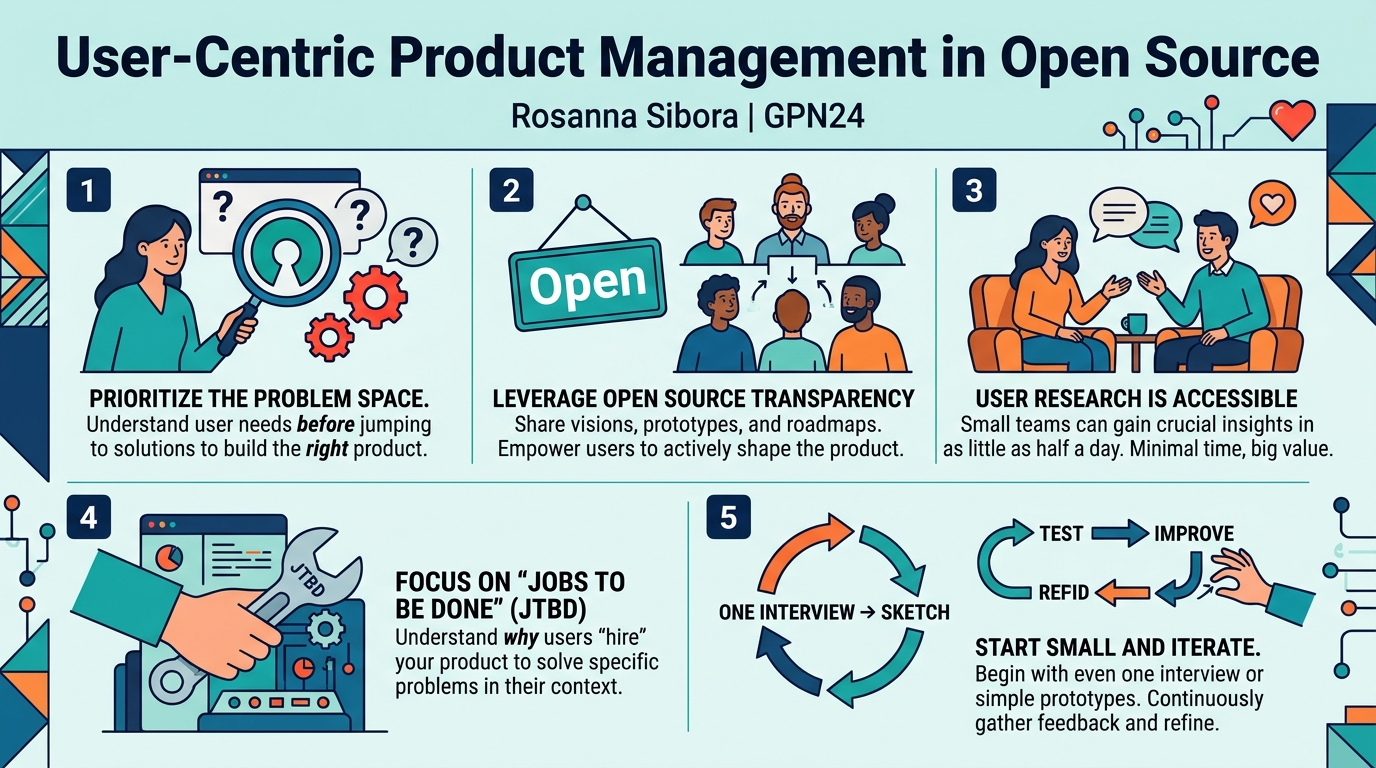
- Prioritize Problem Space Over Solution Space: Invest time in understanding user problems and needs before jumping into developing solutions. This ensures you build the right product and avoid wasted effort.
- User Research is Accessible for All Teams: Even small, resource-constrained open-source projects can conduct effective user research with minimal time investment. Foundational insights can be gained in as little as half a day of interviews, and deep dives can begin with as few as six conversations.
- Listen with Curiosity, Not Judgment: When conducting user interviews, ask open-ended questions like "What is the most annoying thing to you?" and "What might be the most life-changing thing?" to uncover true needs and motivations, fostering genuine understanding.
- Focus on "Jobs to be Done" (JTBD): Shift from simply fulfilling feature requests to understanding why users "hire" your product—what progress they are trying to make or what underlying problem they are solving in a specific context.
- Leverage Open Source Transparency: Utilize the inherent transparency of open source by sharing product visions, prototypes, and roadmaps publicly. This not only invites invaluable community feedback but also empowers users to actively shape the product.
- Start Small and Iterate: Begin with even one user interview or simple prototypes (e.g., sketches on paper). Continuously gather feedback, adjust, and iterate to refine the product, training your "user-centricity muscle" over time.
About the Speaker(s)
Rosanna Sibora is an accomplished product leader dedicated to fostering user-centricity within the open-source ecosystem. Her expertise lies in building effective product teams and guiding the development of digital products that prioritize user needs. She is a strong advocate for the principles of transparency, freedom, and trust that underpin open-source software, believing that a user-focused approach can significantly enhance its adoption and impact.
Currently, Rosanna holds a leadership position at OpenProject, a prominent open-source project management tool that serves as an alternative to Jira. In this role, she actively applies and champions the pragmatic user-centric methodologies discussed in her talk, notably guiding strategic initiatives such as enabling seamless migration for users transitioning from Jira. Committed to sharing her knowledge and empowering others, Rosanna offers mentoring in product management, user-centricity, and product leadership, available in German, English, or Polish.
Reviews
Dr. Zero (Offensive Security Researcher) — SOLID
Competent intro to product management basics for open-source maintainers who've never heard of JTBD or user interviews. Zero novelty for anyone who's read a product blog in the last decade, but fills a slot for a dev-heavy audience that genuinely needs the nudge.
Heather Calloway (CISO) — OUT OF SCOPE
This is a product management talk for open-source developers, not a security talk. Solid content for its intended audience — practical advice on user research with minimal resources — but there's no security angle here. Nothing for your risk committee.