Keynote: Welcome + Opening Remarks - Chris Aniszczyk, CTO, Cloud Native Computing Foundation
Chris Aniszczyk, CTO, Cloud Native Computing Foundation
KubeCon + CloudNativeCon Europe 2025 · Keynote
Overview
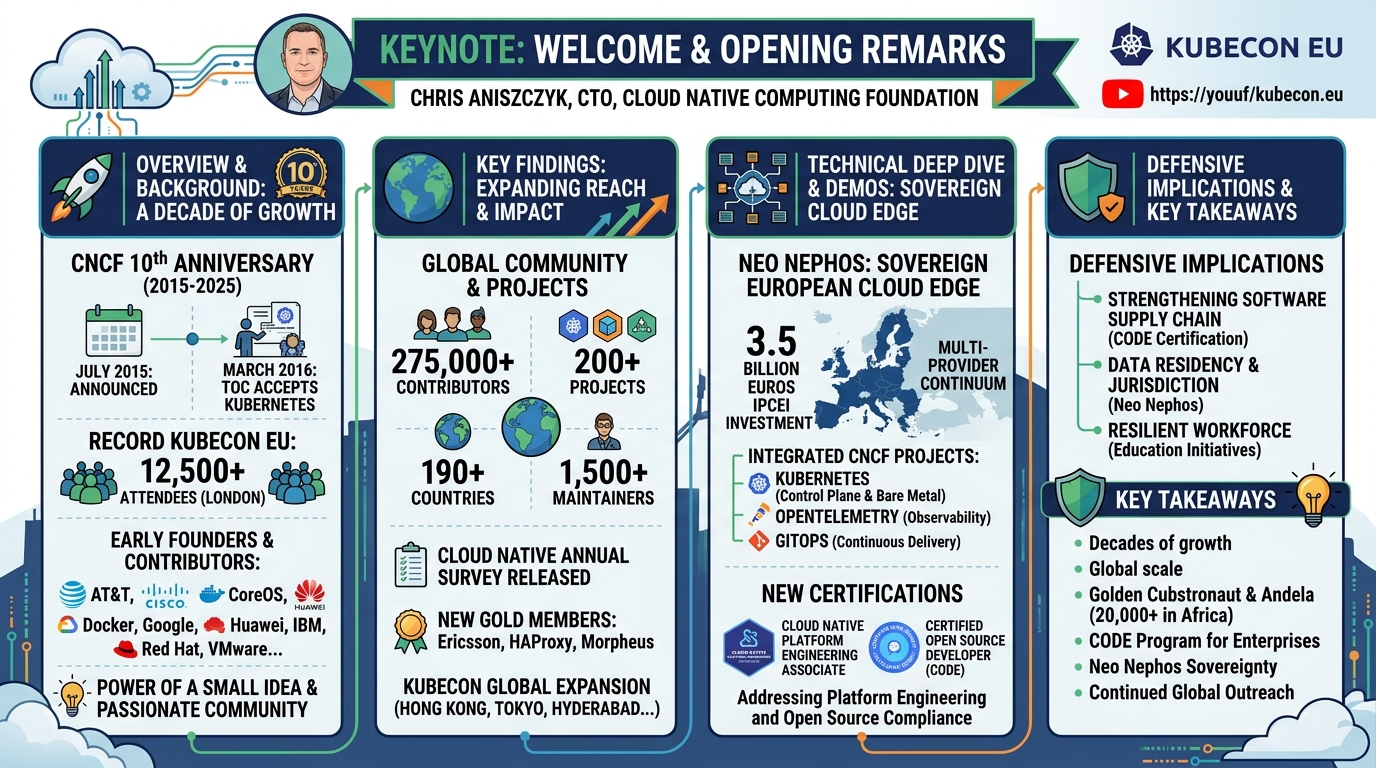
Chris Aniszczyk, CTO of the Cloud Native Computing Foundation (CNCF), delivered the opening keynote at KubeCon Europe in London, marking a significant milestone for the organization. This year, the CNCF celebrates its 10th anniversary, coinciding with its largest KubeCon event to date, boasting over 12,500 attendees. Aniszczyk's address served as both a nostalgic look back at the foundation's humble beginnings and a forward-looking exposition of its continued growth, strategic initiatives, and impact on the global technology landscape. The talk highlighted the power of community-driven open-source development and unveiled several key programs aimed at expanding cloud-native education, fostering developer talent in emerging regions, and addressing critical industry challenges such as platform engineering and open-source compliance.
Key moments
- 0:00 Welcome, KubeCon EU size, CNCF 10-year anniversary
- 1:10 CNCF founding and Kubernetes project acceptance
- 2:15 Thanking early CNCF founders and contributors
- 3:30 Announcing worldwide CNCF 10-year celebration parties
- 4:00 Global scale of Cloud Native community and projects
- 5:00 Appreciation for 1500+ CNCF project maintainers
- 5:40 New Cloud Native Annual Survey available for download
- 6:40 Introduction of the Golden Cubstronaut education program
Keynote: Welcome + Opening Remarks - Chris Aniszczyk, CTO, Cloud Native Computing Foundation
Speakers: Chris Aniszczyk, CTO, Cloud Native Computing Foundation
Conference: KubeCon EU
YouTube: https://www.youtube.com/watch?v=85MDID9Ju04
Overview
Chris Aniszczyk, CTO of the Cloud Native Computing Foundation (CNCF), delivered the opening keynote at KubeCon Europe in London, marking a significant milestone for the organization. This year, the CNCF celebrates its 10th anniversary, coinciding with its largest KubeCon event to date, boasting over 12,500 attendees. Aniszczyk's address served as both a nostalgic look back at the foundation's humble beginnings and a forward-looking exposition of its continued growth, strategic initiatives, and impact on the global technology landscape. The talk highlighted the power of community-driven open-source development and unveiled several key programs aimed at expanding cloud-native education, fostering developer talent in emerging regions, and addressing critical industry challenges such as platform engineering and open-source compliance.
The keynote underscored the CNCF's evolution from a nascent idea championed by a small group of passionate individuals to a global powerhouse supporting over 200 projects and hundreds of thousands of contributors. Aniszczyk emphasized the foundational role of Kubernetes and the subsequent diversification into a vast ecosystem that now underpins much of modern cloud infrastructure. A particularly notable announcement during the keynote was the launch of Neo Nephos, a groundbreaking European initiative to establish a sovereign multi-provider cloud edge continuum, demonstrating the direct application and strategic importance of CNCF technologies in addressing national and regional digital sovereignty goals.
The significance of this talk extends beyond mere organizational updates. It paints a vivid picture of a thriving open-source community that is not only innovating at a rapid pace but also actively working to democratize access to cloud-native education and tools worldwide. For developers, enterprises, and policymakers alike, the initiatives unveiled by Aniszczyk provide clear pathways for engagement, skill development, and strategic alignment with the future of cloud computing, reinforcing the CNCF's role as a pivotal force in shaping the digital infrastructure of tomorrow.
Background
▶ Watch: Welcome, KubeCon EU size, CNCF 10-year anniversary (0:00)
The Cloud Native Computing Foundation was officially announced in July 2015, with approximately 20 original organizations collaborating to foster the development of cloud-native technologies. This foundational period saw its first board meeting in December 2015, followed by the formal establishment of the Cloud Native Technical Oversight Committee (TOC) in March 2016. It was the TOC's inaugural act to formally vote and accept Kubernetes as the CNCF's first hosted project, a decision that would profoundly shape the future of cloud computing. Aniszczyk reminisced about this initial phase, recalling his attendance at the first KubeCon Europe in London in 2016, an event that gathered "a few hundred passionate folks" in stark contrast to the massive turnout of over 12,500 at the current conference.
The early list of participating companies included industry stalwarts and innovators such as AT&T, Box, Cisco, CoreOS, Docker, eBay, Goldman Sachs, Google, Huawei, IBM, Intel, Mesosphere, Red Hat, VMware, and Weave Works. Aniszczyk noted that some of these pioneering organizations have since been acquired or dissolved, underscoring the dynamic nature of the tech industry. However, the enduring lesson from this period, as highlighted by Aniszczyk, is the transformative power of a "small kernel of idea with passionate folks" coming together to build better infrastructure. This vision laid the groundwork for the robust cloud-native ecosystem that exists today.
Beyond Kubernetes, the CNCF has become home to a diverse portfolio of projects. Interestingly, Aniszczyk pointed out that some projects now under the CNCF umbrella actually predate the foundation itself. Examples include Vitess, a database clustering system, and The Update Framework (TUF), a security framework for package managers, which are 15 and 16 years old, respectively. These projects, along with Kubernetes, demonstrate the long-term impact and sustained relevance of the technologies nurtured by the CNCF. The upcoming 10-year anniversary celebrations, dubbed "C10CF parties," are planned worldwide, inviting the global community to reflect on a decade of hard work and innovation that has fundamentally reshaped how software is built and deployed.
Key Findings
▶ Watch: Thanking early CNCF founders and contributors (2:15)
The keynote delivered a series of significant updates and announcements, collectively painting a picture of a vibrant, rapidly expanding, and strategically focused organization. These "key findings" represent the CNCF's current state, its recent achievements, and its forward-looking initiatives.
Firstly, the scale and global reach of the CNCF community were prominently showcased. Aniszczyk reported that the CNCF now encompasses over 275,000 contributors across more than 200 projects, originating from 190 different countries. This truly global footprint is further evidenced by the 1,500+ maintainers who actively drive the development and evolution of these projects. A heat map of maintainer locations visually reinforced this global distribution, with a specific zoom-in on the UK for the London audience. The inaugural Maintainer Summit, held just prior to the keynote, brought these crucial individuals together to share insights and best practices, acknowledging their pivotal role in the ecosystem.
Secondly, the CNCF continues to provide valuable insights into industry trends through its research. The latest Cloud Native Annual Survey has been released, offering updated information on project usage, the growing number of cloud-native developers, and other key metrics for the community and industry to leverage.
Thirdly, the foundation announced its continued expansion through new member affiliations. Ericsson, HAProxy, and Morpheus were welcomed as Gold Members, alongside numerous other Silver, Academic, and Non-profit members, demonstrating ongoing industry support and investment in the CNCF's mission.
A major focus of the keynote was on education and talent development. Aniszczyk announced an update to the Cloud Native Education Ambassador program with the introduction of the Golden Cubstronaut program. This new tier recognizes individuals who have achieved multiple CNCF certifications, including not only Kubernetes certifications but also those for projects like Istio, Backstage, and Argo. This initiative aims to foster comprehensive expertise across the diverse cloud-native landscape.
Furthermore, the CNCF is making significant strides in expanding its reach into underserved regions. A partnership with Andela was announced, aiming to train over 20,000 individuals in Africa on cloud-native technologies, starting with the KCNA (Kubernetes and Cloud Native Associate) and early Kubernetes training. The program has already seen remarkable interest, with 6,400 applications from 46 African countries, and is set to officially kick off in May 2025. This initiative directly addresses the goal of diversifying the global maintainer and contributor base.
To meet evolving industry demands, two new certifications were launched. The Cloud Native Platform Engineering Associate exam is now available, addressing the growing popularity of platform engineering and aiming to provide vendor-neutral, open-source-friendly education in this critical domain. Additionally, in collaboration with the Linux Foundation and the Open Source Initiative, the new Certified Open Source Developer (CODE) training and certification was unveiled. This program is specifically designed for enterprises navigating the complexities of open-source usage, upcoming regulations, and licensing issues.
Finally, a groundbreaking European initiative, Neo Nephos, was announced by Vasu from SAP. Hosted by the Linux Foundation Europe, Neo Nephos's mission is to build a sovereign multi-provider cloud edge continuum for Europe. This initiative leverages 3.5 billion euros in investments from the EU's Important Project of Common European Interest (IPCEI) and aims to utilize CNCF projects like Kubernetes, OpenTelemetry, and GitOps to create a common open-source infrastructure for various EU initiatives. It specifically seeks to extend the capabilities of Kubernetes down to bare metal and across telco edges to establish a European standard.
Technical Deep Dive
▶ Watch: Global scale of Cloud Native community and projects (4:00)
While the keynote primarily focused on community growth and strategic announcements, it also provided glimpses into significant technical directions and the foundational role of CNCF projects in these endeavors. The most substantial technical segment revolved around the Neo Nephos initiative, a new open-source project hosted by the Linux Foundation Europe.
Neo Nephos is designed to address the critical need for digital sovereignty within Europe by building a "sovereign multi-provider cloud edge continuum." This ambitious goal necessitates a robust and interoperable technical foundation, which the initiative aims to achieve by heavily leveraging existing CNCF projects. The core technical approach involves using Kubernetes as the orchestrator across diverse environments, from traditional cloud data centers to bare metal deployments and distributed telco edges. This vision extends the familiar kubectl command's reach to manage infrastructure at unprecedented scale and heterogeneity, aiming to establish it as a de facto European standard for cloud and edge operations.
Key CNCF technologies explicitly mentioned as integral to Neo Nephos include:
- Kubernetes: The foundational container orchestration platform, used to provide a consistent control plane across various infrastructure types. The initiative aims to push the boundaries of what Kubernetes can do, specifically mentioning funding maintainers for the KCP project. KCP (Kubernetes Control Plane) is a project focused on building a multi-cluster, multi-tenant control plane for Kubernetes, enabling the management of many clusters and resources from a single point, which is directly relevant to a "multi-provider cloud edge continuum."
- OpenTelemetry: A crucial project for observability, enabling the collection of metrics, logs, and traces from applications and infrastructure. Its adoption within Neo Nephos would ensure comprehensive monitoring and troubleshooting capabilities across the distributed continuum.
- GitOps: A methodology for implementing continuous delivery for cloud-native applications, leveraging Git as the single source of truth for declarative infrastructure and applications. GitOps principles would ensure automated, auditable, and reliable deployments across the sovereign cloud edge.
Vasu from SAP elaborated on the technical aspirations, stating the mission is to "jointly build a reference that serves this sovereign cloud edge purpose." This implies the creation of a standardized architecture and set of best practices, demonstrating how CNCF projects can be integrated and extended to meet specific sovereignty requirements. The initiative is also accepting "donated projects based entirely upon the Kubernetes principles," some of which have already "matured in our respective enterprises" and are "working at scale," suggesting a practical, battle-tested approach to building the continuum. The ultimate technical goal is to enable users to "take our beloved kubectl command... and apply Kubernetes down to bare metal across cross-platform providers into the telco edges and make it the European standard." This signifies a powerful unification of infrastructure management under a single, open-source paradigm, promising significant advancements in interoperability and operational efficiency for European digital infrastructure.
Beyond Neo Nephos, the new Cloud Native Platform Engineering Associate certification implicitly points to the technical intricacies of building and operating internal developer platforms. Such platforms typically abstract away the complexity of underlying CNCF technologies, providing self-service capabilities for developers. The certification would cover the technical skills required to design, implement, and maintain these platforms, often leveraging projects like Crossplane for infrastructure as code, Backstage for developer portals, and various CI/CD tools integrated with Kubernetes.
The Certified Open Source Developer (CODE) certification, while focused on compliance and licensing, also touches upon the technical aspects of open-source software integration and dependency management within large enterprises. Understanding the implications of software supply chain security and managing Software Bill of Materials (SBOMs) are increasingly technical requirements for developers and architects, directly influenced by open-source usage and regulatory pressures.
In essence, while Aniszczyk's keynote was an overview, it underscored the deep technical underpinnings and strategic importance of CNCF projects in addressing some of the most complex and pressing challenges in modern computing, from global-scale infrastructure orchestration to regional digital sovereignty and enterprise-grade open-source adoption.
Demo / Proof of Concept
▶ Watch: Appreciation for 1500+ CNCF project maintainers (5:00)
As an opening keynote for KubeCon Europe, the presentation by Chris Aniszczyk was primarily focused on organizational updates, strategic announcements, and community celebrations. Consequently, there was no live technical demonstration or proof of concept presented during this session. The talk served as a high-level overview of the CNCF's past, present, and future initiatives rather than a deep dive into the practical application or operational mechanics of specific technologies.
Defensive Implications
▶ Watch: Introduction of the Golden Cubstronaut education program (6:40)
While Chris Aniszczyk's keynote was not a security-focused talk, several announced initiatives and underlying themes carry significant defensive implications for organizations operating in the cloud-native landscape. These implications primarily revolve around improving supply chain security, fostering digital sovereignty, enhancing compliance, and building a more resilient and knowledgeable workforce.
The introduction of the Certified Open Source Developer (CODE) training and certification is a direct defensive measure for enterprises. By partnering with the Linux Foundation and the Open Source Initiative, the CNCF is addressing the growing complexities surrounding open-source usage, licensing, and regulatory compliance. In an era of increasing software supply chain attacks (e.g., SolarWinds, Log4j), understanding and managing open-source dependencies, licenses, and potential vulnerabilities is paramount. The CODE program aims to equip enterprises with the knowledge to navigate these challenges, establish robust internal policies, and contribute back to open-source projects responsibly, thereby strengthening the overall software supply chain. This directly contributes to a better defensive posture by mitigating legal and security risks associated with unmanaged open-source components.
The Neo Nephos initiative, focused on building a "sovereign multi-provider cloud edge continuum for Europe," has profound defensive implications, particularly from a geopolitical and data sovereignty perspective. By promoting an open-source, multi-provider approach to cloud and edge infrastructure, Neo Nephos aims to reduce reliance on single vendors and enhance data residency and control within European jurisdictions. This "sovereign cloud" concept inherently strengthens national security and economic resilience by ensuring that critical data and infrastructure are governed by local regulations and standards, making them less susceptible to foreign legal mandates or extraterritorial data access requests. The use of CNCF projects like Kubernetes and OpenTelemetry in this context provides a transparent, auditable, and community-driven foundation, which can be more thoroughly scrutinized for backdoors or vulnerabilities compared to proprietary alternatives.
Furthermore, the significant investment in education and talent development, including the Golden Cubstronaut program and the Africa training initiative (Andela partnership), indirectly bolsters defensive capabilities. A more skilled and knowledgeable workforce across the globe is better equipped to implement secure cloud-native architectures, identify and remediate vulnerabilities, and adhere to security best practices. The Cloud Native Platform Engineering Associate exam also contributes to this by professionalizing the role of platform engineers, who are crucial in embedding security controls and best practices directly into the development and deployment pipelines. By making security an inherent part of the platform, rather than an afterthought, organizations can achieve a more robust and proactive defensive posture.
In summary, while not explicitly a security keynote, Aniszczyk's address outlined several strategic directions that will significantly impact the defensive landscape of cloud-native computing. From promoting responsible open-source consumption and development to enabling national digital sovereignty and fostering a globally skilled workforce, the CNCF's initiatives are foundational to building more secure, resilient, and compliant digital infrastructures.
Key Takeaways
- CNCF's Decade of Growth: The Cloud Native Computing Foundation is celebrating its 10th anniversary, marked by KubeCon Europe's record attendance of over 12,500 people, demonstrating the massive global adoption and impact of cloud-native technologies.
- Expanding Global Community: The CNCF ecosystem has grown to over 275,000 contributors across 200+ projects from 190 countries, supported by 1,500+ maintainers, highlighting its truly global and diverse nature.
- Enhanced Educational Pathways: New programs like the "Golden Cubstronaut" tier for multi-certified professionals and the "Cloud Native Platform Engineering Associate" exam are expanding specialized education, while a partnership with Andela aims to train over 20,000 individuals in Africa, democratizing access to cloud-native skills.
- Enterprise Open Source Guidance: The new "Certified Open Source Developer (CODE)" training and certification, developed with the Linux Foundation and Open Source Initiative, provides crucial guidance for enterprises navigating open-source usage, licensing, and regulatory compliance, strengthening software supply chain security.
- Sovereign Cloud Initiative: The launch of "Neo Nephos" in Europe, backed by 3.5 billion euros in EU investments, is a landmark initiative to build a sovereign multi-provider cloud edge continuum using CNCF projects like Kubernetes, OpenTelemetry, and GitOps, aiming to establish a European standard for cloud infrastructure down to bare metal and telco edges.
- Continued Global Outreach: The CNCF is expanding its KubeCon events to five worldwide locations this year (including Hong Kong, Tokyo, and Hyderabad for the first time) and has announced future venues like Amsterdam (2025) and Barcelona (2026), reinforcing its commitment to reaching and serving its diverse global community.
About the Speaker(s)
Chris Aniszczyk is the Chief Technology Officer (CTO) of the Cloud Native Computing Foundation (CNCF). A long-standing figure in the cloud-native community, Aniszczyk has been instrumental in the growth and strategic direction of the CNCF since its early days. He recalls attending the very first KubeCon Europe in London in 2016, witnessing firsthand the evolution of the foundation from a "small kernel of idea" to the global force it is today. His role involves overseeing the technical vision and fostering the open-source ecosystem that underpins modern cloud infrastructure.
Vasu (from SAP) joined Chris Aniszczyk on stage to announce the Neo Nephos initiative. While representing SAP, a long-time platinum sponsor and supporter of the CNCF, Vasu's presence was to represent a broader, multi-company initiative across Europe. Chris Aniszczyk personally lauded Vasu for his significant efforts in driving funding and support for CNCF maintainers and upstream contributors within SAP, highlighting his commitment to the open-source community.
Reviews
Dr. Zero (Offensive Security Researcher) — STRONG ACCEPT
Chris Aniszczyk's KubeCon EU keynote, marking the CNCF's 10th anniversary, delivered a substantive strategic overview rather than mere celebratory fluff. It provided significant signal with concrete announcements like the 3.5 billion Euro Neo Nephos initiative for a European sovereign cloud edge continuum, new certifications for platform engineering and open-source compliance, and a massive cloud-native training program in Africa. The talk was rich with actionable information for strategic planning, talent development, and understanding future industry direction, making it a valuable listen for anyone invested in the cloud-native landscape.
Heather Calloway (CISO) — STRONG ACCEPT
This keynote, while celebratory, presents several initiatives with profound implications for security governance, business risk, and institutional accountability. The launch of the Certified Open Source Developer (CODE) program directly addresses a critical and growing supply chain risk, providing a clear path for enterprises to manage open-source compliance and security. Furthermore, the Neo Nephos initiative for European digital sovereignty, backed by substantial EU investment, signals a strategic shift towards resilient, controlled infrastructure that CISOs and boards must understand. While not a security deep dive, it provides actionable strategic direction for managing risk and…