Keynote: Empowering Accessibility Through Kubernetes: The Future of Real-Time Sign Langu... Rob Koch
Rob Koch
KubeCon + CloudNativeCon Europe 2025 · Keynote
Overview
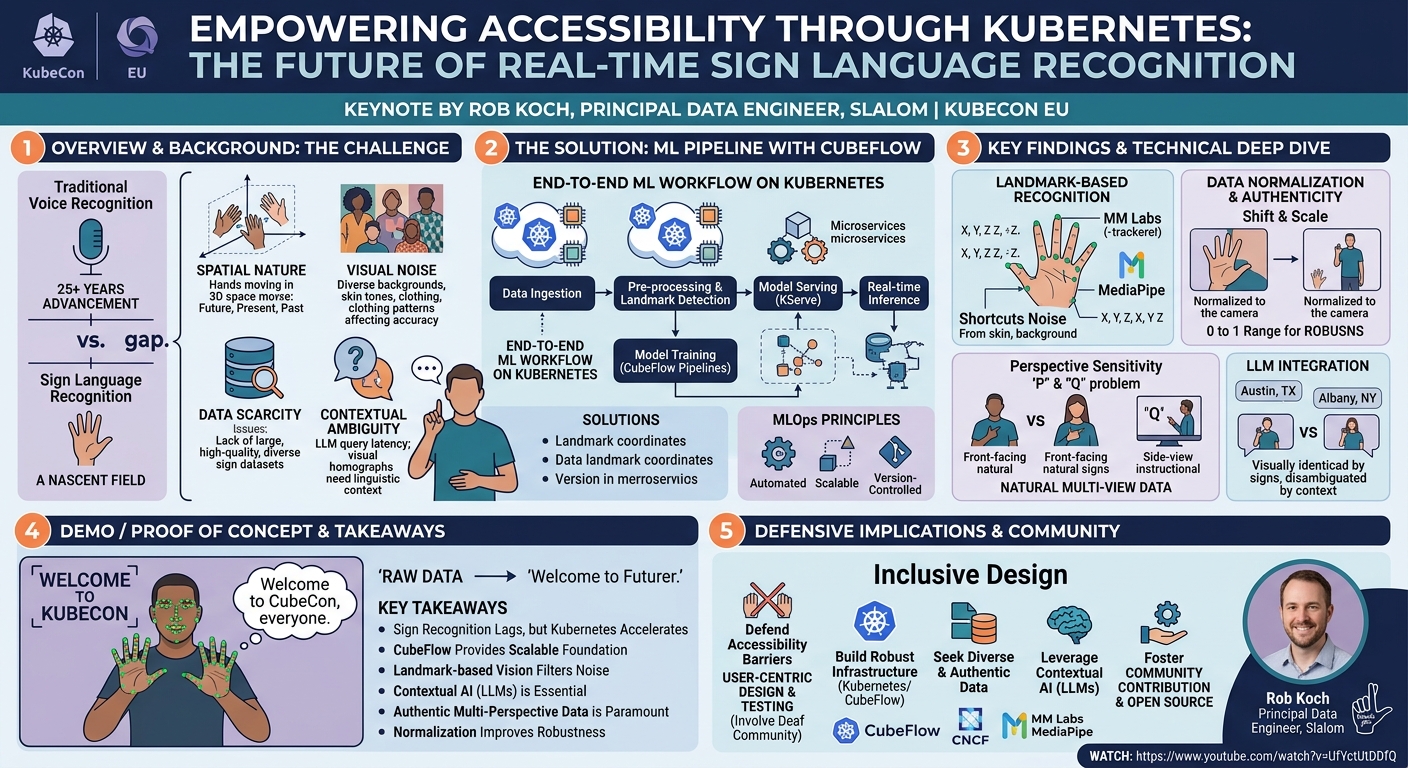
In a compelling keynote presentation at KubeCon EU, Rob Koch, a Principal Data Engineer at Slalom, unveiled a groundbreaking project aimed at revolutionizing real-time sign language recognition through the strategic application of Kubernetes and advanced machine learning. As a deaf individual who uses American Sign Language (ASL), Koch provided a unique and deeply personal perspective on the challenges and immense potential of this endeavor. The talk highlighted the critical need for robust, scalable, and context-aware systems to bridge the existing accessibility gap for the deaf and hard of hearing community.
Key moments
- 0:00 Introduction: The challenge of real-time sign language recognition
- 1:00 Explaining the spatial nature of American Sign Language
- 2:30 Implementing CubeFlow for end-to-end ML sign language workflows
- 4:50 Addressing 'visual noise' in sign language recognition processing
- 6:25 How LLMs and Kubernetes provide contextual understanding
- 8:50 Live demonstration of the real-time sign language system
- 9:50 Leveraging MediaPipe for efficient sign language data collection
Keynote: Empowering Accessibility Through Kubernetes: The Future of Real-Time Sign Language Recognition
Speakers: Rob Koch, Principal Data Engineer, Slalom
Conference: KubeCon EU
YouTube: https://www.youtube.com/watch?v=UfYctUtDDfQ
Overview
In a compelling keynote presentation at KubeCon EU, Rob Koch, a Principal Data Engineer at Slalom, unveiled a groundbreaking project aimed at revolutionizing real-time sign language recognition through the strategic application of Kubernetes and advanced machine learning. As a deaf individual who uses American Sign Language (ASL), Koch provided a unique and deeply personal perspective on the challenges and immense potential of this endeavor. The talk highlighted the critical need for robust, scalable, and context-aware systems to bridge the existing accessibility gap for the deaf and hard of hearing community.
The core of Koch's presentation centered on an ML pipeline implementation with CubeFlow, designed to streamline machine learning workflows for sign language recognition efficiently. Unlike traditional voice recognition systems, which have benefited from decades of research and development, sign language recognition faces distinct challenges related to its spatial nature, visual complexity, and the relative scarcity of comprehensive datasets. This initiative seeks to leverage modern cloud-native technologies, particularly Kubernetes and its ecosystem, to accelerate progress in this vital field, offering a unified platform for automated, version-controlled, and scalable sign language translation.
This talk is not merely a technical demonstration but a powerful call to action for greater inclusivity in technology. By addressing the intricacies of real-time sign language interpretation, Koch's work underscores how sophisticated engineering can directly impact human connection and access to information. The project's success hinges on overcoming significant hurdles in computer vision, data processing, and contextual understanding, ultimately aiming to empower deaf individuals with seamless communication in a rapidly evolving digital landscape.
Background
▶ Watch: Introduction: The challenge of real-time sign language recognition (0:00)
The journey towards effective real-time sign language recognition is fraught with unique complexities that set it apart from its more mature counterpart, voice recognition. Rob Koch meticulously outlined these challenges, emphasizing why the problem exists and the significant gap that needs to be addressed. Voice recognition technologies have had a 20-25 year head start, leading to highly developed speech-to-text programs that are now commonplace. Sign language, by contrast, is a relatively nascent field in terms of automated recognition.
One of the primary difficulties lies in the spatial nature of sign languages like ASL. Unlike spoken languages which are largely linear, sign languages convey meaning through movement, location, and orientation within a three-dimensional space. Koch illustrated this by explaining how signs for "future," "present," and "past" are articulated in front of, near, and behind the signer's body, respectively. Capturing and interpreting these subtle spatial cues presents a formidable challenge for machine learning models.
Furthermore, visual noise is a pervasive problem. Videos and images used for training data often contain variations in skin tones, diverse backgrounds, and even patterns on clothing, all of which can interfere with accurate sign recognition. Koch specifically highlighted the difficulty of finger spelling, where the rapid transition between letters (e.g., 'H' to 'O' in "HOW" briefly resembling a 'C') introduces considerable visual ambiguity. Cleaning this "noise" from the visual data is a critical technical hurdle.
The scarcity of high-quality, diverse sign language datasets is another significant impediment. The sheer volume and variety of data available for spoken languages simply do not exist for sign languages, making it harder to train robust and generalizable models. Moreover, the real-time requirements of sign language interpretation pose specific demands that current Large Language Models (LLMs), with their inherent latency in query prompts, are not yet optimized to meet. This necessitates a different approach to contextual understanding.
To address these challenges, Koch's team turned to CubeFlow, an open-source platform designed to make deployments of machine learning workflows on Kubernetes simple, portable, and scalable. CubeFlow offers an end-to-end solution for managing the entire ML lifecycle, from data preparation and model training to deployment and monitoring. Its inherent support for MLOps principles—automating processes, ensuring data versioning, and providing a robust ecosystem with active development and integration tools—made it an ideal foundation for tackling the complexities of real-time sign language recognition. The goal was to create a unified, readily available platform that could automate data ingestion, model training, and inference consistently, allowing for rapid iteration and improvement.
Key Findings
▶ Watch: Implementing CubeFlow for end-to-end ML sign language workflows (2:30)
The development of the real-time sign language recognition system yielded several crucial findings that significantly advanced the project's capabilities and understanding of the underlying challenges. These discoveries were instrumental in navigating the inherent complexities of visual language processing.
Firstly, a pivotal insight was the adoption of landmark-based recognition over traditional image processing. Instead of attempting to interpret entire hand images, the system focuses on identifying specific vector points (landmarks) on the palm and fingers. These landmarks, represented by X, Y, and Z coordinates, provide a more precise and less noisy representation of hand posture and movement. This approach significantly reduced the impact of extraneous visual elements like backgrounds, skin tones, and clothing patterns, which had previously introduced considerable "noise" into the data. By concentrating on these critical anatomical points, the model's ability to discern distinct signs improved tremendously.
Secondly, the successful implementation of an overlay framework proved to be a game-changer. Tools like MM Labs and MediaPipe were leveraged to accurately identify and track these landmarks in real-time video streams. This framework allowed the project to shortcut the arduous task of manually collecting and annotating thousands of diverse hand images. Instead, by focusing on the vector points identified by these specialized libraries, the model could more effectively generalize across different users and environments, leading to a substantial improvement in recognition accuracy and efficiency.
Thirdly, the team discovered the critical need for data normalization through shift and scale techniques. Early experiments revealed that the model's performance was highly sensitive to the distance of the signer from the camera. If a signer was too far, fingers might blend together; too close, and the scale would be inconsistent. By normalizing the landmark data to a consistent range, typically from zero to one, the system became robust to variations in camera distance and hand size. This ensured that the relative positions and movements of the landmarks remained consistent regardless of the signer's position, making the model far more reliable.
Finally, a profound finding emerged during the testing phase concerning perspective sensitivity and the importance of authentic data collection. The team encountered a significant problem with recognizing the signs for 'P' and 'Q' when signed directly facing the camera, even though the model had been trained on these signs. The revelation was that the training images predominantly showed these signs from a side-view perspective, which is how they are often depicted in static instructional materials, but not necessarily how they are naturally signed or viewed from a front-facing camera. This highlighted a crucial lesson: to build truly effective and authentic sign language recognition, data must be collected from multiple, natural perspectives (front, side, top, back) and ideally from native signers, ensuring that the model learns from genuine human signing behavior rather than idealized or artificial representations. This underscored the broader principle that contextual understanding, both visual and linguistic, is paramount, requiring Large Language Models (LLMs) to disambiguate signs that are visually identical but carry different meanings based on the broader communicative context (e.g., the sign for Austin, Texas, and Albany, New York being identical).
Technical Deep Dive
▶ Watch: Addressing 'visual noise' in sign language recognition processing (4:50)
The technical architecture underpinning Rob Koch's sign language recognition project is a sophisticated blend of modern machine learning, computer vision, and cloud-native orchestration. At its core, the system leverages a Kubernetes foundation to provide the necessary scalability, resilience, and seamless integration for complex ML workflows.
The primary mechanism for sign interpretation relies on computer vision models designed for real-time video processing. Before any recognition occurs, extensive pre-processing of video streams is crucial. This step addresses the "visual noise" inherent in raw video data, such as variations in skin tones, diverse backgrounds, and clothing patterns. The goal is to isolate the critical visual information pertaining to the hands and body movements of the signer.
A key innovation in this pre-processing stage is the use of an overlay framework that incorporates advanced libraries like MM Labs and MediaPipe. Instead of processing entire video frames, these tools are employed to identify and track specific landmarks on the signer's hands. These landmarks are essentially a set of X, Y, and Z coordinates representing key anatomical points on the palm and fingers. This approach significantly reduces the data dimensionality and filters out irrelevant visual noise, allowing the subsequent ML models to focus on the most pertinent features. The accuracy of these landmark detections is paramount, as errors here propagate down the pipeline.
The entire ML lifecycle, from data ingestion to model deployment, is orchestrated using CubeFlow. This platform, built on Kubernetes, provides an end-to-end management system for machine learning workflows. Key components of the CubeFlow implementation include:
- Pipelines: These define and automate the sequence of operations for data preparation, model training, and evaluation. They are designed for repeatability, ensuring that new words or signs can be integrated into the system efficiently.
- Notebook Integration: Data scientists can use Jupyter notebooks within CubeFlow to experiment, tweak, and test models, facilitating rapid iteration and development.
- Model Serving: For optimized inference, the project utilizes KServe (formerly KFServing), a serverless model inference platform built on Kubernetes. KServe enables high-performance, scalable serving of trained models, crucial for real-time applications.
- Resource Management: CubeFlow intelligently leverages the underlying Kubernetes cluster to utilize the latest CPU and GPU capabilities, optimizing video processing and inference speeds without requiring manual resource reconfigurations. This scalability is critical for handling the high throughput demanded by real-time video analysis.
The system architecture involves several interacting components: a UI client for user interaction, an inference service that takes landmark data and queries the deployed models, and the models themselves running within CubeFlow pipelines. Data is continuously added and refined through these pipelines.
Beyond pure visual recognition, the project integrates Large Language Models (LLMs) to provide essential contextual understanding. As Koch demonstrated with the example of "Austin, Texas" and "Albany, New York" having identical signs, raw visual recognition alone is insufficient for accurate interpretation. The LLM component analyzes the surrounding linguistic context (if available, or inferred from previous signs) to disambiguate homographs in sign language, ensuring the correct meaning is conveyed. This is a crucial step towards transforming word-for-word recognition into meaningful, contextually accurate translations.
Finally, the technical challenge of data normalization was addressed through shift and scale transformations. By mapping the raw X, Y, Z coordinates of the landmarks to a normalized range (e.g., 0 to 1), the system mitigates the impact of varying distances from the camera or differences in hand sizes. This ensures that the relative geometry of the signed gestures remains consistent for the model, making it more robust and less prone to environmental variations. The meticulous handling of these vector points, along with the integration of an LLM for semantic context, represents a comprehensive approach to a highly complex problem.
Demo / Proof of Concept
▶ Watch: Live demonstration of the real-time sign language system (8:50)
Rob Koch's presentation included a live demonstration that vividly illustrated the project's capabilities and the underlying technical principles. The demo showcased the real-time processing of his signed gestures, immediately translating them into spoken English.
During the demonstration, the audience could observe a visual overlay on Koch's hands, displaying the X, Y, and Z coordinates of the identified landmarks. As he signed, these landmark points were dynamically tracked and passed to the inference service, which then processed the data against the trained machine learning model. The immediate output was a spoken translation: "Welcome to CubeCon, everyone." This successful real-time translation provided a powerful proof of concept for the system's core functionality.
Koch elaborated on the evolution of this demo, explaining the significant improvements achieved by moving from traditional image-based recognition to the landmark-centric approach. Initially, the project attempted to use regular images of hands, a method that proved incredibly challenging due to the immense variability in backgrounds, lighting, skin tones, and clothing. The sheer scale of data required to cover these variations, potentially involving thousands of diverse hand images, was impractical to prepare within the project's timeline.
The breakthrough came with the integration of MM Labs and MediaPipe for identifying and tracking the specific vector points (landmarks) on the hands. This technique effectively "shortcut" the data collection burden by abstracting away the irrelevant visual noise. By focusing solely on these anatomical points, the model's ability to understand and interpret the signs improved tremendously, demonstrating a more robust and efficient recognition process.
The demo also highlighted the practical challenges of scale and shift. Koch demonstrated how signing too far from the camera could cause fingers to blend together, hindering landmark recognition. Conversely, signing within a specific, optimized space improved accuracy. This observation led to the implementation of shift and scale normalization, a technique that transforms the landmark data into a consistent 0-1 range. This normalization ensured that the model's performance remained stable regardless of the signer's distance from the camera or the size of their hands, making the system far more adaptable to real-world usage.
Perhaps the most insightful part of the demo, though not a direct demonstration of functionality, was Koch's anecdote about the 'P' and 'Q' problem. During testing, the model failed to recognize the signs for 'P' and 'Q' when he signed them directly facing the camera. After investigation, the team realized that the training data, likely sourced from instructional materials, showed these signs primarily from a side perspective. This crucial discovery underscored the importance of authenticity in data collection and the need for multi-perspective views. A hearing person might not intuitively realize how a deaf person naturally signs from a front-facing perspective, leading to models that perform poorly in real-world scenarios. The 'P' and 'Q' problem served as a stark reminder that effective sign language recognition requires data that accurately reflects how deaf individuals sign, necessitating the collection of diverse views (front, side, top, back) to ensure comprehensive model training.
Defensive Implications
▶ Watch: Leveraging MediaPipe for efficient sign language data collection (9:50)
While Rob Koch's keynote is not a security talk, the principles and challenges discussed have significant "defensive implications" when viewed through the lens of accessibility and inclusive design. These implications focus on how organizations and developers can "defend against" accessibility barriers and "empower" marginalized communities through thoughtful technological implementation.
Firstly, the project underscores the critical need for user-centric design and testing, particularly involving the target demographic. The "P's and Q's" problem vividly illustrates the pitfalls of developing technology for a community without direct input from its members. Defenders of accessibility must ensure that development teams include or extensively consult with deaf individuals, sign language experts, and the broader deaf community throughout the entire lifecycle, from data collection to final deployment. This approach defends against inadvertent biases and ensures that solutions are genuinely useful and authentic.
Secondly, the talk highlights the importance of robust and scalable ML infrastructure for addressing complex societal challenges. By leveraging Kubernetes and CubeFlow, Koch's team built a system that is not only powerful but also designed for continuous iteration and improvement. Organizations aiming to tackle similar accessibility or social impact problems should invest in such mature MLOps platforms. This "defends" against stagnation, allowing for rapid adaptation to new data, model architectures, and user feedback, ensuring the solution remains relevant and effective over time.
Thirdly, the emphasis on data diversity and authenticity has profound implications. The project demonstrated that simply having "data" is not enough; the data must accurately reflect the real-world usage and perspectives of the target users. For any AI system addressing human behavior or communication, developers must actively seek out and curate diverse datasets that account for variations in demographics, context, and natural expression. This defends against algorithmic bias and ensures the system performs equitably across different users, preventing the creation of new forms of exclusion.
Fourthly, the integration of contextual AI, specifically LLMs, points to a crucial defensive strategy against misinterpretation and ambiguity. Natural languages, including sign languages, are inherently complex and often rely on context to convey meaning accurately. Developers of AI-driven communication tools must incorporate mechanisms for contextual understanding to defend against literal, but incorrect, translations. This ensures that the intent and nuance of communication are preserved, which is vital for effective accessibility tools.
Finally, the call for community contribution and open-source engagement serves as a defensive strategy against resource limitations and promotes collective progress. Koch's invitation to partner on data collection and engage with the deaf and hard of hearing working group exemplifies how open collaboration can accelerate innovation in underserved areas. Organizations should foster environments that encourage external contributions and leverage open-source projects to pool resources and expertise, thereby defending against the immense challenges that a single entity might face in developing comprehensive accessibility solutions.
Key Takeaways
- Sign language recognition is a complex and underserved domain: It lags significantly behind voice recognition due to the spatial nature of the language, visual noise, and a scarcity of diverse, high-quality datasets.
- Kubernetes and CubeFlow provide a powerful foundation: These cloud-native technologies enable scalable, automated, and end-to-end machine learning workflows essential for tackling the complexities of real-time sign language interpretation.
- Landmark-based computer vision is crucial for noise reduction: Leveraging tools like MM Labs and MediaPipe to identify X, Y, Z coordinates of hand landmarks dramatically improves model accuracy by focusing on essential features and mitigating visual noise from backgrounds and skin tones.
- Contextual understanding is vital, requiring LLM integration: Raw visual recognition is insufficient; Large Language Models (LLMs) are necessary to disambiguate signs that are visually identical but carry different meanings based on the broader communicative context.
- Authentic and multi-perspective data collection is paramount: The "P's and Q's" problem highlighted that models must be trained on natural, multi-view (front, side, top, back) signing data from native signers to ensure real-world applicability and accuracy.
- Data normalization improves model robustness: Techniques like shift and scale, which normalize landmark data to a consistent range (e.g., 0-1), make models resilient to variations in camera distance and hand size, ensuring reliable performance across different users and environments.
About the Speaker(s)
Rob Koch is a Principal Data Engineer at Slalom, a global consulting firm focused on strategy, technology, and business transformation. As a deaf individual who uses American Sign Language, Koch brings a deeply personal and invaluable perspective to the development of accessibility technologies. His professional expertise spans software development, data engineering, and cloud-native infrastructure, with a particular focus on Kubernetes. He is passionate about leveraging advanced technologies like machine learning and cloud platforms to create inclusive solutions that empower the deaf and hard of hearing community.
Koch's work on the real-time sign language recognition project exemplifies his commitment to bridging accessibility gaps through innovative engineering. He acknowledges the significant contributions of his colleagues, Kamal John and Ali, who were instrumental in the success of this project and keynote presentation, highlighting the collaborative spirit required for such complex endeavors. Rob Koch is also an advocate for community involvement, encouraging individuals to learn sign language, contribute to data collection efforts, and engage with the deaf and hard of hearing working group within the CNCF ecosystem. He also highlighted a new mentorship program implemented by the CNCF TAG for underrepresented groups, further demonstrating his dedication to fostering an inclusive tech community.
Reviews
Dr. Zero (Offensive Security Researcher) — MUST SEE
This keynote is a masterclass in applying sophisticated cloud-native ML to a profoundly challenging and underserved accessibility problem. Rob Koch delivers a deeply technical, highly credible, and impactful presentation that showcases novel approaches to real-time sign language recognition using Kubernetes and CubeFlow. The insights into landmark-based processing, data normalization, and the critical need for authentic, multi-perspective data collection are invaluable for any ML practitioner, let alone those focused on human-centric AI. This isn't just a talk; it's a blueprint for leveraging technology for genuine human empowerment.
Heather Calloway (CISO) — STRONG ACCEPT
While not a security talk in the traditional sense, Rob Koch's presentation on real-time sign language recognition offers profound lessons for technology governance, ethical AI development, and the critical importance of user-centric design. It powerfully illustrates how institutional blind spots and unexamined assumptions in data collection can lead to significant operational failures, underscoring the need for authentic engagement with affected communities and robust MLOps practices to build truly impactful and responsible systems.