Keynote: Awards Ceremony
KubeCon + CloudNativeCon Europe 2025 · Keynote
Overview
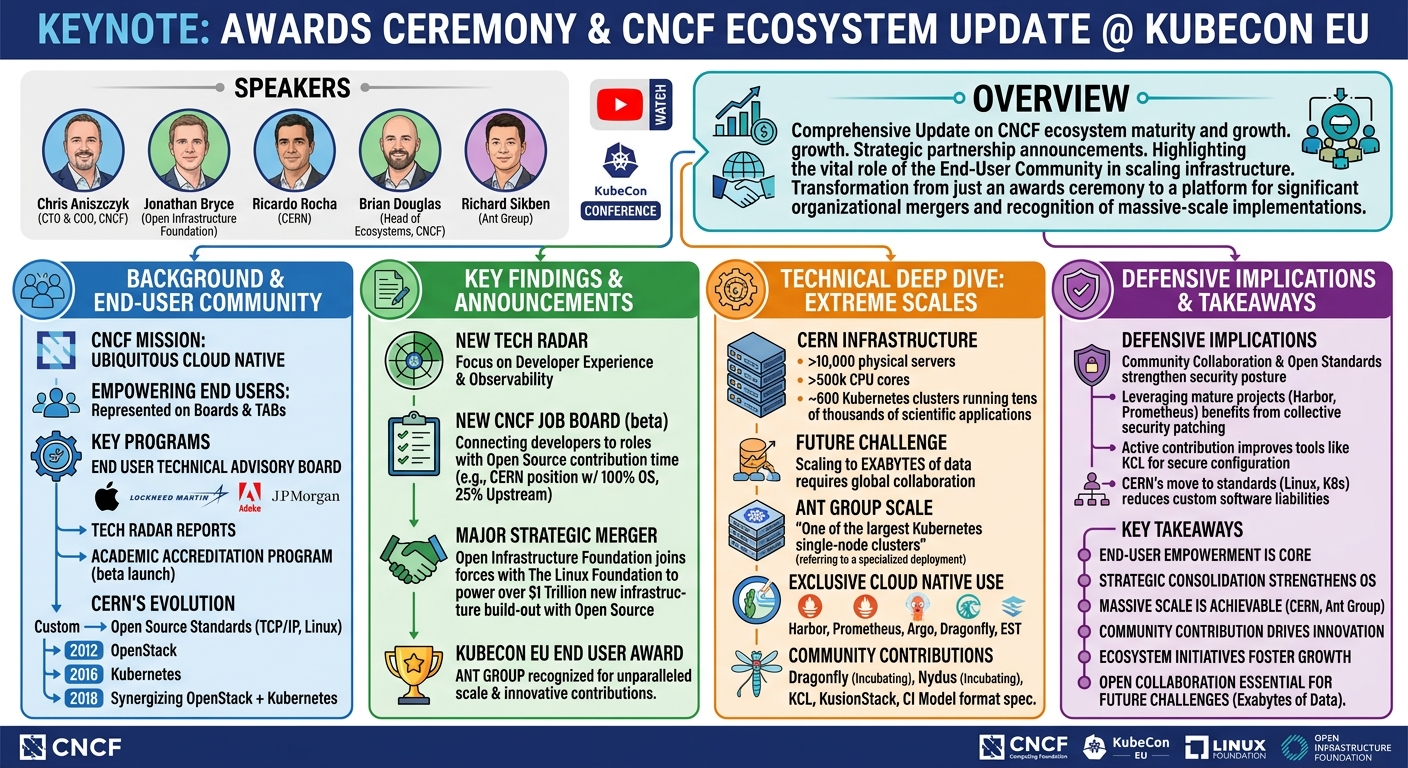
This keynote address from KubeCon EU served as a comprehensive update on the state of the Cloud Native Computing Foundation (CNCF) ecosystem, highlighting its growth, strategic partnerships, and the vital role of its end-user community. The talk, delivered by a series of prominent figures from the CNCF, the Open Infrastructure Foundation, CERN, and Ant Group, underscored the foundational importance of collaborative open source development in scaling modern infrastructure. It moved beyond a mere awards ceremony, transforming into a platform for significant announcements, including a major organizational merger and the recognition of groundbreaking cloud-native implementations by global enterprises and scientific institutions.
Key moments
- 0:00 Introduction to CNCF End User Community
- 1:49 Release of latest End User Tech Radar
- 2:09 Launch of Academic Accreditation Program
- 3:00 Introducing new Cloud Native Job Board (beta)
- 4:38 Open Infrastructure Foundation joins Linux Foundation
- 6:08 CERN's journey with OpenStack & Kubernetes at scale
Keynote: Awards Ceremony
Speakers: Chris Aniszczyk (CTO & COO, CNCF), Jonathan Bryce (Open Infrastructure Foundation), Ricardo Rocha (CERN), Brian Douglas (Head of Ecosystems, CNCF), Richard Sikben (Ant Group)
Conference: KubeCon EU
YouTube: https://www.youtube.com/watch?v=K3edF36HWYU
Overview
This keynote address from KubeCon EU served as a comprehensive update on the state of the Cloud Native Computing Foundation (CNCF) ecosystem, highlighting its growth, strategic partnerships, and the vital role of its end-user community. The talk, delivered by a series of prominent figures from the CNCF, the Open Infrastructure Foundation, CERN, and Ant Group, underscored the foundational importance of collaborative open source development in scaling modern infrastructure. It moved beyond a mere awards ceremony, transforming into a platform for significant announcements, including a major organizational merger and the recognition of groundbreaking cloud-native implementations by global enterprises and scientific institutions.
The primary objective of the keynote was to showcase the maturity and expansive reach of cloud-native technologies, emphasizing how end-user feedback and contributions are shaping the future of the ecosystem. Speakers detailed the diverse applications of Kubernetes and related cloud-native tools across various industries, from finance and pharmaceuticals to streaming media and scientific research. The session culminated in the prestigious KubeCon EU End User Award, celebrating Ant Group's unparalleled scale and innovative contributions to the cloud-native landscape, thereby reinforcing the community's commitment to fostering both adoption and upstream development.
The significance of this talk extends to anyone involved in cloud-native development, operations, or strategic planning. It provided critical insights into the CNCF's efforts to cultivate talent, formalize academic engagement, and streamline job opportunities within the community. More broadly, it painted a picture of an increasingly interconnected open source world, where foundations and organizations are joining forces to tackle the monumental infrastructure challenges of the coming decades, particularly in managing exabytes of data and supporting a trillion-dollar infrastructure build-out with open source tools.
Background
▶ Watch: Introduction to CNCF End User Community (0:00)
The Cloud Native Computing Foundation (CNCF) was established with a core mission: to make cloud-native computing ubiquitous. A cornerstone of this mission has always been the empowerment and formal representation of end users. From its inception, the CNCF ensured that organizations leveraging cloud-native technologies had a direct voice, with representation on both its governing board and technical advisory board. This commitment has fostered a vibrant ecosystem where end users, ranging from financial services giants and bio-pharma companies to streaming platforms and generational tech firms like Apple, actively contribute, learn, and drive the evolution of projects.
This emphasis on end-user engagement has manifested in several key programs. The CNCF's End User Technical Advisory Board, comprising experts from diverse organizations such as the New York Times, Apple, Lockheed Martin, Boeing, JP Morgan, Adobe, Toyota, BlackRock, and CERN, works directly with maintainers to improve projects for unique industry needs. Furthermore, the community regularly produces valuable resources like the Tech Radar, offering in-depth reports on open source project adoption and recommendations. Recognizing the growing demand for cloud-native talent, the CNCF also formalized an Academic Accreditation Program to enhance university curricula and prepare the next generation of developers. These initiatives collectively form the bedrock upon which the cloud-native ecosystem continues to expand and innovate, ensuring that practical, real-world challenges inform development priorities.
A powerful testament to the journey and evolution of open source infrastructure was provided by CERN, the European Organization for Nuclear Research. Ricardo Rocha from CERN recounted their decades-long reliance on custom-built infrastructure, from their own networking stack (CERNet in the 1980s) and analysis libraries (1990s) to handling petabytes of data with bespoke systems in the early 2000s. The shift came with the rise of standardized open source solutions. CERN embraced TCP/IP and Linux, and critically, in the early 2010s, recognized the necessity of participating in larger communities. This led to their adoption of OpenStack in 2012 and Kubernetes by 2016, with a strategic integration of both by 2018. CERN's trajectory exemplifies a broader industry trend: moving away from isolated, proprietary solutions towards collaborative, community-driven open source frameworks to manage increasingly complex and data-intensive infrastructure challenges. This background sets the stage for understanding the imperative of open collaboration and the significant announcements made during the keynote.
Key Findings
▶ Watch: Launch of Academic Accreditation Program (2:09)
The KubeCon EU keynote unveiled several significant developments and findings that underscore the rapid maturation and strategic expansion of the cloud-native ecosystem. These announcements highlight the CNCF's commitment to community building, talent development, and fostering large-scale open source collaboration.
Firstly, the CNCF End User Community released its latest Tech Radar, a comprehensive report focusing on developer experience and observability. This resource provides invaluable insights into the open source projects and technologies actively being used by end users, detailing their experiences, adoption strategies, and recommendations. It serves as a critical guide for organizations navigating the complex cloud-native landscape, offering peer-validated perspectives on effective toolchains and best practices.
Secondly, addressing the persistent challenge of talent acquisition in the cloud-native space, the CNCF announced the beta launch of a new job board. This platform is designed to connect cloud-native developers with companies seeking to hire, with a particular emphasis on opportunities that allow for direct contribution back to open source projects. A notable example cited was a Kubernetes engineer position at CERN, offering 100% of time working on open source technology and allocating 25% of time specifically for upstream contributions to Kubernetes. This initiative not only facilitates recruitment but also reinforces the virtuous cycle of open source development, encouraging professionals to actively shape the technologies they use.
The most impactful announcement of the keynote was the strategic decision for the Open Infrastructure Foundation to join forces with the Linux Foundation. Jonathan Bryce, representing the Open Infrastructure Foundation, highlighted this as a pivotal moment, anticipating over a trillion dollars in new infrastructure build-out that should be powered by open source tools. This collaboration is designed to strengthen the collective open source community, recognizing that many end users are already bridging across different projects and communities (like OpenStack and Kubernetes) to build robust infrastructure in diverse sectors such as financial services, AI, and scientific research. This merger signifies a concerted effort to unify and amplify the impact of open infrastructure initiatives under a single, powerful umbrella.
Finally, the keynote celebrated Ant Group as the recipient of the KubeCon EU End User Award. Richard Sikben from Ant Group showcased their extraordinary adoption of cloud-native technologies, including building "one of the largest Kubernetes single-node clusters on the planet" (a statement likely referring to a highly optimized or specialized large-scale instance within their distributed environment) and extensive use of projects such as Harbor, Prometheus, Argo, Dragonfly, and EST (likely referring to the Envoy proxy or a service mesh solution). Beyond consumption, Ant Group was recognized for its significant contributions as a developer community player and project innovator, actively contributing to projects like Dragonfly and Nydus (both in incubation stage), and having contributed KCL and KusionStack to the CNCF family last year, alongside work on the CI model format specification. This award powerfully illustrates how leading organizations are not just adopting but also profoundly shaping the cloud-native future through innovation and upstream collaboration.
Technical Deep Dive
▶ Watch: Introducing new Cloud Native Job Board (beta) (3:00)
The technical discussions within the keynote provided compelling insights into the extreme scales and sophisticated integrations characterizing modern cloud-native deployments. Ricardo Rocha from CERN offered a historical and contemporary view of their infrastructure, illustrating a profound evolution from bespoke systems to a highly integrated, community-driven open source stack. In the 1980s, CERN relied on its proprietary networking stack, CERNet, and continued with custom analysis libraries through the 1990s. By the early 2000s, as data volumes reached petabytes, CERN built its own custom compute infrastructure. The pivotal shift occurred in the early 2010s with the advent of cloud technologies, prompting CERN to embrace large-scale open source communities. They adopted OpenStack in 2012 for their foundational IaaS layer and introduced Kubernetes into production by 2016. By 2018, CERN achieved a significant milestone by integrating OpenStack and Kubernetes, realizing that this synergy would allow them to expand capacity and optimize resource utilization within existing budgets. Today, CERN's infrastructure is staggering: it comprises over 10,000 physical servers, more than half a million CPU cores, approximately 600 Kubernetes clusters, running tens of thousands of scientific applications. The organization now faces the challenge of scaling this by an order of magnitude, anticipating exabytes of data in the coming years, a task they acknowledge cannot be achieved without global community collaboration.
Ant Group, the recipient of the End User Award, presented an equally impressive technical landscape, demonstrating cloud-native adoption at an unprecedented scale. Richard Sikben highlighted their use of Kubernetes to build "one of the largest Kubernetes single-node clusters on the planet." While the term "single-node cluster" typically refers to a development or minimalist setup, in the context of Ant Group's massive scale, this likely denotes a unique, highly optimized, or specialized architecture perhaps focusing on a single, extremely powerful instance or a specific logical deployment within a much larger distributed system, rather than a literal single Kubernetes node. Their infrastructure extensively leverages various cloud-native technologies, including Harbor for container image registry and management, Prometheus for monitoring and alerting, and Argo for GitOps-driven continuous delivery and workflow orchestration.
Beyond consumption, Ant Group is a significant contributor to the cloud-native ecosystem. They are actively involved in the incubation stages of several projects, notably Dragonfly and Nydus. Dragonfly is an intelligent P2P-based image and file distribution system, crucial for accelerating large-scale application deployments by efficiently distributing container images and other artifacts across vast clusters. Nydus is a next-generation container image format and associated content-addressable image service that significantly improves container startup performance and reduces storage consumption, particularly vital for environments with thousands of containers. Last year, Ant Group contributed two major projects to the CNCF: KCL (Configuration Language), a declarative, policy-aware configuration language designed to improve the management of complex configurations in cloud-native environments; and KusionStack, an application delivery and management platform that integrates configuration, deployment, and operation into a unified workflow. Furthermore, Ant Group is actively working on the CI model format specification, aiming to standardize how continuous integration processes are defined and managed. These contributions underscore Ant Group's commitment not only to utilizing but also to fundamentally advancing the state of cloud-native technology, addressing real-world challenges of scale, performance, and manageability.
Demo / Proof of Concept
▶ Watch: Open Infrastructure Foundation joins Linux Foundation (4:38)
While no live demonstration or proof-of-concept was performed during this specific keynote address, Ricardo Rocha of CERN did briefly reference a historical live demo. He recounted his "first live demo" during the OpenStack Summit in Vancouver in 2018. The purpose of this past demonstration was to showcase the successful integration of OpenStack, used for their foundational infrastructure, with Kubernetes, which orchestrates their containerized applications. He humorously noted a small hiccup but confirmed the demo ultimately worked, effectively illustrating the feasibility and benefits of bridging these two major open source communities to expand capacity and optimize resource usage at CERN. This historical anecdote served to contextualize CERN's long-standing commitment to open source collaboration and the technical challenges they've overcome.
Defensive Implications
▶ Watch: CERN's journey with OpenStack & Kubernetes at scale (6:08)
The discussions in the keynote, while not directly focused on security vulnerabilities or exploits, carry significant defensive implications for organizations operating in the cloud-native space. The overarching theme of community collaboration, adoption of open standards, and robust infrastructure design inherently contributes to a stronger defensive posture.
Firstly, the emphasis on adopting widely-used open source projects like Kubernetes, Prometheus, and Harbor, as demonstrated by Ant Group and CERN, means leveraging tools that benefit from a large, active community constantly identifying and patching security issues. These projects are subject to rigorous public scrutiny and benefit from collective intelligence, making them generally more resilient than proprietary, closed-source alternatives. For instance, Harbor provides critical capabilities like vulnerability scanning, image signing, and content trust, which are fundamental for securing the container supply chain. The use of Prometheus for monitoring is a key defensive tool, allowing for early detection of anomalous behavior or resource exhaustion that could indicate an attack or system instability.
Secondly, Ant Group's active contribution to projects like Dragonfly, Nydus, KCL, and KusionStack directly improves the security and stability of these tools for the entire community. By identifying and addressing their own operational challenges and contributing solutions upstream, they are helping to fortify the cloud-native ecosystem. For example, contributions to KCL can lead to more secure and auditable configuration management, reducing the surface area for misconfigurations that often lead to security breaches. Similarly, advancements in container image formats and distribution (like Nydus and Dragonfly) can enhance the integrity and efficiency of software delivery, minimizing risks associated with compromised images or slow deployments during incidents.
Thirdly, CERN's journey from custom, internal networking and analysis stacks to embracing community-driven standards like TCP/IP, Linux, OpenStack, and Kubernetes highlights a critical defensive strategy. Relying on well-established, peer-reviewed open standards reduces the burden of maintaining unique security patches and allows organizations to benefit from shared security expertise. Custom solutions, while tailored, can become security liabilities if not continuously maintained and audited by a broad community. The move towards standardized, open infrastructure ensures that CERN's vast scientific data processing capabilities are built on a more secure and sustainable foundation.
Finally, the CNCF's initiatives, such as the End User Tech Radar and the new job board, indirectly bolster defensive capabilities. The Tech Radar helps organizations identify mature, well-vetted tools that have proven their reliability and security in real-world scenarios. The job board, by encouraging upstream contributions, fosters a culture where security-conscious developers actively improve the core components of the cloud-native stack, making the entire ecosystem more robust against evolving threats. In essence, the keynote reinforced that a strong, collaborative, and open cloud-native community is a powerful defensive asset in the ongoing battle for secure and resilient digital infrastructure.
Key Takeaways
- End-User Empowerment is Core to CNCF: The Cloud Native Computing Foundation actively empowers its end-user community through dedicated programs, board representation, and technical advisory boards, ensuring real-world operational needs drive cloud-native development.
- Strategic Consolidation Strengthens Open Source: The Open Infrastructure Foundation's decision to join the Linux Foundation marks a significant step towards unifying and amplifying open source efforts, particularly in building the foundational infrastructure for future global needs.
- Massive Scale Cloud-Native Adoption: Organizations like CERN and Ant Group are pushing the boundaries of cloud-native technology, managing exabytes of data and tens of thousands of applications across hundreds of Kubernetes clusters, demonstrating the maturity and scalability of the ecosystem.
- Community Contribution Drives Innovation: Leading end users are not just consuming but actively contributing to cloud-native projects (e.g., Ant Group's contributions to Dragonfly, Nydus, KCL, KusionStack), fostering innovation and enhancing the robustness of the entire ecosystem.
- Ecosystem Initiatives Foster Growth: New CNCF initiatives, including the End User Tech Radar (focusing on developer experience and observability), the Academic Accreditation Program, and the beta Job Board, are crucial for talent development, knowledge sharing, and professional growth within the cloud-native community.
- Open Collaboration is Essential for Future Challenges: Tackling the projected exabytes of data and trillion-dollar infrastructure build-outs requires unprecedented open source collaboration, moving beyond isolated solutions towards shared, community-driven standards and tools.
About the Speaker(s)
Chris Aniszczyk serves as the CTO and COO of the Cloud Native Computing Foundation (CNCF), playing a pivotal role in guiding the technical direction and operational strategy of the organization. He is deeply involved in fostering the CNCF's end-user community and driving its various programs.
Jonathan Bryce is a prominent figure from the Open Infrastructure Foundation, a community dedicated to building and operating open source infrastructure. He played a key role in announcing the foundation's strategic merger with the Linux Foundation, highlighting the imperative of open source in future infrastructure development.
Ricardo Rocha is a representative from CERN, the European Organization for Nuclear Research. He shared insights into CERN's extensive history with open source, their journey from custom infrastructure to adopting OpenStack and Kubernetes, and their current challenges in managing massive data volumes.
Brian Douglas, also known as "Buggy" on the internet, is the new Head of Ecosystems for the CNCF. With a background from GitHub and other startups, he is responsible for cultivating end-user stories and engagement programs. He also hosts "The Secret Sauce" podcast, which focuses on open source maintainer success stories.
Richard Sikben represented Ant Group at the keynote. He presented Ant Group's extensive use of cloud-native technologies at scale and highlighted their significant contributions as both a developer community player and an innovator in several CNCF projects.
Reviews
Dr. Zero (Offensive Security Researcher) — STRONG ACCEPT
This KubeCon keynote, while framed as an awards ceremony, delivered substantive updates on the CNCF ecosystem, avoiding the usual executive platitudes. It provided crucial insider signal with the Open Infrastructure Foundation merger into Linux Foundation, detailed impressive large-scale cloud-native adoption from CERN and Ant Group, and outlined concrete initiatives like the new job board and Tech Radar. For a strategic keynote, it offered genuine depth and actionable insights, validating the critical role of open source collaboration in scaling global infrastructure.
Heather Calloway (CISO) — STRONG ACCEPT
This keynote, while framed as an awards ceremony, provided a critical strategic overview of the cloud-native ecosystem's maturity and future direction. It highlighted the profound institutional decisions by organizations like CERN and Ant Group to embrace and contribute to open source, demonstrating how collaborative development is essential for managing infrastructure at petabyte and exabyte scales. For security leaders, the message is clear: active engagement with and contribution to established open source communities are not just technical choices but fundamental governance decisions that underpin resilience, talent development, and the ability to operate securely at an unprecedented…