Public End User Technical Advisory Board (TAB) Town Hall
KubeCon + CloudNativeCon Europe 2025 · Session
Overview
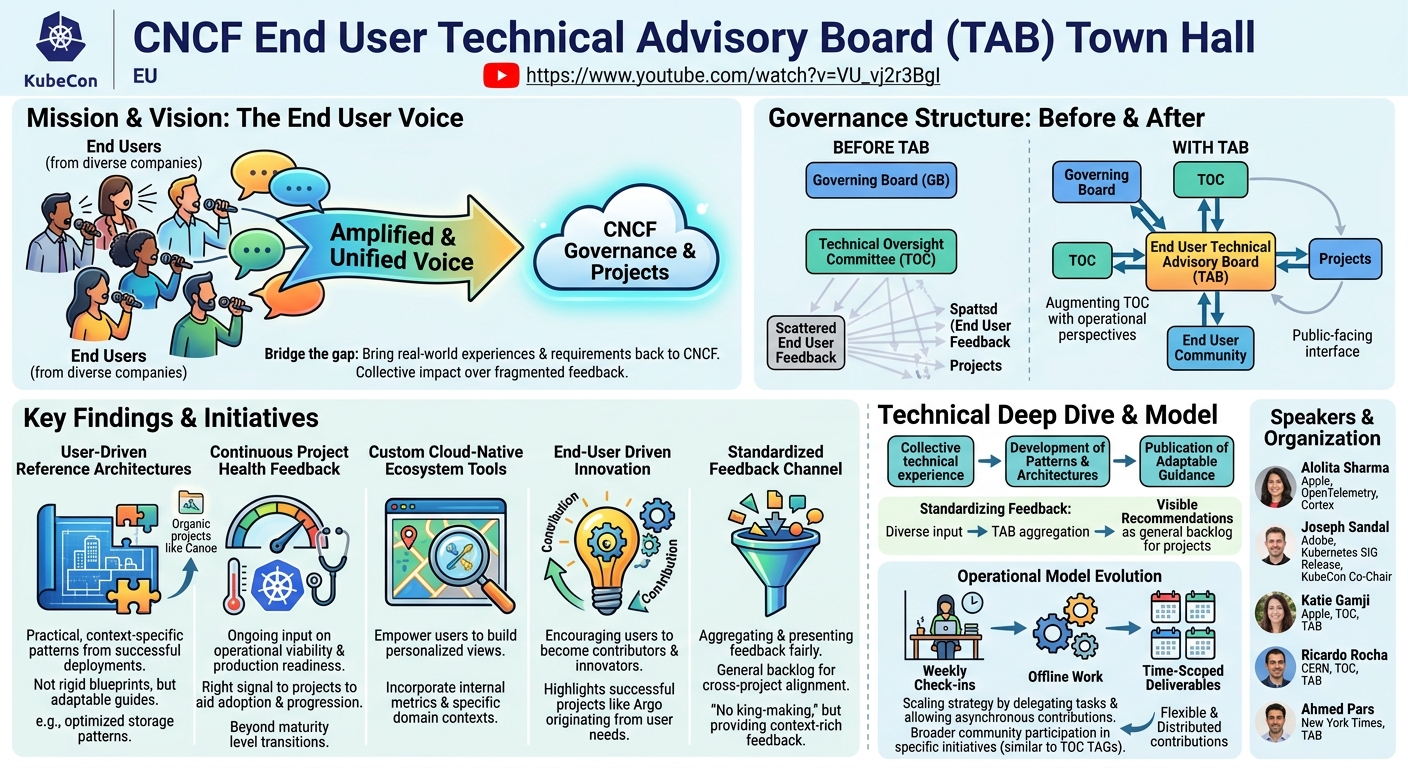
This KubeCon EU town hall provided a comprehensive look into the mission, achievements, and future directions of the CNCF End User Technical Advisory Board (TAB). Established just over a year prior to this discussion, the TAB was conceived to bridge a critical gap in the Cloud Native Computing Foundation's (CNCF) expansive ecosystem: providing a dedicated, collective voice for end users. The talk featured a panel of distinguished TAB members from prominent organizations like Apple, Adobe, CERN, and The New York Times, offering insights into the board's operational philosophy and its strategic initiatives.
Key moments
- 0:00 Introduction of the Technical Advisory Board (TAB) members
- 2:10 Why the TAB was created and its purpose
- 3:55 How TAB brings end-user feedback to projects
- 5:20 Empowering end-users to drive impact in CNCF
- 6:30 Breaking silos and making collective impact
- 8:20 TAB as a public-facing interface for end-user voice
Public End User Technical Advisory Board (TAB) Town Hall
Speakers: Alolita Sharma (Head of Observability Engineering, Apple; OpenTelemetry/Cortex maintainer), Joseph Sandal (Adobe; Kubernetes SIG Release; KubeCon Co-Chair), Katie Gamji (Senior Software Engineer, Apple; TOC member), Ricardo Rocha (Computer Engineer, CERN; TOC member), Ahmed Pars (Principal Engineer, New York Times)
Conference: KubeCon EU
YouTube: https://www.youtube.com/watch?v=VU_vj2r3BgI
Overview
This KubeCon EU town hall provided a comprehensive look into the mission, achievements, and future directions of the CNCF End User Technical Advisory Board (TAB). Established just over a year prior to this discussion, the TAB was conceived to bridge a critical gap in the Cloud Native Computing Foundation's (CNCF) expansive ecosystem: providing a dedicated, collective voice for end users. The talk featured a panel of distinguished TAB members from prominent organizations like Apple, Adobe, CERN, and The New York Times, offering insights into the board's operational philosophy and its strategic initiatives.
The core purpose of the TAB, as articulated by its members, is to ensure that the real-world experiences, challenges, and requirements of organizations consuming cloud-native technologies are actively fed back into the projects and governance structures of the CNCF. This includes fostering better interaction between projects and end users, influencing project roadmaps, and providing practical guidance on deploying and operating cloud-native solutions in production environments. The session underscored the TAB's ambition to move beyond dispersed, individual feedback to a more structured, impactful mechanism for end-user advocacy and collaboration.
This article delves into the critical role the TAB plays in shaping the future of cloud-native adoption and innovation. It explores how the board addresses common pain points for end users navigating the complex landscape, from developing reference architectures to evaluating project health and facilitating community-driven contributions. By empowering end users to collectively share their insights and drive impact, the TAB aims to cultivate a more robust, user-centric, and sustainable cloud-native ecosystem.
Background
▶ Watch: Introduction of the Technical Advisory Board (TAB) members (0:00)
The Cloud Native Computing Foundation (CNCF) operates under a multi-faceted governance structure designed to oversee the development and adoption of cloud-native technologies. This structure traditionally comprises the Governing Board (GB), which focuses on financial and strategic oversight, and the Technical Oversight Committee (TOC), responsible for technical direction, project acceptance, and maturity progression. However, as the CNCF ecosystem matured and expanded, a significant challenge emerged: the voice of the end user, while crucial, often remained fragmented and uncoordinated.
Prior to the TAB's formation, end-user feedback was largely "dissipated and dispersed," as Ricardo Rocha noted (8:00). Organizations would engage directly with individual projects, leading to inconsistent input and a lack of collective influence on broader ecosystem trends. The TOC, while technically astute, found itself not always ideally positioned to capture the nuanced, real-world operational perspectives of end users across diverse industries and scales. This created a need for a dedicated body that could aggregate these experiences and translate them into actionable insights for the CNCF community.
The End User Technical Advisory Board (TAB) was thus created "just over a year" before this town hall (2:00) to complement the existing governance bodies. Its mandate is explicitly end-user centric, focusing on areas like reference architectures, improving interaction between projects and end users, and providing feedback on what works and doesn't work in production (3:00-4:00). Alolita Sharma, the inaugural chair, highlighted the dual aspects of the TAB's role: augmenting the TOC by accelerating end-user interactions and providing critical feedback to projects, thereby influencing roadmaps and ensuring alignment with end-user needs. The overarching goal is to break silos, enable collective impact, and provide a clear, public-facing interface for end-user input into the CNCF ecosystem (7:00-8:00).
Key Findings
▶ Watch: How TAB brings end-user feedback to projects (3:55)
The town hall revealed several key initiatives and philosophical underpinnings driving the End User Technical Advisory Board's efforts to empower end users and shape the cloud-native landscape.
- User-Driven Reference Architectures: A primary focus of the TAB has been the development of reference architectures. Unlike specifications dictated by projects or governance bodies, these architectures are explicitly derived from the real-world experiences and successful deployments of end users (9:00). This initiative aims to provide practical, context-specific patterns rather than rigid blueprints, acknowledging that different use cases (e.g., high-throughput vs. high-reliability storage) necessitate varied architectural choices (16:00). Joe Sandal emphasized the observation of "organic projects stir[ring] up" like Canoe, indicating a widespread user need for shared patterns and building blocks (11:00).
- Enhancing Project Health and Relevance: The TAB seeks to provide ongoing feedback on the health and utility of CNCF projects, moving beyond the initial assessment during maturity level transitions (10:00). This involves continuous input from end users on what truly works in production, ensuring projects remain aligned with practical operational realities and evolving needs. The objective is to give projects the "right signal from end users," including stories and use cases, to aid their adoption and progression (12:00).
- Tools for Custom Cloud-Native Landscapes: Recognizing the overwhelming complexity of the cloud-native landscape, the TAB is working to provide end users with tools to create their own customized views of the ecosystem (10:00). This initiative acknowledges that while CNCF maturity levels offer one metric, organizations often rely on additional internal metrics and specific domain contexts. The goal is to empower end users to build personalized landscapes that reflect their unique requirements and decision-making criteria.
- Fostering End-User Driven Innovation: The board actively encourages and celebrates end-user driven projects like Argo, which originated from an end user's needs and contributions (11:00). This highlights the TAB's commitment to cultivating an ecosystem where end users are not just consumers but also active contributors and innovators, leading to new projects and solutions that directly address real-world problems.
- Standardizing Feedback and Impact: A fundamental challenge identified is how to standardize and channel diverse end-user feedback back to projects in a neutral and fair manner (13:00-14:00). The TAB aims to make these recommendations visible as a "general backlog" (16:00), fostering cross-project alignment. While acknowledging the CNCF's "no king-making" principle, the emphasis is on providing context-rich feedback, explaining why certain projects are chosen over others for specific use cases, thereby building a collective knowledge base (16:00-17:00).
Technical Deep Dive
▶ Watch: Empowering end-users to drive impact in CNCF (5:20)
The "technical" aspect of the TAB, as discussed, is less about specific code implementations and more about the architecture of community engagement, technical guidance frameworks, and feedback standardization protocols within the CNCF ecosystem. The board acts as a critical interface, establishing mechanisms to systematize and amplify the collective technical experience of end users.
A cornerstone of the TAB's technical contribution is the development of End-User Driven Reference Architectures. As Joe Sandal elaborated, the existing cloud-native landscape, while rich, often leads to confusion (10:00). Projects like Canoe, which organically emerge from users combining existing building blocks, demonstrate a clear demand for documented patterns. The TAB aims to formalize this by collecting and publishing successful architectural patterns from end users. These are not prescriptive blueprints to be copied verbatim but rather "patterns for you to kind of build off of" (18:00), akin to the "Google's infrastructure for everyone else" (GYE) philosophy. The emphasis is on contextualizing choices, explaining why a particular project or configuration was selected for a specific domain or workload (e.g., storage solutions optimized for high throughput versus high reliability) (16:00-17:00). This approach acknowledges that "unless you're also Google, it might not actually be good enough for you" (20:00), highlighting the need for adaptable guidance rather than universal solutions. Furthermore, Alolita Sharma introduced the concept of extending these into a maturity model for architectures, incorporating not just technology but also "dependencies in the ecosystem," such as required expertise and organizational complexity (19:00-20:00).
Another crucial initiative focuses on Project Health and Lifecycle Management. The CNCF's existing maturity levels (Sandbox, Incubating, Graduated) provide a snapshot of a project's status, but the TAB identifies a gap in continuous monitoring and feedback after a project reaches a certain level (10:00). End users are uniquely positioned to offer insights into the long-term operational viability, ease of use, and production readiness of projects. The TAB seeks to establish feedback loops that provide projects with "the right signal" on use cases, adoption patterns, and areas for improvement, thereby influencing their roadmaps and ensuring sustained relevance (12:00). This involves understanding "what works and doesn't work for end users" (4:00) in real-world production scenarios.
To address the overwhelming complexity of the cloud-native landscape, the TAB is developing Tools for Custom Cloud-Native Ecosystem Views. Ricardo Rocha articulated the vision of empowering end users to build "their own view of the cloud native ecosystem" (10:00). This goes beyond the static CNCF landscape by allowing organizations to integrate their own internal metrics, compliance requirements, and strategic priorities alongside the public maturity levels. This initiative aims to provide a framework for personalized decision-making, enabling end users to navigate the vast array of projects more effectively based on their specific organizational context.
The challenge of Standardizing and Channeling End-User Feedback is a significant technical and organizational hurdle. With diverse end users providing feedback on potentially overlapping projects, the TAB's role is to aggregate and present this feedback in a "standardized way back to the projects" (14:00). This process must respect the CNCF's principle of "no king making" (16:00), meaning the TAB does not endorse one project over another but rather facilitates context-rich discussions. The goal is to make these recommendations visible as a "general backlog" (16:00) to foster cross-project alignment and inform technical roadmaps, ensuring that end-user priorities are considered without dictating project direction.
Operationally, the TAB is evolving its own Community Engagement Model. Having learned from its first year of experience, the board is mimicking successful strategies from the TOC, particularly the shift towards more offline work and time-scoped deliverables (24:00). While a weekly check-in remains important, the emphasis is on delegating tasks and allowing contributions to happen asynchronously. This scaling strategy aims to "not be restricted to the end user technical advisory board members" (24:00), but rather to "open the access to this initiatives to a much broader community" (25:00). This includes inviting non-board members to contribute to specific deliverables, review white papers, or collaborate on initiatives, effectively creating a structure similar to the TOC's Technical Advisory Groups (TAGs). This model fosters broader participation, leveraging the collective expertise of the wider end-user community to enhance the TAB's impact and reach. The estimated commitment for TAB members is around 5-10 hours per week, with a goal to make contributions more flexible and distributed (21:00-24:00).
Demo / Proof of Concept
▶ Watch: Breaking silos and making collective impact (6:30)
As a town hall and "Ask Me Anything" (AMA) session focused on the strategic and operational aspects of the End User Technical Advisory Board, this talk did not include a live demonstration or proof of concept of any specific technology or architectural pattern. The discussion centered on the board's initiatives, challenges, and future plans for community engagement and technical guidance.
Defensive Implications
▶ Watch: TAB as a public-facing interface for end-user voice (8:20)
While this talk was not explicitly about security, the work of the End User Technical Advisory Board has significant "defensive implications" for the health, stability, and secure adoption of cloud-native technologies within organizations. Rather than defending against specific vulnerabilities, the TAB helps organizations "defend" against poor architectural choices, project irrelevance, and the pitfalls of navigating a complex, rapidly evolving ecosystem without adequate guidance.
- Mitigating Adoption Risk through Reference Architectures: By providing end-user-driven reference architectures, the TAB helps organizations avoid common missteps and anti-patterns. These patterns, rooted in real-world production experience, serve as a defensive shield against deploying unproven or ill-suited solutions. They offer validated approaches, reducing the risk of costly re-architectures, operational instability, and potential security misconfigurations that often arise from "hello world" copy-pasting without understanding the underlying context and maturity requirements (17:00-18:00). The concept of a "maturity model" for architectures (19:00) further helps organizations assess their readiness and required expertise before committing to a complex deployment.
- Ensuring Project Viability and Security Posture: The TAB's focus on continuous project health feedback beyond initial graduation helps ensure that projects remain actively maintained, secure, and relevant. End-user feedback loops can highlight areas where projects might be falling short in terms of operational robustness, ease of integration, or even unaddressed security concerns that become apparent in production environments. By providing this signal, the TAB indirectly contributes to the long-term security posture of widely adopted cloud-native components, as projects are incentivized to address real-world issues.
- Informed Decision-Making and Resource Optimization: The initiative to provide tools for custom cloud-native landscapes empowers organizations to make more informed decisions about which projects to adopt. By allowing end users to integrate their internal metrics, compliance requirements, and risk assessments, they can "defend" against adopting projects that don't align with their specific security policies, operational capabilities, or regulatory mandates. This prevents wasted resources on incompatible technologies and ensures that investments are made in solutions that genuinely fit the organization's unique threat model and operational context.
- Breaking Silos and Fostering Collective Security Intelligence: The TAB's fundamental goal of breaking silos and fostering a collective end-user voice (7:00) has indirect security benefits. When organizations share their experiences with cloud-native technologies, they also implicitly share insights into operational challenges, potential security pitfalls encountered, and effective mitigation strategies. This collective intelligence, channeled through the TAB, can help the broader community identify emerging threats, best practices for securing specific projects, and areas where project maintainers need to focus their security efforts. It creates a "defense in depth" at the community level by pooling practical knowledge.
- Influencing Roadmaps for Resiliency and Security: By providing structured feedback to project maintainers, the TAB can influence project roadmaps to prioritize features that enhance resiliency, operational stability, and security. End users in production often uncover edge cases or requirements for robustness that might not be immediately apparent to developers. Advocating for these needs through the TAB ensures that projects evolve in a way that makes them more defensible against failures, attacks, and operational challenges in real-world deployments.
In essence, the TAB acts as an early warning system and a collective intelligence hub, enabling organizations to proactively "defend" their cloud-native strategies against the inherent complexities and potential pitfalls of a rapidly evolving technological landscape.
Key Takeaways
- The CNCF End User Technical Advisory Board (TAB) was created to provide a dedicated, collective voice for end users within the CNCF ecosystem, complementing the Governing Board and Technical Oversight Committee.
- Key initiatives include developing user-driven reference architectures to provide practical, context-specific deployment patterns, rather than rigid blueprints.
- The TAB aims to provide continuous feedback on project health and operational relevance, ensuring projects remain valuable to end users beyond initial maturity level transitions.
- Efforts are underway to provide tools for end users to build custom cloud-native landscapes, incorporating internal metrics and specific organizational contexts to aid decision-making.
- The TAB is evolving its community engagement model to encourage broader participation beyond board members, leveraging offline work and time-scoped deliverables, similar to the TOC's TAGs.
- The board's work helps organizations mitigate adoption risks, make informed technical decisions, and indirectly enhances the security and operational stability of cloud-native deployments by channeling real-world experience back to projects.
About the Speaker(s)
The panel comprised a diverse group of experienced cloud-native practitioners and leaders:
- Alolita Sharma: Head of Observability Engineering at Apple, Alolita has been deeply involved in the CNCF as a maintainer of the OpenTelemetry project and in Cortex. She served as the inaugural chair of the TAB, playing a crucial role in establishing its foundational structure and initiatives.
- Joseph Sandal: Associated with Adobe, Joseph is also a member of Kubernetes SIG Release and serves as a KubeCon co-chair. He has been particularly active in the TAB's reference architecture initiative, drawing on his extensive experience in the Kubernetes community.
- Katie Gamji: A Senior Software Engineer at Apple, Katie is a member of both the CNCF Technical Oversight Committee (TOC) and the TAB, bringing a dual perspective from both technical governance and end-user advocacy.
- Ricardo Rocha: A Computer Engineer at CERN, where he leads the platforms infrastructure teams, Ricardo is also a member of the TOC and the TAB. He recently chaired the TAB, contributing his expertise from large-scale scientific computing environments.
- Ahmed Pars: A Principal Engineer at The New York Times, Ahmed is one of the newest members of the TAB, bringing fresh perspectives from a major media organization and a strong desire to break silos and drive collective impact within the open-source community.
Reviews
Dr. Zero (Offensive Security Researcher) — STRONG ACCEPT
This KubeCon EU town hall provided a substantive and highly credible update on the CNCF End User Technical Advisory Board (TAB). Featuring deeply embedded practitioners from major organizations, the panel moved beyond generic statements to detail the TAB's concrete initiatives, such as user-driven reference architectures, tools for custom cloud-native landscapes, and an evolving community engagement model. While not a code-level technical deep dive, it offered significant practical impact by outlining how end users can better navigate, contribute to, and influence the complex CNCF ecosystem, providing actionable insights for architectural decisions and project adoption strategies. It…
Heather Calloway (CISO) — STRONG ACCEPT
The CNCF End User Technical Advisory Board (TAB) town hall presents a critical institutional mechanism for injecting real-world operational and risk considerations into the sprawling cloud-native ecosystem. By formalizing end-user feedback and developing community-driven reference architectures, the TAB directly addresses the systemic challenge of fragmented user voice, which often leads to misaligned projects and increased business exposure. This initiative is vital for organizations seeking to navigate cloud-native adoption with greater accountability and reduced risk, offering a clear path for leaders to make more informed decisions about project viability and architectural resilience.