No Code Needed: From Emojis To Glory on the Contribution Ladder - Nancy Chauhan & Carol Valencia
Nancy Chauhan, Carol Valencia
KubeCon + CloudNativeCon Europe 2025 · Session
Overview
In the dynamic and rapidly expanding world of cloud native technologies, the success of open source projects often appears to be solely attributed to the brilliance of their code. However, Nancy Chauhan and Carol Valencia, in their KubeCon EU talk, "No Code Needed: From Emojis To Glory on the Contribution Ladder," passionately dismantle this misconception, advocating for the indispensable role of non-code contributions. This presentation serves as a clarion call to the vast majority of individuals who interact with open source software but may not identify as developers, demonstrating that their expertise, feedback, and organizational skills are not just valuable, but essential multipliers for the entire ecosystem.
Key moments
- 0:00 Speakers Nancy and Carol introduce themselves
- 2:10 Why non-code contributions matter: fixing documentation
- 2:50 Non-code contributors are multipliers for open source success
- 4:00 Providing user feedback as a valuable contribution
- 5:00 Data shows high percentage of non-developers at KubeCon
- 6:00 Community is more than code; non-coders drive impact
- 6:40 Huge list of non-code roles in open source
- 8:00 Starting your journey by reading contributor guides
No Code Needed: From Emojis To Glory on the Contribution Ladder - Nancy Chauhan & Carol Valencia
Speakers: Nancy Chauhan, Engineer & Developer Advocate; Carol Valencia, Cloud Native Security Professional
Conference: KubeCon EU
YouTube: https://www.youtube.com/watch?v=pPKuJg_6A3k
Overview
In the dynamic and rapidly expanding world of cloud native technologies, the success of open source projects often appears to be solely attributed to the brilliance of their code. However, Nancy Chauhan and Carol Valencia, in their KubeCon EU talk, "No Code Needed: From Emojis To Glory on the Contribution Ladder," passionately dismantle this misconception, advocating for the indispensable role of non-code contributions. This presentation serves as a clarion call to the vast majority of individuals who interact with open source software but may not identify as developers, demonstrating that their expertise, feedback, and organizational skills are not just valuable, but essential multipliers for the entire ecosystem.
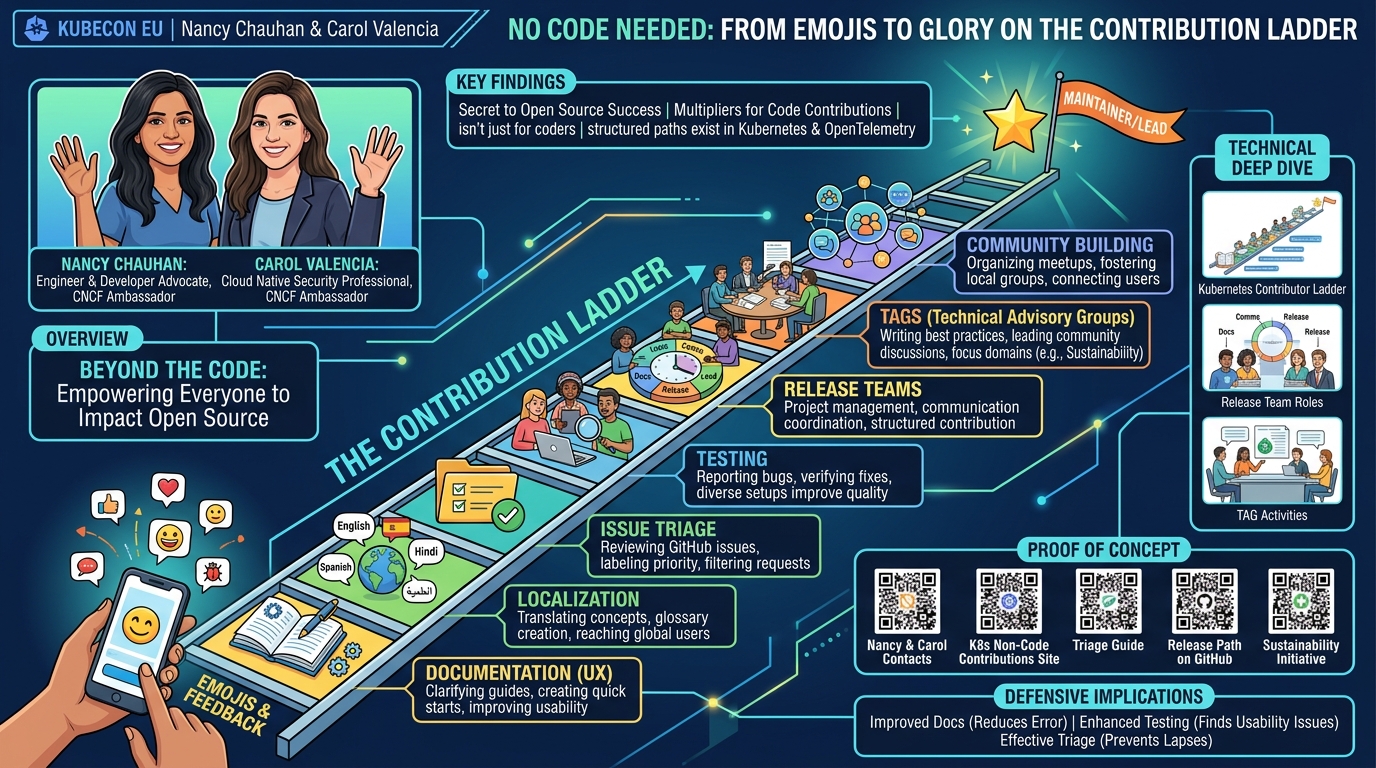
The speakers, both accomplished CNCF ambassadors and active community leaders, illuminate a diverse spectrum of pathways for engagement beyond writing code. From refining documentation and enhancing user experience (UX) to managing issue triage, facilitating localization, and bolstering community initiatives, Chauhan and Valencia highlight how these seemingly "non-technical" efforts are the secret sauce behind robust, user-friendly, and sustainable open source projects. Their talk empowers product managers, technical writers, operations specialists, students, and anyone passionate about technology to find their place on the contributor ladder, proving that impact and recognition in open source are accessible to all, regardless of their coding proficiency.
This presentation is particularly significant for several reasons. Firstly, it addresses a common barrier to entry for many potential contributors: the intimidation of complex codebases. By showcasing concrete examples from major projects like Kubernetes and OpenTelemetry, the speakers demystify the contribution process. Secondly, it underscores the critical need for comprehensive and accessible project resources, such as clear documentation and effective community support, which directly benefit the end-users and adopters of these technologies. Ultimately, Chauhan and Valencia's message is a powerful reminder that a thriving open source community is a diverse one, built on the collective efforts of many, where every form of contribution is celebrated and integral to collective success.
Background
▶ Watch: Speakers Nancy and Carol introduce themselves (0:00)
The genesis of this talk lies in a pervasive challenge within the open source landscape: the struggle with inadequate documentation and the widespread perception that significant contributions are exclusively code-based. Nancy Chauhan initiated the discussion by asking the audience how many struggled with bad documentation, receiving a significant show of hands. This simple question highlighted a universal pain point and set the stage for the core message: there's an immense need for contributions that don't involve writing code.
Chauhan and Valencia drew upon feedback from the CNCF and wider open source communities, emphasizing a key insight: "non-code contributors to open source projects are like multipliers for code contributions." This perspective reframes the value proposition, illustrating that efforts like improving documentation or providing user feedback directly amplify the effectiveness and reach of the underlying code. They cited the experience of Moi, who initially felt "overwhelmed" and "intimidated" by the perceived requirement to write complex software, only to discover a fulfilling path as a non-code contributor. This personal anecdote encapsulates the common psychological barrier that the talk aims to dismantle.
The problem persists because many individuals, despite their deep engagement with technology products, do not see themselves reflected in the traditional image of an open source contributor. The speakers presented compelling data from KubeCon Paris 2024, revealing that significant percentages of attendees are from roles traditionally not associated with direct coding: business operations, executives, sales and marketing, product managers, professors, academics, and students. These demographics represent a vast, untapped pool of talent with invaluable insights into product usability, market needs, and user experience—all critical areas where non-code contributions can profoundly impact a project's success. The speakers argued that for any open source project, "community is more than code," and that "non-coders drive impact" by providing essential feedback, fostering connections, and ensuring projects are user-loved and sustainable.
Key Findings
▶ Watch: Non-code contributors are multipliers for open source success (2:50)
The central finding of this talk is the profound and often underestimated impact of non-code contributions on the success and sustainability of open source projects. Nancy Chauhan and Carol Valencia assert that these contributions are not merely supplementary but are, in fact, "secret to open source success," acting as "multipliers for code contributions." They demonstrate that a thriving open source ecosystem requires a diverse range of skills beyond coding, making space for everyone in tech.
Key findings include:
- Diversity of Contribution Pathways: The talk meticulously outlines a comprehensive list of non-code roles, including documentation creation and improvement, localization and translation, community communications (e.g., Slack moderation), issue triage, content moderation, CI/CD pipeline management (from a non-coding perspective like feedback), and even bug reporting. This broadens the understanding of what "contribution" entails.
- Essential for Project Health: Non-code efforts directly address critical project needs often overlooked by code-focused approaches. For instance, user feedback improves onboarding and feature development, robust testing identifies usability issues and bugs, and effective communication ensures community engagement and project adoption. Bad documentation, a common struggle, can be transformed into a project strength through dedicated non-code efforts.
- Structured Opportunities Exist: Large open source projects, particularly within the CNCF landscape like Kubernetes and OpenTelemetry, have mature and well-defined structures for non-code engagement. Examples include dedicated contributor experience initiatives, release teams, and Technical Advisory Groups (TAGs), all of which actively solicit and integrate non-code contributions.
- Recognition Beyond Code: The speakers emphasize that "recognition isn't just for coders." By engaging in these non-code roles, individuals can climb the contributor ladder, gaining influence and even becoming maintainers or project leads, as exemplified by Nancy Chauhan's role in leading the CNCF Sustainability Week initiative.
- Accessibility and Growth: The talk provides practical advice and resources, such as specific GitHub repositories and websites, to guide new contributors. It encourages starting with projects aligned with one's interests or job, fostering collaboration over competition, and maintaining consistency for long-term impact and growth within the community.
These findings collectively present a compelling case for a more inclusive and holistic view of open source contribution, where every skill set is valued and leveraged for collective advancement.
Technical Deep Dive
▶ Watch: Data shows high percentage of non-developers at KubeCon (5:00)
While the talk focuses on non-code contributions, it delves into the technical mechanisms and structures within open source projects that facilitate and benefit from these efforts. The speakers used Kubernetes and OpenTelemetry as prime examples of projects with sophisticated frameworks for diverse contributions.
Documentation and User Experience (UX)
A significant portion of the deep dive revolves around documentation. The speakers highlighted a common disconnect: while technical writers are experts in clarity and structure, and product managers understand user needs, sometimes distinguished engineers are the ones writing documentation, making it "very hard to read." This creates a gap in usability. Non-code contributors, particularly those with a focus on UX or product, can bridge this gap by creating "quick starts," improving clarity, and ensuring the content caters to diverse user types. In open source, where dedicated roles are rare, individuals donating their time to refine documentation are critical for making complex projects accessible.
Localization
Localization extends beyond mere translation. For projects like Kubernetes and OpenTelemetry, which possess "complex knowledge," translating basic concepts (e.g., through a glossary) is crucial for broader adoption, especially for non-English speakers. Carol Valencia specifically mentioned her involvement in Spanish localization for both Kubernetes and OpenTelemetry. Beyond language, localization can involve adapting resources for minority groups, such as translating materials for the deaf and hard-of-hearing community, ensuring inclusivity across different user demographics. This isn't just about documents but also adapting white papers and other resources across various CNCF TAGs.
Issue Triage
Issue triage is presented as a fundamental non-code contribution that provides deep insights into a project's operational environment. It's a structured process for reviewing and organizing new GitHub issues and pull requests. Taggers categorize these items based on factors like priority, urgency, and type, ensuring that maintainers can efficiently address the most critical work. This role is particularly vital for large projects like Kubernetes or OpenTelemetry, which can have "multiple issues and requests" at any given time, preventing important feedback or bugs from getting lost.
Testing
Effective testing is not solely the domain of developers. The talk emphasizes that "everyone's setup is different and that's a strength." Diverse testers can uncover "unique usability issues" that developers might miss. Non-code testing contributions include:
- Testing features: Running the project and actively trying out new functionalities.
- Reporting bugs: Clearly documenting unexpected behavior when something "is not working."
- Verifying fixes: Confirming that reported bugs have been resolved in subsequent releases.
- Triaging issues: As mentioned above, helping to categorize and prioritize bug reports.
Kubernetes Contributor Ladder and Release Teams
The contributor ladder in Kubernetes is a well-defined path for growth. Starting as a contributor (e.g., translating, helping with issue triage, managing Slack, or blog content), individuals can advance to become maintainers through consistent engagement over time (e.g., "months, one year"). Kubernetes actively supports this growth through initiatives like the "building the bro release," which creates blogs to simplify new features (Kube Enhancements Proposals or KCEPs) for beginners, and the contributor experience SIG.
Kubernetes Release Teams offer a prime example of structured non-code collaboration. Each release involves a dedicated team with roles like:
- Enhancements Lead
- Comms Lead (Nancy was a Comms Shadow)
- Docs Lead (Carol has participated in this role)
- Release Signal Lead
- Release Notes Lead
These teams coordinate complex project management tasks, communications, and interactions with various SIGs (Special Interest Groups). The speakers highlighted a visual release path on GitHub, demonstrating the intricate web of activities required for a successful Kubernetes version release, including documentation, communications, and CI/CD pipelines, all of which require significant non-code input.
Technical Advisory Groups (TAGs)
Technical Advisory Groups (TAGs) within the CNCF are community-led groups focused on specific technical domains (e.g., Environment Sustainability, App Delivery, Network Security, Observability, Storage). Despite their technical names, they are rich environments for non-code contributions. Nancy Chauhan shared her experience in TAG Environment Sustainability, where she led a "sustainability initiative" involving 22+ global meetups. Her role was essentially a "project maintainer," requiring significant non-code skills to organize, coordinate, and ensure the success of the initiative. Other non-code contributions to TAGs include:
- Writing white papers: Collaborating on best practices and research documents (e.g., a recent AI white paper).
- Hosting working groups and discussions: Facilitating community engagement and knowledge sharing.
- Learning and participating: Attending open meetings (found via Google or CNCF Slack) to contribute or simply learn.
Community Building
Finally, the talk emphasizes community building as a vital non-code skill. This involves organizing and participating in meetups, fostering local groups, and creating spaces for like-minded individuals to connect, discuss feedback, and collaborate. This foundational work strengthens the overall ecosystem and ensures that projects have a vibrant, engaged user base.
The detailed exploration of these roles and structures, coupled with specific examples and resources like the Kubernetes non-code contributions website, effectively demystifies the process and provides a clear roadmap for individuals to engage deeply with open source projects without writing a single line of code.
Demo / Proof of Concept
▶ Watch: Community is more than code; non-coders drive impact (6:00)
While this talk did not feature a traditional technical demonstration or proof of concept in the sense of showcasing an exploit, a new software feature, or a complex system in action, it effectively demonstrated the pathways and resources for engaging in non-code contributions within the open source ecosystem. The speakers’ "demonstration" was pedagogical, guiding attendees through the existing structures and tools available.
They utilized QR codes extensively to provide direct access to critical resources, acting as a live "proof of concept" for how easy it is to find these opportunities. For instance, QR codes were displayed for:
- Speaker contact information: Encouraging direct engagement.
- Kubernetes non-code contributions website: A comprehensive portal detailing various roles and how to get started. This website itself serves as a central hub for practical guidance.
- Kubernetes issue triage guide: Providing instructions on how to become a triagger and contribute to managing GitHub issues.
- Kubernetes release team GitHub repository: Illustrating the visual release path and the extensive project management involved in Kubernetes releases.
Furthermore, the speakers described the practical application of non-code roles through real-world examples. Nancy Chauhan recounted her experience leading the CNCF Sustainability Week initiative under the TAG Environment Sustainability, explaining how her role as a "project maintainer" was entirely non-code based, involving coordination of 22+ global meetups. Carol Valencia shared her involvement in Spanish localization for Kubernetes and OpenTelemetry and her participation in the Kubernetes release team (specifically in the docs and security aspects), illustrating concrete ways individuals can contribute without coding.
By showcasing these websites, guides, and personal experiences, the talk successfully "demonstrated" that robust, well-defined avenues for non-code contributions genuinely exist and are actively seeking participants. It was a demonstration of opportunity and accessibility rather than technical functionality.
Defensive Implications
▶ Watch: Starting your journey by reading contributor guides (8:00)
Although "No Code Needed" does not directly address cybersecurity vulnerabilities or traditional defensive strategies, its focus on strengthening open source projects through diverse contributions carries significant indirect defensive implications. A well-maintained, user-friendly, and actively governed open source project is inherently more resilient and "defended" against a host of issues, including potential security oversights and project stagnation.
Here's how non-code contributions bolster a project's defensive posture:
- Improved Documentation as a Security Control: Clear, accurate, and comprehensive documentation is a fundamental defensive layer. Bad documentation often leads to user misconfigurations, incorrect deployments, and insecure practices. By improving quick starts, translating complex concepts, and ensuring user-centric content, non-code contributors directly reduce the attack surface created by human error, making systems built on these projects more secure by default.
- Enhanced Testing and Bug Reporting: A diverse group of non-code testers, from various backgrounds and setups, is more likely to identify "unique usability issues" and unexpected behaviors. This broadens the scope of testing beyond what core developers might cover. Early and clear bug reporting, verification of fixes, and active issue triage ensure that vulnerabilities (whether functional or security-related) are identified, prioritized, and addressed promptly, preventing them from being exploited.
- Effective Issue Triage Prevents Critical Lapses: The process of systematically reviewing and categorizing GitHub issues and pull requests based on priority and urgency is a crucial defensive mechanism. It ensures that critical bugs, including potential security flaws, are not overlooked or delayed. A well-oiled triage process acts as a filter, allowing maintainers to focus on the most impactful issues, thereby reducing the window of exposure for vulnerabilities.
- Localization Broadens Security Scrutiny: By making projects accessible to a global audience through localization, more eyes are brought to the project. This increased community engagement can lead to more diverse feedback, including the identification of security concerns that might be specific to certain regions or user groups. A larger, more diverse user base means a larger pool of potential "security researchers" actively using and scrutinizing the software.
- Active Release Teams Ensure Timely Updates and Communications: Well-organized release teams ensure that new versions, which often include security patches and critical bug fixes, are released on schedule and communicated effectively. Roles like the Comms Lead and Docs Lead are vital for disseminating information about security updates, best practices, and configuration changes, enabling users to implement defenses promptly.
- Technical Advisory Groups (TAGs) Directly Address Security: TAGs like the CNCF Security TAG directly focus on security best practices, white papers, and guidance for cloud native projects. Non-code contributions here, such as participating in discussions, helping write best practice guides, or organizing security-focused working groups, directly enhance the security posture of the entire cloud native ecosystem.
- Community Building Fosters Resilience: A strong, collaborative community (facilitated by non-code efforts) ensures that knowledge is shared, problems are collectively solved, and maintainers receive continuous support and feedback. This collective vigilance and responsiveness make a project more resilient to attacks, as the community can quickly mobilize to identify and mitigate threats.
In essence, by advocating for and enabling a broader range of contributions, Chauhan and Valencia are promoting a more robust, transparent, and responsive open source environment. This holistic approach to project health inherently strengthens a project's "defenses" against technical debt, user frustration, and critical vulnerabilities, ultimately leading to more secure and reliable software.
Key Takeaways
- Non-code contributions are indispensable multipliers for open source success. They are not merely supplementary but are critical for the health, usability, and sustainability of projects, enabling them to thrive beyond just code.
- There is a vast and diverse array of roles for non-coders in open source. Opportunities range from documentation and localization to issue triage, testing, release teams, Technical Advisory Groups (TAGs), and community building, providing a place for almost any skill set.
- Major open source projects like Kubernetes and OpenTelemetry offer structured pathways for non-code contributors. These projects have dedicated websites, guides, and teams (e.g., contributor experience, release teams) specifically designed to welcome and integrate diverse forms of contribution.
- Consistency and active community engagement are key to advancing on the contributor ladder. By showing resilience and actively participating over time, individuals can progress from basic contributions to leadership roles, becoming maintainers or project leads.
- Aligning contributions with personal interests or professional roles enhances sustained engagement. Choosing topics related to one's job or passions makes the contribution process more rewarding and helps maintain motivation over the long term.
- Collaboration over competition is the guiding principle. The open source community thrives on mutual support and shared goals, fostering an environment where individuals help each other grow and succeed.
About the Speaker(s)
Nancy Chauhan is an accomplished Engineer and Developer Advocate with a passion for products. She is currently pursuing her Masters from Cornell University. Prior to her current studies, she gained experience at Blinkit, an e-commerce startup, and worked as a developer advocate at Gitboard and LocalStack. Nancy is a recognized CNCF ambassador and is the founder of the Women in CloudNative community, where she met her co-speaker, Carol Valencia. She has also demonstrated her leadership by co-chairing the TAG Environment Sustainability and leading the CNCF Sustainability Week initiative, showcasing her commitment to sustainable practices in tech. Outside of her professional endeavors, Nancy enjoys nature, cats, and travel.
Carol Valencia is a dedicated professional with a strong focus on cloud native security and DevOps topics. She has experience working in security companies like Aqua Security and is currently with Elastic. Like Nancy, Carol is a CNCF ambassador. She is also a prominent organizer for Cloud Native chapters in Latin America, actively supporting communities in her home country of Peru (Lima) and her city of residence (Puebla). Carol has contributed significantly to various KCDs (Kubernetes Community Days) and has been an active participant in the Kubernetes release team, gaining valuable insights into project management and community dynamics. Her commitment to inclusivity is evident in her work on Spanish localization for major projects such as Kubernetes and OpenTelemetry, helping to make these technologies accessible to a broader global audience.
Reviews
Dr. Zero (Offensive Security Researcher) — STRONG ACCEPT
This talk by Chauhan and Valencia is a no-bullshit, highly practical guide to non-code contributions in open source, a critical multiplier for project health and sustainability. They effectively dismantle the myth that only coders contribute, providing concrete examples from Kubernetes and OpenTelemetry. The speakers, clearly deeply embedded in the communities they describe, offer actionable pathways for anyone to contribute, from documentation and issue triage to leading entire initiatives. It's a valuable session for anyone struggling with project engagement or looking to make a real impact beyond writing lines of code.
Heather Calloway (CISO) — STRONG ACCEPT
This KubeCon talk by Chauhan and Valencia powerfully articulates how non-code contributions are critical multipliers for open-source project success, directly impacting their usability, security, and sustainability. From a CISO's perspective, this isn't just about community building; it's a strategic imperative. Poor documentation, neglected user experience, and inadequate testing in open-source components introduce significant operational risk and potential security exposure. The speakers provide clear, actionable pathways for organizations to empower diverse talent to contribute, thereby strengthening the health of their critical open-source dependencies and reducing systemic risk.