Breaking Barriers: Bringing Application Developers Cl... Thomas Vitale & Mauricio "Salaboy" Salatino
Thomas Vitale, Mauricio "Salaboy" Salatino
KubeCon + CloudNativeCon Europe 2025 · Session
Overview
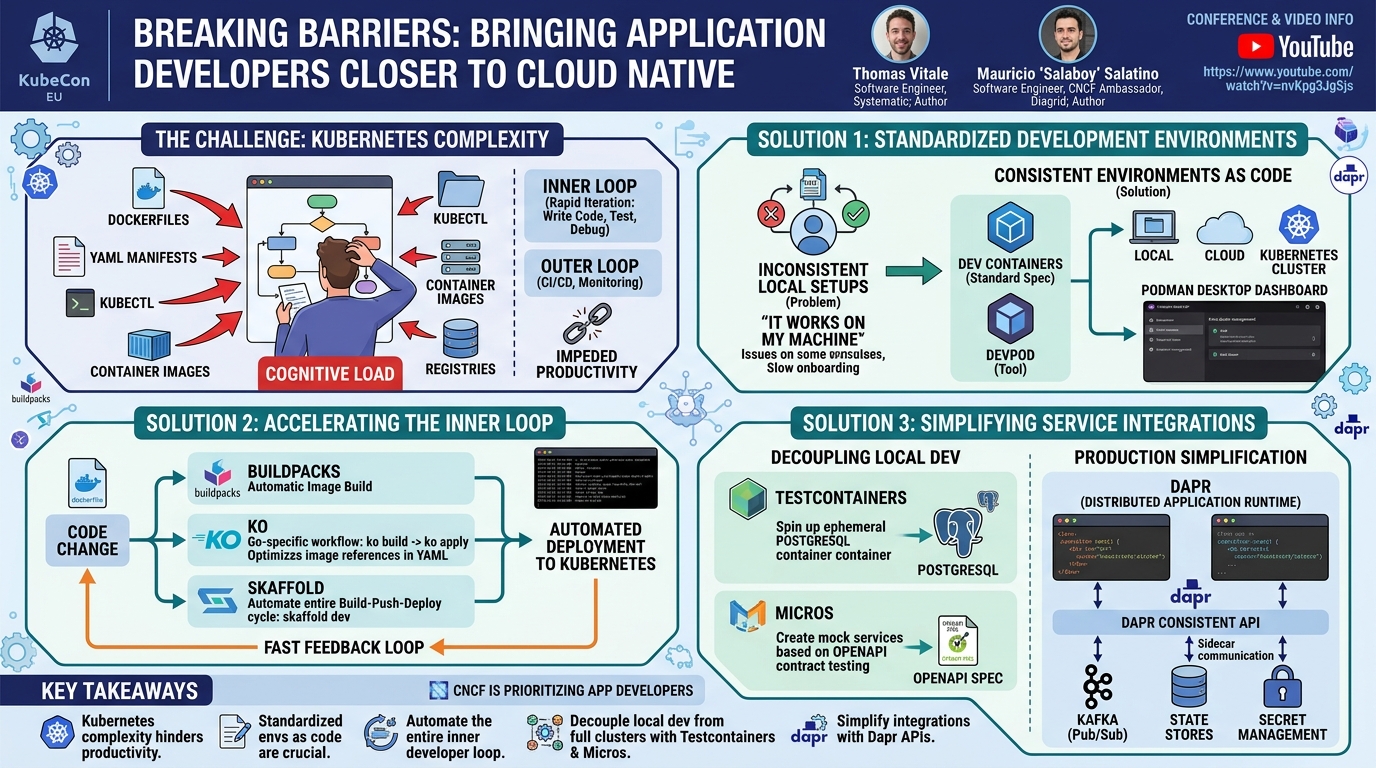
In "Breaking Barriers: Bringing Application Developers Closer to Cloud Native," Thomas Vitale and Mauricio "Salaboy" Salatino tackle a pervasive challenge in modern software development: the widening gap between application developers and the complex cloud-native infrastructure, particularly Kubernetes. The speakers, both seasoned software engineers and authors in the cloud-native space, highlight how the cognitive load and operational overhead imposed by Kubernetes often slow down developer productivity, despite the platform's power. Their central thesis is that by strategically adopting and integrating specific CNCF projects and cloud-native tools, organizations can significantly enhance the developer experience (DX), enabling application developers to focus on delivering business value rather than wrestling with infrastructure intricacies.
Key moments
- 0:00 Introduction: Developer Experience & Inner Loop Challenges
- 4:00 Speakers' Background and New Book Announcement
- 4:40 Defining a Development Environment with Podman Desktop
- 5:30 Creating a Local Kubernetes Cluster with Podman
- 6:00 Visualizing Kubernetes Resources with Podman Dashboard
- 6:40 The Challenge of Sharing Development Environments
Breaking Barriers: Bringing Application Developers Closer to Cloud Native
Speakers: Thomas Vitale, Software Engineer, Systematic; Mauricio "Salaboy" Salatino, Software Engineer, CNCF Ambassador, Diagrid
Conference: KubeCon EU
YouTube: https://www.youtube.com/watch?v=nvKpg3JgSjs
Overview
In "Breaking Barriers: Bringing Application Developers Closer to Cloud Native," Thomas Vitale and Mauricio "Salaboy" Salatino tackle a pervasive challenge in modern software development: the widening gap between application developers and the complex cloud-native infrastructure, particularly Kubernetes. The speakers, both seasoned software engineers and authors in the cloud-native space, highlight how the cognitive load and operational overhead imposed by Kubernetes often slow down developer productivity, despite the platform's power. Their central thesis is that by strategically adopting and integrating specific CNCF projects and cloud-native tools, organizations can significantly enhance the developer experience (DX), enabling application developers to focus on delivering business value rather than wrestling with infrastructure intricacies.
The talk emphasizes the need to bridge the understanding and operational chasm between platform engineers, who build and maintain the Kubernetes-powered platforms, and application developers, who consume these platforms to deploy their applications. Vitale and Salatino argue that a streamlined developer experience is not merely a convenience but a critical factor in accelerating time-to-market, improving code quality, and fostering innovation. They present a practical roadmap, demonstrating how various tools can automate repetitive tasks, standardize development environments, and abstract away underlying complexities, thereby making cloud-native development more accessible and enjoyable for the everyday application developer.
Ultimately, this presentation serves as a call to action for the cloud-native community, including the CNCF itself, to prioritize the needs of application developers. By showcasing tangible solutions and advocating for a developer-centric approach, Vitale and Salatino aim to foster collaboration between different engineering roles and cultivate an ecosystem where developers can leverage the full potential of cloud-native technologies without being overwhelmed by their inherent complexity.
Background
▶ Watch: Introduction: Developer Experience & Inner Loop Challenges (0:00)
The journey of transforming an idea or requirement into a production-ready application typically involves two major phases: the inner developer loop and the outer developer loop. The inner loop encompasses the rapid iteration cycles a developer performs locally—writing code, compiling/running, unit testing, and debugging. The outer loop, on the other hand, deals with continuous integration, deployment, and monitoring in pre-production and production environments. While both loops are critical, the talk primarily focuses on optimizing the inner loop, recognizing that friction here can drastically impede overall productivity.
Historically, application developers concentrated on business logic and application runtime. However, the advent of containerization and orchestrators like Kubernetes introduced new layers of complexity directly into the developer's workflow. Suddenly, developers needed to understand Dockerfiles, container image creation, registries, kubectl commands, YAML manifests, and the nuances of Kubernetes resources (Deployments, Services, Ingress, etc.). While this knowledge can be beneficial for understanding application architecture, it imposes a significant cognitive load on developers whose primary goal is to write application code. This added complexity often leads to slower feedback loops, inconsistent development environments across teams, and a steep learning curve for new team members.
The speakers highlight that many companies, in their rush to adopt Kubernetes, inadvertently slow down their developers. The ideal scenario for an application developer is to focus solely on their code and its immediate runtime (e.g., Java, Go, Node.js). Introducing containers necessitates understanding container runtimes and image distribution. Adding Kubernetes further demands knowledge of the orchestrator itself. This progressive layering of infrastructure concerns onto the application developer's plate creates the "barriers" that the talk aims to break. The challenge is to leverage the power and scalability of Kubernetes without burdening developers with its operational intricacies during their daily coding tasks, thus enabling them to deliver value faster and more efficiently.
Key Findings
▶ Watch: Defining a Development Environment with Podman Desktop (4:40)
The core findings of Vitale and Salatino's presentation revolve around identifying and mitigating the key friction points experienced by application developers in a Kubernetes-centric world. They propose that a holistic approach, combining specific tools and methodologies, can significantly enhance the developer experience.
Firstly, a major finding is the critical need for standardized and portable development environments. Inconsistent local setups across a development team lead to "it works on my machine" problems, prolonged onboarding times, and debugging issues stemming from environmental differences. The talk demonstrates that by defining development environments as code using specifications like Dev Containers and tools like Devpod, developers can achieve consistency, speed up onboarding, and ensure that their local environment mirrors production more closely, regardless of the underlying infrastructure (local machine, cloud, or Kubernetes cluster).
Secondly, the speakers reveal that the inner developer loop can be dramatically accelerated by automating containerization and Kubernetes deployment tasks. Manually crafting Dockerfiles, pushing images to registries, and applying YAML manifests for every code change creates a slow and cumbersome feedback loop. Tools like Buildpacks, Ko (for Go), and especially Skaffold are identified as crucial for abstracting these complexities, allowing developers to focus on code changes while the platform automatically handles the container build, image push, and deployment to a local or remote Kubernetes cluster. This automation directly addresses the cognitive overload associated with Kubernetes operations.
Finally, the talk emphasizes that developers don't always need a full Kubernetes cluster running locally to be productive. For many local development scenarios and integration testing, abstracting external dependencies and services is more effective. Tools like Testcontainers allow developers to spin up required databases or message queues as temporary containers for testing, while Micros facilitates contract testing against external APIs without needing to run those services locally. For production-bound service integrations, Dapr emerges as a key finding for simplifying access to complex underlying infrastructure (e.g., Kafka, managed cloud services) through a common set of language-agnostic APIs, reducing the learning curve for developers integrating with various backends. These findings collectively advocate for a more developer-centric cloud-native ecosystem that prioritizes speed, consistency, and simplicity.
Technical Deep Dive
▶ Watch: Creating a Local Kubernetes Cluster with Podman (5:30)
The technical deep dive of the presentation showcases a suite of cloud-native tools designed to streamline the developer experience on Kubernetes. The solutions presented address three main areas: standardized development environments, accelerating the Kubernetes inner loop, and simplifying service integrations.
Standardized Development Environments
The first technical barrier addressed is the inconsistency of local development environments. The speakers introduce Podman Desktop as an open-source container runtime solution, similar to Docker, but with integrated Kubernetes cluster management capabilities. Podman Desktop allows developers to easily create local Kubernetes clusters using projects like Kind or Minikube, providing a consistent local Kubernetes environment. It also offers a dashboard for visualizing Kubernetes resources and integrates with tools like Headlamp.
To further standardize the development setup, the talk highlights Dev Containers (an open specification) and Devpod. Dev Containers allow developers to define their entire development environment (tools, dependencies, extensions) as code within a devcontainer.json file. This specification is supported by various platforms, including GitHub Codespaces and popular IDEs like Visual Studio Code and JetBrains. Devpod is presented as a powerful tool that consumes this standard format, enabling the creation of portable development environments across different infrastructures—local (Docker, Podman), cloud, or Kubernetes clusters. This ensures that every developer on a team uses the exact same tooling and setup, significantly reducing setup time and "works on my machine" issues. The demo shows a Java Spring Boot application running in a browser-based VS Code instance, provisioned by Devpod, without any local Java tooling installed on the host machine. This setup can be integrated into developer portals like Backstage for seamless project bootstrapping.
Accelerating the Kubernetes Inner Loop
The core challenge for application developers interacting with Kubernetes is the overhead of containerization and deployment. The talk introduces several tools to automate these processes:
- Buildpacks: This CNCF project automates the creation of container images from source code without requiring a Dockerfile. It detects the application's language (e.g., Java, Go, Node.js) and builds an optimized, production-ready image, abstracting away the complexities of container image construction.
- Ko: Created by Google and now a CNCF project, Ko simplifies the inner loop specifically for Go applications. It streamlines the entire process from source code to Kubernetes deployment.
ko buildautomatically builds a multi-platform container image from Go source, pushes it to a container registry, and intelligently replaces image references in Kubernetes YAML manifests with the hash of the built image.ko applythen deploys these updated manifests to the cluster, acting as a developer-friendly wrapper aroundkubectl apply. This eliminates manual Dockerfile creation, image tagging, pushing, and YAML patching, significantly accelerating iteration for Go developers. - Skaffold: This tool generalizes the automation provided by Ko across various languages and build systems. Skaffold watches for code changes, automatically builds container images (using Dockerfiles, Buildpacks, or even Ko), pushes them to a registry, and deploys them to Kubernetes (using Helm, Kustomize, or raw YAMLs). The
skaffold devcommand provides a continuous development loop, tailing logs and redeploying changes automatically, freeing developers from manual build-and-deploy steps and providing immediate feedback.
Simplifying Service Integrations
The final technical area focuses on easing the integration with external services and dependencies, both locally and in production.
- Testcontainers: This library (available for Java, Python, Go, Node.js, and more) allows developers to provision common service dependencies (databases like PostgreSQL, message queues like RabbitMQ, or even custom services) as disposable containers directly within their application's lifecycle or integration tests. This eliminates the need for
docker composeor manual setup, ensuring clean, isolated test environments that are automatically started and stopped. The demo illustrates a Java application automatically spinning up apgvectorPostgreSQL container using Testcontainers. - Micros: For testing integrations with other microservices or external APIs, Micros provides a contract testing capability. It allows developers to define mock services based on OpenAPI specifications (or other API definitions). By integrating Micros via Testcontainers, developers can test their application against mocked versions of external APIs, ensuring compatibility and isolating their development without needing to run the actual dependent services. This significantly speeds up integration testing and reduces environmental dependencies.
- Dapr (Distributed Application Runtime): For production environments, Dapr abstracts away the complexities of integrating with various infrastructure components (e.g., state stores, pub/sub brokers like Kafka, secret management, bindings). Dapr runs as a sidecar container alongside application services, providing a set of language-agnostic APIs for common cloud-native patterns. Developers interact with Dapr's simple APIs (e.g.,
dapr client publish event,dapr client get state), and Dapr handles the underlying communication with the configured infrastructure component. This dramatically reduces the learning curve for developers, allowing them to focus on business logic while Dapr manages the "how" of interacting with the cloud-native ecosystem.
Together, these tools form a comprehensive strategy for empowering application developers by abstracting, automating, and standardizing the cloud-native development process.
Demo / Proof of Concept
▶ Watch: Visualizing Kubernetes Resources with Podman Dashboard (6:00)
The presentation included several live demonstrations that progressively showcased how the proposed tools and methodologies enhance the developer experience.
The initial segment focused on setting up a standardized local development environment. Mauricio began by demonstrating Podman Desktop, highlighting its ability to serve as a container runtime and to provision local Kubernetes clusters using Kind. He showed how a Kind cluster could be quickly created, optionally with an ingress controller, and how Podman Desktop's integrated dashboard or external tools like Headlamp could visualize Kubernetes resources. This laid the groundwork for a consistent local Kubernetes environment.
Next, Thomas introduced Devpod integrated with Dev Containers. He demonstrated how a development environment for a Java Spring Boot application was defined as code. Using Devpod, he launched this environment, which opened directly in a browser-based instance of Visual Studio Code. Crucially, this setup allowed him to run the Java application without any Java development kit or tooling installed on his local machine, showcasing the power of portable, self-contained development workspaces. He emphasized that this setup could also handle credentials and secrets, significantly simplifying the onboarding process for new developers.
The demonstration then shifted to accelerating the inner developer loop with Kubernetes. Mauricio took over, presenting a Go application that initially required a local PostgreSQL database, typically spun up with podman compose. He then introduced Ko, showing how ko build could automatically containerize the Go application into a multi-platform image and push it to a registry. He then used ko apply to deploy the application to the Kind cluster, explaining how Ko intelligently replaced the image reference in the Kubernetes YAML manifest with the newly built image's hash. This highlighted the automation of container image creation, pushing, and Kubernetes deployment.
Building on Ko, Thomas introduced Skaffold. He demonstrated skaffold dev with the same Go application. As he made a minor code change, Skaffold automatically detected it, rebuilt the container image (using Ko in this case), redeployed the application to the Kind cluster, and tailed the logs, providing an immediate feedback loop. This illustrated Skaffold's ability to automate the entire build-deploy-debug cycle, supporting various build tools and deployment methods.
Finally, the demo addressed reducing the dependency on local Kubernetes and simplifying service integrations. Thomas showcased a Java application that, like the Go example, required a PostgreSQL database. However, instead of podman compose, this application used Testcontainers to automatically provision a pgvector PostgreSQL container (an extension for AI vector store operations) as part of the application's startup. He then demonstrated how Micros was used for contract testing against an external "friends API." Micros, also integrated via Testcontainers, provided mocks based on an OpenAPI specification for the external API, allowing the Java application to be developed and tested in isolation without needing the actual "friends API" service running. The demonstration concluded with a conceptual overview of Dapr, showing Java and Go code snippets for publishing and consuming events, illustrating how Dapr abstracts messaging infrastructure like Kafka behind simple, language-agnostic APIs.
Throughout the demonstrations, the speakers emphasized how these tools collectively reduce cognitive load, automate repetitive tasks, and provide faster feedback, thereby significantly improving the overall developer experience when working with cloud-native applications on Kubernetes.
Defensive Implications
▶ Watch: The Challenge of Sharing Development Environments (6:40)
While "Breaking Barriers" is not a security-focused talk, the principles and tools discussed have significant indirect defensive implications for organizations. Improving developer experience, consistency, and automation can lead to more robust, reliable, and inherently more secure software systems.
Firstly, the emphasis on standardized development environments through tools like Dev Containers and Devpod directly contributes to security by reducing configuration drift. When all developers use the same tool versions, dependencies, and environment configurations, it minimizes the risk of "works on my machine" bugs that can mask vulnerabilities or lead to unexpected behavior in production. It also simplifies compliance audits by providing a consistent baseline for development environments. Furthermore, integrating security scanning tools directly into these standardized environments can ensure that security checks are performed early in the development lifecycle, catching issues before they propagate.
Secondly, the automation of the inner developer loop with tools like Ko and Skaffold enables faster iteration and feedback. This rapid feedback loop is crucial for security because it means that security vulnerabilities, once identified, can be patched and deployed much quicker. Continuous delivery, facilitated by these tools, allows for more frequent, smaller releases, which are generally easier to secure and audit than monolithic, infrequent deployments. The ability of Ko to generate multi-platform container images also enhances resilience and portability, indirectly defending against platform-specific exploits.
Finally, the abstraction provided by Testcontainers, Micros, and especially Dapr offers defensive benefits. Testcontainers and Micros promote isolated development and testing, reducing dependencies on shared, potentially insecure, test environments. This isolation helps prevent data leakage between tests and ensures that security-related test cases are run consistently. Dapr, by abstracting common building blocks like secret management, pub/sub, and state management, allows platform teams to enforce consistent security policies and best practices across all microservices. For instance, Dapr can standardize how applications access secrets (e.g., from a secure vault), perform mTLS communication, or implement authorization, offloading these complex security concerns from individual application developers and consolidating them within a well-audited and managed sidecar. This reduces the surface area for common mistakes and strengthens the overall security posture of the distributed system.
Key Takeaways
- Kubernetes Complexity Hinders Developers: The inherent complexity of Kubernetes, including containerization and YAML management, imposes significant cognitive load and slows down the "inner developer loop" for application developers, impacting productivity and time-to-market.
- Standardized Dev Environments are Crucial: Tools like Podman Desktop, Dev Containers, and Devpod enable defining development environments as code, ensuring consistency across teams, accelerating developer onboarding, and reducing "it works on my machine" issues.
- Automate the Inner Loop: Projects like Buildpacks, Ko (for Go), and Skaffold automate the repetitive tasks of container image building, pushing to registries, and deploying to Kubernetes, providing faster feedback loops and allowing developers to focus on code.
- Decouple Local Dev from Full Kubernetes: Developers don't always need a full Kubernetes cluster locally. Testcontainers can provision local dependencies (databases, message queues) as disposable containers, while Micros facilitates contract testing against mocked external APIs, isolating development and speeding up integration tests.
- Simplify Production Service Integrations: Dapr (Distributed Application Runtime) abstracts complex infrastructure concerns (like messaging, state management, secrets) behind simple, language-agnostic APIs, significantly reducing the learning curve for developers integrating with various cloud-native services in production.
- CNCF is Prioritizing App Developers: The CNCF, through initiatives like the TAG App Delivery and dedicated KubeCon tracks, is increasingly focusing on the needs of application developers, encouraging community involvement to bridge the gap between platform engineering and application development.
About the Speaker(s)
Mauricio "Salaboy" Salatino is a distinguished software engineer and a fervent advocate for cloud-native technologies, particularly focusing on the developer experience within Kubernetes environments. He is a CNCF Ambassador and currently works at Diagrid, a company deeply involved with the Dapr project, which aims to simplify the development of distributed applications. Mauricio is also the author of the book "Platform Engineering on Kubernetes," reflecting his deep expertise in building effective developer platforms that bridge the divide between application developers and platform engineers. His work consistently emphasizes reducing friction and cognitive load for developers.
Thomas Vitale is a passionate software engineer working at Systematic in Denmark, with a strong focus on cloud-native development and the Java ecosystem. He is the author of "Cloud Native Spring in Action with Spring Boot and Kubernetes," showcasing his proficiency in building modern applications on Kubernetes using Spring Boot. Thomas shares a common vision with Mauricio in improving the developer experience, and they are collaboratively writing a new book titled "Developer Experience on Kubernetes." His contributions highlight practical strategies for Java developers to thrive in the cloud-native landscape, ensuring productivity and efficiency.
Reviews
Dr. Zero (Offensive Security Researcher) — STRONG ACCEPT
This session effectively tackles a critical pain point in cloud-native development: the overwhelming complexity of Kubernetes for application developers. Vitale and Salatino provide a well-structured, practical roadmap demonstrating how a curated suite of CNCF-aligned tools—including Devpod, Ko, Skaffold, Testcontainers, and Dapr—can collectively abstract away infrastructure intricacies, standardize development environments, and accelerate the inner development loop. The talk is highly actionable, offering concrete solutions that directly enhance developer experience and productivity, backed by solid live demonstrations.
Heather Calloway (CISO) — STRONG ACCEPT
This talk effectively diagnoses a critical operational challenge: the friction application developers face with cloud-native complexities. While not a security-focused presentation, its emphasis on standardized development environments, automated pipelines, and the abstraction of infrastructure through tools like Dapr directly contributes to a more resilient and secure software supply chain. It offers valuable insights for security leaders on how platform engineering initiatives can reduce operational risk, improve consistency, and enable the enforcement of security policies at scale, ultimately accelerating the ability to deliver secure software.