Guiding Kubernetes: The Steering Committee's Role in Project Evo... Maciej Szulik & Stephen Augustus
Maciej Szulik, Stephen Augustus
KubeCon + CloudNativeCon Europe 2025 · Session
Overview
In this insightful KubeCon EU session, Maciej Szulik and Stephen Augustus, both integral members of the Kubernetes Steering Committee, demystified the intricate governance structure underpinning one of the world's largest and most impactful open-source projects. Their talk, "Guiding Kubernetes: The Steering Committee's Role in Project Evolution," provided an unparalleled look into the mechanisms that enable Kubernetes to scale its development, maintain its quality, and foster a vibrant global community. Far from being a purely technical deep dive into code, this presentation illuminated the critical human and organizational infrastructure that allows Kubernetes to thrive.
Key moments
- 0:00 Introduction and speakers' personal project contributions
- 4:00 Understanding Kubernetes' massive community scale and structure
- 4:50 Defining the Kubernetes Steering Committee's governing role
- 5:25 Special Interest Groups (SIGs) as Kubernetes' core work units
- 6:17 How SIG Release orchestrates the Kubernetes development cycle
- 7:00 Kubernetes feature enhancement and review process
Guiding Kubernetes: The Steering Committee's Role in Project Evolution and Governance
Speakers: Maciej Szulik, Member of Kubernetes Steering Committee, Staff Software Engineer at Red Hat; Stephen Augustus, Co-chair of SIG Release, Principal Technical Program Manager at Cisco
Conference: KubeCon EU
YouTube: https://www.youtube.com/watch?v=ZManfhV6DZU
Overview
In this insightful KubeCon EU session, Maciej Szulik and Stephen Augustus, both integral members of the Kubernetes Steering Committee, demystified the intricate governance structure underpinning one of the world's largest and most impactful open-source projects. Their talk, "Guiding Kubernetes: The Steering Committee's Role in Project Evolution," provided an unparalleled look into the mechanisms that enable Kubernetes to scale its development, maintain its quality, and foster a vibrant global community. Far from being a purely technical deep dive into code, this presentation illuminated the critical human and organizational infrastructure that allows Kubernetes to thrive.
The speakers meticulously detailed the responsibilities of the Kubernetes Steering Committee, its interactions with other governance groups like Special Interest Groups (SIGs) and Working Groups (WGs), and the broader processes that shape the project's direction. They shed light on how decisions are made, how new features are introduced via Kubernetes Enhancement Proposals (KEPs), and the continuous efforts to onboard new contributors and sustain existing subprojects. This talk is essential viewing for anyone involved in large-scale open-source projects, offering a masterclass in distributed governance, community management, and the delicate balance required to steer a project of Kubernetes' magnitude.
The significance of this discussion cannot be overstated. As Kubernetes continues to permeate every facet of modern cloud-native infrastructure, understanding its internal workings, especially its governance, becomes paramount. The health and evolution of Kubernetes directly impact countless organizations and developers worldwide. Szulik and Augustus's presentation provided crucial transparency into the often-invisible labor of project stewardship, demonstrating how a dedicated committee, through strategic delegation and community engagement, ensures the long-term viability and innovation of this foundational technology.
Background
▶ Watch: Introduction and speakers' personal project contributions (0:00)
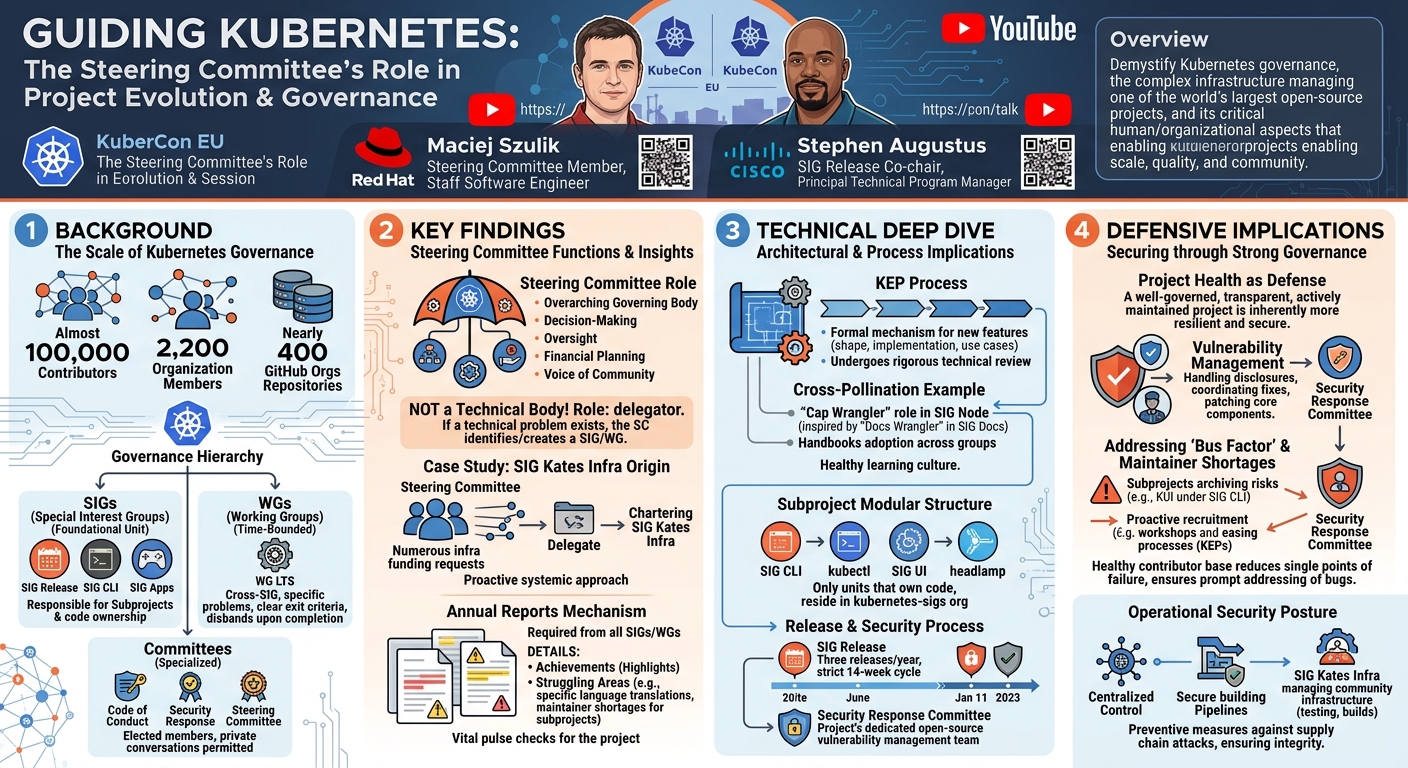
The Kubernetes project is a colossal undertaking, boasting an ecosystem of staggering proportions. As of March 2024, it encompasses nearly 100,000 contributors and over 2,200 organization members across multiple GitHub organizations, including kubernetes/kubernetes, kubernetes-sigs, and kubernetes-client. This vast network manages close to 400 repositories and operates through 32 distinct governance groups. This immense scale necessitates a robust, well-defined governance model to ensure coherence, quality, and sustainable development.
At the core of Kubernetes' governance are three primary types of groups: Special Interest Groups (SIGs), Working Groups (WGs), and Committees. SIGs are the foundational units of work, chartered to focus on specific topics within the project, such as SIG Release (responsible for release cycles), SIG CLI (managing kubectl), or SIG Apps (handling controllers). Each SIG is responsible for governing its own subprojects, which are the actual units that own and develop code for the community. This structure ensures domain-specific expertise and distributed ownership.
Working Groups (WGs), in contrast, are designed for time-bounded efforts. They typically involve collaboration between two or more SIGs to address a specific, often cross-cutting, problem. WGs are established with clear exit criteria, meaning they disband once their objectives are met. An example discussed was the WG LTS (Long Term Support), which initially defined Kubernetes' one-year support cycle and was later restarted to explore further long-term support strategies. This agile approach allows the project to tackle specific challenges without creating permanent organizational overhead.
Committees represent the third, and most specialized, tier of governance. Unlike SIGs and WGs, committee members are typically elected by a subset of the project community or proposed by existing members. These groups hold unique responsibilities and, notably, are the only governance bodies permitted to have private conversations when necessary. Kubernetes has three such committees: the Steering Committee, the Code of Conduct Committee, and the Security Response Committee. This layered approach, from broad technical SIGs to focused, time-bound WGs, and finally to specialized, oversight Committees, forms the backbone of Kubernetes' remarkable ability to manage its complexity and continuous evolution.
Key Findings
▶ Watch: Defining the Kubernetes Steering Committee's governing role (4:50)
The talk meticulously outlined the core functions and evolving responsibilities of the Kubernetes Steering Committee, alongside broader insights into the project's operational philosophy. A primary finding highlighted that the Steering Committee acts as the overarching governing body, providing decision-making and oversight pertaining to the Kubernetes bylaws, subprojects, and financial planning. Crucially, the speakers emphasized that while its members are technically adept, the Steering Committee itself is not a technical body. Instead, its role is primarily that of a delegator and the voice of the community. If a problem arises that requires a technical solution, the Steering Committee identifies or creates the appropriate governance group (a SIG or WG) to address it. This strategic delegation ensures that technical decisions are made by those with the most relevant expertise, while the Steering Committee maintains a high-level view of project health and direction.
A significant evolution in governance was illustrated by the origin story of SIG Kates Infra. Initially, the Steering Committee was directly handling numerous funding requests for infrastructure to support testing and new project ideas. Recognizing this recurring need, the committee delegated this responsibility by chartering a new SIG, SIG Kates Infra, dedicated to managing Kubernetes community infrastructure in a way that all community members can contribute. This exemplifies the Steering Committee's proactive approach to identifying systemic needs and establishing specialized groups to address them efficiently.
The importance of annual reports emerged as a critical mechanism for transparency and accountability across all governance groups. Every year, each SIG and WG is required to submit a report detailing their achievements (highlights) and, equally importantly, areas where they are struggling. These reports serve as vital pulse checks for the project, allowing the Steering Committee and the broader community to understand progress, identify bottlenecks, and allocate resources or attention where needed. Examples included difficulties with specific language translations in SIG Docs (German, Vietnamese) and the loss of maintainers for subprojects like KUI under SIG CLI.
Another key finding was the emphasis on cross-pollination of ideas and best practices among SIGs. A prime example is the introduction of the Cap Wrangler role within SIG Node. This role, inspired by the existing Docs Wrangler in SIG Docs, is dedicated to guiding contributors through the intricate Kubernetes Enhancement Proposal (KEP) process. This highlights a healthy culture of learning and adaptation, where successful operational models developed in one SIG are adopted and tailored by others to improve efficiency and contributor experience. Similarly, the widespread adoption of "handbooks" across various governance groups, initially pioneered by SIG Release for its release team, demonstrates a commitment to documented processes and contributor onboarding, making it easier for newcomers to understand how to contribute. These findings underscore a dynamic, self-improving governance model that prioritizes community health, efficient delegation, and continuous learning.
Technical Deep Dive
▶ Watch: Special Interest Groups (SIGs) as Kubernetes' core work units (5:25)
While the talk primarily focused on organizational governance, it implicitly detailed the architectural underpinnings of how Kubernetes' technical direction is managed and evolved. The most prominent technical process discussed was the Kubernetes Enhancement Proposal (KEP) system. Stephen Augustus, a co-founder of KEPs, explained that these proposals are the formal mechanism for defining new features, outlining their shape, implementation details, and intended use cases. KEPs serve as a crucial technical blueprint and review process, ensuring that new functionalities are well-thought-out, align with project goals, and undergo rigorous scrutiny before implementation. The recent introduction of the Cap Wrangler role within SIG Node, inspired by SIG Docs' Docs Wrangler, further streamlines this process by providing dedicated guidance to contributors navigating the KEP lifecycle, thereby de-risking the release team's efforts and ensuring timely delivery of enhancements.
The project's distributed ownership model is technically manifested through subprojects, which are the only units of governance that own code. Each SIG governs a set of subprojects, which typically reside in the kubernetes-sigs GitHub organization. For instance, SIG CLI is responsible for kubectl, the primary command-line interface for Kubernetes. A recent development highlighted was SIG UI's adoption of headlamp as a subproject, now hosted under kubernetes-sigs/headlamp. This modular structure allows for specialized development and maintenance within distinct technical domains, enabling parallel progress across the vast Kubernetes codebase.
The release process itself is a significant technical orchestration, managed by SIG Release. Kubernetes aims for three releases per year, each following a rigorous 14-week cycle. This process involves coordinating contributions from numerous SIGs, ensuring features are stable, well-tested, and properly documented. The enhancements team within SIG Release plays a critical role, working ahead of other sub-teams to gather and prepare the bundle of features slated for the next release, showcasing a sophisticated technical program management approach.
From a security perspective, the Security Response Committee functions as the project's dedicated open-source vulnerability management team. This committee is composed of highly learned individuals on security topics, responsible for handling disclosures, coordinating fixes, and ensuring the security posture of the core Kubernetes project. Their existence highlights a proactive and specialized approach to managing potential security risks within such a critical infrastructure component.
Furthermore, the talk touched upon the evolving roles within SIGs: Chair and Tech Lead. While Chairs manage the organizational aspects (meetings, agenda, community outreach, annual reports), Tech Leads are specifically responsible for the technical direction, reviewing Pull Requests (PRs), evaluating enhancements, and ensuring the technical soundness of the group's work. This division of labor allows for focused technical leadership and efficient project management. The creation of SIG Kates Infra to manage community infrastructure (e.g., testing environments) also represents a technical architectural decision to centralize and professionalize the provisioning and maintenance of shared resources essential for development and testing. This intricate web of processes, roles, and dedicated groups forms the technical governance architecture that propels Kubernetes forward.
Demo / Proof of Concept
▶ Watch: How SIG Release orchestrates the Kubernetes development cycle (6:17)
This particular session, "Guiding Kubernetes: The Steering Committee's Role in Project Evolution," was a presentation focused on the organizational structure, governance, and operational processes of the Kubernetes project. As such, it did not include a live demonstration or a proof of concept of any specific technical feature or security exploit. The content was entirely discursive, outlining the roles, responsibilities, and challenges faced by the Steering Committee and the broader Kubernetes community.
Defensive Implications
▶ Watch: Kubernetes feature enhancement and review process (7:00)
While the talk centered on project governance rather than direct cybersecurity vulnerabilities, its insights carry significant defensive implications for the security and sustainability of the Kubernetes ecosystem. A well-governed, transparent, and actively maintained open-source project is inherently more resilient and secure.
Firstly, the existence and function of the Security Response Committee is a direct defensive mechanism. This committee serves as the dedicated open-source vulnerability management team for Kubernetes. Their expertise and structured approach to handling security disclosures, coordinating fixes, and communicating patches are paramount to protecting users from known vulnerabilities. Without such a specialized and competent body, critical security issues could remain unaddressed, exposing countless deployments to risk.
Secondly, the emphasis on contributor experience and the ongoing efforts to recruit and onboard new maintainers directly impacts the project's "bus factor" and its ability to address issues promptly, including security bugs. When subprojects like KUI face the risk of archiving due to a lack of active maintainers, it signals a potential vulnerability. A project with a healthy, diverse, and engaged contributor base is better equipped to find and fix bugs, review code for potential weaknesses, and respond to emerging threats. Initiatives like SIG ContribEx's workshops to bring in new contributors and the creation of roles like Cap Wrangler to ease the KEP process are crucial defensive strategies against project stagnation and the concentration of knowledge, which can lead to single points of failure.
Thirdly, the structured processes like Kubernetes Enhancement Proposals (KEPs) and the division of roles into Chair and Tech Lead contribute to a more secure development lifecycle. KEPs ensure that new features undergo thorough design, review, and discussion, reducing the likelihood of introducing architectural flaws or security vulnerabilities from the outset. Tech Leads, with their focus on technical soundness and PR reviews, act as a critical gate for code quality and security.
Finally, the establishment of SIG Kates Infra for managing community infrastructure provides a centralized and professionally managed approach to critical shared resources. Secure and well-maintained testing environments, build pipelines, and other infrastructure components are essential to prevent supply chain attacks and ensure the integrity of the release process. By delegating this to a dedicated SIG, the project enhances its overall operational security posture. In essence, the robust governance discussed in this talk is a foundational defense, ensuring the ongoing health, quality, and responsiveness of Kubernetes, which are all critical factors in its overall security story.
Key Takeaways
- Kubernetes Governance is Complex but Structured: The project relies on a multi-tiered governance model comprising SIGs (Special Interest Groups), WGs (Working Groups), and Committees, each with distinct roles and responsibilities to manage its massive scale.
- Steering Committee as a Delegator and Community Voice: The Steering Committee is not a technical body but an oversight and decision-making entity, primarily responsible for project bylaws, financial planning, and acting as the community's official voice, often delegating technical problems to specialized SIGs.
- Transparency and Accountability through Annual Reports: Mandatory annual reports from all governance groups are vital for transparency, highlighting achievements, and identifying critical challenges such as maintainer shortages, translation needs, or subproject health.
- Cross-Pollination of Best Practices: The Kubernetes community actively shares and adopts successful operational models, as seen with the introduction of the "Cap Wrangler" role (inspired by "Docs Wrangler") to streamline the KEP process, and the widespread use of "handbooks" for contributor onboarding.
- Continuous Focus on Contributor Experience and Maintainer Health: The project prioritizes attracting new contributors (via
SIG ContribExworkshops) and addressing the loss of maintainers for existing subprojects, recognizing these as critical for long-term sustainability and security. - Proactive Project Lifecycle Management: Kubernetes governance includes mechanisms for not only spinning up new groups and projects but also for winding down or archiving subprojects that no longer have active maintainers or serve a clear purpose, ensuring efficient resource allocation and project health.
About the Speaker(s)
Maciej Szulik is a highly engaged member of the Kubernetes Steering Committee and a Staff Software Engineer at Red Hat. His extensive contributions span several critical areas of the Kubernetes project. He is deeply involved in SIG CLI, overseeing development related to kubectl, the primary command-line tool for interacting with Kubernetes clusters. Additionally, Maciej contributes to SIG Apps, focusing on controllers, and has been instrumental in the Batch Working Group, which aims to enhance Kubernetes' capabilities for running batch workloads. His work touches core components that countless users interact with daily.
Stephen Augustus is a prominent figure in the Kubernetes community, serving as a co-chair for SIG Release and a Principal Technical Program Manager at Cisco. He is one of the most tenured co-chairs for SIG Release, a group responsible for orchestrating the three annual Kubernetes release cycles. Stephen is also a founder of the Release Engineering subproject and has been pivotal in building a global team of release managers. Notably, he is credited as one of the founders of Kubernetes Enhancement Proposals (KEPs), a critical process for defining and implementing new features within the project, which originated from the now-defunct SIG PM (Product and Program Management). His past roles include co-chairing SIG Azure, showcasing his broad involvement across various aspects of Kubernetes development and operations.
Reviews
Dr. Zero (Offensive Security Researcher) — STRONG ACCEPT
This session provides an unparalleled, in-depth look into the intricate governance and operational mechanisms of the Kubernetes project, delivered by highly credible insiders. It offers critical transparency into how this colossal open-source project manages its evolution, ensures quality, and fosters a global community. While not a technical exploit deep-dive, it presents substantive, concrete details on project stewardship, decision-making, and community health, which are foundational for the security and sustainability of critical infrastructure.
Heather Calloway (CISO) — STRONG ACCEPT
This session provides crucial transparency into the governance of Kubernetes, a foundational technology for modern enterprises. For any CISO, understanding the intricate mechanisms that ensure the project's quality, security, and long-term sustainability is paramount for institutional risk assessment. The detailed overview of the Steering Committee's delegation, the Security Response Committee's role in vulnerability management, and the community's focus on contributor health directly informs a leader's understanding of their open-source supply chain risk and resilience.