Dapr in 2025: Durable Execution for AgenticAI System... Yaron Schneider, Diagrid & Roberto Rodriguez
Yaron Schneider, Diagrid, Roberto Rodriguez
KubeCon + CloudNativeCon Europe 2025 · Session
Overview
This talk, presented by Dapr core maintainer Yaron Schneider and Dapr maintainer Roberto Rodriguez, delves into the evolution of Dapr (Distributed Application Runtime), highlighting its growing maturity and critical role in enabling the next generation of AI agentic systems. As AI agents move from experimental proofs-of-concept to production environments, the need for robust, reliable, and secure infrastructure becomes paramount. Dapr, with its recently stabilized Workflows building block and the new Dapr Agents project, is positioned as a foundational technology to address these complex challenges.
Key moments
- 0:00 Speakers introduce Dapr project and roles
- 1:00 Dapr graduates as a CNCF project
- 2:06 Dapr powers NASA's ISS astronaut suit checks
- 3:05 Dapr 1.15: Conversation API for secure LLM interaction
- 3:30 Sensitive data obfuscation for LLM prompts and responses
- 4:30 Dapr Workflows are now stable and production-ready
- 5:50 Workflows simplify complex distributed task chaining
Dapr in 2025: Durable Execution for AgenticAI System... Yaron Schneider, Diagrid & Roberto Rodriguez
Speakers: Yaron Schneider, CTO & Co-founder, Diagrid; Roberto Rodriguez, Dapr Maintainer, Nvidia
Conference: KubeCon EU
YouTube: https://www.youtube.com/watch?v=y21i3lG2jUM
Overview
This talk, presented by Dapr core maintainer Yaron Schneider and Dapr maintainer Roberto Rodriguez, delves into the evolution of Dapr (Distributed Application Runtime), highlighting its growing maturity and critical role in enabling the next generation of AI agentic systems. As AI agents move from experimental proofs-of-concept to production environments, the need for robust, reliable, and secure infrastructure becomes paramount. Dapr, with its recently stabilized Workflows building block and the new Dapr Agents project, is positioned as a foundational technology to address these complex challenges.
The speakers meticulously detail how Dapr's durable execution capabilities, combined with its comprehensive set of building blocks, provide a resilient and scalable platform for developing and deploying autonomous AI agents. They address the inherent unpredictability of agentic workflows, contrasting them with traditional structured software, and outline the critical issues of reliability, security, and cost efficiency that Dapr Agents aim to solve. This article explores the technical underpinnings, practical applications, and defensive implications of leveraging Dapr for building production-ready AI agent systems, emphasizing its role in bringing stability and enterprise-grade features to a rapidly evolving field.
Background
▶ Watch: Speakers introduce Dapr project and roles (0:00)
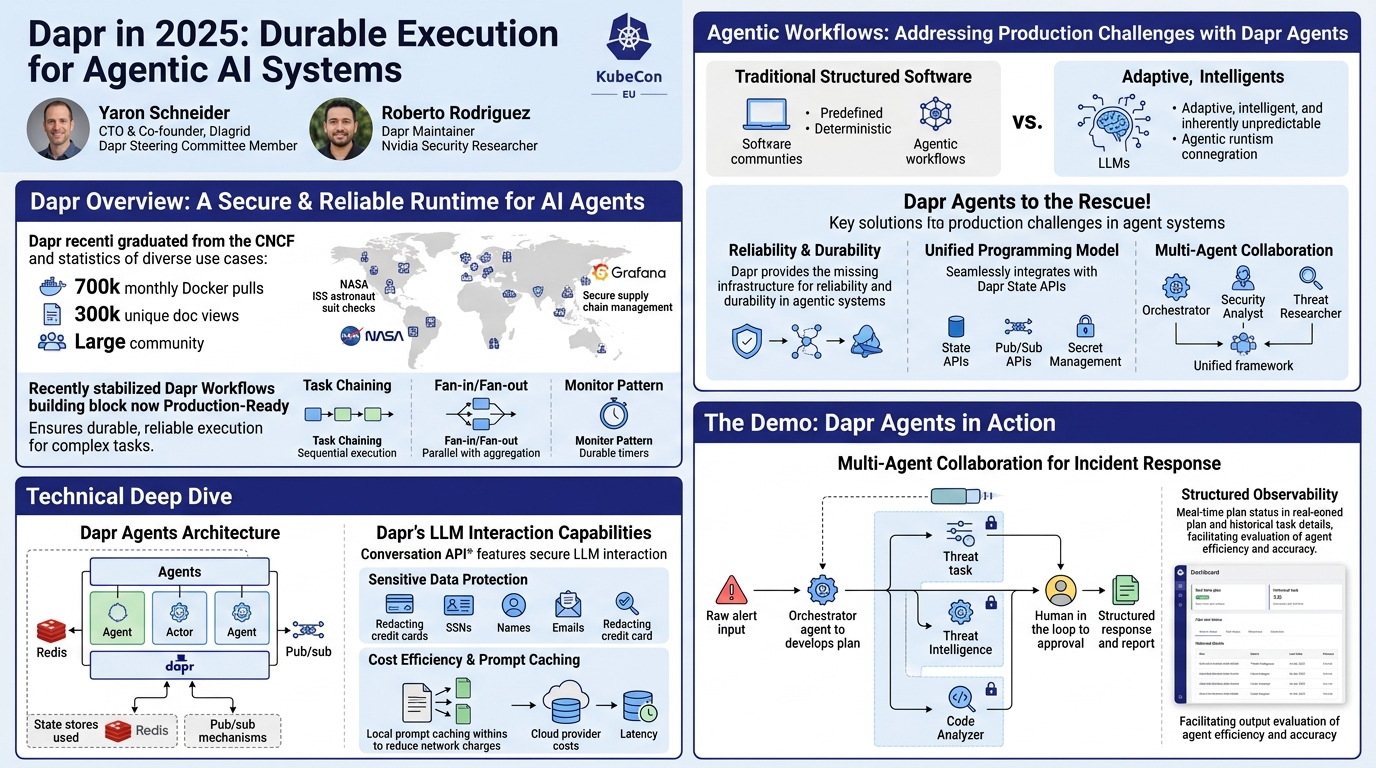
Dapr has undergone significant evolution, culminating in its recent graduation as a CNCF graduated project on November 12, 2024. This milestone underscores its broad adoption and robust community support, positioning it as one of the fastest-growing projects within the CNCF ecosystem. With over 700,000 Docker Hub pulls monthly, 300,000 unique documentation views, and a Discord community exceeding 8,000 members, Dapr's influence is expanding rapidly across diverse industries. Notable use cases include NASA utilizing Dapr on the International Space Station as a message bus for astronaut suit inspection, and Grafana leveraging it for their secure supply chain on AWS.
The project's recent Dapr 1.15 release introduced several pivotal features, particularly in anticipation of the rise of AI workloads. The Conversation API provides developers with a secure and reliable interface for interacting with underlying Large Language Models (LLMs). This API goes beyond simple pass-through, offering crucial enterprise features such as circuit breakers, retries, timeouts, authentication middleware, authorization, and, critically, sensitive data obfuscation. This latter capability automatically redacts personal information like credit card numbers, social security numbers, names, and emails from both user prompts and LLM outputs, addressing significant privacy and compliance concerns. Additionally, the Conversation API includes prompt caching, which stores LLM prompts locally within the Dapr sidecar, dramatically reducing latency, network charges, and cloud provider costs, even for cached responses.
Another cornerstone of Dapr's readiness for AI is the stabilization of its Workflows building block, first introduced in Dapr 1.12. Workflows provide a general-purpose programming model for orchestrating complex distributed systems, offering durable execution guarantees. This means workflows can survive infrastructure failures, pod disruptions, and even complete cluster shutdowns, resuming execution exactly where they left off. Dapr Workflows support various programming languages, including Java, Python, Go, C#, JavaScript, and TypeScript, with PHP support actively under development by the community. They enable patterns like task chaining (sequential execution), fan-in/fan-out (parallel execution and aggregation, with intelligent retries only for failed tasks), the monitor pattern (durable timers for long-running processes, even across years), and external system interaction (pausing workflows to await human or AI agent approval).
However, the advent of AI agents introduces a fundamental shift from traditional software development. Conventional workflows are structured, rule-based, and deterministic, with predefined steps and predictable outcomes. In contrast, agentic workflows are adaptive, intelligent, and inherently unpredictable. They leverage LLMs for reasoning and dynamic decision-making, choosing the next action based on real-time execution state and input data. This autonomy, while powerful, dramatically increases the potential for errors, failures, and security vulnerabilities. Existing AI agent frameworks often excel in demos but lack the production-grade durability, reliability, and security mechanisms required for real-world deployments. This gap—between the unstructured nature of AI agent decision-making and the need for robust, resilient infrastructure—is precisely what the Dapr Agents project aims to bridge.
Key Findings
▶ Watch: Dapr powers NASA's ISS astronaut suit checks (2:06)
The central discovery and contribution presented in this talk is the Dapr Agents project, a novel framework designed to provide a robust, reliable, and secure foundation for building and operating AI agentic systems in production. It directly addresses the inherent challenges of unpredictability, reliability, security, and cost efficiency that arise when deploying autonomous agents.
Key findings and contributions include:
- Durable Foundation for AI Agents: Dapr Workflows, now stable, offer the critical durable execution capabilities necessary for agentic systems. This ensures that even highly dynamic and unpredictable agent workflows can persist through infrastructure failures, picking up exactly where they left off, a feature largely absent in many current AI agent frameworks.
- Unified Programming Model: Dapr Agents provides a unified programming model that seamlessly integrates with existing Dapr APIs and building blocks. This allows developers to leverage Dapr's proven capabilities for state management, pub/sub messaging, secret management, and more, directly within their agent implementations.
- Facilitating Multi-Agent Collaboration: The framework is explicitly designed to support multi-agent collaboration, enabling architectures where specialized agents can work together, each with its own context, tools, and goals. This modular approach enhances reusability, scalability, and resilience compared to monolithic agent designs.
- Built-in Security Mechanisms: Dapr Agents inherits Dapr's robust security features, including authentication, authorization, and encrypted communication between agents. This is crucial for protecting sensitive interactions in distributed agent ecosystems.
- Cost Efficiency and Scalability: Leveraging Dapr's underlying actors model, Dapr Agents can run thousands of agents on a single core. This lightweight, efficient design significantly reduces computational costs and enables massive scalability for complex agentic workloads. Dapr's prompt caching further contributes to cost reduction by minimizing external LLM API calls.
- Flexible Autonomy Models: The framework offers flexibility, allowing developers to choose between fully autonomous agent decision-making and more deterministic, manually defined workflows. Dapr guarantees durability regardless of the chosen autonomy level, ensuring resilience across diverse agent architectures.
- Structured Observability: Dapr Agents provides structured output for agent execution, including plans, task history, and completion status. This is invaluable for validating agent performance, debugging, and assessing the efficiency and accuracy of autonomous operations, particularly in critical domains like cybersecurity.
In essence, Dapr Agents represents a significant step forward in making AI agent systems enterprise-ready by providing the missing infrastructure layer for reliability, security, and operational efficiency, built upon the proven durability of Dapr.
Technical Deep Dive
▶ Watch: Dapr 1.15: Conversation API for secure LLM interaction (3:05)
Dapr's approach to enabling AI agentic systems is deeply rooted in its Workflows building block and the underlying actors model. Workflows provide a durable orchestration layer, allowing developers to define complex sequences of operations that are resilient to failures. Key workflow patterns include:
- Task Chaining: Executing activities sequentially, where the output of one task feeds into the next. Dapr intelligently tracks the state of each activity, ensuring that if a workflow fails, it resumes from the exact point of failure.
- Fan-in/Fan-out: Distributing tasks in parallel (fan-out) and then aggregating their results (fan-in). Dapr's efficiency here is critical for AI workloads, as it only retries individual failed tasks, avoiding reprocessing successfully completed, potentially costly, operations (e.g., LLM calls).
- Monitor Pattern: Creating durable timers or reminders that can pause a workflow for extended periods (even years) and reliably wake up to trigger subsequent actions. This is essential for long-running processes or scheduled agent tasks.
- External System Interaction: Allowing workflows to pause and wait for an external event, such as human approval or a decision from another AI agent. Dapr guarantees that the workflow state persists across these pauses, even through infrastructure outages.
The core concept of an AI agent, as discussed, follows an agentic pattern typically described as a Think-Act-Observe loop. An LLM-powered agent receives a prompt, thinks (reasons and plans) about the desired action, acts by executing chosen tools (e.g., calling functions, interacting with internal/external systems), and then observes the results. This observation is fed back to the LLM, which then decides whether to continue the loop (e.g., pick another tool) or provide a final answer. This iterative, decision-driven process is inherently dynamic and unpredictable, making Dapr's durable workflows a perfect fit.
The talk highlights several evolving agentic patterns:
- Basic Loop: Simple Think-Act-Observe.
- Critique Loop: Adding a self-critique step to refine outputs.
- Planning: Defining initial steps before entering the execution loop.
- Tool Calling: Dynamically selecting the best tool for the job in each iteration.
- Multi-Agent Collaboration: Orchestrating multiple specialized agents, each with its own tools and goals, to achieve a larger objective.
Dapr Agents abstracts these complex workflow and agentic patterns into a unified, developer-friendly framework. A core abstraction is the Task, which serves as a wrapper around a Dapr activity. Developers can define LLM-based tasks using Python functions with docstrings and decorators. Dapr Agents interprets these descriptions as prompts, executing them with the specified LLM provider. This simplifies the creation of AI-driven steps within a durable workflow.
For communication between agents and for maintaining shared context, Dapr Agents extensively utilizes Dapr's existing building blocks:
- Pub/Sub APIs: Agents communicate asynchronously using Dapr's pub/sub APIs, which can leverage standards like CloudEvents for rich metadata exchange. This allows for flexible, decoupled communication between different agent components or even different agents in a multi-agent system.
- State APIs: The state of individual agents and the overall workflow plan are durably stored using Dapr's state APIs. This allows for persistent storage in various backends (e.g., Redis, as shown in the demo), ensuring that agent memory and progress survive failures.
- Dapr Actors: Dapr Agents are built on top of Dapr's actors model. Actors are lightweight, single-threaded, and isolated units of computation and state. Dapr can manage millions of these actors across a small Kubernetes cluster, providing the extreme scalability and isolation necessary for running thousands of individual agents efficiently. This also contributes to the framework's ability to encapsulate agent logic and state effectively.
The architecture promotes modularity, allowing core components like state stores to be swapped easily without altering agent logic. This flexibility is crucial for adapting to different environments and requirements. The framework supports distinct agent roles, such as an orchestrator agent responsible for overall planning and task distribution, and specialized assistant agents (e.g., a "threat intelligence analyst" agent or a "reverse engineer" agent in a security context) that perform specific tasks using their defined toolsets. This microservices-like approach to agents, enabled by Dapr, mitigates the single point of failure problem inherent in monolithic agent designs.
Demo / Proof of Concept
▶ Watch: Dapr Workflows are now stable and production-ready (4:30)
Roberto Rodriguez presented a compelling demo showcasing the Dapr Agents framework in action, utilizing a multi-agent collaboration pattern with a relatable scenario: "taking the Ring to Mordor" from Lord of the Rings.
The setup involved:
- An Orchestrator Agent: Responsible for receiving the main task, generating an overall plan, distributing sub-tasks, and deciding the next steps.
- Multiple Assistant Agents: Represented by Lord of the Rings characters like Gandalf (wizard agent), Frodo (hobbit agent), and Legolas. Each assistant agent has a specific role, goal, and set of tools.
The demo flow illustrated how this multi-agent system operates:
- The orchestrator receives the main task (e.g., "Take the ring to Mordor").
- It generates an initial plan, potentially breaking it down into sub-steps.
- The orchestrator then sends parts of this plan or specific tasks to the relevant assistant agents.
- Assistant agents receive messages, consult their internal state (history), execute their specific tasks (which might involve using their tools, potentially in parallel via Dapr Workflow's fan-out/fan-in), and then send responses back to the orchestrator.
- The orchestrator, upon receiving responses, updates its global state and plan. Using the Dapr Workflow's continue as new API for iterative loops, it decides whether to continue the workflow by assigning new tasks, or if the overall goal is achieved, respond back to the user. This iterative decision-making is driven by the LLM behind the orchestrator, which assesses the current progress and plan.
During the demo, the agents were deployed locally using Dapr YAML files (dapper run -f dapper-llm.yaml) and leveraged local Docker containers for Redis (for state management) and Zipkin (for observability). The communication between agents was handled via Dapr's pub/sub mechanism, with a "beacon channel" where all agents listen for broadcasts, ensuring everyone is aware of the current state and available participants.
A key highlight of the demo was the real-time, structured output generated by the agents. A dedicated file tracked the evolving plan, sub-tasks, and task history, including which agent was assigned which task and its completion status. This output, generated by the LLM's reasoning, provided a clear audit trail of the agent's decision-making process. Roberto noted an interesting observation: some sub-tasks were marked as "completed" by the model even without a specific agent executing them, because the model assessed that based on other agents' actions, those sub-tasks were implicitly fulfilled. This demonstrated the dynamic and sometimes unpredictable nature of autonomous agents, and the importance of Dapr's robust infrastructure to manage such scenarios.
The structured report at the end serves a critical purpose, particularly in security operations. It allows analysts to validate how closely the agent's actions and report align with what a human security analyst would do, enabling evaluation of the agent's efficiency and accuracy for specific tasks. The demo effectively illustrated how Dapr Agents provides the necessary durability, communication, and state management for complex, multi-agent AI systems, transforming abstract concepts into tangible, observable execution.
Defensive Implications
▶ Watch: Workflows simplify complex distributed task chaining (5:50)
The Dapr Agents project, built on Dapr's robust foundation, offers significant defensive implications for organizations looking to integrate AI agents into their operations, particularly in security.
- Enhanced Reliability and Resilience for Critical AI Workloads: The core promise of Dapr Workflows—durable execution—is a game-changer for AI agents. In security operations, an agent investigating an alert or responding to an incident cannot afford to fail mid-process due to infrastructure instability. Dapr guarantees that even if a pod crashes, a node goes down, or the underlying database experiences an outage, the agent's workflow will resume precisely from where it left off. This resilience is paramount for maintaining continuous security monitoring and response capabilities, preventing missed alerts or incomplete investigations due to system failures.
- Built-in Security for Inter-Agent Communication: As multi-agent systems become prevalent, securing communication between autonomous entities is critical. Dapr Agents leverages Dapr's native capabilities for authentication, authorization, and encrypted communication. This means that specialized agents (e.g., a "threat intelligence" agent collaborating with an "incident response" agent) can communicate securely without developers having to implement complex security protocols from scratch. This reduces the attack surface and ensures that sensitive information exchanged between agents remains protected, preventing unauthorized access or data leakage within the agent ecosystem.
- Sensitive Data Protection and Compliance: The Conversation API in Dapr 1.15 introduces sensitive data obfuscation, a vital feature for protecting privacy and ensuring compliance. AI agents often process a wide range of data, including potentially sensitive user inputs (prompts) or outputs from LLMs. Dapr can automatically identify and redact personally identifiable information (PII), credit card numbers, social security numbers, and other sensitive data from both prompts sent to LLMs and responses received from them. This significantly mitigates the risk of sensitive data exposure and helps organizations meet regulatory requirements like GDPR, HIPAA, or CCPA.
- Cost Efficiency in LLM Interactions: The prompt caching feature within Dapr's Conversation API directly addresses the financial overhead of frequent LLM API calls. By caching prompts locally within the Dapr sidecar, organizations can drastically reduce network charges and the per-token costs associated with external LLM providers. Even if an LLM provider has its own cache, Dapr's local cache eliminates network egress costs and often provides a faster, more cost-effective solution, allowing security teams to run more analyses or queries without incurring prohibitive expenses.
- Scalability and Resource Optimization: Dapr's underlying actors model allows Dapr Agents to run thousands of lightweight agents on a minimal Kubernetes cluster (e.g., a single core can host thousands of agents). This efficient resource utilization is critical for scaling security operations, enabling the deployment of numerous specialized agents to monitor different systems or handle various types of alerts without overwhelming infrastructure resources. The modular multi-agent architecture also prevents a single agent's failure from impacting the entire security operation, enhancing overall system robustness.
- Enhanced Observability and Auditing: Dapr's integration with observability tools like Zipkin (demonstrated in the talk) provides invaluable insights into the execution paths of complex agentic workflows. For security incident response, understanding how an agent arrived at a particular conclusion or which tools it used is crucial for auditing and validation. The structured output generated by Dapr Agents, detailing the plan, task history, and completion status, serves as an auditable record of the agent's autonomous actions, aiding in post-incident analysis and compliance reporting.
- Mitigation of Unpredictability: While AI agents are inherently unpredictable, Dapr provides the necessary guardrails. By providing a durable execution environment and robust error handling, Dapr reduces the operational risks associated with agent autonomy. Developers can focus on refining agent logic and decision-making, confident that the underlying infrastructure will ensure reliability even in the face of unexpected agent behavior or external system failures.
In summary, Dapr Agents empowers security teams to safely and effectively leverage the power of AI agents by providing an enterprise-grade platform that prioritizes reliability, security, cost efficiency, and observability—all critical elements for defending modern digital environments.
Key Takeaways
- Dapr's Maturity and Durability: Dapr has achieved CNCF graduated status and its Workflows building block is now stable, providing robust, durable execution for complex distributed systems, essential for the reliability of AI agents.
- Addressing AI Agent Production Challenges: The Dapr Agents project offers a specialized framework built on Dapr Workflows to tackle the critical challenges of reliability, security, and cost efficiency inherent in deploying autonomous AI agents in production.
- Secure and Cost-Efficient LLM Interactions: Dapr's Conversation API includes vital features like sensitive data obfuscation for privacy compliance and local prompt caching to significantly reduce latency, network charges, and LLM API costs.
- Scalable Multi-Agent Architectures: Dapr Agents facilitates multi-agent collaboration and leverages Dapr's underlying actor model, enabling the efficient deployment of thousands of agents on minimal infrastructure, promoting modularity and resilience over monolithic designs.
- Flexible Autonomy with Durability Guarantees: Developers can choose between fully autonomous agent behaviors and more structured, manually defined workflows, with Dapr guaranteeing durable execution and state persistence across all configurations.
- Enhanced Observability and Validation: The framework provides structured output and integrates with observability tools, offering critical insights into agent planning and execution history, which is invaluable for debugging, auditing, and validating agent performance in real-world scenarios.
About the Speaker(s)
Yaron Schneider is a core maintainer of the Dapr project and a Steering Committee member. He also holds the position of CTO and co-founder at Diagrid, a company focused on building and operating distributed applications with Dapr. His extensive experience in distributed systems and open-source contributions are foundational to Dapr's development.
Roberto Rodriguez is a new Dapr maintainer and the creator of the Dapr Agents project. He is also part of the Nvidia team, where he applies his expertise as a security researcher to enable autonomy and AI agents in security operations, particularly for defending Nvidia's products. His work directly contributed to the Dapr Agents framework, bridging the gap between AI agent capabilities and production-grade infrastructure.
Reviews
Dr. Zero (Offensive Security Researcher) — MUST SEE
Schneider and Rodriguez deliver a critical and timely deep-dive into Dapr's evolution, specifically the new Dapr Agents project. This isn't just another 'AI-powered' marketing slide deck; it's a foundational technical blueprint for building production-grade, durable, and secure autonomous AI agent systems. The talk brilliantly bridges the gap between the unpredictable nature of agentic workflows and the enterprise-grade reliability required for real-world deployment, addressing core challenges in a field currently rife with experimental proofs-of-concept lacking operational rigor. From durable execution via Dapr Workflows to critical security features like sensitive data obfuscation in the…
Heather Calloway (CISO) — STRONG ACCEPT
This talk presents Dapr Agents as a critical infrastructure layer for deploying production-grade AI agent systems, directly addressing core CISO concerns around reliability, security, and cost. By leveraging Dapr's durable workflows, sensitive data obfuscation, and prompt caching, the framework provides a robust foundation for managing the inherent unpredictability and operational risks of autonomous AI, offering clear pathways for secure and compliant institutional adoption.