Triangle of Pain
Frank Victory (President · Denver OWASP)
RTV Overflow 2026 (Red Team Village) · Day 1 · Main Stream
Overview
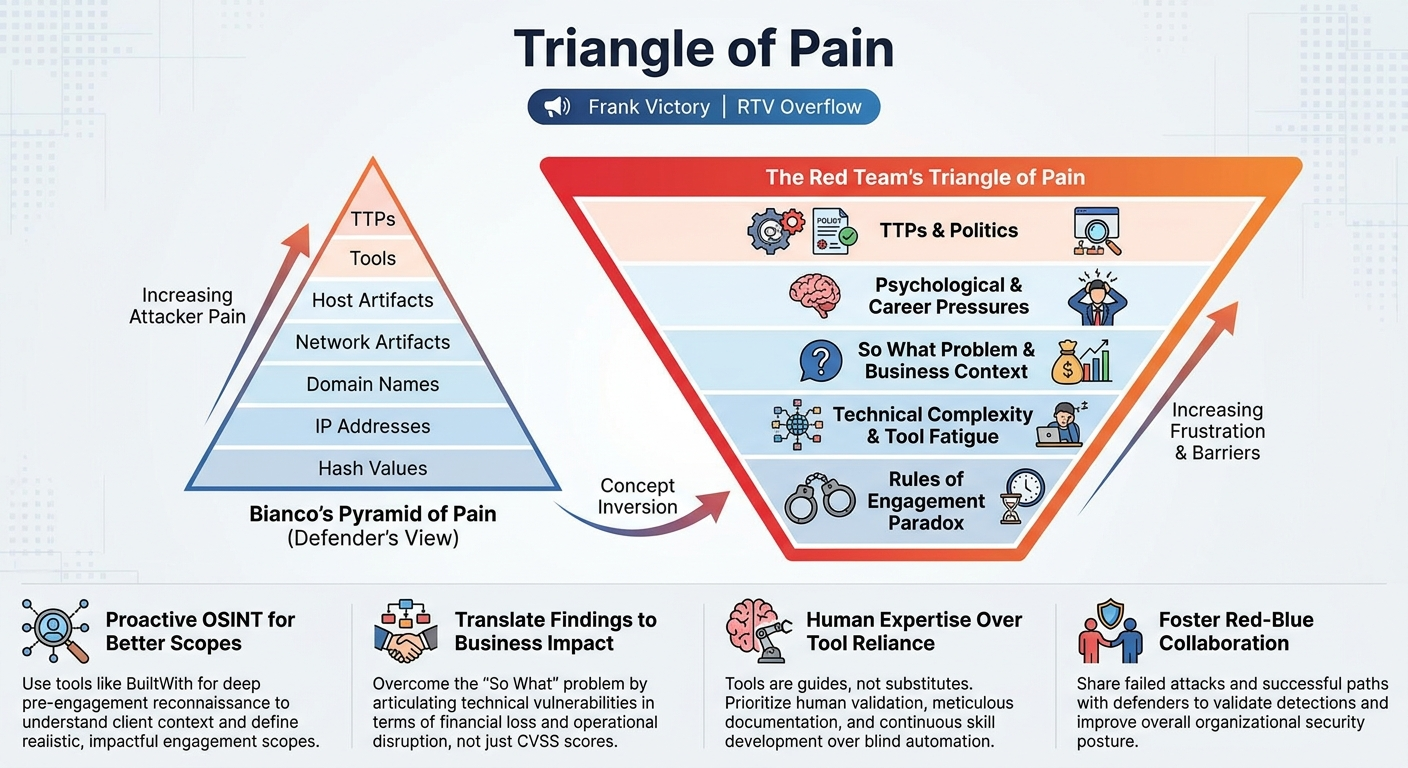
In his RTV Overflow talk, "Triangle of Pain," Frank Victory, President of the Denver OWASP chapter, presents a compelling re-evaluation of offensive security strategies, particularly for red teams operating within corporate environments. Building upon David Bianco's foundational "Pyramid of Pain," which focuses on how defenders can inflict pain upon attackers, Victory ingeniously inverts this concept. His "Triangle of Pain" illuminates the multifaceted challenges and frustrations experienced by offensive security professionals themselves, stemming from the very nature of their engagements, the tools they use, and the organizational dynamics they navigate.
Key moments
- 4:00 Introducing the Red Team's "Triangle of Pain"
- 7:50 Overcoming limited scope: understanding business goals
- 10:00 Leveraging OSINT (BuiltWith demo) for attack planning
- 21:00 Tools guide, human expertise validates: continuous learning
- 32:00 The "So What" dilemma: business context for findings
- 46:00 Quantifying business disruption and validating findings
- 51:00 Q&A: Dealing with client disagreement on findings
Triangle of Pain
Speakers: Frank Victory, President, Denver OWASP
Conference: RTV Overflow
YouTube: https://www.youtube.com/watch?v=OlHiFnpjtYk
Overview
In his RTV Overflow talk, "Triangle of Pain," Frank Victory, President of the Denver OWASP chapter, presents a compelling re-evaluation of offensive security strategies, particularly for red teams operating within corporate environments. Building upon David Bianco's foundational "Pyramid of Pain," which focuses on how defenders can inflict pain upon attackers, Victory ingeniously inverts this concept. His "Triangle of Pain" illuminates the multifaceted challenges and frustrations experienced by offensive security professionals themselves, stemming from the very nature of their engagements, the tools they use, and the organizational dynamics they navigate.
Victory’s presentation argues that while red team operations aim to expose weaknesses and validate defenses, their effectiveness is often hampered by operational limits, misaligned business goals, and a pervasive lack of understanding from the client side. He delves into the paradoxes of limited engagement scopes, the complexities of tool selection and fatigue, the critical "so what" problem of findings without business context, and the psychological pressures faced by practitioners. The core message is a call to action for offensive security teams to transcend mere technical execution, advocating for a more empathetic, business-aligned, and continuously improving approach to maximize their value and achieve true security outcomes.
This talk is crucial for anyone involved in offensive or defensive security, offering a fresh perspective on how to bridge the gap between technical findings and strategic impact. It challenges traditional mindsets, pushing for a holistic understanding of the client's business, proactive reconnaissance, and a commitment to demonstrating tangible value. By addressing the "pain" felt by red teams, Victory provides actionable insights for improving engagement quality, fostering better collaboration, and ultimately elevating the role of offensive security within the broader organizational security posture.
Background
▶ Watch: Introducing the Red Team's "Triangle of Pain" (4:00)
The genesis of Frank Victory's "Triangle of Pain" lies in a reinterpretation of David Bianco's widely recognized Pyramid of Pain. Bianco's model, developed from a defender's perspective, illustrates that the more an attacker's indicators of compromise (IOCs) move up the pyramid—from simple IP addresses to network artifacts, host artifacts, tools, and ultimately their tactics, techniques, and procedures (TTPs)—the more "pain" defenders can inflict upon them. Identifying and defending against TTPs, for instance, forces attackers to expend significant effort to change their methods, causing them the most pain.
Victory, however, shifts the focus from the attacker's pain to the pain experienced by offensive security professionals, particularly in the context of corporate America. He observes that despite the clear objective of offensive security—to expose technical vulnerabilities and validate defenses—the reality is often fraught with operational limits and frustrations. Companies are frequently compromised, as evidenced by data breaches cataloged on sites like informationisbeautiful.net, yet the efficacy of red team engagements in preventing these breaches remains a persistent challenge.
This problem exists due to several interconnected factors. First, traditional penetration testing often operates under rules of engagement that severely limit scope and time, preventing truly realistic adversarial simulations. Second, the sheer volume and complexity of security tools lead to tool fatigue, where the focus shifts from human expertise to scanner output. Third, a significant disconnect exists between technical findings and their business context, leading to the "so what" problem where critical vulnerabilities are deprioritized or ignored. Compounding these issues are the psychological and career pressures on offensive teams, who face blame, political risks, and the temptation to under-report true gaps. Finally, even when TTPs are identified, the challenge often lies in translating these into actionable policy changes and ensuring remediation. Victory's "Triangle of Pain" aims to address these underlying issues, providing a framework for offensive teams to overcome these barriers and deliver more impactful security outcomes.
Key Findings
▶ Watch: Leveraging OSINT (BuiltWith demo) for attack planning (10:00)
Frank Victory's "Triangle of Pain" identifies several critical areas where offensive security teams, particularly red teams, experience significant challenges and where improvements can lead to more impactful outcomes.
At the base of the "Triangle of Pain" lies the Rules of Engagement Paradox. Offensive security teams are frequently constrained by limited scopes and unrealistic timelines (e.g., testing "a thousand servers in three days"). This prevents comprehensive and realistic testing, leading to a superficial understanding of an organization's true security posture. Victory emphasizes that effective testing requires a deep understanding of the client's business goals, recognizing that security is often a cost center, not the primary product.
Moving up, Technical Complexities and Tool Fatigue represent another layer of pain. The traditional "scan, exploit, repeat" cycle can lead to burnout and a reliance on automated tools without sufficient human validation. Victory stresses that while tools are essential, they should "only show you where to look," not replace human expertise, validation, and thorough documentation with screenshots. He advocates for proactive tool preparation and continuous skill development, aligning offensive efforts with common attack vectors found in reports like the Verizon DBIR.
The "So What Problem" emerges as a significant source of pain, highlighting the disconnect between technical findings and their business impact. Reports often lack the context necessary for business leaders to understand the true risk. Victory stresses the need for empathy towards defenders and the importance of translating technical vulnerabilities into tangible business consequences, such as financial losses per minute of outage. This section also addresses remediation deprioritization, where critical vulnerabilities remain unaddressed year after year, citing the Equifax Struts vulnerability as a classic example.
Above this are Psychological and Career Pressures. Offensive security professionals often face blame for system disruptions, political risks, and the temptation to avoid aggressive testing that might expose uncomfortable truths or damage career prospects. Victory calls for clear escalation channels, recognition for validated findings, and a focus on not just finding vulnerabilities but also demonstrating how to defend against them.
Finally, at the apex, are TTPs (Tactics, Techniques, and Politics). This refers not just to attacker TTPs, but the organizational "politics" that impede effective security. Challenges include policy change resistance, the failure to address basic security hygiene, and the lack of metrics for disruption. Victory argues that offensive teams must "seize the day" by engaging stakeholders, presenting findings with business metrics, and even making the absence of such metrics a formal finding. He also highlights the critical need for validated findings, not just Nessus scans, and the importance of engaging with blue teams to verify detection capabilities.
Collectively, these findings underscore that effective offensive security transcends technical prowess; it requires strategic business alignment, continuous personal development, and a proactive, empathetic approach to engagement and reporting.
Technical Deep Dive
▶ Watch: Tools guide, human expertise validates: continuous learning (21:00)
The technical core of Frank Victory's talk revolves around empowering offensive security professionals to overcome the "Triangle of Pain" through strategic use of reconnaissance, adaptive methodologies, and contextualized reporting.
Victory first addresses the Rules of Engagement Paradox by advocating for a comprehensive OSINT (Open-Source Intelligence) profile before an engagement begins. This proactive approach helps offensive teams understand the client's infrastructure and business context, allowing them to push for more realistic and impactful engagement scopes. He demonstrates the utility of tools like Shodan and Recon-ng, but highlights BuiltWith (builtwith.com) as a powerful, often underutilized resource. Using owasp.org and tesla.com as examples, he shows how BuiltWith can reveal:
- Technical results: Underlying technologies and versions.
- Associations: Connected services like Fastly, Sessionize, Salesforce, Akamai, and Google Optimize.
- Metadata: IP addresses and other static data.
- Performance metrics: How website performance is affected, providing a crucial business context, especially for retail sites where downtime or slowdowns directly impact revenue.
- Relationships and Redirections: Identifying where data flows, such as through 301 HTTP response codes, which can expose unknown third-party data handlers.
This OSINT allows testers to go into engagements "armed with this information," potentially influencing the scope to focus on actual risks rather than arbitrary limitations.
To combat Technical Complexity and Tool Fatigue, Victory emphasizes that "modern red teaming is not about just bypassing EDR, finding their open ports, beating up those credential portals." Instead, it's about "engineering adaptive adversary simulation platforms under the legal, telemetry, and cloud restraints." He stresses that tools, whether commercial scanners or advanced frameworks like Metasploit, should only "show you where to look." The true value comes from human expertise, validation, and meticulous documentation, including screenshots. He highlights the OWASP Top 10 (2025 list) as a baseline, focusing on critical vulnerabilities like broken access control and security misconfigurations.
Victory provides a simple demonstration of a Python script (version ~0.7) for testing broken access control. This script brute-forces "default URLs" to identify potential unauthorized access points, such as those indicating "thunder authorization." This example reinforces the idea that even basic, custom scripts, when combined with human analysis, can pinpoint areas for deeper investigation.
He then connects these offensive techniques to defensive frameworks. While acknowledging MITRE ATT&CK's value, Victory points out that its primary focus is often on mitigations and detections. He advocates using ATT&CK to understand how defenses are supposed to work, enabling red teams to craft more sophisticated and evasive attacks. He introduces MITRE FIGHT (fight.mitre.org), a complementary framework that expands beyond traditional attack techniques to include concepts like Exfiltration, Impact, and Fraud (TA5001 - Obtain service without contractually paying for it). This encourages red teams to think beyond technical exploits and simulate broader business impacts.
For practical execution, Victory recommends HatTricks (hat-tricks.xyz). This platform provides detailed, line-by-line enumerations and commands for various attack scenarios (e.g., attacking POP email services in a local environment). While HatTricks shows "what to type," Victory notes its drawback is not explaining "why." This is where the synergy with MITRE comes in: HatTricks provides the "how," and MITRE provides the "why" and the context of detection and mitigation.
Finally, to address the challenge of tools changing per engagement, Victory strongly advocates for a 30-60-90 day plan for personal and team development. This plan involves baselining scripts, rehearsing common attacks, and continuously refining toolsets. He encourages practitioners, from students to seasoned professionals, to repeatedly practice labs (e.g., on TryHackMe), first with cheats, then with notes, and finally from memory, matching techniques to MITRE and understanding the purpose of each step. This disciplined approach ensures readiness and reduces "day one" setup time, allowing offensive teams to focus on adaptive adversary simulation rather than tool configuration.
Demo / Proof of Concept
▶ Watch: Quantifying business disruption and validating findings (46:00)
Frank Victory's talk incorporated practical demonstrations to illustrate the concepts of proactive reconnaissance and basic vulnerability identification, underscoring the importance of going beyond standard scanning.
The primary demonstration involved BuiltWith (builtwith.com), a powerful OSINT tool. Victory showcased its capabilities by analyzing two distinct websites:
- owasp.org: As the president of the Denver OWASP chapter, he used his own organization's site to demonstrate how BuiltWith quickly reveals the underlying technologies, including web servers, programming languages, content management systems, and associated services like Fastly and Sessionize. He highlighted how this information helps build a comprehensive technical profile, including metadata like IP addresses and insights into website performance. For OWASP, which doesn't sell products, performance metrics might seem less critical, but Victory used this to pivot to the potential impact on retail sites where performance directly equates to revenue.
- tesla.com: Chosen because of its presence on bug bounty lists, Tesla's website demonstrated BuiltWith's ability to identify connections to major third-party services such as Salesforce, Akamai, and Google Optimize. Victory explained that this data is invaluable for planning attack paths, as these interconnected services often present new vectors and expand the attack surface beyond the primary domain. The demo visually illustrated how to map out an organization's digital footprint without ever directly interacting with their systems, thus staying within legal boundaries for initial reconnaissance.
Beyond BuiltWith, Victory briefly demonstrated a simple, custom-developed Python script designed to test for broken access control. This script, described as a "0.7 version," performs a brute-force attack against "default URLs" to identify potentially unauthorized access points. While acknowledging it's a "low intrusion" method, the demo showed how it could detect "thunder authorization" issues, indicating where a more focused, human-driven investigation should begin. This served as a proof of concept for the idea that even basic automation, guided by human expertise, can effectively pinpoint critical vulnerabilities that might be missed by generic scanners.
These demonstrations collectively reinforced Victory's core message: effective offensive security requires proactive, intelligent reconnaissance to inform engagement scope, and a combination of specialized tools with human validation to identify and contextualize vulnerabilities. They showcased how red teams can gather significant intelligence and pinpoint weaknesses before even touching the target environment, thereby enhancing the value and realism of their engagements.
Defensive Implications
▶ Watch: Q&A: Dealing with client disagreement on findings (51:00)
Frank Victory's "Triangle of Pain" offers profound implications for defensive security teams, urging them to understand the offensive mindset and proactively address the pain points that hinder effective red teaming. By grasping these challenges, defenders can better prepare, collaborate, and ultimately strengthen their security posture.
Firstly, defenders must recognize the limitations of traditional penetration tests and push for more realistic and comprehensive engagements. This means moving beyond arbitrarily limited scopes and short timelines. Blue teams should actively engage with red teams to ensure the rules of engagement reflect genuine business risks and critical assets, rather than just superficial compliance checks. Leveraging OSINT tools like BuiltWith internally can help defenders map their own attack surface, identify third-party dependencies (e.g., Fastly, Salesforce), and understand potential vectors that even they might not be aware of.
Secondly, the "So What Problem" is a critical defensive concern. When receiving penetration test reports, blue teams should demand business context for every finding. Instead of just technical vulnerability IDs (Qualys QIDs), reports should articulate the potential impact on business operations, revenue (e.g., "$632 per minute of outage" for a travel company), and customer trust. If a report fails to provide this, defenders should challenge it. This empowers blue teams to effectively communicate risk to management and secure the resources needed for remediation, preventing the perennial issue of remediation deprioritization (as exemplified by the Equifax Struts vulnerability).
Thirdly, defenders need to shift their perspective on reporting. Victory suggests that reports should include failed attack attempts, not just successful ones. This provides invaluable feedback to blue teams, demonstrating where their defenses are working correctly and allowing them to show value to their higher-ups. Defenders should actively ask their red team counterparts, "Show me what Splunk showed. Did you even detect me?" This collaborative approach helps validate detection capabilities, tune SIEM alerts, and improve incident response playbooks.
Fourthly, the "human element" in breaches often stems from management failures, not just staff errors. Defenders should use red team findings to highlight systemic issues and advocate for necessary policy changes and resource allocation. By quantifying risk in business terms, blue teams can better influence decision-makers.
Finally, defenders must prioritize validation of findings. A report consisting solely of a Nessus scan without proof of concept or screenshots should be met with skepticism. Blue teams should require reproducible steps and evidence (e.g., screenshots, logs) for every critical finding. This ensures the findings are legitimate and reduces the "noise" of false positives or low-impact vulnerabilities, allowing defenders to focus their efforts on actual threats to their "crown jewels" or critical assets. Comparing current reports against previous years' findings can also reveal trends in remediation effectiveness or persistent vulnerabilities, providing a valuable metric for security program maturity.
In essence, Victory's talk encourages a more symbiotic relationship between red and blue teams, where offensive insights directly inform defensive strategy, leading to a more robust and business-aligned security posture.
Key Takeaways
- Elevate Offensive Security Beyond Technical Exploits: Red teams must move beyond simply finding vulnerabilities to understanding and articulating the business impact of their findings. This involves comprehensive OSINT and contextualizing technical risks for non-technical stakeholders.
- Proactive OSINT is Foundational: Utilize tools like BuiltWith, Shodan, and Recon-ng for extensive pre-engagement reconnaissance. This allows for a deeper understanding of the target's attack surface, third-party dependencies, and business context, enabling more realistic and impactful engagement scopes.
- Human Expertise and Validation Trump Tool Reliance: Automated tools are guides, not substitutes for human skill. Red teamers must validate findings with screenshots and reproducible steps, ensuring that every reported vulnerability is real and actionable. Continuous personal development, including a 30-60-90 day plan, is crucial for mastering tools and techniques.
- Business Context Drives Remediation: Translate technical vulnerabilities into tangible business consequences (e.g., financial loss per minute of outage). This is essential for overcoming the "so what" problem and ensuring that findings are prioritized and remediated by management.
- Foster Red-Blue Team Collaboration: Encourage open communication with blue teams, sharing not only successful attack paths but also failed attempts to help validate and improve defensive capabilities. Ask "What did Splunk show?" to ensure detections are effective.
- Address Psychological and Organizational Pressures: Recognize and mitigate the career and political risks associated with aggressive testing. Advocate for clear escalation channels and ensure that validated findings, and the efforts to remediate them, receive due recognition within the organization.
About the Speaker(s)
Frank Victory is a prominent figure in the cybersecurity community, known for his leadership and expertise in offensive security. He currently serves as the President of the Denver OWASP chapter, a testament to his commitment to open-source web application security. Beyond his leadership roles, Frank is a dedicated educator, holding positions as a lead instructor for various programs at different universities, where he shares his practical knowledge and passion for cybersecurity with the next generation of professionals.
His extensive background includes hands-on experience as a penetration tester, notably having run a web application penetration team at Anthem for over three years. This offensive experience is complemented by his time on the defensive side, where he served as a Director of Vulnerability Management, giving him a unique, holistic perspective on the challenges faced by both red and blue teams. Frank is also the host of the podcast "Colorado = Security" and is involved in organizing cybersecurity events, including the upcoming SnowFROC conference in Denver. His GitHub handle is frank-victory, where he shares some of his tools and scripts. He is a strong advocate for continuous learning, personal development, and fostering a collaborative, empathetic approach within the security industry.
Reviews
Dr. Zero (Offensive Security Researcher) — WEAK
Frank Victory rebrands standard pentest consulting gripes into a "Triangle of Pain," but forgets to bring any actual research to the stage. If your idea of "modern red teaming" peaks with a BuiltWith demo and a Python script that brute-forces default URLs, you aren't doing adversary simulation. This is an entry-level advisory talk for junior consultants, not a serious conference presentation.
Heather Calloway (CISO) — MUST SEE
Frank Victory diagnoses exactly why organizations spend hundreds of thousands of dollars on penetration testing only to end up with a PDF full of unactionable CVSS scores. He pivots the conversation from technical exploitation to the structural limits of red teaming—specifically restrictive rules of engagement and the failure to translate findings into business risk. It is a necessary watch for anyone managing a security testing budget or leading a vulnerability management program.