Adversary Intel Lab: Build Your First Threat Emulation Plan
Fredrik Sandstrom (Head of Cyber Security Consultant · Basalt AB)
RTV Overflow 2026 (Red Team Village) · Day 1 · Main Stream
Overview
In his compelling RTV Overflow presentation, Fredrik Sandstrom, Head of Cyber Security Consultant at Basalt AB, guides attendees through the crucial process of building an Adversary Emulation Plan. This talk serves as a practical blueprint for organizations seeking to elevate their security posture beyond traditional penetration testing, offering a structured, intelligence-driven approach to understanding and defending against sophisticated threats. Sandstrom shares his personal journey into this specialized field, born from Basalt AB's transition to product security for significant government clients, which introduced a new landscape of advanced state actors.
Key moments
- 4:00 Defining Adversary Emulation and its Benefits
- 14:00 Understanding TTPs and the Pyramid of Pain
- 19:30 Using MITRE ATT&CK Navigator to analyze threats
- 31:00 Comparing Threat Actors using ATT&CK Navigator layers
- 41:00 The Holy Trifecta of a Threat: Opportunity, Intent, Capability
- 46:00 Caldera: Open-source tool for running emulation campaigns
- 52:00 Key Characteristics of a Good Emulation Plan
- 53:00 Q&A and Resources for Learning More
Adversary Intel Lab: Build Your First Threat Emulation Plan
Speakers: Fredrik Sandstrom, Head of Cyber Security Consultant, Basalt AB
Conference: RTV Overflow
YouTube: https://www.youtube.com/watch?v=KfuOPqwAV64
Overview
In his compelling RTV Overflow presentation, Fredrik Sandstrom, Head of Cyber Security Consultant at Basalt AB, guides attendees through the crucial process of building an Adversary Emulation Plan. This talk serves as a practical blueprint for organizations seeking to elevate their security posture beyond traditional penetration testing, offering a structured, intelligence-driven approach to understanding and defending against sophisticated threats. Sandstrom shares his personal journey into this specialized field, born from Basalt AB's transition to product security for significant government clients, which introduced a new landscape of advanced state actors.
The presentation is thoughtfully divided into two core parts: an exploration of the fundamental terminology and systematic steps involved in threat emulation, followed by a practical field study culminating in a demonstration of tools and techniques. Sandstrom underscores the critical shift from reactive "cowboy" pen testing to proactive, planned assessments based on specific threat intelligence. This methodology is particularly pertinent for organizations with a degree of security maturity—those that have established blue teams, SOCs, SIEMs, and engage in purple teaming—as it allows for continuous validation of defenses against real-world adversary tactics, techniques, and procedures (TTPs).
The ultimate goal of adversary emulation, as articulated by Sandstrom, is to enable organizations to test their resilience against documented attacks before they occur in the wild. This proactive stance helps counter the often-misguided belief that a company is "hack-proof" after conventional pen tests or the acquisition of new security solutions like XDRs and EDRs. By meticulously emulating known threat actor behaviors, organizations can identify gaps, refine their defenses, and ensure their security controls are truly effective against the most relevant threats.
Background
▶ Watch: Defining Adversary Emulation and its Benefits (4:00)
Sandstrom's deep dive into adversary emulation was a direct response to a significant shift in his professional landscape. After a decade in offensive security, primarily focused on traditional penetration testing, his role at Basalt AB evolved. The company transitioned from general security consulting to developing security products for high-profile government clients. This pivot introduced a new and formidable class of adversaries: advanced state actors. The stakes were higher, and the need to understand and defend against highly resourced, patient, and skilled attackers became paramount. Traditional "shoot-from-the-hip" pen testing, while valuable, proved insufficient for addressing these sophisticated, targeted threats.
The core problem, Sandstrom explains, is that in a world of hundreds of potential adversaries, organizations need a method to filter out what is truly relevant to test. Adversary emulation provides this focus by breaking down known attacks into their constituent steps and meticulously recreating them. Unlike general penetration tests that aim to find any vulnerability, emulation targets specific threat actors, using their documented TTPs to validate defenses. This approach moves beyond simply identifying vulnerabilities to assessing an organization's ability to detect, prevent, and respond to the specific behaviors of its most probable attackers.
Sandstrom emphasizes that adversary emulation is not a starting point for every organization. It requires a certain level of security maturity. Companies must first establish foundational security controls, understand their assets, conduct regular security scanning, and have operational blue teams, SOCs, and SIEMs. Only after reaching this stage, often signified by engaging in purple team exercises, does an organization gain the necessary context and infrastructure to effectively leverage emulation. As he quotes Sun Tzu, "If you know your enemy and know yourself, you need not to fear the results of 100 battles." However, the challenge in cybersecurity is often not knowing the enemy, which emulation seeks to address.
A critical aspect of this methodology is the shared language of TTPs (Tactics, Techniques, and Procedures). Sandstrom highlights the common disconnect between red teamers (e.g., "initial access by spear phishing, Trojan PDF for C2") and blue teamers (e.g., "email anomalies, PDF warning, weird DNS traffic"). TTPs, particularly as formalized by frameworks like MITRE ATT&CK, bridge this communication gap, allowing both sides to discuss attacks using a common, granular vocabulary. This focus on TTPs is strategic, aligning with David Bianco's Pyramid of Pain, which posits that TTPs are the most difficult indicators for adversaries to change, making them highly valuable for detection and defense.
Key Findings
▶ Watch: Using MITRE ATT&CK Navigator to analyze threats (19:30)
Fredrik Sandstrom's talk elucidates several key findings and principles for effective threat emulation:
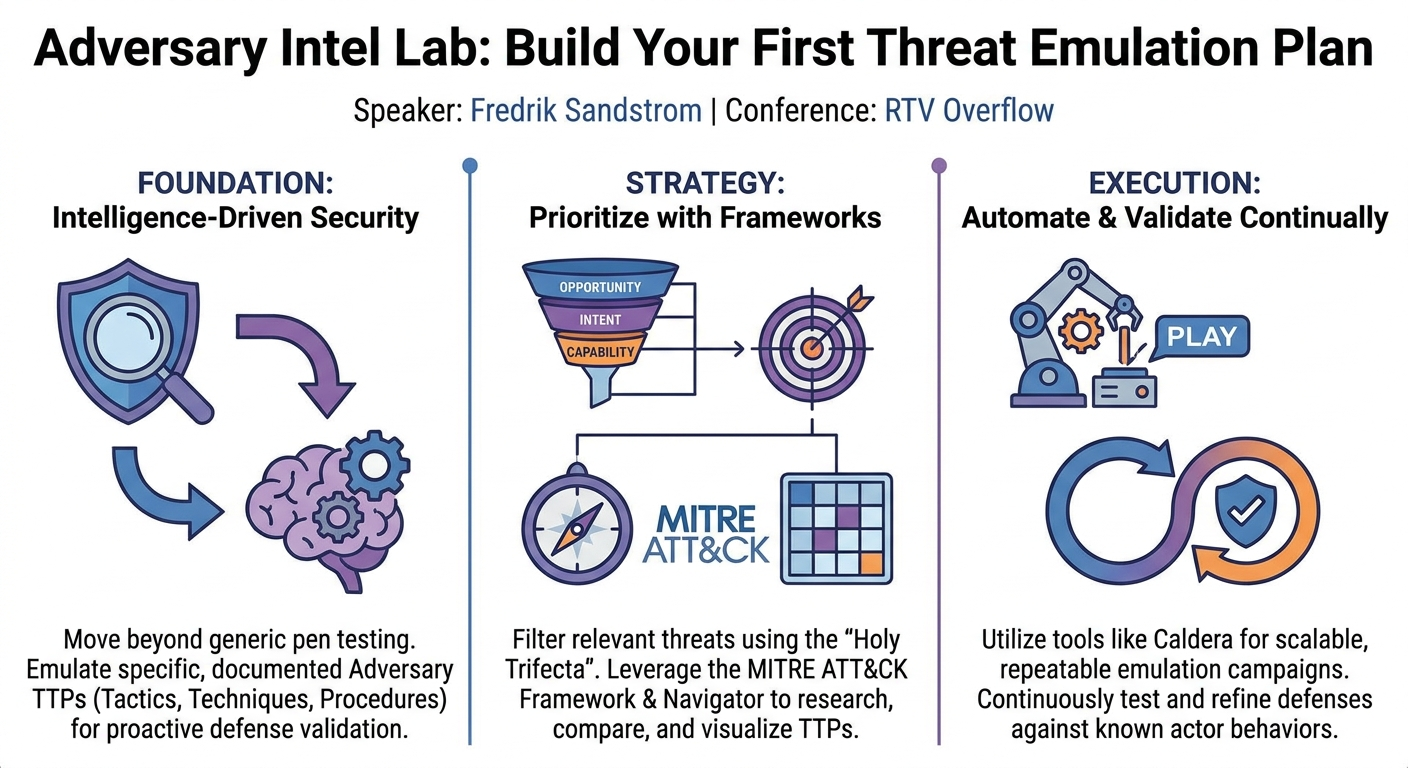
- Adversary emulation is a critical evolution for mature security programs. It moves beyond generic vulnerability assessments to intelligence-driven testing, allowing organizations to proactively validate their defenses against the specific TTPs of relevant threat actors. This is essential for companies facing advanced state-sponsored or highly motivated adversaries, offering a planned and repeatable approach to security validation.
- The MITRE ATT&CK Framework is the cornerstone of effective threat emulation. It provides a universally recognized, granular catalog of adversary TTPs, enabling security professionals to research, understand, and categorize how adversaries operate. This framework is not just a reference but a dynamic tool for building tailored emulation plans.
- The MITRE ATT&CK Navigator is an indispensable tool for comparative threat intelligence and prioritization. It allows security teams to visualize, compare, and score the TTPs of multiple threat actors, identifying overlaps and unique techniques. This capability helps prioritize testing efforts by focusing on the most common or impactful TTPs relevant to an organization's specific threat landscape.
- Official Adversary Emulation Plans provide actionable blueprints. Resources like those offered by MITRE for groups such as APT29 offer highly detailed, step-by-step guides on how to emulate specific adversaries. These plans are invaluable starting points for organizations to understand the structure and content required for their own emulation efforts.
- The "Holy Trifecta of a Threat" (Opportunity, Intent, and Capability) is crucial for filtering relevant threats. Sandstrom emphasizes that a true threat requires all three elements. An adversary might have the capability (a ladder) and the intent (to steal), but if there's no opportunity (an open window), there's no immediate threat. This framework helps organizations narrow down the vast number of potential adversaries to those that genuinely pose a risk.
- Open-source tools like Caldera enable scalable, repeatable, and documented emulation campaigns. Moving beyond manual testing, platforms like Caldera allow security teams to automate the execution of TTPs, track their success or failure, and generate reports that can be directly mapped back to the ATT&CK Framework. This facilitates continuous validation and provides clear metrics for improving defensive capabilities.
Technical Deep Dive
▶ Watch: The Holy Trifecta of a Threat: Opportunity, Intent, Capability (41:00)
The technical core of Sandstrom's talk revolves around leveraging the MITRE ATT&CK Framework and its associated tools, combined with practical execution platforms. The MITRE ATT&CK Framework, accessible at attack.mitre.org, serves as the authoritative knowledge base for adversary TTPs. Users can explore various threat groups (e.g., APT29), understand their objectives, typical targets, and documented campaigns. Each group entry details the specific techniques they employ, often linking to forensic reports that provide granular insights into their execution.
A critical component for planning emulation is the MITRE ATT&CK Navigator, found at attack.mitre.org/resources/navigator. This interactive web-based tool, which can also be run offline from its GitHub repository, allows security professionals to visualize and manipulate the ATT&CK matrix. Sandstrom demonstrated its power by:
- Visualizing TTPs for a single threat actor: Highlighting techniques used by groups like APT29 for phases such as recon (e.g., scanning), initial access (e.g., spear phishing attachment, valid accounts), and persistence.
- Comparing multiple threat actors: By creating separate layers for different groups (e.g., APT28 and APT29), users can assign scoring (e.g., 1 for APT28, 2 for APT29). A combined layer can then be generated, which sums the scores for overlapping techniques. Techniques with higher combined scores (e.g., "drive-by compromise" scoring 4 if both use it, vs. 2 if only one does) indicate common TTPs that should be prioritized for testing due to their prevalence across multiple relevant adversaries.
- Performing differential analysis with mitigations: A third layer can be introduced to represent existing security controls or mitigations (e.g., an antivirus solution). By applying a negative score (e.g., -1 for techniques blocked by AV), users can perform an
A + B - Coperation to visualize which TTPs remain a significant threat even with current defenses, thus highlighting areas for improved protection.
Sandstrom then delved into the structure of Adversary Emulation Plans, which are typically divided into three phases, mirroring common kill chain models:
- Phase 1: Initial Foothold/Compromise: Focuses on how an adversary gains initial access (e.g., phishing, exploitation) and establishes a beachhead within the target environment.
- Phase 2: Network Propagation: Details the adversary's actions post-compromise, including discovery of internal systems, lateral movement across the network, and privilege escalation.
- Phase 3: Exfiltration/Impact: Describes how the adversary achieves their ultimate objective, whether it's data exfiltration, system destruction, or maintaining persistence.
These detailed plans, exemplified by MITRE's own emulation plans for groups like APT29, provide specific tools (e.g., Mimikatz), commands, and expected outcomes, making them invaluable for red teamers and blue teamers alike. The concept extends to threat actor playing cards or profiles, which compact the most relevant TTPs, tools, and lateral movement techniques for a specific adversary into an easily digestible format for testers.
For practical execution, Sandstrom advocated for open-source tools like Caldera, an adversary emulation platform developed by MITRE. Caldera allows for:
- Agent deployment: Deploying small agents (shells) onto target systems that connect back to the C2 server.
- Operation creation: Designing customized campaigns (operations) based on specific threat actors or desired TTPs. Caldera comes with pre-built threat actors and a vast library of techniques mapped to ATT&CK.
- Automated execution: Running sequences of commands and techniques across multiple agents.
- Tracking and reporting: Documenting the success or failure of each command, capturing output, and providing detailed reports. These reports can then be exported as JSON files and imported into the ATT&CK Navigator to visually represent the tested and detected techniques.
Finally, Sandstrom touched upon Travis's T.E.A.C.H. Framework, which, although no longer directly supported by the latest ATT&CK Navigator versions, offers a valuable conceptual model for mapping techniques to their difficulty levels—ranging from "mom could probably do it" to requiring "real technical skills" or "firmware corruption." This helps in understanding the technical expertise required for different attack vectors.
Demo / Proof of Concept
▶ Watch: Caldera: Open-source tool for running emulation campaigns (46:00)
Fredrik Sandstrom provided a concise yet effective demonstration of Caldera, an open-source adversary emulation platform, to illustrate how a threat emulation plan can be brought to life. While acknowledging his preference for pre-recorded segments over live demos due to inherent risks, he seamlessly transitioned between a video demonstration and a live interaction with a virtual machine running Caldera.
The demonstration began by showcasing Caldera's agent management capabilities. Sandstrom explained that agents function as shells on target systems, connecting back to the Caldera C2 server. He illustrated how simple payloads, such as a "clickbait PDF" designed to simulate a spear phishing attack, could be used to establish these agent connections. The interface displayed crucial information about each connected agent, including its privileges and operational status, akin to other common C2 frameworks.
The core of the demo revolved around creating and executing an "operation" within Caldera, designed to emulate a specific threat actor. Sandstrom highlighted Caldera's strength in having many pre-built threat actors and their associated techniques already mapped to the MITRE ATT&CK Framework. He showed how an operation, perhaps for a hypothetical APT329 (likely a reference to APT29 or a generic example), could be configured to run a scenario encompassing various TTPs.
As the operation executed, the demo clearly showed Caldera's real-time tracking and reporting features. For each command or technique attempted by the emulated adversary, Caldera displayed:
- The command used.
- The output from the target system.
- The status (successful or failed).
For instance, a command for discovery might succeed, while another attempting a privilege escalation might fail, perhaps due to a "sudo not found" error, indicating issues with the target environment (e.g., containerization). This detailed feedback is crucial for red teamers to understand the efficacy of their techniques and for blue teams to identify where detections are triggered or missed.
A key takeaway from the demo was the ability to export operation results. Once an operation is complete, Caldera can generate a JSON file summarizing the executed and observed TTPs. This file can then be uploaded to the MITRE ATT&CK Navigator. Sandstrom demonstrated how importing this JSON file would visually update the Navigator matrix, highlighting the specific techniques that were successfully executed or detected during the emulation. This provides a clear, visual representation of the organization's defensive coverage against a particular threat actor's TTPs.
Although not explicitly demonstrated, Sandstrom also mentioned the potential for integrating with tools like Vectra to further analyze blue team detections, providing a holistic view of both offensive execution and defensive response. For attendees eager to gain hands-on experience, Sandstrom generously provided a virtual machine with a pre-configured Caldera instance and two agents, accessible via a QR code and GitHub repository, encouraging direct engagement with the concepts presented.
Defensive Implications
▶ Watch: Q&A and Resources for Learning More (53:00)
The insights from Fredrik Sandstrom's talk offer profound implications for security defenders, urging a strategic shift from reactive security to a proactive, intelligence-driven posture.
Firstly, the emphasis on proactive testing is paramount. Instead of waiting for real-world attacks, organizations should actively emulate relevant adversaries to test their defenses. This structured approach, rooted in threat intelligence, provides a much clearer picture of an organization's true resilience than generic penetration tests. It allows defenders to understand how their existing EDR, XDR, SIEM, and other security controls perform against the specific TTPs of state-sponsored or highly motivated attackers.
Secondly, the talk underscores the importance of continuous validation. Tools like Caldera enable repeatable emulation campaigns. This means that after implementing new security patches, deploying new systems, or updating detection rules, defenders can "push play" on customized operations to immediately assess the impact on their defensive capabilities. This iterative testing helps ensure that security investments are genuinely effective and that new deployments don't inadvertently create blind spots. For instance, testing if an EDR detects specific exfiltration techniques or if a SIEM rule catches particular lateral movement commands.
Thirdly, the MITRE ATT&CK Navigator is presented not just as a red team planning tool but as a powerful defensive asset. By performing differential analysis (e.g., A + B - C with mitigations), blue teams can visualize which adversary techniques remain potent despite current defenses. This allows for prioritization of defensive investments, focusing resources on strengthening controls against the TTPs that pose the highest residual risk. It helps answer critical questions like: "Even with our antivirus, are we still vulnerable to this type of phishing payload?"
Moreover, Sandstrom stresses the foundational importance of understanding your own organization and attack surface. Before any emulation, defenders must meticulously profile their company's sector, geographical area, technology stack, and third-party dependencies. This self-awareness allows them to filter out irrelevant threat actors and TTPs, making emulation efforts highly targeted and efficient. For example, if an organization has no exposed Wi-Fi networks or open USB ports, testing adversaries that rely solely on these vectors becomes unnecessary.
Finally, for organizations facing state-level adversaries, the talk highlights the often-overlooked threat of insider compromise. State actors possess vast resources, exceptional skill, and extreme patience, making it "not unreasonable to think that you have actually already employed someone from a state actor." This necessitates a focus on internal controls, robust hiring practices, and adherence to principles like least privilege (implied by "committed for our principle"), and strong employee oversight to mitigate the risk of credentialed insiders. A good emulation plan, ultimately, is one that is well-documented, repeatable, and allows for clear communication and measurable improvement in defensive posture.
Key Takeaways
- Embrace Intelligence-Driven Security: Move beyond traditional, generic penetration testing to adversary emulation, which uses specific threat intelligence and TTPs to simulate real-world attacks.
- Know Thyself, Then Thy Enemy: A deep understanding of your organization's assets, attack surface, sector, and geographical context is fundamental to identifying and prioritizing relevant threat actors.
- MITRE ATT&CK is Your Compass: Utilize the MITRE ATT&CK Framework and especially the ATT&CK Navigator (
attack.mitre.organdattack.mitre.org/resources/navigator) to research, compare, and visualize adversary TTPs, aiding in the design of focused emulation plans. - Prioritize with the "Holy Trifecta": Filter potential threats by assessing the "Opportunity, Intent, and Capability" of adversaries, ensuring emulation efforts are focused on the most realistic and impactful risks.
- Automate for Repeatability and Scale: Leverage open-source tools like Caldera to automate the execution of TTPs, track results, and generate reports, enabling continuous validation of defenses against specific threat actor behaviors.
- Structured Plans Drive Improvement: A good emulation plan is documented, repeatable, and provides measurable insights into defensive capabilities, allowing for targeted improvements and effective communication between red and blue teams.
About the Speaker(s)
Fredrik Sandstrom is the Head of Cyber Security Consultant at Basalt AB, a role that has seen him transition from a decade of experience in general offensive security to specializing in product security for government clients. This shift necessitated a deep dive into adversary emulation to combat the advanced capabilities of state-sponsored threat actors. Sandstrom is passionate about sharing his knowledge and empowering the security community, as evidenced by his detailed presentations and provision of practical lab resources. He is a regular contributor to security conferences, including Red Team Village, and looks forward to attending events like Def Con.
Reviews
Dr. Zero (Offensive Security Researcher) — SOLID
Sandstrom delivers a competent but entirely standard 101 primer on setting up a purple team capability using Caldera and MITRE ATT&CK. If your org just woke up and realized threat emulation exists, this is a useful starting point. For anyone already doing the work, there is zero new signal.
Heather Calloway (CISO) — MUST SEE
As a CISO, I am tired of paying for penetration tests that just hand me a list of missing patches. This talk outlines exactly how testing should work once an organization reaches baseline maturity: intelligence-led emulation that proves whether our multimillion-dollar SOC and EDR investments actually detect the adversaries targeting our sector.