OSINT for Hackers
Lee McWhorter (CEO · McWhorter Technologies)
RTV Overflow 2026 (Red Team Village) · Day 1 · Main Stream
Overview
In this insightful RTV Overflow talk, "OSINT for Hackers," Lee McWhorter, CEO of McWhorter Technologies, distills years of expertise into a compelling exploration of Open-Source Intelligence (OSINT) methodologies. This presentation is a condensed version of a popular two-hour workshop co-developed with his partner, Sandra Stibbard, owner of Camelot Investigations. McWhorter, a founding volunteer of the Red Team Village at Def Con and a seasoned security researcher, pen tester, and educator, brings a red teamer's perspective, while Stibbard's background as a private and fraud investigator provides a unique, complementary lens.
Key moments
- 0:00 Introduction: Speaker and unique OSINT approach
- 4:00 Agenda: Mindset, identities, AI, and tools
- 10:00 Thinking outside the box: Phone number search example
- 28:00 Methodology for creating effective sock puppet identities
- 34:00 Using virtual machines for secure identity management
- 44:00 AI's limitations: False accusation story
- 48:00 Overview of essential OSINT tools for hackers
- 54:00 Q&A: Verifying phone numbers with advanced techniques
OSINT for Hackers
Speakers: Lee McWhorter (CEO, McWhorter Technologies)
Conference: RTV Overflow
YouTube: https://www.youtube.com/watch?v=y5Q-QB9oeBE
Overview
In this insightful RTV Overflow talk, "OSINT for Hackers," Lee McWhorter, CEO of McWhorter Technologies, distills years of expertise into a compelling exploration of Open-Source Intelligence (OSINT) methodologies. This presentation is a condensed version of a popular two-hour workshop co-developed with his partner, Sandra Stibbard, owner of Camelot Investigations. McWhorter, a founding volunteer of the Red Team Village at Def Con and a seasoned security researcher, pen tester, and educator, brings a red teamer's perspective, while Stibbard's background as a private and fraud investigator provides a unique, complementary lens.
The talk transcends typical OSINT discussions by emphasizing a "thinking outside the box" philosophy, crucial for uncovering elusive information. It delves into the practical art of creating and maintaining sock puppets (fake identities) for covert reconnaissance, a technique vital for both red team engagements and private investigations. Furthermore, McWhorter addresses the burgeoning role of Artificial Intelligence (AI) in OSINT, highlighting its capabilities for data aggregation while critically examining its limitations, such as hallucinations and guardrail bypasses, which can lead to misleading or dangerous results.
This presentation is highly relevant for red teamers, penetration testers, security researchers, and even blue team members seeking to understand adversary reconnaissance techniques. It provides actionable strategies for gathering intelligence on targets, whether human or technological, by leveraging publicly available information creatively and securely. The dual perspective from red teaming and private investigation offers a holistic view of OSINT application, making it a valuable resource for anyone looking to deepen their understanding of modern intelligence gathering in the cybersecurity landscape.
Background
▶ Watch: Introduction: Speaker and unique OSINT approach (0:00)
The landscape of cybersecurity demands sophisticated reconnaissance, and Open-Source Intelligence (OSINT) forms the bedrock of effective engagements. OSINT, the practice of collecting information from publicly available sources, is critical for red teams and penetration testers to understand their targets' digital and physical footprints before launching any direct attacks. Traditionally, OSINT might involve passive techniques like querying WHOIS records for domain ownership or analyzing DNS records to map network infrastructure. However, as organizations adopt complex hybrid environments—spanning on-premises infrastructure, various cloud providers, and numerous Software-as-a-Service (SaaS) and Platform-as-a-Service (PaaS) solutions—the challenge of comprehensive reconnaissance has grown significantly.
This talk frames OSINT within two distinct yet interconnected domains: traditional red teaming and private investigation. Lee McWhorter's background is rooted in the technical, offensive security side, using OSINT to identify vulnerabilities, map attack surfaces, and inform social engineering campaigns. Sandra Stibbard, on the other hand, approaches OSINT from the perspective of fraud investigation, where uncovering hidden connections and verifying identities is paramount. This unique partnership has allowed them to develop a comprehensive OSINT methodology that benefits from both technical depth and investigative rigor.
The core problem addressed is that readily available information is often obscured, incomplete, or intentionally hidden. Simple searches often yield insufficient results, necessitating a more creative and persistent approach. The speaker highlights that while technical audiences are proficient with tools and data, they often overlook the fundamental investigative mindset required to uncover information that isn't immediately obvious. This "thinking outside the box" philosophy, originating from Sandra Stibbard's private investigation work, is presented as a crucial prerequisite for successful OSINT, bridging the gap between mere data collection and genuine intelligence gathering. This foundational mindset sets the stage for more advanced techniques, including identity creation and the strategic use of emerging technologies like AI.
Key Findings
▶ Watch: Thinking outside the box: Phone number search example (10:00)
The talk presents several key findings and methodologies essential for advanced OSINT practitioners:
- The "Thinking Outside the Box" Search Philosophy: This is the foundational principle, emphasizing that the absence of information in a standard search doesn't mean it doesn't exist. Instead, it necessitates trying every conceivable permutation of a search query. Examples include varying phone number formats (hyphenated, parentheses, spaces, dots, slashes, even leetspeak), date formats (DD/MM/YYYY, MM/DD/YYYY, contractual language), and name/email variations (dotted, aliased, comma-separated). The critical insight is that adversaries or even legitimate entities might use non-standard formatting, which, if replicated in a search query, can yield previously undiscovered results. The story of finding a fraudulent website's origin by precisely copying a spaced phone number from its HTML underscores this point.
- Strategic Use of Geographic Context: Search results can vary significantly based on the searcher's geographical location. McWhorter highlights the importance of using Virtual Private Networks (VPNs) to simulate searches from different regions, especially when targeting international companies or those with multiple offices. This allows red teamers to uncover location-specific information, resources, or vulnerabilities that might not be visible from their default location.
- Methodological Sock Puppet Creation for Covert Reconnaissance: Creating believable fake identities is crucial for active reconnaissance, such as joining professional networks or forums to gather intelligence without revealing the red teamer's true affiliation. The talk outlines a structured, secure methodology for this:
- Persona Development: Choosing a generic but not overly common name (e.g., "Sam Colton") and considering a plausible backstory or age (e.g., using "1993" in an email address).
- Visual Representation: Using AI-generated images (e.g.,
thispersondoesnotexist.com) or generic icons to avoid legal issues or easy detection associated with stock photos or real individuals. - Simultaneous Email Creation: Opening two browsers to simultaneously create email accounts (e.g., Gmail and ProtonMail) for the same persona, using each as the recovery email for the other. This ensures consistent naming and robust recovery options.
- Isolation and Operational Security (OpSec): The most critical finding for sock puppets is the absolute necessity of using dedicated Virtual Machines (VMs) or containers for each identity. This prevents accidental cross-contamination of identities, ensures all activity is contained, and mitigates the risk of revealing the operator's true self or other personas. McWhorter suggests customizing the VM desktop with the persona's details (picture, name, email) as a constant reminder.
- AI as a Double-Edged Sword in OSINT: AI tools (e.g., ChatGPT, Claude, open-source models) can significantly accelerate basic information gathering, summarization, and code generation. However, McWhorter strongly emphasizes their inherent limitations:
- Hallucinations: AI can "make stuff up," presenting fabricated information as fact.
- Guardrail Bypass: While AIs have built-in safety mechanisms, creative prompting (e.g., the "grandmother attack," adversarial poetry) can often bypass these, leading to potentially unethical or illegal outputs.
- Validation is Key: All AI-generated information must be critically validated against reliable sources, especially for non-definitive or subjective queries. The anecdote of AI falsely accusing a man of being a sex offender due to a near-name match highlights the severe consequences of unverified AI output.
- Leveraging Specialized OSINT Tools: Beyond general search engines, specific tools offer unique intelligence-gathering capabilities:
- LinkedIn: A goldmine for understanding a target company's technology stack, employee skills, project details, and even identifying satellite offices through employee posts and certifications.
- Maltego: A powerful graphical link analysis tool for connecting disparate pieces of information.
- Google Earth/Street View: Invaluable for physical reconnaissance, identifying entry points, surveillance opportunities, and employee habits (e.g., smoker locations).
- TweetDeck (now X's paid feature): Allows real-time monitoring of keywords, hashtags, individuals, and groups on Twitter/X, useful for tracking public sentiment or detecting incident responses during an engagement.
- Shodan: The "search engine for the Internet of Things," crucial for discovering exposed devices, services, and misconfigurations (e.g., default passwords) associated with a target. It can also be configured for continuous monitoring.
- OSINT Framework (osintframework.com): A comprehensive, tree-like repository of OSINT tools and resources, categorizing them by type and function.
These findings collectively underscore that effective OSINT is a blend of investigative mindset, meticulous execution, technological leverage, and rigorous validation.
Technical Deep Dive
▶ Watch: Using virtual machines for secure identity management (34:00)
The technical depth of this talk resides not just in enumerating tools, but in the methodologies for using them, particularly the "thinking outside the box" search philosophy and the secure creation of sock puppets.
Thinking Outside the Box: Beyond Standard Queries
The core of this philosophy is the relentless pursuit of information through exhaustive query permutation. McWhorter illustrates this with concrete examples:
- Phone Numbers: A phone number like
213-555-1212can be entered in numerous ways: 213-555-1212(hyphenated)(213) 555-1212(parentheses)213 555 1212(spaces)213.555.1212(dots)213/555/1212(slashes)2 1 3 5 5 5 1 2 1 2(individual digit spacing)
The speaker recounts a critical case where a private investigator found a link to a fraudulent site only by copying and pasting the exact spaced format of a phone number from an existing site. This format, likely a result of sloppy HTML coding, was not discoverable through standard hyphenated or parenthesized searches. This highlights the importance of replicating source formatting precisely. Beyond these, the talk mentions considering leetspeak (e.g., 5kY for SKY) or specific vernacular if tracking particular hacker groups, and also including country codes (e.g., +1 for North America) as potential prefixes.
- Dates: Dates, especially in international contexts, offer similar variability:
MM/DD/YYYY(US standard)DD/MM/YYYY(most of the world)YYYY-MM-DD(ISO 8601, common in technical contexts)December 31st, 2023(long form)31 of the 12th month(contractual language)On this first day of January(legal phrasing)
Searching with these variations can uncover legal documents, news articles, or other time-sensitive information that might be missed with a single format.
- Names and Emails:
- Names:
John Smith,Smith, John,J. Smith,John J. Smith,John-Smith. For married couples,Mr. and Mrs. Smith,John and Jane Smith,John Jane Smith(no 'and'). These variations are crucial for finding legal documents, publications, or social media profiles. - Emails:
[email protected],[email protected],[email protected]. The speaker notes that many email providers (like Gmail) treat dots in the local part of an address as irrelevant (e.g.,[email protected]goes to the same inbox as[email protected]). However, users often leverage these variations to sign up for different services or filter incoming mail. An OSINT practitioner can use this logic to search for aliases or understand a target's online habits.
- IP Addresses and Ranges: Beyond individual IPs, searching for CIDR blocks (e.g.,
/24) can reveal broader patterns. An IP address that doesn't resolve anymore might still have historical context if its parent/24block is known for nefarious activity (e.g., hosting bulletproof servers, compromised cloud instances). The speaker's observation of daily attacks from compromised Amazon, Microsoft, and Google resources (spun up VMs/containers) underscores the importance of examining entire IP ranges to identify patterns of abuse originating from specific hosting providers.
Sock Puppet Creation: The Art of Digital Disguise
The talk outlines a meticulous, OpSec-focused process for creating sock puppets or fake identities:
- Persona Conception: Start with a generic, plausible name (e.g., "Sam Colton") that isn't too common to get lost, nor too unique to be easily traced. Consider the target demographic: if infiltrating a younger group, use age-appropriate elements (e.g., "SColton93" in an email).
- Visual Identity: Avoid stock photos or images of real people. Instead, use AI-generated faces (e.g., from
thispersondoesnotexist.com) or simple icons that align with the persona's supposed interests. This minimizes legal exposure and detection risk. - Simultaneous Email Account Creation: This is a critical step for redundancy and recovery.
- Open two distinct web browsers.
- In one, navigate to Gmail. In the other, navigate to ProtonMail (or other secure email service).
- Begin creating accounts with the chosen persona name (e.g.,
[email protected]and[email protected]). - Once a desired name is confirmed available on both platforms, use the Gmail address as the recovery email for the ProtonMail account, and vice-versa.
- Complete both registrations simultaneously, using burner phone numbers or temporary verification services if required. This ensures two linked, self-recovering email accounts for the persona.
- Isolation with Virtual Machines (VMs): This is the paramount OpSec measure.
- Create a dedicated Virtual Machine (e.g., a Kali Linux VM) for each sock puppet identity.
- All activities related to that persona—email creation, social media logins (LinkedIn, X/Twitter, Facebook), forum interactions—must occur exclusively within that VM.
- Customization: Personalize the VM's desktop environment (wallpaper, icons) to reflect the persona's details (e.g., a green background for an "environmentalist" Sam Colton, with the persona's face and email address visible). This mental cue helps the operator stay in character and prevents accidental identity mixing.
- Full Screen Mode: Operate the VM in full-screen mode to minimize distractions and prevent inadvertently accessing personal accounts from the host system.
This strict isolation prevents accidental disclosure (e.g., being logged into a personal LinkedIn account while researching with a sock puppet) and ensures that forensic analysis of a compromised persona only reveals information related to that specific fake identity.
AI in OSINT: Power and Peril
AI tools like ChatGPT, Claude, and various open-source models (e.g., GPT for All, Stable Diffusion locally hosted with Web UI) can be powerful OSINT aids for:
- Summarization: Quickly processing large volumes of text.
- Information Retrieval: Answering factual questions (e.g., "Why is the sky blue?" often yields consistent, correct answers).
- Code Generation/Syntax: Providing quick code snippets or syntax help.
- Location Mapping: Identifying company locations.
However, McWhorter cautions against blind trust:
- Hallucinations: AI can generate plausible but entirely false information. The story of an AI falsely identifying a man as a sex offender due to a partial name match is a stark warning. This is not hallucination in the traditional sense, but a flawed pattern match leading to a highly damaging, incorrect conclusion.
- Guardrail Bypass: AI models are programmed with safety filters ("if bomb, say no"). However, creative prompting techniques like the "grandmother attack" (appealing to emotion) or adversarial poetry (asking questions in riddles or poems, reportedly 80% effective) can circumvent these guardrails, potentially leading to the disclosure of sensitive or harmful information.
- Validation: Always cross-reference AI-generated information with multiple, reliable sources. Open-source, de-censored AI models (available on platforms like Hugging Face) exist, demonstrating that guardrails are often imposed after the fact, rather than being intrinsic to the model's core reasoning.
Specialized Tools
- LinkedIn: Scrutinize employee profiles for mentions of technology stacks, certifications, project challenges, and even internal frustrations, which can reveal valuable insights into a target's environment.
- Shodan: Essential for identifying exposed ports, services, default credentials, and IoT devices. It can be set up for continuous monitoring to track changes in a target's external footprint.
- Google Earth/Street View: Beyond simple mapping, it enables virtual physical reconnaissance, identifying potential entry points, security measures, and routine employee behaviors (e.g., smoker gathering spots).
- Maltego: A graphical link analysis tool that visualizes connections between entities (people, domains, IPs), helping uncover hidden relationships.
- TweetDeck (X): Allows setting up real-time columns to monitor keywords, company mentions, or specific individuals, useful for immediate intelligence during an active engagement.
- OSINT Framework (osintframework.com): A comprehensive, categorized directory of OSINT tools, guiding practitioners to appropriate resources.
This deep dive illustrates that effective OSINT is a multi-faceted discipline, requiring not only technical proficiency with tools but also a creative, investigative mindset, rigorous operational security, and a critical understanding of AI's capabilities and limitations.
Demo / Proof of Concept
▶ Watch: AI's limitations: False accusation story (44:00)
While this specific talk was a condensed, one-hour presentation of a longer workshop, and therefore did not feature a live, interactive demonstration, the speaker Lee McWhorter effectively walked the audience through several practical "proof of concept" scenarios. He detailed how his partner, Sandra Stibbard, and he have successfully applied these OSINT techniques in real-world investigations and red team engagements.
For instance, the powerful anecdote of discovering hidden connections for a fraudulent website by precisely copying and pasting a non-standard, spaced phone number directly from the site's HTML into a search engine served as a compelling demonstration of the "thinking outside the box" principle. Similarly, the step-by-step explanation of creating a sock puppet identity—from persona development and simultaneous email registration to the crucial use of a dedicated Virtual Machine (VM) with customized desktop backgrounds—functioned as a clear methodological blueprint, illustrating how a covert identity can be established and maintained securely.
The discussion around AI also included a vivid "proof of concept" through the story of an AI falsely accusing an individual of being a sex offender due to a partial name match. This served as a cautionary tale, demonstrating the real-world risks of unverified AI output and the critical need for human validation. Although not a live, interactive demo, these detailed narratives and explanations effectively conveyed the practicality and impact of the discussed OSINT techniques, providing a clear understanding of "how it worked" in actual scenarios. The speaker also encouraged attendees to participate in the longer, hands-on workshop at Def Con's Red Team Village, where these concepts are explored with direct tool interaction.
Defensive Implications
▶ Watch: Q&A: Verifying phone numbers with advanced techniques (54:00)
The insights shared in "OSINT for Hackers" are not just valuable for offensive operations; they offer crucial defensive implications for organizations and individuals alike. Understanding how adversaries gather intelligence is the first step in building a resilient defense.
- Employee OSINT Awareness and Training: Organizations must educate employees, particularly those in technical roles (DevOps, system administrators, developers), about the risks of oversharing on professional platforms like LinkedIn. Details about the technology stack, specific projects, operational challenges, or even frustrations with particular software can be invaluable to an attacker. Training should cover what constitutes sensitive information and how seemingly innocuous posts can be aggregated into a comprehensive attack plan. For instance, a post bragging about overcoming a challenge with "XYZ database version 7.2" immediately gives an attacker a specific target and version to research for known vulnerabilities.
- Digital Footprint Management and Information Hygiene: Companies should regularly audit their public-facing information. This includes not only obvious assets like domain registrations but also how contact information (phone numbers, addresses) and dates are presented across various platforms, legal documents, and marketing materials. The talk's example of a spaced phone number revealing a hidden site highlights that seemingly minor formatting inconsistencies can expose connections. Defenders should consider how their organization's data might be formatted in non-standard ways and proactively search for these permutations to identify unknown exposures.
- Proactive External Attack Surface Management (EASM): Tools like Shodan and Google Earth are not just for attackers. Defenders should use them to map their own external infrastructure, identify exposed services, misconfigured devices (e.g., default passwords on IoT devices), and unpatched systems that might be inadvertently exposed to the internet. Setting up continuous monitoring with Shodan, as suggested by McWhorter, allows organizations to track changes in their attack surface and quickly address new exposures. Google Earth and Street View can be used to conduct virtual physical security assessments of company premises, identifying potential entry points or surveillance blind spots.
- Social Engineering Preparedness: The detailed methodology for creating sock puppets demonstrates how sophisticated adversaries can craft convincing fake identities to infiltrate professional networks or gain trust. Defenders need to be aware that connection requests or interactions from seemingly legitimate, but unknown, individuals might be reconnaissance attempts. Implementing strong vetting processes for new connections on platforms like LinkedIn and fostering a culture of healthy skepticism can mitigate this risk.
- Critical Evaluation of AI-Generated Information: While AI can be a helpful tool for security operations, the talk's emphasis on hallucinations and guardrail bypass is a critical warning. Security teams using AI for threat intelligence or incident response must implement robust validation mechanisms for any AI-generated insights. Relying solely on AI without human verification can lead to misidentified threats, false positives, or even overlooking real threats due to AI errors, as shown by the false accusation anecdote.
- Geographic OSINT for Global Organizations: Companies with a global presence should recognize that their attack surface and publicly available information might vary significantly by region. Using VPNs to conduct OSINT searches from different geographical locations (e.g., London for a London office) can reveal region-specific exposures, compliance issues, or local employee posts that would be invisible from the corporate headquarters' location.
By adopting an offensive mindset in their defensive strategies, organizations can anticipate and counteract the advanced reconnaissance techniques employed by adversaries, transforming OSINT from a weapon against them into a powerful tool for their own protection.
Key Takeaways
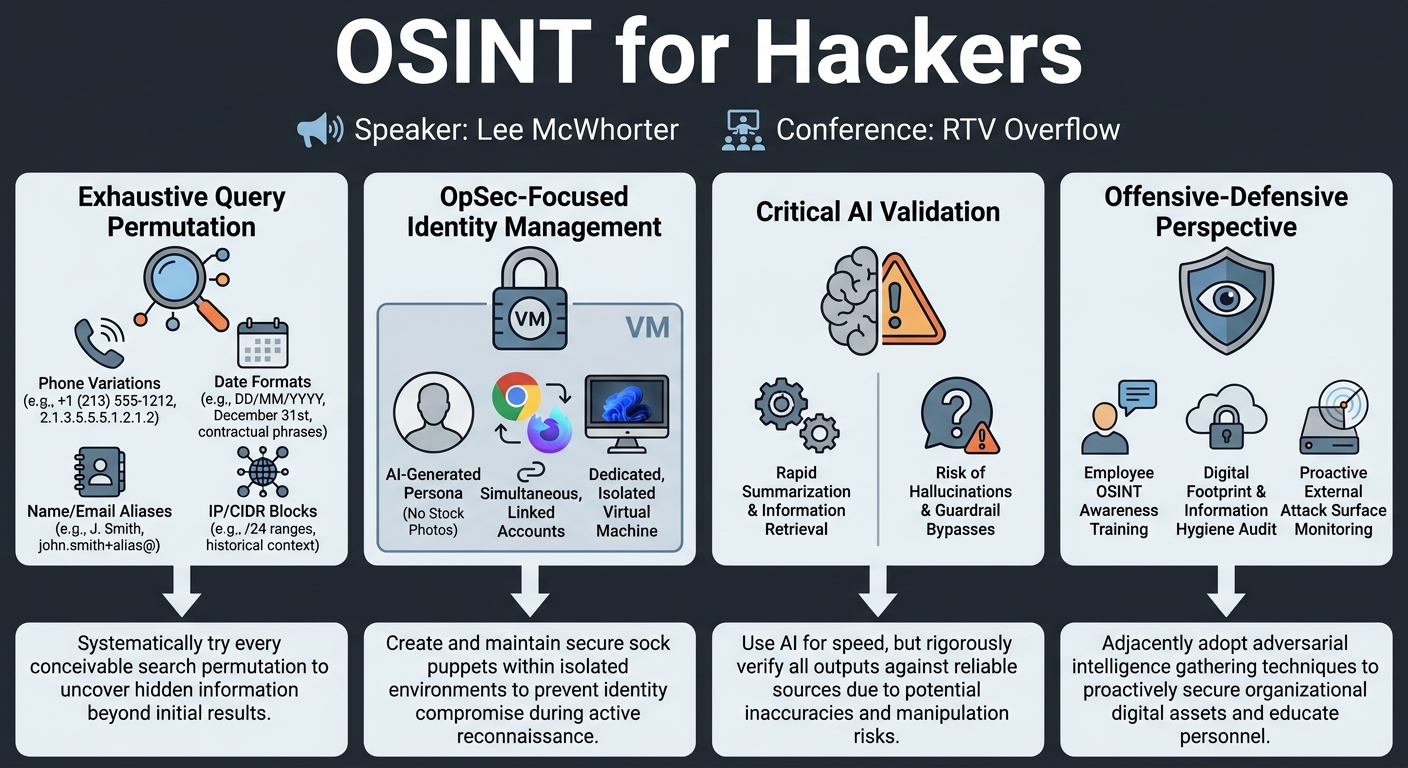
- OSINT requires a "thinking outside the box" mindset: Don't stop at initial search results. Systematically try every conceivable permutation of search queries for phone numbers, dates, names, and IP addresses to uncover hidden information.
- Securely leverage sock puppets for deeper reconnaissance: Create fake identities using generic personas, AI-generated images, and a robust, isolated environment (dedicated Virtual Machines) to prevent identity compromise and maintain operational security during active intelligence gathering.
- AI is a powerful but fallible OSINT tool: Use AI for rapid information retrieval and summarization, but critically validate all outputs due to the risk of hallucinations and the ability of adversaries to bypass guardrails with creative prompting.
- Utilize a diverse toolkit for comprehensive intelligence: Combine general search engines with specialized OSINT tools like LinkedIn (for tech stack and employee insights), Shodan (for exposed devices), Google Earth (for physical recon), and the OSINT Framework (for tool discovery).
- Geographic context is crucial for global targets: Employ VPNs to conduct searches from various geographical locations to uncover region-specific information and different search engine results, particularly for international organizations.
- Defenders must adopt an offensive OSINT perspective: Understand how adversaries gather intelligence to proactively manage organizational digital footprints, educate employees on information hygiene, and implement robust external attack surface management.
About the Speaker(s)
Lee McWhorter is a versatile cybersecurity professional, serving as a part-time CTO, CISO, independent consultant, security researcher, pen tester, speaker, and educator. He is deeply embedded in the hacking community, notably as one of the founding volunteers for the Red Team Village at Def Con and an active participant in the Texas Cyber Summit. McWhorter brings a traditional red teaming and computing background to OSINT, focusing on how intelligence gathering can inform offensive security engagements. His passion extends beyond tech, as he's also a hacker, raver, and competitive pool player, having recently competed in the APA World Championships.
Sandra Stibbard is McWhorter's partner in developing and delivering their comprehensive OSINT training. As the owner of Camelot Investigations and a seasoned private investigator, Stibbard approaches OSINT from the perspective of fraud and commercial investigations. She has extensive experience conducting and teaching OSINT globally, with a significant highlight being her and McWhorter's opportunity to teach OSINT tactics to Interpol officers in Singapore in 2023. Though she often claims not to be a "techie," McWhorter attests to her advanced technical proficiency. Her expertise in uncovering hidden information for investigative purposes provides a unique and invaluable complement to McWhorter's red team-focused approach, creating a holistic and highly effective OSINT methodology.
Reviews
Dr. Zero (Offensive Security Researcher) — WEAK
This is day-one OSINT 101 masquerading as advanced hacker tradecraft. Searching for different phone number formats and setting up a dedicated Kali VM for a sock puppet isn't research; it's the bare minimum for breathing on the internet. If you've been in the industry for more than a week, you already know everything in this talk.
Heather Calloway (CISO) — SOLID
A competent, operational-level primer on modern OSINT techniques, from sock puppet hygiene to AI hallucinations. While this is baseline material for dedicated threat intel teams, it serves as a stark reminder for leadership that unmanaged external assets and employee oversharing remain highly exploitable early-stage risks.