Embracing the Hackers: Opening Keynote by Gattaca
Dave Lewis (Cisco)
Swiss Cyber Storm 2019 · Day 1 · Main
Overview
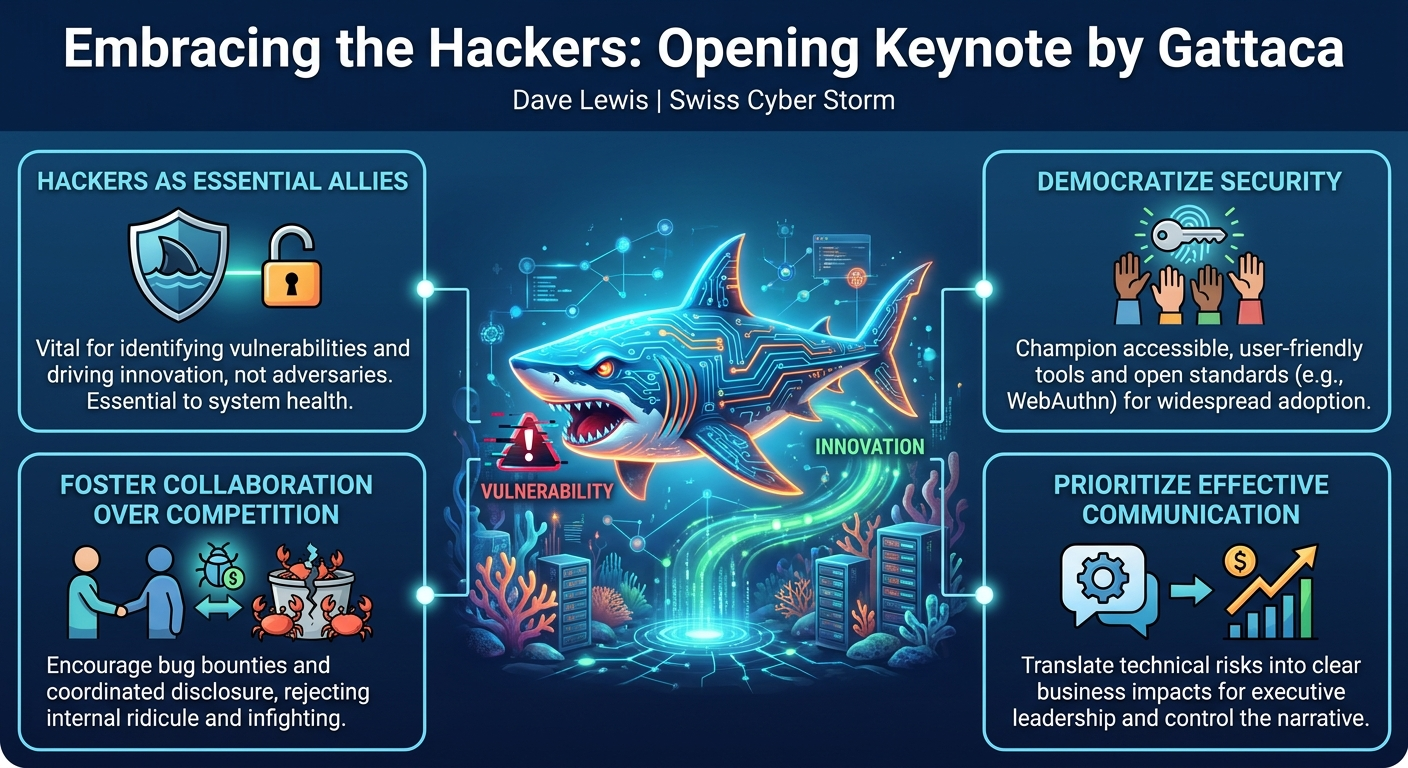
In his compelling keynote, "Embracing the Hackers," Dave Lewis, a seasoned security professional from Duo Security (a Cisco business unit), challenges conventional perceptions of hackers and advocates for their essential role in building a more secure world. Drawing a provocative analogy between hackers and sharks in an ecosystem, Lewis argues that these often-maligned figures are crucial for identifying vulnerabilities, driving innovation, and maintaining the health of our digital infrastructure. The talk emphasizes that security practitioners, regardless of their specific role, are fundamentally defenders, and their true purpose is to make systems better, not to ridicule or self-aggrandize.
Key moments
- 1:50 Introducing the positive hacker-shark analogy
- 4:40 Hackers as defenders making systems better
- 15:50 Alarming growth in scale of data breaches
- 21:50 Sharks and hackers: crucial roles in their ecosystems
- 25:50 The need to democratize security with better tools
- 28:50 Blackout of 2003: understanding real-world impact
- 36:00 Q&A: Learning from mistakes vs. being told
Embracing the Hackers: Opening Keynote by Gattaca
Speakers: Dave Lewis, Principal, Duo Security (Cisco)
Conference: Swiss Cyber Storm
YouTube: https://www.youtube.com/watch?v=ZBfMxspYGxA
Overview
In his compelling keynote, "Embracing the Hackers," Dave Lewis, a seasoned security professional from Duo Security (a Cisco business unit), challenges conventional perceptions of hackers and advocates for their essential role in building a more secure world. Drawing a provocative analogy between hackers and sharks in an ecosystem, Lewis argues that these often-maligned figures are crucial for identifying vulnerabilities, driving innovation, and maintaining the health of our digital infrastructure. The talk emphasizes that security practitioners, regardless of their specific role, are fundamentally defenders, and their true purpose is to make systems better, not to ridicule or self-aggrandize.
Lewis’s presentation is a call to action for the security industry to mature, communicate more effectively, and actively engage with the hacking community. He highlights the dangers of outdated mindsets, fear-driven narratives, and the "crab bucket mentality" that can hinder progress. By sharing personal anecdotes from his 25-year career—from discovering vulnerabilities to co-founding community initiatives—Lewis illustrates the transformative power of ethical hacking when channeled constructively. The keynote ultimately champions a paradigm shift: instead of viewing hackers as adversaries, organizations and society at large should embrace their unique curiosity and problem-solving skills to democratize security and address the escalating challenges of the digital age.
Background
▶ Watch: Introducing the positive hacker-shark analogy (1:50)
Dave Lewis's journey into cybersecurity began not in a traditional academic setting, but through an innate curiosity fostered by early exposure to technology. In 1983, a science teacher provided him and a friend access to a computer, teaching them BASIC, which quickly led to "duping video games and selling them," inadvertently setting him on the path of a hacker driven by exploration rather than malice. This foundational experience was reinforced by a Compact Luggable computer at home, which, despite lacking a modem, allowed him to delve into the mechanics of computing and even experiment with VisiCalc. This early engagement instilled a lifelong lesson: breaking things, when motivated by curiosity, leads to a deeper understanding and ultimately, improvement.
His career, spanning over 25 years as a CISO, firewall admin, and various other security roles, taught him the importance of documenting experiences, a habit he learned from a mentor at MCA Records—a practice that led to stacks of notebooks filled with lessons learned from mistakes. Lewis observed that the corporate world often stifles the non-linear, creative thinking inherent to hackers, leading to frustration. He argues that all security practitioners, whether red teamers, compliance officers, or infrastructure engineers, are ultimately defenders. Their goal, he asserts, must be to contribute positively, moving beyond tactical minutiae like the "deep dark web" (or "vanta web") to adopt a strategic, adult perspective.
Lewis also recounted establishing Liquid Matrix.org in 1997, a website he manually aggregated using VI to share security articles. To his surprise, its readership expanded to militaries, law enforcement, and governments worldwide, demonstrating the powerful reach of shared knowledge. This experience, coupled with co-founding BSides Toronto, underscored the need for safe environments where individuals can learn and share hacking techniques without fear of reprisal. He criticizes the pervasive, often negative, public perception of hackers—fueled by sensationalized media (like the movie Jaws and its impact on shark hunting, or stereotypical images of hackers in hoodies and gloves)—and highlights his own father's disbelief when Lewis appeared on a magazine cover in 2006, fearing it would negatively impact security. This historical context forms the bedrock of Lewis's argument: the security community must take control of its narrative and actively bridge the gap between its true purpose and public misconception.
Key Findings
▶ Watch: Alarming growth in scale of data breaches (15:50)
Dave Lewis’s keynote presented several critical findings that challenge the status quo of the cybersecurity industry and call for a fundamental shift in perspective:
- Hackers are Essential for Systemic Improvement: The core finding is that hackers are not adversaries but vital components of the digital ecosystem, akin to sharks in an ocean. They identify weaknesses, force innovation, and maintain balance by exposing vulnerabilities that make systems stronger. Removing them, Lewis argues, would leave systems dangerously exposed and prevent necessary evolution.
- The Security Industry Suffers from Immaturity and Miscommunication: Despite its critical role, Lewis asserts that the security profession is "fairly immature" compared to established fields like medicine or law (which have "hundreds of years" of defined processes). This immaturity manifests in poor communication with senior management (failing to articulate business risk), getting lost in trivial details, and allowing external narratives to define the industry.
- Escalating Data Breaches Highlight Systemic Failures and Lack of Accountability: The talk starkly illustrates the worsening landscape of data breaches. Lewis notes that in 2012, a breach of LinkedIn involving 6.5 million records was considered massive; today, "orders of magnitude of billions of records" are compromised, often barely making headlines. This escalation points to fundamental flaws in how organizations prioritize and implement security, with a significant contributing factor being basic misconfigurations like publicly exposed Amazon S3 buckets.
- Security Solutions Must Be Democratized and User-Friendly: A major barrier to effective security is the complexity of existing tools and practices. Lewis highlights the enduring problem of passwords, first documented in 1962 at MIT, as an example of a persistent, user-unfriendly flaw. He advocates for the adoption of accessible, open standards like WebAuthn and points to Duo Security's mission to "democratize security" by making it "as easy as possible" for people to use, thereby improving adoption.
- Collaboration and Ethical Disclosure are Paramount, Not "Crab Bucket Mentality": Lewis strongly condemns infighting and ridicule within the security community, referring to it as a "crab bucket mentality." He stresses the importance of working together, supporting initiatives like bug bounty programs and coordinated vulnerability disclosure, and fostering an environment where researchers are encouraged, not threatened, for their discoveries. His personal experience of being threatened with legal action for disclosing a vulnerability underscores the historical challenges and the need for improved, collaborative frameworks.
Technical Deep Dive
▶ Watch: Sharks and hackers: crucial roles in their ecosystems (21:50)
The talk, while philosophical, is grounded in concrete technical examples and historical context, illustrating the practical implications of security practices and missteps.
Lewis harks back to his formative experiences with early computing, learning BASIC and manipulating VisiCalc on a Compact Luggable computer. This hands-on exploration fostered an innate curiosity about how systems worked and, crucially, how they could be broken. He vividly recalls a 2002 incident where a copy-protected music CD was trivially bypassed by using a green marker to color the outer edge, allowing data to be copied. This simple exploit demonstrates the constant cat-and-mouse game between protection mechanisms and determined individuals.
His early foray into information sharing involved Liquid Matrix.org, a website he meticulously built and maintained using VI, manually aggregating security articles. The unexpected audience, including "militaries, law enforcement organizations, governments from around the world," underscored the power of information dissemination, even through rudimentary means.
Lewis critically examines the misuse of powerful tools like Shodan, which, while valuable for identifying internet-connected devices, is often used by some for "ridiculing and cutting down whoever it was that was the victim." This practice, he argues, makes the security community "look like morons" and detracts from the goal of positive change. He cites WannaCry as a stark example of a widespread attack leveraging a "vulnerability that was known for at least 10 years" but remained unpatched, highlighting a systemic failure to address known risks.
Modern cloud misconfigurations are another area of concern. Lewis points to Amazon S3 buckets as a common source of data breaches. Despite S3 buckets being set to "not being publicly available" by default and Amazon explicitly advising "do not grant public access," many administrators inadvertently expose sensitive data. He notes that "GitHub is laden with tools" that attackers can easily use to discover these publicly accessible buckets, making it "easier for the attackers."
The talk also delves into the critical area of election security. Lewis references a 2012 incident where a hacker claimed to have influenced the outcome of the Mexican election, initially dismissed as fiction but later revealed to be a stark reality. He discusses the varying approaches to voting, contrasting Canada's use of paper ballots (with scanning devices for convenience, but paper for auditability) with other countries lacking such safeguards. The lack of clear definitions around "e-voting" further complicates the issue.
A significant technical anecdote comes from his time at a power company, where two sites were initially designed to use BGP for load balancing. This architecture proved ineffective as the sites were "20 kilometers apart," and the entire user base was primarily regional. By "reverse engineering the whole thing" and asking, "how would we break it?", his team redesigned the system with "one main system and a hot standby" utilizing VRRP (Virtual Router Redundancy Protocol) for seamless failover. This demonstrates how a hacker's mindset—actively seeking weaknesses—can lead to more robust and resilient system designs.
Finally, Lewis traces the origins of passwords back to 1962 at MIT, where they were introduced as a "compensating control" to prevent students from "stealing time" on a shared computer system. The enduring reliance on this decades-old, often insecure method is a testament to the industry's stagnation. He champions modern alternatives like WebAuthn, an "open standard" for multi-factor authentication, as a superior, user-friendly approach that the security community should actively promote and implement. His own vulnerability research, working with companies like Websense (which issued a fix in "two hours") and Oracle (fix in "less than six months"), contrasts sharply with an unnamed company that "threatened me" with legal action, highlighting the historical challenges of ethical disclosure before the widespread adoption of bug bounties.
Demo / Proof of Concept
▶ Watch: Blackout of 2003: understanding real-world impact (28:50)
This talk did not feature a live demonstration or proof-of-concept in the traditional sense. Instead, Dave Lewis focused on conceptual frameworks, historical context, and real-world examples from his extensive career to illustrate his core arguments about the nature of hacking, the state of cybersecurity, and the need for a shift in perspective. His presentation leveraged anecdotes and analogies to convey complex ideas rather than showcasing specific tools or exploits.
Defensive Implications
▶ Watch: Q&A: Learning from mistakes vs. being told (36:00)
Dave Lewis's keynote provides a clear roadmap for defenders, urging them to adopt a proactive, collaborative, and user-centric approach to cybersecurity:
- Embrace the Hacker Mindset and Community: Organizations must move beyond an adversarial view of hackers. Instead, they should actively engage with the hacking community through structured bug bounty programs, establishing clear outreach channels for vulnerability researchers, and even hiring individuals with ethical hacking skills. This fosters a collaborative environment where vulnerabilities are discovered and remedied before malicious actors exploit them.
- Prioritize Effective Communication and Narrative Control: Security professionals need to become adept communicators, translating technical risks into clear business impacts for the C-suite. Lewis stresses the importance of managing the public narrative around security to counter misinformation and fear-mongering. This means speaking confidently, honestly, and in a way that resonates with non-technical stakeholders, ensuring that security is seen as an enabler rather than a mystical barrier.
- Focus on Foundational Security and Accountability: The prevalence of breaches due to known vulnerabilities (like WannaCry leveraging a 10-year-old exploit) and misconfigurations (e.g., publicly exposed Amazon S3 buckets) highlights a failure in basic security hygiene. Defenders must diligently address long-standing issues, ensure secure default configurations, and hold themselves and their organizations accountable for the escalating volume of data breaches.
- Democratize Security Through User-Friendly Tools and Education: Security solutions should be designed for usability, not just technical robustness. Lewis contrasts the complexity of PGP with the simplicity of solutions like WebAuthn and Duo Security's approach. Defenders should advocate for and implement tools that empower users to make secure choices easily, rather than imposing complex, frustrating processes that lead to circumvention. Education is also key, providing users with the understanding to make informed decisions.
- Cultivate a Strategic, Not Just Tactical, View: While tactical exploits are important, defenders must elevate their perspective to understand the broader, real-world implications of security failures. Lewis's anecdote about the 2003 North American blackout underscores that software failures, even without malicious intent, can have catastrophic consequences (e.g., potential fatalities if it occurred in winter). Security efforts must align with protecting critical functions, human safety, and democratic processes, moving beyond merely "getting shells on systems."
- Foster a Learning Culture and Safe Environments for Testing: Learning from mistakes, both personal and collective, is crucial. Organizations should create safe environments, such as cloud-based private networks, where internal teams and external researchers can test systems without fear of legal repercussions. This encourages continuous improvement and proactive vulnerability discovery, mirroring Lewis's own journey of learning through experimentation.
Key Takeaways
- Embrace Hackers as Allies: The security industry must shift its perception of hackers from adversaries to essential contributors. Ethical hackers provide invaluable insights into vulnerabilities, driving innovation and improving system resilience, much like sharks maintain a healthy ecosystem.
- Prioritize Communication and Narrative Control: Security professionals need to become expert communicators, translating complex technical risks into understandable business impacts for non-technical leadership and the public. Failing to control this narrative allows misinformation and fear to dictate perceptions.
- Democratize Security for Wider Adoption: Effective security solutions must be user-friendly and accessible to everyone, not just engineers. Advocating for and implementing open standards like WebAuthn and simple, intuitive tools will significantly improve overall security posture by increasing user adoption.
- Address Systemic Failures and Accountability: The escalating scale of data breaches, often caused by known vulnerabilities (e.g., WannaCry) and basic misconfigurations (e.g., Amazon S3 buckets), demands greater accountability from both individuals and organizations. Focus must return to foundational security practices.
- Foster Collaboration Over Competition: The "crab bucket mentality" of internal ridicule and infighting within the security community is detrimental. Collaboration through bug bounty programs, coordinated disclosure, and community initiatives like BSides Toronto is crucial for collective progress.
- Adopt a Strategic, Impact-Driven Perspective: Security efforts should extend beyond technical exploits to consider the real-world implications of failures, such as critical infrastructure outages or threats to democratic processes. A strategic mindset, informed by a hacker's ability to "break things," leads to more robust and resilient designs.
About the Speaker(s)
Dave Lewis is a highly experienced and respected figure in the cybersecurity community, currently serving as a Principal at Duo Security, a business unit of Cisco. With over 25 years in various security roles, including CISO and firewall administrator, Lewis brings a wealth of practical knowledge and a unique perspective to the field. He is known for his work as an individual contributor, researcher, and speaker, sharing his insights globally.
Lewis's background is notably diverse; he holds a degree in archaeology and previously worked for a music company, MCA Records, before entering the tech industry. This non-traditional path has shaped his creative and analytical approach to security. He is also a proud Canadian, even sporting a Maple Leaf tattoo to underscore his national identity. Beyond his corporate roles, Lewis is a community builder, notably co-founding BSides Toronto, a conference dedicated to fostering a safe environment for security professionals to share ideas and learn. His career reflects a deep commitment to improving cybersecurity through advocacy, education, and challenging conventional wisdom.
Reviews
Dr. Zero (Offensive Security Researcher) — WEAK
Lewis gives a 25-year retrospective on why hackers are actually good and passwords are bad. It's the kind of hollow opening keynote that makes you check your watch and wonder if the coffee station is open yet. Zero technical depth, zero strategic signal, just a Duo principal reciting campfire platitudes we've all heard since 2005.
Heather Calloway (CISO) — WEAK
Lewis gives a polished, retrospective keynote arguing that the industry needs to mature and embrace hackers as part of a healthy ecosystem. It's an entertaining history lesson for a general audience, but for a leadership team, it offers zero new strategic leverage. We don't need another keynote reminding us that passwords are weak and S3 buckets shouldn't be public.