Digital Exposure of Traditional Swiss Voting Channels
Christian Killer (PhD candidate · Erick University), Melchior Limacher (freelance pen tester)
Swiss Cyber Storm 2019 · Day 1 · Main
Overview
In an era dominated by discussions around the security of electronic voting, Christian Killer and Melchior Limacher presented a critical and timely analysis at Swiss Cyber Storm on the often-overlooked security posture of traditional Swiss postal voting channels. Their talk, "Digital Exposure of Traditional Swiss Voting Channels," unveiled a comprehensive threat model for a system widely perceived as inherently more secure than its digital counterparts. This research is particularly salient in Switzerland, where a public initiative for a "secure and trusted democracy" sought a temporary ban on remote e-voting, demanding that any future system guarantee "at least the same security against manipulation as in the case of handwritten voting." Killer, a PhD candidate at Erick University, spearheaded the development of the first-ever threat model for Swiss postal voting, providing an unprecedented overview of its complex, multi-layered process. Melchior Limacher, a freelance pen tester, then complemented this theoretical framework with practical insights derived from penetration testing engagements with Swiss cantons, translating the threat model into tangible attack vectors and vulnerabilities.
Key moments
- 0:00 Introduction: Digital exposure of traditional Swiss voting
- 3:49 Core problem: Fragmented Swiss remote postal voting system
- 5:30 Uncovering hidden stakeholders in the voting process
- 11:58 Threat event: Accessing poorly protected stored voting envelopes
- 13:58 Major technical vulnerability: Manipulating the final tally
- 15:58 Broader attack vector: Hacking voting advice applications
- 24:00 Suggestions for improving security without e-voting
Digital Exposure of Traditional Swiss Voting Channels
Speakers: Christian Killer (PhD candidate, Erick University); Melchior Limacher (freelance pen tester)
Conference: Swiss Cyber Storm
YouTube: https://www.youtube.com/watch?v=HQbbExpuaz8
Overview
In an era dominated by discussions around the security of electronic voting, Christian Killer and Melchior Limacher presented a critical and timely analysis at Swiss Cyber Storm on the often-overlooked security posture of traditional Swiss postal voting channels. Their talk, "Digital Exposure of Traditional Swiss Voting Channels," unveiled a comprehensive threat model for a system widely perceived as inherently more secure than its digital counterparts. This research is particularly salient in Switzerland, where a public initiative for a "secure and trusted democracy" sought a temporary ban on remote e-voting, demanding that any future system guarantee "at least the same security against manipulation as in the case of handwritten voting." Killer, a PhD candidate at Erick University, spearheaded the development of the first-ever threat model for Swiss postal voting, providing an unprecedented overview of its complex, multi-layered process. Melchior Limacher, a freelance pen tester, then complemented this theoretical framework with practical insights derived from penetration testing engagements with Swiss cantons, translating the threat model into tangible attack vectors and vulnerabilities.
The core premise of their work challenges the prevailing public perception that traditional paper-based voting, particularly via mail, is intrinsically more secure than remote electronic voting. By meticulously dissecting the entire lifecycle of a postal vote, from material production and delivery to tallying and publication, the speakers exposed a fragmented system riddled with numerous external dependencies, manual processes, and varying security standards across Switzerland's federalist structure. Their findings underscore the critical need for increased transparency, rigorous security testing, and process improvements to safeguard the integrity of democratic processes, advocating for a security-conscious approach that moves beyond mere perception to address systemic vulnerabilities in all voting channels.
Background
▶ Watch: Introduction: Digital exposure of traditional Swiss voting (0:00)
The impetus for this research stems directly from a heated political debate in Switzerland concerning remote electronic voting. A public initiative, "secure and trusted democracy," proposed a moratorium on remote e-voting until it could be demonstrably proven to offer "at least the same security against manipulation as in the case of handwritten voting." This seemingly straightforward demand immediately highlighted a critical gap: what exactly constitutes "handwritten voting" in the context of modern Swiss elections, and what is its baseline security level? The common public and political assumption posits traditional postal voting as the gold standard of security, often contrasted favorably against the perceived risks of internet-based systems. However, as Killer and Limacher pointed out, this perception is often based on an incomplete understanding of the actual processes involved.
Switzerland's unique federalist structure plays a significant role in the complexity and fragmentation of its voting system. With elections managed at municipal and cantonal levels rather than solely by a central federal government, there is considerable autonomy and variation in how voting processes are implemented. This decentralization, while offering flexibility and distributing trust, also leads to a highly heterogeneous landscape. Different cantons and municipalities employ diverse procedures, engage various external suppliers for everything from ballot production to tallying software, and exhibit widely differing levels of security maturity. This fragmentation makes a generalized security assessment challenging, as "the Swiss remote postal voting system is fragmented and difficult to generalize." The speakers emphasized that this situation means there's no single, consistent security baseline for traditional voting channels, making direct comparisons to e-voting problematic without a thorough, formalized analysis. Their work thus aimed to provide this missing security approach, systematically identifying weaknesses and proposing improvements to the existing system rather than seeking to dismantle it.
Key Findings
▶ Watch: Uncovering hidden stakeholders in the voting process (5:30)
The research revealed that the traditional Swiss postal voting system, far from being a monolithic and uniformly secure entity, is a highly complex and fragmented ecosystem fraught with vulnerabilities. The primary findings can be summarized as follows:
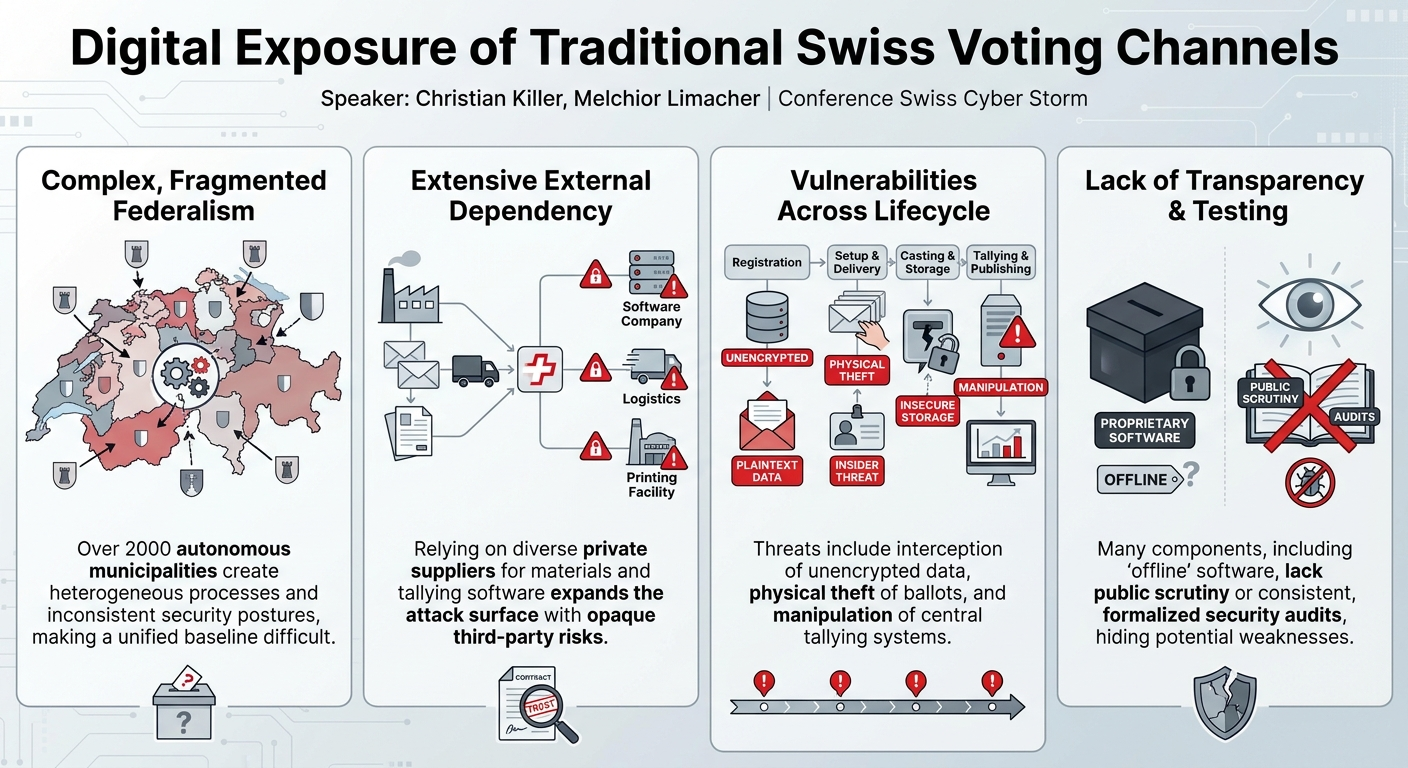
Firstly, the system's fragmentation and heterogeneity are defining characteristics. With over 2000 municipalities and 26 cantons each having a degree of autonomy, processes vary significantly. This makes a unified security posture challenging to achieve and assess. While physical decentralization was acknowledged as a positive aspect, making it "hard to hit at the same time at different locations," it simultaneously introduces a multitude of potential weak points due to inconsistent implementation and oversight.
Secondly, there is substantial reliance on external suppliers and third-party trust. From the production of voting envelopes and paper ballots to the assembly of voting packages and the provision of tallying software, numerous private and partially state-owned companies are involved. This outsourcing introduces a vast and often opaque attack surface, where the security practices of these diverse entities directly impact the integrity of the entire electoral process. The speakers highlighted that "we have a lot of distribution of trust even though I'd like to maybe raise the question if it would be better to eliminate trust in this system."
Thirdly, the lack of transparency and formalized security testing exacerbates these issues. Many components, particularly software used for tallying, are proprietary and not subject to public scrutiny or consistent third-party security audits. The talk referenced an accounting supplier claiming "they do not need additional security checking because their software is offline," illustrating a common misconception about security in isolated systems. This environment provides little incentive for security researchers to actively look for vulnerabilities, despite the critical nature of the infrastructure.
Finally, the research identified numerous specific threat events across the entire voting lifecycle, from voter registration to final tally publication. These range from digital manipulation of voter registers and interception of sensitive data transmitted via plaintext email, to physical theft of voting materials, insider threats within municipalities, and sophisticated manipulation of central tallying systems. The cumulative effect of these vulnerabilities challenges the notion that traditional postal voting automatically provides "at least the same security" as any well-designed e-voting system, suggesting that its security baseline is often lower than publicly perceived.
Technical Deep Dive
▶ Watch: Threat event: Accessing poorly protected stored voting envelopes (11:58)
The technical deep dive into the Swiss postal voting process meticulously mapped out the entire lifecycle, identifying critical junctures where security could be compromised. The process flow was segmented into several phases: setup and delivery, casting a vote, and tallying and publishing.
The setup and delivery phase begins with external suppliers producing voting envelopes and paper ballots. A crucial component is the voting signature card, which verifies eligibility based on the Electoral Register, an export from the national n1 register. This phase involves multiple changes of hands:
- Material Production: External factories produce envelopes and ballots.
- Data Export: The
n1 registeris exported to create the Electoral Register. - Assembly: Voting envelopes are assembled, often by another external supplier, sometimes including additional political material. This involves significant manual labor.
- Dispatch: Assembled envelopes are transferred from municipal or cantonal authorities to the Swiss Post, which uses a special delivery service.
Several threat events were identified in this phase:
- Threat Event 2: Manipulation of
einman register(voting register master records): While difficult due to consistency requirements, controlling this register could allow adding or removing voters. - Threat Event 3: Interception of
snapshot data: This data, used to produce voting material, is "not uncommon to this date that this snapshot data is transmitted by plaintext email." Intercepting these files could enable adding or removing voters. - Threat Event 5: Stealing
assembled voting envelopes: Before dispatch, these envelopes could be stolen, potentially through social profiling. The recipients would not miss them, as they wouldn't expect them yet.
The casting a vote phase offers three main options: remote postal return, physical deposit in a municipal letterbox, or direct deposit into an urn at a polling station. Options 1 and 2 involve an intermediate step of storage of voting envelopes at the municipality before assembly and validation. Cantons often validate eligibility by comparing signatures against the snapshot data, acting as a crucial security check.
The tallying and publishing phase is where votes are counted and results compiled. This phase also relies heavily on external suppliers for accounting mechanisms and assistance tools due to the sheer volume of paper ballots.
- Counting: Municipalities count ballots using various means, from "precision scales and banknote counting machines" to "scanners with computers accounting."
- Reporting: Municipalities report intermediate or final tallies back to the canton.
- Plausibility Checks: Cantons may perform statistical plausibility checks to detect anomalies (e.g., a municipality flipping "yes/no" votes).
- Publishing: Results are published at municipal, cantonal, and federal levels, serving as a final validation step.
Critical threat events in the later phases include:
- Threat Event 11: Accessing
stored voting envelopes: With over 2000 municipalities, not all storage facilities are "physically very well-protected." An insider with access to thousands of envelopes poses a significant risk. - Threat Event 12: Manipulating
tallying: The diverse counting methods, including "offline" software, present varied attack surfaces. One supplier's assertion that "they do not need additional security checking because their software is offline" was highlighted as a dangerous misconception. - Threat Event 14: Manipulating the
final tally: This was described as a favorite target. Municipalities transfer intermediate results to a central server. In complex elections with modified voting cards, municipalities enter "each single voting card in the central system separately." While some systems return a paper receipt for verification, the speakers hypothesized that "not all Canton's would would detect if we would change that records after they were marked as verified." Gaining access to these central servers, which are assumed to be on internal networks, would require lateral movement after initial network penetration. The speakers noted that some systems might use a "plain SQL database" with "good old fat client employing client-side authentication schemes," potentially vulnerable to "weak or standard passwords," allowing an attacker with sufficient writes on a fat client to "literally do whatever we want on the database."
Beyond the direct manipulation of voting infrastructure, the speakers also raised the threat of influencing public opinion via Voting Advice Applications (VAAs). These applications guide citizens on who to vote for. Hacking or subtly manipulating these VAAs, or even creating a seemingly "open-source, verifiable" but compromised VAA, could sway voter behavior without needing to directly manipulate ballots or tallies, circumventing all the complex security checks of the physical process. This vector capitalizes on the "constant lack of human resources" in organizations running VAAs, making them susceptible to offers of "help to improve the code" or "change the questionnaire to support our favorite candidates."
Demo / Proof of Concept
▶ Watch: Broader attack vector: Hacking voting advice applications (15:58)
While the talk did not feature a live, real-time demonstration of an exploit, Melchior Limacher, as a freelance pen tester, presented compelling insights derived from penetration testing engagements with various Swiss cantons. This work effectively served as a "proof of concept" by illustrating the practical feasibility of many identified threat events. Limacher explicitly stated, "we couldn't do that within all's as with Swiss cantons but if we assume that there are at least ten systems with such systems with Canton's or with external suppliers I think an average penetration test should be able to at least get on one of those systems." This indicates that the vulnerabilities discussed were not merely theoretical but had been validated or found to be plausible through real-world security assessments.
Specifically, the discussion around Threat Event 14 (Manipulating the final tally) provided concrete hypothetical attack scenarios based on observed system architectures. The mention of central servers using "plain SQL databases" with "good old fat client employing client-side authentication schemes" and the potential for "weak or standard passwords" directly stems from pen-testing insights. An attacker gaining "sufficient writes on one of those fat clients" could "literally do whatever we want on the database." This highlights a practical attack path where a relatively low-sophistication attacker could achieve high impact, underscoring that the "digital exposure" of traditional channels is not just about isolated components but also the entire interconnected IT infrastructure supporting the physical process. The collective experience from these engagements validated the threat model, demonstrating that the identified weaknesses translate into exploitable vulnerabilities in actual canton-level systems.
Defensive Implications
▶ Watch: Suggestions for improving security without e-voting (24:00)
The detailed analysis of vulnerabilities in traditional Swiss postal voting systems offers several critical defensive implications for authorities, security professionals, and citizens. The speakers emphasized that improving the security of these channels is not just about hardening specific technical components but also about fostering a culture of transparency and continuous improvement.
Firstly, increased transparency and open-source initiatives are paramount. The current reliance on proprietary software and opaque processes from external suppliers hinders effective security scrutiny. As Melchior Limacher noted, "transparency or open source alone is not enough, security researchers need an incentive to actually go and look for vulnerabilities." This suggests a need for bug bounty programs or similar initiatives to engage the security community.
Secondly, mandatory and comprehensive security testing is essential. "Every important software should be undergo some security testing before production," including regular penetration tests. These tests should not be limited to software but also encompass physical security assessments of storage facilities and process audits. This moves beyond the dangerous assumption that "offline" systems are inherently secure.
Thirdly, process adjustments and robust verification mechanisms are crucial, particularly in the tallying and reporting phases. The current reliance on manual checks and inconsistent plausibility tests needs to be strengthened. Implementing "immutable public logs" (specifically a public permissioned ledger where authorities publish data that citizens can verify) was proposed as a long-term solution to address the risk of central server manipulation and malicious administrators. This would provide verifiable audit trails that could detect post-verification tampering.
Fourthly, physical security improvements for stored voting envelopes are urgently needed. With many municipalities having inadequately protected storage facilities, simple physical access becomes a significant threat vector, especially from insiders.
Fifthly, strengthening Identity Management and securing data transmission channels are vital, particularly for sensitive data like the snapshot data that is sometimes sent via "plaintext email." Encrypted and authenticated communication protocols, such as sedex (a federal tool mentioned for encrypted communication between cantons and federal level), should be universally adopted where sensitive data is exchanged.
Finally, authorities should consider the threat of indirect manipulation through Voting Advice Applications (VAAs). While not directly a vulnerability of the voting system itself, it is a significant vector for influencing election outcomes. Awareness campaigns, promoting critical media literacy, and potentially auditing VAA platforms could mitigate this risk. Ultimately, the goal is to "optimize" all identified security threats by adopting a more proactive, security-first approach, rather than relying on outdated assumptions or fragmented security practices.
Key Takeaways
- Traditional postal voting is not inherently more secure than e-voting; it has its own extensive attack surface. The perception of superior security for "handwritten voting" is challenged by a complex, fragmented system with numerous vulnerabilities.
- The Swiss federalist structure leads to significant fragmentation and heterogeneity in voting processes. This creates diverse security postures across over 2000 municipalities and cantons, making a unified security baseline difficult to establish.
- Heavy reliance on external suppliers and third-party trust introduces substantial risk. From ballot production to tallying software, outsourced services expand the attack surface and necessitate rigorous vetting and oversight of all involved parties.
- Specific threat vectors exist across the entire voting lifecycle, from registration to final tally. These include digital manipulation of voter registers, interception of data via plaintext email, physical theft of ballots, insider threats in storage, and manipulation of central tallying systems via weak IT security practices.
- Transparency, open-source adoption, and mandatory security testing are critical for improvement. Proprietary systems and a lack of public scrutiny hinder vulnerability discovery, while consistent penetration testing and process audits are necessary to identify and mitigate risks.
- Long-term solutions may involve immutable public logs (permissioned blockchain) and enhanced physical security. To counter central server manipulation and insider threats, verifiable audit trails and improved physical protection of sensitive materials are essential.
About the Speaker(s)
Christian Killer is a PhD candidate at Erick University. His research focuses on the security of voting systems, with this particular talk highlighting his work on developing the first-ever threat model for traditional Swiss postal voting. He provided the foundational theoretical framework and process mapping for the presentation.
Melchior Limacher is a freelance pen tester. He complemented Christian Killer's academic threat modeling with practical, real-world insights derived from his experience conducting penetration tests with various Swiss cantons. His contributions translated the theoretical vulnerabilities into tangible attack vectors and demonstrated the practical feasibility of exploitation within existing systems.
Reviews
Dr. Zero (Offensive Security Researcher) — STRONG ACCEPT
This is exactly the kind of systems analysis that punctures the political bullshit surrounding paper ballots. Killer and Limacher mapped the actual attack surface of Swiss postal voting, proving that decentralizing trust to 2000 municipalities just creates 2000 different ways to own the backend database.
Heather Calloway (CISO) — STRONG ACCEPT
A rigorous threat model of traditional Swiss postal voting that dismantles the assumption that paper systems are inherently secure. The speakers map out a highly fragmented IT supply chain riddled with plaintext data transfers and unaudited third-party vendors. It is highly relevant for anyone evaluating the actual risk of legacy physical processes.