Opening Keynote: Securing the Supply Chain Without Drowning in the Data
Wendy Nather (Cisco)
Swiss Cyber Storm 2021 · Day 1 · Arena
Overview
In her opening keynote at Swiss Cyber Storm, Wendy Nather of Cisco's CISO Advisory Board tackled one of the most pressing and overwhelming challenges in modern cybersecurity: securing the supply chain without succumbing to an unmanageable deluge of data. While much of the industry conversation focuses on generating supply chain security data, such as Software Bill of Materials (S-bombs), Nather’s talk pivoted to the critical, yet often overlooked, aspect of data consumption. Her presentation offered a pragmatic, CISO-level perspective on how organizations can effectively utilize this data for risk management, accountability, and notification, rather than being paralyzed by its volume and complexity.
Key moments
- 2:16 What to do with supply chain security data
- 8:50 Software Bill of Materials (S-BOMs) explained
- 14:00 Prioritizing vulnerabilities: no better than random chance
- 19:00 Caution: binary scanning for S-BOMs is inaccurate
- 22:00 Why automating mitigation is extremely difficult
- 25:00 Can you reconstruct past software versions and use?
- 28:30 It's not a supply chain; we are all suppliers
Opening Keynote: Securing the Supply Chain Without Drowning in the Data
Speakers: Wendy Nather, CISO Advisory Board, Cisco
Conference: Swiss Cyber Storm
YouTube: https://www.youtube.com/watch?v=hqJIv4f4ztg
Overview
In her opening keynote at Swiss Cyber Storm, Wendy Nather of Cisco's CISO Advisory Board tackled one of the most pressing and overwhelming challenges in modern cybersecurity: securing the supply chain without succumbing to an unmanageable deluge of data. While much of the industry conversation focuses on generating supply chain security data, such as Software Bill of Materials (S-bombs), Nather’s talk pivoted to the critical, yet often overlooked, aspect of data consumption. Her presentation offered a pragmatic, CISO-level perspective on how organizations can effectively utilize this data for risk management, accountability, and notification, rather than being paralyzed by its volume and complexity.
Nather's central thesis highlighted the gap between data production and actionable intelligence. She acknowledged the industry's enthusiasm for new data sources like S-bombs but challenged the audience to consider the practical implications for practitioners. The talk systematically broke down the types of data available, their limitations, and the strategic considerations necessary for integrating them into existing security operations. This analytical approach aimed to equip security leaders with the mindset and frameworks to navigate the intricate landscape of supply chain security effectively.
The importance of this discussion cannot be overstated. As supply chain attacks become more sophisticated and prevalent, organizations are increasingly mandated or compelled to gather more information about their vendors and components. However, without a clear strategy for processing and acting upon this data, the effort can quickly become counterproductive, leading to analysis paralysis and a false sense of security. Nather's keynote served as a timely and essential guide for translating raw supply chain data into tangible security improvements.
Background
▶ Watch: What to do with supply chain security data (2:16)
The journey to securing the supply chain traditionally involves a multi-faceted approach, broadly categorized into vetting people, process, and technology. For people, organizations often rely on certifications as a shorthand for expertise, though Nather noted the difficulty in quantitatively measuring relationships, reputation, incentives, and influence. Process vetting has matured significantly, with certifications like ISO and SOC 2 audits providing standardized data on a supplier's knowledge, controls, and practices. Technology, however, presents the most dynamic and complex challenge, encompassing infrastructure, tools, configurations, and crucially, software components.
The rise of Software Bill of Materials (S-bombs) has brought a new dimension to technology vetting. An S-bomb is essentially an ingredient list for software, detailing its components. While S-bombs are heralded as a significant step forward, Nather emphasized that they represent just one more source of data in an already crowded field. Other data sources include vendor questionnaires (often point-in-time assertions), audits and certifications, security testing (scanning, penetration testing), and active monitoring or sampling. A key observation was that most of this data—with the exception of real-time monitoring—is "point-in-time," making it challenging to maintain an up-to-date and accurate security posture over time.
The underlying problem Nather addressed is the sheer volume and often ambiguous nature of this data. Organizations gather vast amounts of information, but the critical question remains: "What do you do with it?" The existing frameworks for risk management, accountability (often contractual), and notification are strained by the influx of granular component-level data. This talk aimed to bridge the gap between the aspiration of comprehensive supply chain visibility and the operational realities of managing and acting upon that information effectively.
Key Findings
▶ Watch: Prioritizing vulnerabilities: no better than random chance (14:00)
Wendy Nather’s keynote delivered several critical findings that challenge conventional wisdom and offer practical guidance for navigating supply chain security data:
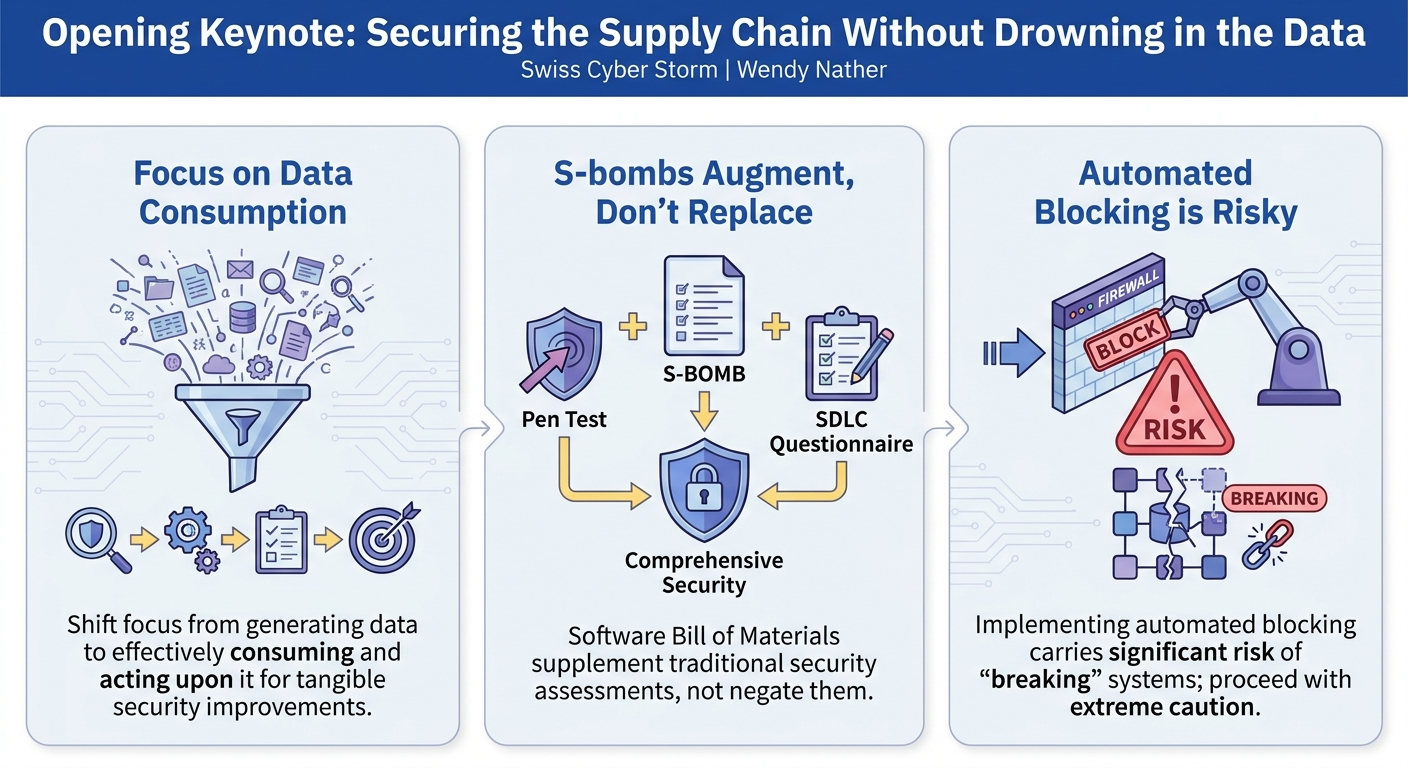
- S-bombs are a Tool, Not a Panacea: While S-bombs provide valuable component-level information, they are not a replacement for comprehensive security assessments like penetration tests or SDLC questionnaires. Their primary utility extends beyond security to areas like license compliance and supply chain provenance.
- Vulnerability Prioritization is Flawed: Drawing on research from the Kenna Security and Cyentia Institute's "Prioritization to Prediction" reports, Nather highlighted a startling finding: using any single prioritization method (e.g., criticality, exploit status, age) for vulnerability remediation is no better than random chance. Only by combining multiple methods can organizations achieve a statistically better outcome, underscoring the complexity of effective vulnerability management.
- Binary Scanning for Vulnerabilities is Inaccurate: Nather shared internal Cisco findings indicating that binary scanning tools were only about 60% accurate in identifying vulnerabilities compared to static source code analysis. This suggests that relying solely on binary scans when source code is unavailable can lead to significant false positives or, more dangerously, a false sense of security.
- Automation of Blocking is Risky ("Blocking is Breaking"): While machine-readable S-bombs might suggest automated mitigation, Nather cautioned against this, particularly for blocking actions in application security. She noted that only about 10% of organizations with Web Application Firewalls (WAFs) actually enable blocking features, with the rest operating in logging mode. The risk of breaking legacy systems or critical applications due to unforeseen dependencies makes aggressive automation impractical for many organizations.
- The "Supply Chain" is a Network, Not a Linear Chain: Organizations are not merely end-consumers but are simultaneously suppliers within a complex, interconnected network. This means they not only receive S-bombs but must also be prepared to generate and share them, understanding their role in a multi-directional flow of dependencies and information.
- Data Overload Creates New Legal and Operational Challenges: The granular detail provided by S-bombs, especially when combined with the "point-in-time" nature of much security data, complicates forensic investigations and breach notifications. Determining which software version was in use months ago or whether a specific component was actually exploited becomes incredibly difficult, potentially leading to over-notification and legal implications.
These findings collectively emphasize that effective supply chain security is less about simply collecting more data and more about developing sophisticated strategies for its contextualization, analysis, and judicious application.
Technical Deep Dive
▶ Watch: Caution: binary scanning for S-BOMs is inaccurate (19:00)
The core technical discussion revolved around the Software Bill of Materials (S-bomb) and its implications for existing security practices. An S-bomb is conceptualized as an ingredient list, providing transparency into the components of a software product. Key elements typically include an artifact ID (identifying an executable, container, or file), and metadata such as vendor name, responsible person, release version, contact information, license, and copyright. While the exact contents are still being standardized, these elements form the basis for its utility.
Nather outlined several practical applications for S-bombs:
- Licensing Compliance: By including licensing metadata, S-bombs can help organizations avoid conflicts (e.g., GPL licenses) or consolidate duplicate software purchases, offering a non-security business benefit.
- Provenance Checking: S-bombs can be used to enforce policies against software from specific regions (e.g., North Korea) or components with known bad reputations.
- Vulnerability Identification: S-bombs can highlight big ticket vulnerabilities associated with specific components, prompting discussions with providers. However, Nather cautioned against delaying procurement over every vulnerability, suggesting focus on "unambiguous" red flags.
Crucially, Nather clarified that S-bombs are an additional tool, not a replacement. They do not negate the need for SDLC questionnaires, which assess vendor maturity and willingness, or penetration tests, which uncover different types of vulnerabilities not necessarily linked to known component flaws. The absence of a reported vulnerability in an S-bomb does not guarantee its security.
Integrating S-bombs into risk and vulnerability management introduces new complexities:
- Criticality Ratings: A vendor's criticality rating for a vulnerability may not align with an organization's specific context. Factors like whether a vulnerable function is actually called, or if existing mitigations are in place, can alter perceived risk.
- Annotation: Organizations must be able to annotate S-bomb data, indicating whether a vulnerability is truly affected, how it's evaluated, and what mitigation steps are being taken, including future plans if a function is not currently in use but might be later. This mirrors existing audit requirements.
- Patching Responsibility: S-bombs deepen the complexity of patching decisions. Who is responsible for patching (the consumer or the supplier)? What is the disposition for open-source components? How are partial remediations managed, especially with deeper dependencies exposed by S-bombs? Nather emphasized that S-bombs push organizations to a more granular, component-by-component assessment, requiring more robust remediation and update processes.
Regarding threat intelligence, Nather stressed the importance of trust in the source of an S-bomb. The contact information within an S-bomb becomes vital for technical questions that the brief S-bomb specification cannot answer. A significant technical caution was raised about scanning binaries versus source code. Cisco's internal data showed binary scanners to be only about 60% accurate compared to static source code analysis. This implies that organizations attempting to scan binaries without source code, out of distrust for a supplier, risk generating numerous false positives or missing critical issues, leading to wasted time and strained vendor relationships.
Nather also critically evaluated the allure of social graphs and automation. While tracing component dependencies and visualizing their widespread use might be "fun" and "cool" for a Black Hat talk, she questioned their practical utility for a CISO. The sheer scale of such graphs might not fundamentally change a decision to remediate or rip out a component, given the significant operational effort involved.
Finally, Nather addressed automation of mitigation/remediation. She expressed skepticism about the idea of machine-readable S-bombs directly feeding firewalls for automated blocking. Her philosophy for automation rests on four pillars:
- Certainty: Be absolutely sure the automation will do what is intended.
- Precision: Carefully scope the automation to affect only desired components, without unintended side effects on dependencies.
- Transparency: Everyone, even non-users, must understand the automation's purpose, inputs, and actions.
- Commitment: Automation requires initial setup and continuous running, not weekly tweaking, which defeats its purpose.
This deep dive reveals that while S-bombs promise greater transparency, they also introduce substantial technical and operational hurdles that demand careful strategic planning and cautious implementation.
Demo / Proof of Concept
▶ Watch: Can you reconstruct past software versions and use? (25:00)
This keynote address focused on strategic and practical considerations for data consumption in supply chain security rather than demonstrating specific tools or proof-of-concept exploits. Wendy Nather's presentation was analytical and advisory, providing frameworks and insights for CISO-level decision-making rather than a technical demonstration.
Defensive Implications
▶ Watch: It's not a supply chain; we are all suppliers (28:30)
Wendy Nather's talk provided crucial defensive implications for organizations grappling with supply chain security data:
- Prioritize Unambiguous "Go/No-Go" Decisions: Defenders should focus on using S-bomb data for clear, policy-driven decisions first. This includes immediately rejecting software from sanctioned entities or components with undeniable, critical vulnerabilities that align with organizational risk appetite. These "go/no-go" decisions are easier to negotiate and implement across departments, including legal and procurement.
- Integrate S-bombs into Existing Processes, but Expect Increased Load: S-bombs are an additional layer of detail, not a replacement for current vulnerability and risk management. Organizations must adapt their existing processes for assessing dependencies, tracking remediation, and managing updates to accommodate the deeper, component-level information. This will inevitably increase the workload for security teams.
- Develop Robust Annotation and Remediation Workflows: Given that criticality ratings are subjective and partial remediations are common, organizations need clear processes for annotating vulnerabilities found via S-bombs. This includes documenting evaluations, planned actions, mitigation strategies, and tracking future dependencies or remediation requirements.
- Understand Data Limitations for Forensics and Notification: The "point-in-time" nature of S-bomb data makes historical forensics incredibly challenging. Defenders must recognize that it's often impossible to definitively know which version of a component was in use months ago or whether a specific vulnerability was actually exploited. This uncertainty can lead to difficult conversations with legal teams regarding breach notification obligations, necessitating proactive engagement with legal counsel.
- Exercise Caution with Automation, Especially Blocking: While the allure of automated mitigation from machine-readable S-bombs is strong, defenders must proceed with extreme caution. Automated blocking in application security carries a high risk of "breaking" critical systems, particularly those with legacy codebases. Automation should only be implemented where there is certainty, precision, transparency, and commitment.
- Define Boundaries for Deep Dependency Vetting: When dealing with SaaS providers and their nested S-bombs (S-bombs of S-bombs), organizations must define a pragmatic limit for how many layers deep they will investigate. Attempting to vet every single dependency endlessly will lead to analysis paralysis and is unsustainable.
- Recognize the Network Effect of the Supply Chain: Organizations are not just consumers; they are also suppliers. Defenders must prepare for their role in generating and sharing S-bombs and other supply chain data with their downstream customers, understanding that their security posture affects others in the broader ecosystem.
- Invest in Contact Information and Trust: The contact information within S-bombs is critical for resolving technical questions. Defenders should prioritize suppliers who provide clear, accessible contact points and foster trusted relationships to facilitate communication during vulnerability disclosures.
- Be Skeptical of Binary Scanning Accuracy: If source code is unavailable, defenders should be aware that binary scanning tools may only be around 60% accurate in identifying vulnerabilities. Relying on these scans without corroborating information can lead to chasing ghosts or missing real threats, wasting valuable security resources.
In essence, defenders must shift their focus from merely acquiring data to strategically consuming, interpreting, and acting upon it, recognizing its inherent limitations and the operational complexities it introduces.
Key Takeaways
- Data Consumption is the Core Challenge: While the industry focuses on generating supply chain data like S-bombs, the real, underexplored problem for practitioners and CISOs is effectively consuming and acting upon this vast amount of information.
- S-bombs are an Augmentation, Not a Replacement: S-bombs provide valuable component-level detail for licensing and provenance, but they do not negate the need for traditional security assessments like penetration tests or SDLC questionnaires.
- Vulnerability Prioritization is Highly Complex: Research suggests that single-factor vulnerability prioritization methods are often no better than random chance; a multi-faceted approach is essential but still challenging.
- Automated Blocking is Inherently Risky: Implementing automated blocking based on S-bomb data carries significant risk in application security ("blocking is breaking") and requires extreme caution, certainty, precision, transparency, and long-term commitment.
- Supply Chain is a Network of Mutual Dependencies: Organizations must recognize their dual role as both consumers and suppliers in a complex, interconnected supply network, preparing to both receive and provide detailed component information.
- New Data Creates New Legal & Operational Hurdles: Granular S-bomb data complicates historical forensics and breach notification obligations, necessitating early engagement with legal teams and clear processes for managing uncertainty.
About the Speaker(s)
Wendy Nather is a distinguished figure in the cybersecurity community, currently serving on the CISO Advisory Board at Cisco. She is widely recognized for her thoughtful and pragmatic insights, often described as a "voice of sense and reason" in security discussions. With a career spanning several decades, Nather brings a wealth of experience from various roles, including working for a Swiss bank 25 years ago and as an industry analyst. Her expertise encompasses the strategic and operational challenges faced by security leaders, particularly in navigating complex issues like supply chain security and data management.
Reviews
Dr. Zero (Offensive Security Researcher) — STRONG ACCEPT
Wendy Nather bypasses the SBOM hype cycle and states what every operator already knows: generating compliance data doesn't patch bugs. She drops concrete internal metrics on binary scanning failures and WAF logging reality to make a solid case against blind automation. This is exactly the kind of sobering, operationally grounded keynote a CISO track actually needs.
Heather Calloway (CISO) — STRONG ACCEPT
Wendy Nather delivers a badly needed reality check on SBOMs and supply chain data consumption. Instead of celebrating data generation, she diagnoses the operational paralysis it causes, offering a pragmatic framework for when to act and when to log.