Partner Keynote: Security through Vulnerability in a connected World
Sandro Nafzger
Swiss Cyber Storm 2021 · Day 1 · Arena
Overview
In an era defined by pervasive connectivity and increasingly complex digital landscapes, the traditional approaches to cybersecurity are proving insufficient. This keynote address, delivered by Sandro Nafzger, founder of Bug Bounty Switzerland, champions a paradigm shift from striving for impenetrable systems to actively embracing and leveraging vulnerabilities. Titled "Security through Vulnerability in a connected World," the talk argues that true cyber resilience is achieved not by avoiding weaknesses, but by proactively seeking them out through collaboration with ethical hackers.
Key moments
- 0:00 Speaker introduction and talk theme: Security through Vulnerability
- 2:00 Introducing the paradigm shift: collaborating with ethical hackers
- 4:00 Real-world examples of critical vulnerabilities found quickly
- 8:00 Why ethical hackers find what automated tools miss
- 12:00 Debunking the 'not ready yet' for bug bounty programs
- 15:45 Protonmail's Head of Security on using bug bounties
- 17:55 Why Protonmail chose a local Swiss bug bounty partner
Partner Keynote: Security through Vulnerability in a connected World
Speakers: Sandro Nafzger, Founder, Bug Bounty Switzerland; Serge Dross, Head of Security, Proton
Conference: Swiss Cyber Storm
YouTube: https://www.youtube.com/watch?v=q73ithD05XY
Overview
In an era defined by pervasive connectivity and increasingly complex digital landscapes, the traditional approaches to cybersecurity are proving insufficient. This keynote address, delivered by Sandro Nafzger, founder of Bug Bounty Switzerland, champions a paradigm shift from striving for impenetrable systems to actively embracing and leveraging vulnerabilities. Titled "Security through Vulnerability in a connected World," the talk argues that true cyber resilience is achieved not by avoiding weaknesses, but by proactively seeking them out through collaboration with ethical hackers.
Nafzger's presentation outlines how bug bounty programs represent a critical evolution in cybersecurity strategy, enabling organizations to dramatically enhance their security posture and gain a competitive advantage. He posits that these programs are indispensable for uncovering the elusive, high-impact vulnerabilities that evade conventional testing methods. The talk culminates in a significant announcement: a partnership between Bug Bounty Switzerland and the renowned secure email provider, Proton, underscoring the real-world applicability and growing adoption of this forward-thinking approach.
This article delves into Nafzger's compelling arguments, exploring the foundational principles, technical intricacies, and strategic implications of integrating ethical hacking communities into an organization's security framework. It highlights why this collaborative model is not merely a supplementary measure but a fundamental requirement for navigating the modern threat landscape and establishing a new standard for cybersecurity, particularly within the Swiss ecosystem.
Background
▶ Watch: Speaker introduction and talk theme: Security through Vulnerability (0:00)
For decades, the prevailing cybersecurity philosophy has been rooted in an aspiration for perfection—to build IT systems devoid of flaws, meticulously hardened against all known threats. Organizations have historically invested heavily in internal security teams, automated scanning tools, and periodic penetration tests, all aimed at identifying and mitigating vulnerabilities before malicious actors could exploit them. This approach often fostered a culture of secrecy around security issues, viewing vulnerabilities as indicators of failure rather than opportunities for improvement. The goal was to project an image of absolute security, often at the expense of genuine understanding of an organization's true risk posture.
Sandro Nafzger’s journey to advocating for "security through vulnerability" began two years prior to this talk, at the 2019 Swiss Cyber Storm conference. He recounts being deeply inspired by the conference's theme of "embracing the hackers," realizing the profound potential of collaborating with the very individuals traditionally viewed as adversaries. This epiphany spurred him to action, leading to the founding of Bug Bounty Switzerland in April 2020. With a team including CTO Florian Botticher, whose experience in bug bounty programs dates back to 2015, the company quickly positioned itself as a leading provider of these services in Switzerland, aiming to establish a national ecosystem for vulnerability management.
Nafzger emphasizes that the traditional, fragmented approach to security testing—involving a limited number of experts examining isolated systems, often in non-production environments—is fundamentally ill-suited for today's interconnected and agile world. Modern IT infrastructures are characterized by constant change, rapid development cycles, and complex supply chain dependencies. In such an environment, the idea of a "perfect" system is a myth; vulnerabilities are an inevitability. The problem, as Nafzger articulates, is that "you don't know what you don't know." Many organizations operate under a false sense of security, believing they have everything under control, while the reality is far more "blurry and scary." This critical gap between perceived and actual security necessitates a radical shift in perspective—one that actively seeks out and embraces vulnerabilities as a cornerstone of continuous improvement.
Key Findings
▶ Watch: Real-world examples of critical vulnerabilities found quickly (4:00)
The central thesis of Sandro Nafzger's talk is underpinned by several compelling findings derived from Bug Bounty Switzerland's experience with various organizations, from critical infrastructure to public sector entities. These findings collectively highlight the urgent need for a paradigm shift in how cybersecurity is approached:
First, Nafzger asserts that no IT system is perfect, and none ever will be. This fundamental truth challenges the traditional goal of achieving absolute security. Instead, he demonstrates that even organizations with very high security maturity levels are immediately vulnerable when subjected to bug bounty programs. He recounts instances where ethical hackers, with no prior knowledge of the target systems, began reporting vulnerabilities within the first hour of a program launching. In one notable example, a remote code execution (RCE) vulnerability was discovered on the second day of testing for a highly mature organization. For less mature systems, RCEs were found within the first hour. This rapid discovery rate underscores the effectiveness of collective hacker intelligence.
Second, bug bounty programs reveal a stark reality about the limitations of conventional security testing. Nafzger shares typical program statistics: from 73 reports received, 90% were accepted, with duplicates being the primary reason for rejection (only the fastest reporter gets rewarded). He notes that while approximately one in ten vulnerabilities found is critical, the sheer volume and diversity of findings paint a picture far removed from the "everything under control" sentiment often expressed by security responsibles. The core revelation here is that "you don't know what you don't know," meaning many organizations are unaware of significant security gaps.
Crucially, Nafzger presents a breakdown of vulnerability types:
- Approximately 48% of the vulnerabilities found in bug bounty programs could theoretically be detected by automated security tools, provided those tools were properly implemented and utilized. In these cases, the bug bounty program acts as a crucial "last line of defense," catching issues that slipped through existing automated checks.
- However, more than 50% of the vulnerabilities discovered, due to their inherent nature, cannot be found by any other security tool or test than a diverse set of ethical hackers. This statistic is perhaps the most impactful finding, demonstrating an irreplaceable value proposition for bug bounties. It implies that without such programs, organizations are almost certainly harboring critical security issues that no other method can uncover.
Finally, the talk emphasizes that even seemingly small or low-severity vulnerabilities, when intelligently chained together, can lead to a significant impact. This highlights the creative and adversarial thinking brought by ethical hackers, which automated tools struggle to replicate. Nafzger also debunks the common misconception that organizations need to be "ready" or highly secure before engaging with ethical hackers, likening it to saying "I will start going to the gym once I am in great shape." He asserts that the "bug bounty effect"—a drastic increase in security maturity and reduction of cyber risks—is universal, regardless of an organization's starting point, providing a much-needed realistic risk assessment.
Technical Deep Dive
▶ Watch: Why ethical hackers find what automated tools miss (8:00)
The technical superiority of bug bounty programs, as articulated by Sandro Nafzger, stems from their ability to harness the collective intelligence of a global community of ethical hackers, addressing fundamental shortcomings of traditional security methodologies. This approach tackles the challenges of scale, scope, and agility that plague conventional testing.
Traditionally, security assessments rely on a limited number of internal experts or external penetration testers. While highly skilled, these individuals possess finite time, specific skill sets, and a defined scope. They often test single systems or fragmented parts of a larger architecture, rarely encompassing the entire attack surface. Moreover, these tests are frequently point-in-time snapshots, often conducted in staging or development environments, which may not accurately reflect the complexities and real-world conditions of production systems. This fragmented, time-bound approach is fundamentally at odds with the dynamic nature of modern IT.
Bug bounty programs, in contrast, offer a holistic and continuous security assessment. Nafzger stresses the importance of leveraging "the collective intelligence of a top-notch global community of ethical hackers, security researchers, and IT talents." This diverse pool brings an unparalleled range of expertise, methodologies, and adversarial perspectives that no single team or automated tool can match. Instead of looking at isolated systems, ethical hackers examine the organization "as a whole," encompassing the entire interconnected ecosystem, including supply chain dependencies—a critical concern in today's digital world.
The most compelling technical argument lies in the statistic that over 50% of vulnerabilities cannot be found by any other security tool or test than a diverse set of ethical hackers. While this talk doesn't delve into specific CVEs or detailed technical examples (referencing CTO Florian Botticher's talk for that), we can infer the nature of these elusive vulnerabilities. They typically include:
- Complex Business Logic Flaws: Automated tools struggle with understanding application logic and how legitimate functionalities can be abused. Ethical hackers excel at identifying these subtle weaknesses, such as insecure direct object references, privilege escalation through non-obvious workflows, or improper input validation within complex multi-step processes.
- Chained Vulnerabilities: A single, seemingly low-severity bug might be harmless on its own, but when combined with other minor flaws, it can create a critical attack path. Ethical hackers are adept at connecting these dots, demonstrating real-world impact through sophisticated attack chains that automated scanners cannot envision.
- Novel Attack Vectors and Zero-Days: The global hacking community constantly discovers new attack techniques and zero-day vulnerabilities. Their creative, out-of-the-box thinking allows them to identify weaknesses that existing tools, built on known signatures and patterns, would simply miss.
- Human-Centric Vulnerabilities: While not strictly technical, issues arising from misconfigurations, weak access controls, or social engineering opportunities (where applicable within scope) often require human discernment to uncover and exploit.
- Race Conditions and Timing Attacks: These highly complex vulnerabilities are notoriously difficult to detect with automated tools, requiring precise timing and understanding of system behavior under load, which ethical hackers can meticulously test.
Furthermore, the "continuous testing" aspect is vital. In an agile development environment where systems change daily, even multiple times a day, traditional annual penetration tests are obsolete. Bug bounty programs offer a 24/7, always-on security layer, adapting to constant updates and new deployments. This ensures that security is baked into the development lifecycle rather than being an afterthought, providing immediate feedback on new vulnerabilities introduced. This continuous feedback loop fosters a proactive security posture, allowing organizations to maintain vigilance over their dynamic attack surface at all times.
Demo / Proof of Concept
▶ Watch: Protonmail's Head of Security on using bug bounties (15:45)
While not a traditional technical demo involving code or exploit execution, the talk featured a powerful real-world proof of concept for the bug bounty model: a live announcement of a significant partnership between Bug Bounty Switzerland and Proton Mail. Serge Dross, Head of Security at Proton, was invited to the stage to discuss this collaboration, providing invaluable third-party validation for the "security through vulnerability" philosophy.
Serge Dross shared Proton's journey and rationale for embracing bug bounties. He explained that upon taking over Proton's bug bounty program 17 months prior, he initially felt overwhelmed. However, he quickly realized its profound value. Despite Proton's reputation for security and its products undergoing three to four traditional penetration tests, the bug bounty program consistently uncovered "really serious" vulnerabilities that had been missed. This experience solidified his conviction that "certain things you cannot find with traditional methods." Dross emphasized that this is not about "bug bounties versus pen testing," but rather a symbiotic relationship: "You don't choose if you put water or flour into bread; you kind of need both, otherwise the bread doesn't taste well."
When asked why Proton, a global company with a significant presence in Silicon Valley, chose Bug Bounty Switzerland over international competitors like HackerOne or Bugcrowd, Dross provided a nuanced answer. He acknowledged that the global players had "outstanding, excellent offerings." However, the deciding factor was Bug Bounty Switzerland's "best offering" combined with Proton's commitment to building a Swiss ecosystem. As a Swiss-headquartered company, Proton believes in supporting high-quality Swiss businesses and contributing to national independence in the cyber realm.
The collaboration also marked a significant milestone for Bug Bounty Switzerland: for the first time in its history, it was opening up its previously exclusive hacker community. Talented IT and security professionals, including pen testers, were invited to apply to join the Proton community to find bugs. This move underscored the collaborative spirit and the drive to expand the pool of ethical hackers contributing to Swiss cybersecurity.
Looking to the future, Dross expressed hope that this initial private, limited-duration program with Proton would evolve into a public bug bounty program and become an "instrumental part of securing our products." Both Nafzger and Dross envisioned a long and fruitful partnership, solidifying the idea that embracing ethical hackers is not a temporary fix but a fundamental, ongoing commitment to robust security. This live demonstration of industry adoption by a highly respected security-focused company like Proton served as compelling evidence of the bug bounty model's efficacy and strategic importance.
Defensive Implications
▶ Watch: Why Protonmail chose a local Swiss bug bounty partner (17:55)
The insights from Sandro Nafzger's talk provide clear and actionable directives for organizations seeking to bolster their cybersecurity defenses in the modern era. The core defensive implication is a fundamental paradigm shift: defenders must move away from the unattainable goal of absolute security and instead embrace "security through vulnerability."
- Embrace Vulnerability and Continuous Learning: Organizations must adopt a mindset that acknowledges the inevitability of vulnerabilities. Instead of fearing or hiding them, they should actively seek them out as opportunities for learning and improvement. This means fostering a transparent and collaborative culture where security is viewed as a continuous process, not a static state.
- Implement Bug Bounty Programs: This is the most direct implication. Organizations should integrate bug bounty programs into their security strategy. Nafzger advises starting with a private bug bounty program to get a "reality checker" and then transitioning to a continuous program, potentially becoming public as maturity grows. This approach provides immediate and drastic increases in security maturity and reductions in cyber risks, offering a realistic, external perspective on an organization's attack surface.
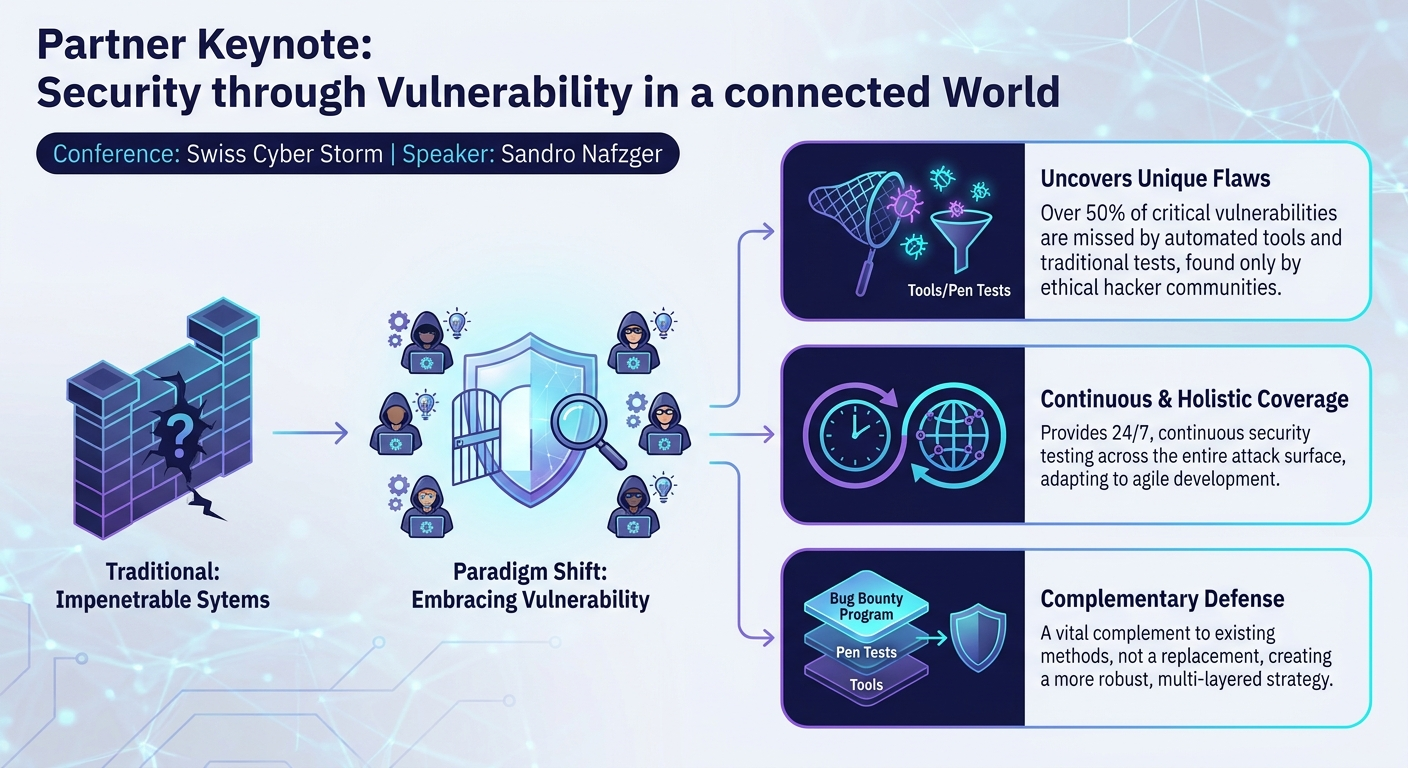
- Complement, Don't Replace, Existing Security Measures: Bug bounty programs are not a silver bullet, nor are they intended to entirely replace traditional methods. As Serge Dross from Proton articulated, they are a vital complement to automated tools, internal security teams, and professional penetration tests. They fill the critical gap of finding the >50% of vulnerabilities that other methods miss, forming a synergistic defense strategy.
- Prioritize Holistic and Continuous Testing: Given the agility and complexity of modern IT environments, organizations need 24/7, continuous security testing that covers their entire attack surface, including supply chain dependencies. Bug bounty programs offer this constant vigilance, adapting to daily changes and ensuring that security is integrated throughout the development lifecycle.
- Build a "Fun and Learning Organization": Adopting a bug bounty program signals a commitment to transparency, collaboration, and continuous improvement. This fosters an organizational culture that is more resilient, adaptable, and attractive to talent. It also builds digital trust with customers and stakeholders, demonstrating a proactive stance on security.
- Don't Wait to Be "Ready": A common misconception is that an organization needs to be highly secure before engaging with ethical hackers. Nafzger emphatically states that there's "never a better time than just right now." The "bug bounty effect" delivers improvement regardless of the starting maturity level, making immediate action beneficial.
- Consider Ecosystem Development: For organizations in specific regions, like Switzerland, supporting local bug bounty providers (e.g., Bug Bounty Switzerland) can contribute to building a stronger national cybersecurity ecosystem, aligning with broader strategic goals of digital independence and high-quality local expertise.
By internalizing these defensive implications, organizations can move beyond reactive security measures to a proactive, adaptive, and highly effective posture, truly embracing security through vulnerability.
Key Takeaways
- Paradigm Shift is Essential: The traditional approach of avoiding vulnerabilities is outdated. Organizations must embrace "security through vulnerability" by actively seeking out and learning from flaws to achieve true cyber resilience.
- Ethical Hackers Uncover Unique Flaws: Over 50% of critical vulnerabilities are missed by automated tools and traditional penetration tests, and can only be found by the diverse skill sets and adversarial thinking of ethical hacking communities.
- Continuous and Holistic Coverage: Bug bounty programs provide 24/7, continuous security testing across the entire attack surface, adapting to agile development and complex supply chains, which static, periodic tests cannot match.
- Immediate Security Maturity Boost: Regardless of an organization's current security maturity, implementing a bug bounty program leads to an immediate and drastic increase in security posture, offering realistic risk assessments and reducing cyber risks.
- Complementary, Not Replacement: Bug bounties are not a standalone solution but a vital complement to existing security tools and practices, creating a more robust, multi-layered defense strategy.
- Fosters a Learning Culture and Builds Trust: Engaging with ethical hackers promotes organizational transparency, collaboration, and continuous learning, ultimately building stronger digital trust with users and stakeholders.
About the Speaker(s)
Sandro Nafzger is the passionate founder of Bug Bounty Switzerland, a company dedicated to elevating cybersecurity standards in Switzerland through the power of ethical hacking. His journey into this field was deeply personal, sparked by the 2019 Swiss Cyber Storm conference, where the theme of "embracing the hackers" profoundly resonated with him. Inspired by the transformative potential of collaborating with ethical hackers, Nafzger was determined to bring this concept to the forefront. His persistence and conviction led him to found Bug Bounty Switzerland in April 2020, with a mission to build a comprehensive Swiss ecosystem for vulnerability management and bug bounty programs. He is a strong advocate for the paradigm shift towards "security through vulnerability," believing it is the only path to true cyber resilience in a connected world.
Serge Dross serves as the Head of Security at Proton, the renowned Swiss company behind secure email and privacy-focused services. With significant experience in managing security programs, including bug bounties, Dross brings a pragmatic and insightful perspective on integrating external security researchers into an organization's defense strategy. He candidly acknowledges the limitations of traditional testing methods, having observed firsthand how even extensively pen-tested products can harbor critical vulnerabilities discovered by bug bounty participants. His decision to partner with Bug Bounty Switzerland not only underscores Proton's commitment to cutting-edge security but also reflects a strategic emphasis on fostering high-quality local cybersecurity ecosystems.
Reviews
Dr. Zero (Offensive Security Researcher) — HARD PASS
This isn't a keynote. It's a localized sales pitch for Bug Bounty Switzerland wrapped in decade-old marketing rhetoric about the 'paradigm shift' of crowdsourced security. Unless you are specifically shopping for a regional European bug bounty broker, there is absolutely zero reason to watch this.
Heather Calloway (CISO) — WEAK
This keynote frames crowdsourced security as a revolutionary paradigm shift, but it ultimately plays as a vendor pitch for Bug Bounty Switzerland. While Proton's inclusion offers a glimpse into regional procurement strategies, the talk ignores the operational tax of running these programs. Skip this unless you are specifically looking for Swiss data sovereignty in your security vendors.