When they attacked the supply chain of a nuclear power plant
Chris Kubecka (Distinguished Chair · Middle East Institute)
Swiss Cyber Storm 2021 · Day 1 · Arena
Overview
In a riveting presentation at Swiss Cyber Storm, Chris Kubecka, a Distinguished Chair at the Middle East Institute, recounted a harrowing incident she describes as her "first nuclear incident" – a sophisticated nation-state attack that leveraged a critical vulnerability in a trusted security vendor to compromise a nuclear power plant's supply chain. The talk meticulously details how an organization’s reliance on a central managed antivirus system, coupled with a vendor's lack of security testing, created an unexpected pivot point for attackers to reach highly sensitive critical infrastructure.
Key moments
- 0:00 Speaker introduction and supply chain trust problem
- 2:39 The specific incident: compromised antivirus vendor
- 4:26 Nation-state attack using unauthenticated 'super dap file'
- 8:00 Emergency physical evacuation plans for employees
- 12:00 Discovery: Attack pivoted to unsegmented nuclear plant
- 14:00 Recommendations: Communicating risks in business language
- 18:20 Q&A: What has the industry learned and improved?
When they attacked the supply chain of a nuclear power plant
Speakers: Chris Kubecka, Distinguished Chair, Middle East Institute
Conference: Swiss Cyber Storm
YouTube: https://www.youtube.com/watch?v=EuvQCbPf4WM
Overview
In a riveting presentation at Swiss Cyber Storm, Chris Kubecka, a Distinguished Chair at the Middle East Institute, recounted a harrowing incident she describes as her "first nuclear incident" – a sophisticated nation-state attack that leveraged a critical vulnerability in a trusted security vendor to compromise a nuclear power plant's supply chain. The talk meticulously details how an organization’s reliance on a central managed antivirus system, coupled with a vendor's lack of security testing, created an unexpected pivot point for attackers to reach highly sensitive critical infrastructure.
Kubecka, drawing on her extensive background in military cyber operations and heading information protection for a global energy giant, illuminates the severe consequences of overlooking cybersecurity in procurement, legal contracts, and vendor selection. The incident escalated rapidly, moving from a digital compromise to the very real threat of physical harm and requiring emergency evacuation plans. This case serves as a stark reminder that even the most seemingly robust security measures can harbor critical weaknesses if the underlying supply chain is not rigorously vetted and secured.
The presentation underscores the intertwined nature of cyber and physical security, particularly within critical infrastructure, and highlights the urgent need for a holistic approach to risk management that extends beyond technical controls to encompass legal, procurement, and executive communication strategies. Kubecka's account is not just a technical post-mortem but a compelling call to action for organizations to rethink their trust models and demand higher security standards from their third-party providers.
Background
▶ Watch: Speaker introduction and supply chain trust problem (0:00)
The pervasive challenge of supply chain security forms the bedrock of Kubecka's narrative. As organizations grow, their reliance on third-party vendors, partners, and contractors expands exponentially, necessitating a level of trust that is often difficult to thoroughly vet. This inherent trust, while essential for business operations, introduces significant attack surfaces that are frequently overlooked or underestimated.
A primary vulnerability stems from deficiencies in an organization's legal and procurement processes. Many legal departments lack the specialized cybersecurity expertise required to embed robust security clauses into contracts. Consequently, agreements may fail to mandate essential security controls such as data encryption (at rest and in transit), independent penetration tests, or adherence to responsible disclosure programs. This oversight leaves procurement departments, often driven by cost-saving mandates, free to select the cheapest options, which, as Kubecka emphasizes, rarely equate to the most secure or privacy-conscious choices. The speaker highlights that this creates a critical gap where organizations can incur significant financial penalties or regulatory fines due to a third-party's security failures, without contractual recourse.
Central to the incident was a central managed antivirus system. These systems are ubiquitous in medium to large organizations, offering streamlined deployment and management of endpoint security across thousands of devices. They operate with admin privileges on every system they protect, making them incredibly powerful—and, if compromised, incredibly dangerous. Kubecka points out a disturbing trend: many security companies and major vendors themselves do not implement robust security testing or responsible disclosure programs for their own products. This creates a paradoxical situation where the very tools designed to secure an organization become its weakest link, functioning as prime targets for sophisticated attackers. The problem is exacerbated by a lack of resiliency planning, leaving organizations vulnerable if their core security infrastructure fails or is weaponized.
The specific geopolitical context of the attack further amplifies its significance. The incident involved a nation-state actor, North Korea, targeting a South Korean joint venture. Kubecka notes that North Korea is notorious for its aggressive cyber campaigns, frequently targeting critical infrastructure and telecom networks, and has a history of physical acts of terrorism and kidnapping. This background underscores the high stakes involved and the potential for cyber attacks to translate directly into physical danger and geopolitical instability.
Key Findings
▶ Watch: Nation-state attack using unauthenticated 'super dap file' (4:26)
The central discovery of this incident revolved around a critical vulnerability within a widely deployed central managed antivirus system from a major security vendor. This vendor, despite providing security solutions, had not adequately security tested its own central management platform. This oversight created a significant backdoor into the speaker's organization and, subsequently, into highly sensitive critical infrastructure.
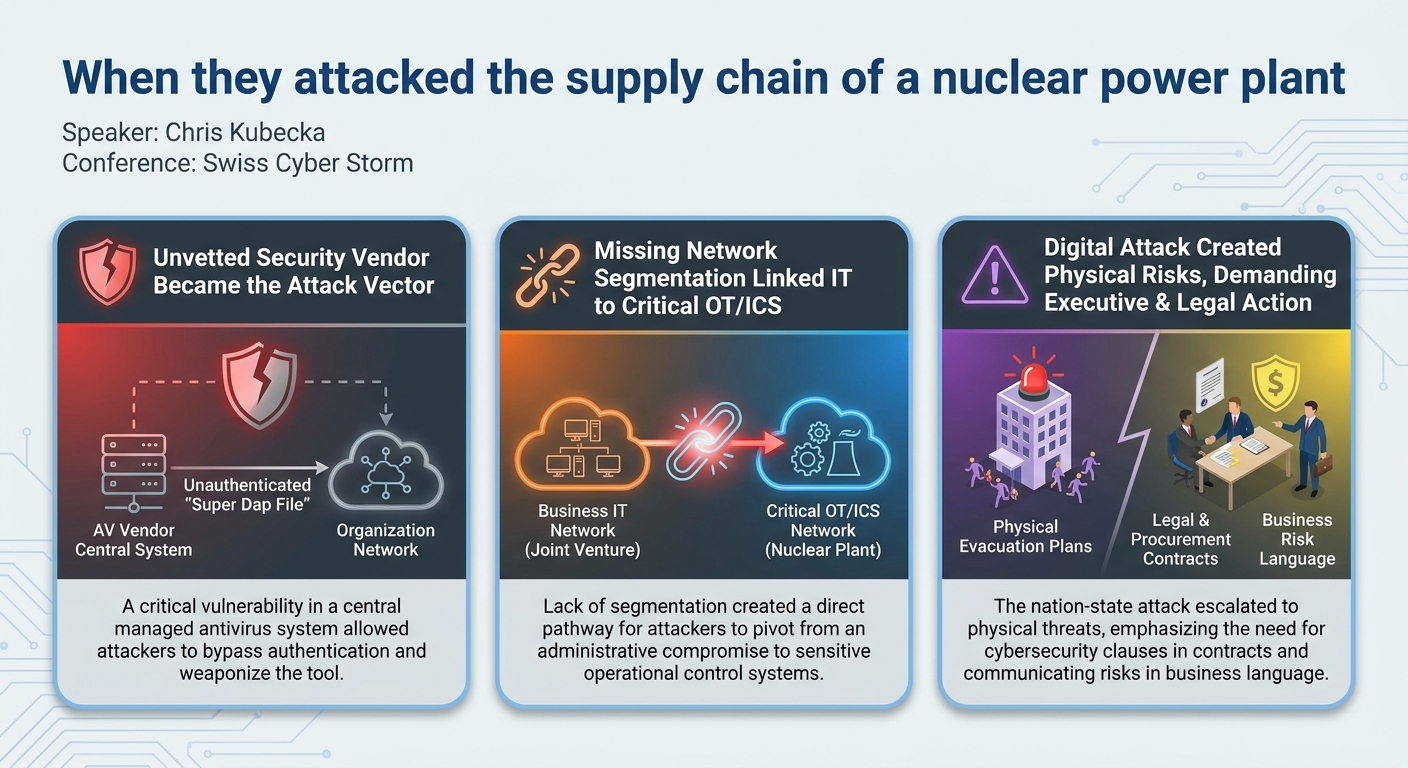
The core of the attack leveraged a mechanism Kubecka termed a "super dap file." Attackers discovered that if another party's central managed antivirus system (which they had presumably already compromised) sent this "super dap file" to the speaker's organization's system, it would be accepted "with no authentication whatsoever." This complete lack of authentication or validation for such a powerful control file represented a catastrophic design flaw.
Upon acceptance, the "super dap file" provided attackers with unprecedented control over the organization’s endpoint security posture. Specifically, the attackers used it to:
- Disable detection for Potentially Unwanted Files (PUA): This was selectively applied to their specific toolset, allowing their reconnaissance and lateral movement tools to operate undetected.
- Turn off malware alerts: For the actual malware payload intended for the attack, all alerts were suppressed, ensuring stealthy operation.
Effectively, the organization's own security tools were weaponized against it, allowing the nation-state actor (identified as North Korea) to gain unhindered access and establish the speaker's network as a pivot point. This pivot was used to launch further attacks against a South Korean joint venture with whom the organization was doing business.
The investigation revealed that the ultimate target was a nuclear power plant connected to the joint venture. A critical finding was the severe lack of network segmentation at both the joint venture and the nuclear facility. The joint venture's network was directly connected to the nuclear facility’s business network, which in turn was unsegmented from its operational control systems. This meant that a compromise starting at an antivirus vendor, pivoting through an initial victim, could directly impact the safety and operations of a nuclear power plant. The attackers exploited this unsegmented architecture to move laterally from an administrative network to sensitive industrial control systems (ICS).
The profound implications of this attack led to extreme measures, including preparing for physical evacuation of personnel, deploying satellite phones as a communication backup, and even considering a dead man switch for data wiping in case of complete loss of control. During the incident response, Kubecka's team contacted Tenable, a cybersecurity company, which commendably developed a special scanner to accurately identify all computers with maliciously adjusted antivirus updates, providing this critical tool free of charge—a stark contrast to the initial antivirus vendor's demand for an additional $50,000 for "platinum support."
Technical Deep Dive
▶ Watch: Emergency physical evacuation plans for employees (8:00)
The technical core of this incident highlights a severe supply chain vulnerability stemming from a critical flaw in a central managed antivirus (AV) system. These systems are designed to offer centralized control over endpoint security, typically running with admin privileges on every managed device. This elevated privilege level makes them an attractive target for adversaries, as compromising the central management server grants control over an entire fleet of endpoints.
The specific vulnerability exploited by the nation-state actor (North Korea) was the AV vendor's failure to adequately security test its own central management solution. This oversight permitted an unauthorized, unauthenticated command-and-control mechanism. Attackers could craft and transmit a specialized file, dubbed a "super dap file," from a pre-compromised central AV system (belonging to another entity) directly to the target organization's AV management server. Crucially, the target system accepted this file "with no authentication whatsoever," bypassing all expected security checks.
The "super dap file" acted as a malicious configuration payload. It contained instructions that allowed the attackers to manipulate the AV software's behavior on managed endpoints. Specifically, the file was configured to:
- Disable detection for "potentially unwanted files" (PUA): This was a surgical strike, turning off PUA detection only for the specific tools and utilities the attackers intended to use for reconnaissance, lateral movement, and privilege escalation. This allowed their initial foothold and subsequent activities to proceed without triggering alerts.
- Suppress malware alerts: For the actual malicious payloads (malware) used later in the attack chain, the "super dap file" instructed the AV system to turn off all associated alerts. This ensured that even if the malware was detected, no alarm would be raised, maintaining the attackers' stealth and persistence.
By effectively weaponizing the organization's own security infrastructure, the attackers transformed the AV system into a compliant agent rather than a defensive barrier. This allowed them to establish the speaker's organization as a pivot point to reach a more critical target: a South Korean joint venture.
The technical progression of the attack then exposed a series of profound architectural weaknesses at the joint venture and its connected facility. The joint venture's network was characterized by an unsegmented network architecture. This meant that once the attackers gained a foothold in the joint venture's business network, they could move freely. Critically, this unsegmented network was directly connected to the business network of a nuclear power plant. The most alarming revelation was that the nuclear power plant itself suffered from a lack of segmentation between its business network and its operational technology (OT) or industrial control system (ICS) network. This direct, unmitigated connection allowed the attackers to potentially bridge the gap from standard IT systems to the critical control systems responsible for operating the nuclear facility. The underlying assumption, "who's going to attack us? why would we be a target?" proved to be a fatal miscalculation.
During the incident response, the team faced challenges in accurately identifying all compromised systems with the manipulated AV configurations. Standard dashboards proved insufficient. To address this, Kubecka's team reached out to Tenable, a cybersecurity company specializing in vulnerability management. Tenable quickly developed a special scanner tailored to detect the specific malicious adjustments made to the antivirus updates across the network. This bespoke tool allowed the incident responders to gain a precise understanding of the scope of compromise and more effectively push out remediation, highlighting the value of vendor collaboration in a crisis.
Furthermore, the extreme nature of the threat led to the consideration of advanced defensive measures, including a dead man switch system. This involved configuring critical data systems with a mechanism using D-band (data wiping) that would automatically initiate a multi-pass data destruction process if a predefined "heartbeat" signal was missed for a certain duration. This drastic measure was designed as a last resort to prevent sensitive intellectual property or operational data from falling into enemy hands during a potential physical evacuation.
Demo / Proof of Concept
▶ Watch: Recommendations: Communicating risks in business language (14:00)
While the talk did not feature a live technical demonstration by the speaker, the narrative itself serves as a detailed account of the attackers' proof of concept (PoC) in action. The core of this PoC was the successful exploitation of the vulnerable central managed antivirus system through the deployment of the "super dap file."
The attackers' ability to craft and transmit this specific file to the target organization's AV management server, bypassing all authentication and validation, definitively proved the existence and exploitability of the underlying vulnerability. Furthermore, the subsequent actions—specifically, the AV system's compliance in turning off "potentially unwanted files" detection for the attackers' tools and suppressing malware alerts—demonstrated the full impact of this PoC. The "super dap file" was, in essence, the attackers' malicious payload and the tangible proof that their chosen attack vector was viable and highly effective at subverting the target's primary endpoint security controls. This real-world demonstration of a security product being turned against its owner is a powerful and chilling example of a supply chain PoC.
Defensive Implications
▶ Watch: Q&A: What has the industry learned and improved? (18:20)
The incident described by Chris Kubecka presents a sobering array of defensive implications, urging organizations to fundamentally reassess their cybersecurity posture, particularly concerning supply chain dependencies and critical infrastructure protection.
- Rigorous Supply Chain Security & Vendor Vetting:
- Demand Security Testing: Organizations must move beyond assuming security vendors are inherently secure. It is imperative to demand evidence of robust security testing, including independent penetration tests and vulnerability assessments, for all third-party security products, especially those operating with high privileges like central managed AV systems.
- Responsible Disclosure: Vendors should be required to have and adhere to transparent responsible disclosure programs. The incident highlighted the AV vendor's poor support response, demanding an additional $50,000 for "platinum support" to address an attack stemming from their own product's vulnerability. This illustrates the need for contractual obligations for vendor support in security incidents.
- Contractual Cybersecurity Clauses: Legal departments must embed stringent cybersecurity clauses into all contracts. These clauses should specify requirements for data encryption (at rest and in transit), independent security audits, incident response obligations, and clear liabilities for breaches originating from the vendor's products or services.
- Procurement Shift: Procurement must balance cost-efficiency with security. The "cheapest option" is rarely the most secure and can introduce immense financial and operational risk. A total cost of ownership model should include potential cybersecurity incident costs.
- Robust Network Segmentation:
- Isolate Critical Infrastructure: The unsegmented networks at the joint venture and the nuclear power plant were a catastrophic flaw. Organizations, especially those managing Operational Technology (OT) or Industrial Control Systems (ICS), must implement strict network segmentation. This involves creating logical and physical barriers between IT networks, business networks, and critical control system networks to prevent lateral movement from less secure segments to highly sensitive ones.
- Zero Trust Principles: Adopting Zero Trust Network Architecture (ZTNA) principles can further bolster segmentation by requiring explicit verification for every access attempt, regardless of origin within the network.
- Comprehensive Incident Response Planning:
- Beyond Cyber: Incident response plans must extend beyond purely technical remediation to include physical security and personnel safety. The preparation for physical evacuation, use of satellite phones, and consideration of data wiping with a dead man switch highlight the extreme measures necessary when critical infrastructure is targeted by nation-states.
- Geopolitical Awareness: Organizations must recognize that attacks can have geopolitical motivations and consequences, potentially involving state-sponsored actors and leading to national security implications.
- Effective Executive Communication:
- Business Lingo: Technical staff (CISOs, security engineers) must translate complex technical risks into business lingo that resonates with management, legal, and procurement. Emphasize financial penalties, regulatory fines, reputational damage, and the potential for "exploitation to capitalize on business" rather than just "bits and bytes." Kubecka's suggestion of bringing an "iodine bottle" to the boardroom to illustrate nuclear risk is a powerful analogy for conveying tangible threats.
- Cross-Functional Collaboration: Foster continuous dialogue between IT/security, legal, and procurement departments to ensure a unified approach to risk management and supply chain security.
- Continuous Monitoring and Validation:
- Trust but Verify: Don't blindly trust security dashboards. Implement independent tools and processes (like the Tenable special scanner) to validate the integrity and operational status of security controls, especially after updates or suspected compromise.
- Proactive Threat Hunting: Assume compromise and actively hunt for indicators of compromise (IOCs) within the network, even when security tools report no issues.
By addressing these defensive implications, organizations can build more resilient and secure environments, better equipped to withstand sophisticated nation-state attacks and protect critical assets.
Key Takeaways
- Security vendors are not immune to vulnerabilities: Organizations must rigorously vet and demand security testing from all third-party security product vendors, especially for central management systems that operate with elevated privileges.
- Supply chain security starts with legal and procurement: Contracts must include specific, enforceable cybersecurity clauses (e.g., encryption, independent pen tests, incident response obligations), and procurement decisions should prioritize security over mere cost.
- Network segmentation is paramount for critical infrastructure: Unsegmented networks, particularly between business IT and operational technology (OT/ICS), create direct pathways for attackers to move from administrative compromise to critical control systems, posing severe physical risks.
- Translate technical risks into business impact for executives: Cybersecurity professionals must communicate risks to management, legal, and procurement using business language, focusing on financial penalties, reputational damage, and tangible threats, rather than purely technical jargon.
- Prepare for extreme incident response scenarios: Comprehensive incident plans must include provisions for physical evacuation, alternative communications (like satellite phones), and data destruction strategies (e.g., dead man switches) when dealing with nation-state attacks on critical infrastructure.
- Trust but verify all security controls: Do not blindly rely on security dashboards; actively validate the integrity of security configurations and be prepared to deploy custom tools (like the Tenable scanner) for accurate incident assessment.
About the Speaker(s)
Chris Kubecka is a highly distinguished figure in the cybersecurity landscape, currently serving as a Distinguished Chair for the Middle East Institute's cyber program. Her career is characterized by an extensive background in both offensive and defensive security, earning her a reputation that, as the conference host quipped, "resembles James Bond a lot."
Kubecka possesses a deep technical understanding, proudly identifying as an "ethical hacker" who enjoys "hacking everything." Her practical experience is vast, having previously headed the Information Protection Group for Aramco, a major global company, where she managed complex and unique threat profiles and challenges. She also brings a significant military background from her service in the US Air Force Space Command, which undoubtedly informs her strategic approach to national security and critical infrastructure protection.
Her current work at the Middle East Institute includes impactful contributions such as drafting the cyber addendum to the Abraham Peace Accords and developing the Gulf Cooperation Countries' GDPR policy. Beyond these high-level policy initiatives, Kubecka is actively engaged in sharing her expertise, having presented multiple times at the United Nations and provided evidence to the EU Commission. She is also being considered as a lecturer at the U.S. Naval Academy to modernize their offensive security education, demonstrating her commitment to advancing cybersecurity capabilities across various sectors. Her unique blend of technical prowess, strategic insight, and real-world incident handling experience makes her a sought-after expert in critical infrastructure security.
Reviews
Dr. Zero (Offensive Security Researcher) — STRONG ACCEPT
Kubecka delivers a brutal post-mortem on what happens when your enterprise security vendor becomes the primary threat vector. This is not a theoretical whiteboard exercise about supply chain risk. It is a step-by-step unrolling of a North Korean pivot from an unauthenticated AV management console straight into an unsegmented nuclear ICS.
Heather Calloway (CISO) — STRONG ACCEPT
Kubecka's breakdown of a nation-state attack on a nuclear facility isn't just an ICS threat briefing; it is an indictment of how we buy enterprise security software. When your centralized AV vendor becomes the unauthenticated pivot point for North Korea, the failure is as much in procurement and legal as it is in network architecture. I'd make this mandatory viewing for my third-party risk and legal teams.