How a Software Bill of Materials is a key factor when securing the supply chain
Patrick Dwyer (Software Development Lead)
Swiss Cyber Storm 2021 · Day 1 · Scenario_2
Overview
In an era defined by complex, interconnected software ecosystems, understanding the provenance and composition of digital assets has become a paramount security challenge. Patrick Dwyer, a Software Development Lead for an Australian government organization and co-leader of the OWASP CycloneDX SBOM standard project, delivered a compelling talk at Swiss Cyber Storm, dissecting the critical role of Software Bill of Materials (SBOMs) in fortifying the software supply chain. His presentation illuminated how modern software development, heavily reliant on third-party components, introduces inherent risks that remain largely invisible without a standardized approach to component transparency.
Key moments
- 2:00 Modern software's reliance on third-party components and risks
- 6:00 The core challenge: knowing if and where you're affected
- 8:40 Defining a Software Bill of Materials (SBoM)
- 11:40 Practical use cases for SBoMs across industries
- 18:00 Getting started with SBoMs: advice for consumers and producers
- 24:00 Commercial pressures and government mandates driving SBoM adoption
How a Software Bill of Materials is a key factor when securing the supply chain
Speakers: Patrick Dwyer, Software Development Lead
Conference: Swiss Cyber Storm
YouTube: https://www.youtube.com/watch?v=zQmtdV-4ZiQ
Overview
In an era defined by complex, interconnected software ecosystems, understanding the provenance and composition of digital assets has become a paramount security challenge. Patrick Dwyer, a Software Development Lead for an Australian government organization and co-leader of the OWASP CycloneDX SBOM standard project, delivered a compelling talk at Swiss Cyber Storm, dissecting the critical role of Software Bill of Materials (SBOMs) in fortifying the software supply chain. His presentation illuminated how modern software development, heavily reliant on third-party components, introduces inherent risks that remain largely invisible without a standardized approach to component transparency.
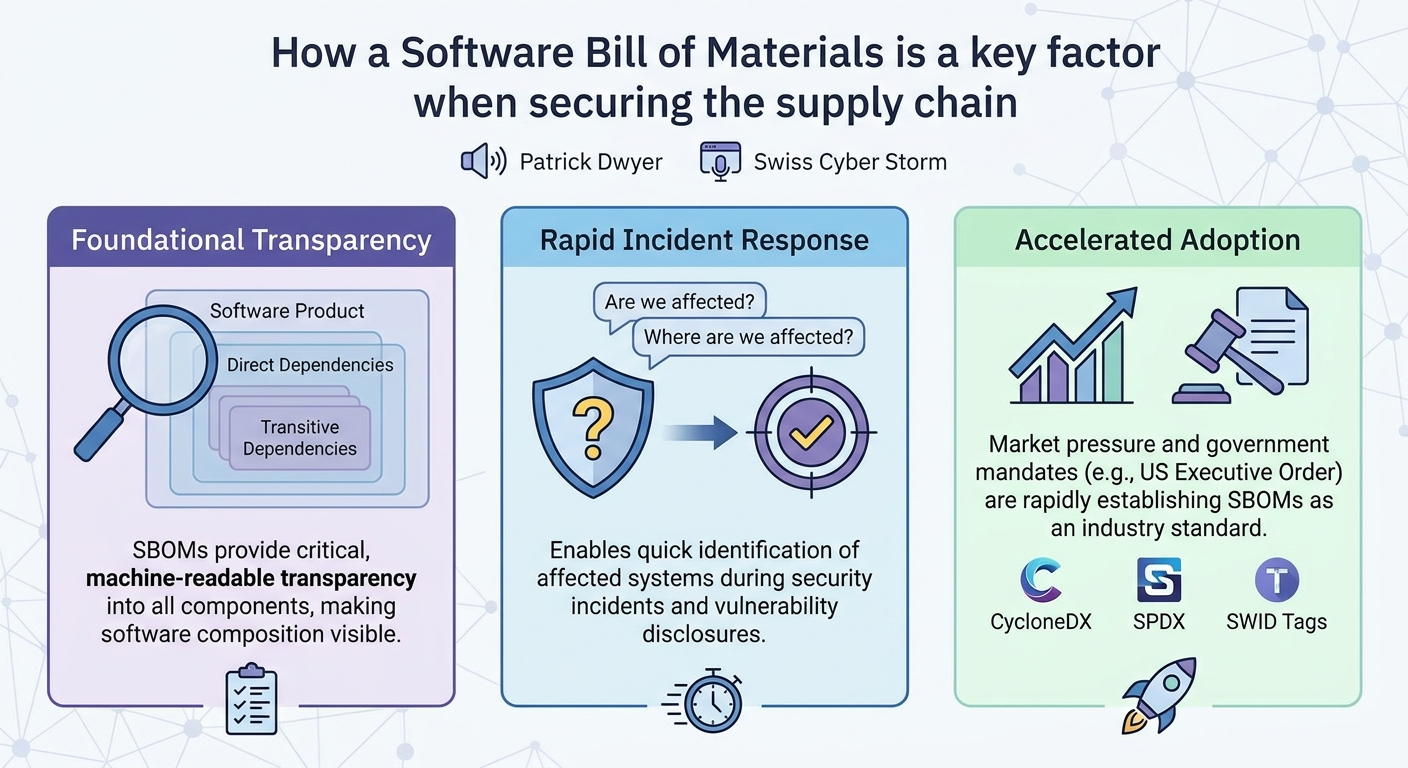
Dwyer's central thesis is that SBOMs are not merely an inventory list but a foundational element for informed risk management and robust cybersecurity. By providing a machine-readable, comprehensive record of all software components—including direct and transitive dependencies—SBOMs empower organizations to answer fundamental questions like "Are we affected?" and "Where are we affected?" during security incidents. This capability is increasingly vital as sophisticated supply chain attacks and widespread vulnerabilities continue to underscore the precariousness of opaque software dependencies.
The talk underscores the urgent need for greater transparency in software, drawing parallels with established standards in other industries like food labeling, where detailed ingredient lists are commonplace. Dwyer argues that the digital infrastructure, which underpins critical services globally, demands a proportional level of trustworthiness and transparency. SBOMs represent the essential mechanism to achieve this, enabling both software producers to understand their own products better and consumers to make risk-based decisions about the software they deploy, ultimately enhancing collective cybersecurity resilience.
Background
▶ Watch: Modern software's reliance on third-party components and risks (2:00)
The modern software landscape is characterized by an extensive reliance on third-party components, whether commercial off-the-shelf (COTS) products or open-source libraries. This modular approach offers undeniable advantages: faster development cycles, reduced costs (especially with open-source software), and enhanced quality by leveraging well-tested, specialized components for common functionalities like cryptography, logging, and data serialization. However, this assembly-line model introduces a significant blind spot: a lack of visibility into the actual ingredients that constitute a software product.
Dwyer highlighted the severe consequences of this opacity with several impactful examples. He referenced the "Copy-Paste Advisory" issued by the Australian Cyber Security Centre, which saw the Prime Minister announce a national cyber attack. This advisory stemmed from persistent attacks on Australian organizations by a state-backed actor, who were "copy-pasting" publicly available exploit code. A particularly salient case involved a critical remote code execution vulnerability in a user interface control component, widely used in internet-facing systems. Despite the CVE and public exploit code being available for six months, many organizations affected were completely unaware they were even using the vulnerable component. Crucially, this was not an open-source component, but a commercial one bundled by vendors, illustrating that the problem extends beyond just open-source dependencies.
The human cost of this lack of transparency was further underscored by a Ponnemon Institute research report, sponsored by Sensornet, on the impact of ransomware on healthcare during COVID-19. The report revealed that 23% of respondents indicated an increase in mortality rate as a direct result of cyber attacks, with third-party risks being identified as the biggest pain point for healthcare delivery organizations. This stark statistic emphasizes that software supply chain vulnerabilities are not merely theoretical risks but have tangible, life-threatening implications.
Dwyer eloquently articulated the core problem by contrasting the digital world with everyday consumer products. He pointed out the ubiquitous presence of food labels, which provide detailed information on ingredients, provenance, and allergens, enabling consumers to make informed, risk-based decisions. Yet, for critical digital infrastructure, such transparency is largely absent. This disparity prevents organizations from answering two fundamental questions crucial during any security incident: "Are we affected?" and "Where are we affected?" The absence of a standardized "ingredient list" for software, akin to a food label or a car's bill of materials with its deeply nested components, leaves organizations vulnerable and unable to adequately assess or mitigate risks. As a recent US Presidential Executive Order on improving the nation's cybersecurity aptly states, "the trust we place in our digital infrastructure should be proportional to how trustworthy and transparent that infrastructure is and the consequences we will incur if that trust is misplaced." SBOMs are designed to bridge this critical transparency gap.
Key Findings
▶ Watch: Defining a Software Bill of Materials (SBoM) (8:40)
The central finding presented by Patrick Dwyer is that Software Bill of Materials (SBOMs) are an indispensable tool for achieving the transparency required to secure the modern software supply chain. Without an SBOM, organizations operate with a dangerous blind spot regarding the components within their software, making effective risk management virtually impossible.
Dwyer outlined the essential information an SBOM typically contains, transforming a vague notion of software into a concrete, auditable inventory:
- Component Name and Version: The fundamental identifiers for any piece of software.
- Author and Supplier: Critical for understanding provenance, as components are often repackaged and redistributed.
- Unique Identifier: A machine-readable reference crucial for automation, such as Common Platform Enumeration (CPE) for commercial products or Package URL (PURL) for open-source components.
- License Information: Essential for legal and compliance reasons, as different licenses carry different obligations and risks.
- Intrinsic Identifier: A cryptographic hash (e.g., SHA-256) to verify the integrity and exact version of a component.
The talk highlighted the existence of multiple SBOM formats, each with distinct origins and primary use cases, yet all contributing to the broader goal of software transparency:
- SPDX (Software Package Data Exchange): An ISO standard originating from the Linux Foundation, initially focused on open-source software compliance, including license and copyright identification.
- SWID Tags (Software Identification Tags): Another ISO standard, traditionally used for software inventory, asset management, and license entitlement.
- OWASP CycloneDX: Emerging from the OWASP community, this format is specifically designed with a heavy focus on software security use cases and supply chain analysis, reflecting its origins in addressing practical security challenges.
Dwyer emphasized the broad applicability of SBOMs beyond just vulnerability detection. Key use cases include:
- Procurement: Enabling informed vendor selection by assessing the quality and security posture of components being shipped.
- Product Lifecycle Management: Particularly for long-lived devices (medical, smart infrastructure), SBOMs help identify when a device's risk profile becomes unacceptable.
- Software Portfolios: Providing a unified, machine-readable view across disparate projects and tech stacks, which was Dwyer's initial motivation for engaging in this space.
- Impact Analysis: Rapidly identifying affected systems during supply chain incidents or newly disclosed vulnerabilities.
- Pedigree and Provenance: Understanding the origin and maintenance history of components, crucial for commercial software vendors who might fork and internally maintain open-source projects.
- License Compliance: Automating the enforcement of open-source license policies.
- Integrity: Verifying that deployed software matches what was supplied and what left the build system.
- Services and Endpoints: Extending the concept of the supply chain to external cloud services and their communication patterns.
- Component Risk: Proactively identifying and managing risks by understanding and even sponsoring strategic open-source components, as exemplified by Gitpod's approach.
Ultimately, Dwyer's findings converge on the idea that SBOMs are reaching a tipping point in their adoption. The US President's Executive Order on improving the nation's cybersecurity, which mandates SBOMs for federal government suppliers, is creating a significant ripple effect across the industry. This top-down pressure, combined with increasing market demand for transparency, is rapidly establishing SBOMs as a foundational requirement for securing the digital supply chain.
Technical Deep Dive
▶ Watch: Practical use cases for SBoMs across industries (11:40)
The core technical concept behind SBOMs is to provide a structured, machine-readable inventory of all components within a software product, including their relationships and associated metadata. This goes beyond a simple list, aiming for a hierarchical representation of a software's "ingredients," much like a car's assembly with its nested sub-components. For instance, a car's dashboard contains an instrument cluster, which in turn contains a speedometer, comprising elements like resistors and LEDs—each with its own supply chain. SBOMs aim to capture this intricate dependency graph for software.
The essential data elements within an SBOM are designed to facilitate automated analysis and comprehensive risk assessment:
- Component Identification:
- Name and Version: The primary means of identifying a component. For example,
Apache Log4j 2.15.0. - Author and Supplier: Crucial for understanding who created the component versus who distributes it. A commercial vendor might supply a product that includes an open-source component, making them the supplier, while the open-source project is the author.
- Unique Identifiers: These are critical for unambiguous, automated lookup.
- CPE (Common Platform Enumeration): A structured naming scheme for IT systems, platforms, and packages, often used for commercial software.
- Package URL (PURL): A proposed standard for identifying and locating software packages, particularly useful for open-source components across various ecosystems (e.g.,
pkg:maven/org.apache.logging.log4j/[email protected]). - Intrinsic Identifier: Typically a cryptographic hash (e.g., SHA-1, SHA-256) of the component's binary or source code. This enables integrity verification, ensuring that the component being used is exactly what was intended and has not been tampered with.
- License Information: While not immediately perceived as a security concern, license compliance is a significant risk factor. SBOMs include details about the licenses under which each component is distributed (e.g., Apache 2.0, MIT, GPL). This allows organizations to automatically enforce policies and prevent the inclusion of incompatible licenses that could lead to legal issues or restrict software distribution. The "left-pad incident" (a trademark issue) or the Ruby on Rails incident (inclusion of GPL code under a non-GPL compliant license) serve as stark reminders of these risks.
- Relationships and Dependencies: An SBOM explicitly defines the relationships between components. This includes direct dependencies (what your application directly uses) and transitive dependencies (what your direct dependencies use). Understanding this full dependency tree is vital because a vulnerability in a deeply nested transitive dependency can still affect the end product.
The talk highlighted three prominent SBOM formats, each with its strengths and historical context:
- SPDX (Software Package Data Exchange):
- Developed by the Linux Foundation and an ISO standard (ISO/IEC 5962:2021).
- Its initial focus was on open-source software compliance, helping organizations track licenses, copyrights, and other legal information.
- SPDX is highly detailed, capable of describing source files, snippets, and packages, making it suitable for deep source code audits.
- SWID Tags (Software Identification Tags):
- Also an ISO standard (ISO/IEC 19770-2:2015).
- Primarily designed for traditional software inventory, asset management, and license entitlement tracking.
- SWID tags provide a standardized way to identify software installed on a system, aiding in patch management and vulnerability assessment across an enterprise.
- OWASP CycloneDX:
- Emerged from the OWASP community, known for its focus on application security.
- Specifically engineered for software security use cases and supply chain analysis.
- CycloneDX is designed to be lightweight, easy to implement, and highly consumable by security tools. It emphasizes the component-to-component relationships and security-relevant metadata. Patrick Dwyer's involvement as a co-leader of this project underscores its focus on practical security applications.
The power of these formats lies in their machine-readability. This characteristic enables automated tooling to parse SBOMs, compare them against vulnerability databases (like the NVD), analyze license compatibility, and identify outdated components at scale. This automation is crucial for managing the hundreds or thousands of components that can make up a single software product, providing a comprehensive and continuously updated view of an organization's software risk posture.
Demo / Proof of Concept
▶ Watch: Getting started with SBoMs: advice for consumers and producers (18:00)
The talk did not include a live demonstration or a detailed description of a specific proof of concept. While the speaker, Patrick Dwyer, mentioned his past work on the OWASP Dependency Check tool as foundational to his involvement in SBOM standards, the presentation focused on the conceptual framework, practical applications, and strategic importance of SBOMs rather than a technical showcase of their generation or analysis.
Defensive Implications
▶ Watch: Commercial pressures and government mandates driving SBoM adoption (24:00)
The widespread adoption of SBOMs carries profound defensive implications for both consumers and producers of software, enabling a shift from reactive patching to proactive risk management.
For Software Consumers (Organizations procuring software):
- Informed Procurement Decisions: Consumers should begin by simply asking vendors for SBOMs. This act itself is a powerful indicator of a vendor's maturity and commitment to security. If a vendor can provide an SBOM, it suggests a greater awareness of their supply chain. If they are unwilling or unable, it raises a red flag.
- Vendor Quality Evaluation: With an SBOM in hand, consumers can perform basic analysis:
- Are the components significantly outdated (e.g., three major versions behind)?
- Do they contain publicly known vulnerabilities? While not all vulnerabilities are exploitable in every context, an abundance of known issues indicates potential neglect.
- Enhanced Vendor Accountability: SBOMs empower consumers to hold vendors accountable for their security posture. For critical vulnerabilities, consumers can set expectations for receiving advisories within a specified timeframe. The "Copy-Paste Advisory" example highlighted how organizations were unaware of vulnerabilities for six months; an SBOM would provide the necessary data to challenge vendors and demand timely disclosures.
- Automated Vulnerability Analysis: SBOMs, being machine-readable, can be automatically consumed by security tools. These tools can then cross-reference the listed components against public vulnerability databases (like the NVD) to quickly identify known CVEs, streamlining the assessment of a vendor's software risk.
For Software Producers (Organizations building and shipping software):
- Internal Transparency and Risk Assessment: The most immediate and significant return on investment for producers is to start by generating SBOMs for their own products. This provides an honest, objective view of their internal component quality and the state of their dependencies. It can reveal where focus might be misplaced (e.g., prioritizing new features over quality or updates) or where development processes lack necessary guardrails (e.g., insufficient testing preventing component upgrades).
- Prioritized Risk Mitigation: Producers should focus their SBOM efforts first on high-value, high-risk products. Once generated, SBOMs help identify:
- Vulnerable Dependencies: Prioritize upgrading patch versions, which often resolve many vulnerabilities without introducing breaking changes. This eliminates the need to assess exploitability for every single vulnerability.
- Outdated Components: Identify components that are no longer actively maintained or have fallen significantly behind current versions.
- Open-Source Software License Compliance: Automatically apply policies to ensure compliance with open-source licenses, mitigating legal and distribution risks.
- Proactive Supply Chain Management: Beyond just identifying risks, SBOMs enable proactive steps. The example of Gitpod was cited, where they analyzed their SBOM, identified strategically important open-source components, and then actively contributed back to those projects or sponsored their maintainers on platforms like GitHub. This approach directly increases the maintainability and security of their own supply chain.
- Improved Development Practices: The process of generating and analyzing SBOMs can highlight systemic issues within a development pipeline, such as a lack of comprehensive testing, which might make developers hesitant to upgrade components. Addressing these underlying issues, perhaps through implementing canary deployments or robust regression testing, improves overall software quality and security.
In essence, SBOMs provide the foundational knowledge required to defend against increasingly sophisticated supply chain attacks. As Dwyer stated, "You can't defend what you don't know about." By making the invisible visible, SBOMs empower both sides of the software supply chain to make informed decisions, build trust, and implement effective security controls. The ripple effect of initiatives like the US Executive Order, mandating SBOMs for federal suppliers, is expected to accelerate this adoption, pushing the industry towards a more transparent and secure future.
Key Takeaways
- Transparency is foundational for security: Software Bill of Materials (SBOMs) provide critical, machine-readable transparency into all components (direct and transitive dependencies) of a software product, essential for securing the supply chain.
- Enables rapid incident response: Without an SBOM, organizations cannot effectively answer "are we affected?" or "where are we affected?" during security incidents or vulnerability disclosures, leading to dangerous blind spots.
- Standardized formats drive adoption: Multiple SBOM standards exist (SPDX, SWID Tags, OWASP CycloneDX), with CycloneDX specifically designed for software security use cases and supply chain analysis.
- Comprehensive defensive capabilities: SBOMs enable a wide range of defensive actions, including informed procurement, vendor accountability for vulnerabilities, proactive internal risk management (e.g., identifying outdated or vulnerable components), and automated license compliance.
- Market forces are accelerating adoption: Increasing market pressure, driven by initiatives like the US President's Executive Order mandating SBOMs for federal government suppliers, is rapidly establishing SBOMs as an industry standard.
- Actionable steps for all: Both software consumers and producers have clear, actionable steps to start leveraging SBOMs, from simply asking vendors for them to generating them internally for self-assessment and proactive supply chain management.
About the Speaker(s)
Patrick Dwyer serves as a Software Development Lead for a government organization in Australia. He is a prominent figure in the open-source security community, notably as a co-leader of the OWASP CycloneDX SBOM standard project. His work extends to being an open-source software maintainer and an active participant in multiple OWASP-related and other international security initiatives. Dwyer's expertise is rooted in practical application, as he leveraged his experience with tools like the OWASP Dependency Check to contribute to the development of standardized SBOMs.
Reviews
Dr. Zero (Offensive Security Researcher) — SOLID
Dwyer is a CycloneDX co-lead who absolutely knows this space, but he delivered a talk that belongs in a 2021 awareness campaign. It is a perfectly competent executive pitch for software supply chain transparency, but it completely skips the technical nightmare of actually implementing and parsing these manifests.
Heather Calloway (CISO) — SOLID
Dwyer delivers a clean baseline argument for SBOMs that outlines exactly why the industry is standardizing on formats like CycloneDX. It provides necessary context for your procurement and architecture teams. It stops short of addressing the operational nightmare of ingesting these files at scale.