Ransomware in Switzerland and around the world: insights, facts and findings
Stephan Berger (Senior Cyber Security Analyst · InfoGuard AG)
Swiss Cyber Storm 2021 · Day 1 · Scenario_1
Overview
In this compelling talk from Swiss Cyber Storm, Stephan Berger, a Senior Cyber Security Analyst at InfoGuard AG, dissects the multifaceted threat of ransomware, offering critical insights derived from extensive incident response engagements across Switzerland and Europe. Berger's presentation, delivered with urgency and precision, moves beyond theoretical discussions to provide a raw, real-world perspective on how attackers breach, persist within, and ultimately encrypt organizational networks. He emphasizes that while ransomware is a pervasive global challenge, its impact on Swiss businesses is significant, often going unreported in public discourse.
Key moments
- 4:40 Hidden web shells evade Microsoft security tools
- 8:00 MFA all the things: Protecting cloud RDP
- 10:00 Attackers use legitimate tools for persistence
- 13:40 Detecting network scanning via high CPU load
- 18:00 Critical mistake: Ignoring antivirus alerts
- 21:00 PingCastle reveals stored domain admin passwords
- 25:00 Ransomware tactics: Disabling AV, weekend attacks
Ransomware in Switzerland and around the world: insights, facts and findings
Speakers: Stephan Berger, Senior Cyber Security Analyst, InfoGuard AG
Conference: Swiss Cyber Storm
YouTube: https://www.youtube.com/watch?v=lWznjxNxpkk
Overview
In this compelling talk from Swiss Cyber Storm, Stephan Berger, a Senior Cyber Security Analyst at InfoGuard AG, dissects the multifaceted threat of ransomware, offering critical insights derived from extensive incident response engagements across Switzerland and Europe. Berger's presentation, delivered with urgency and precision, moves beyond theoretical discussions to provide a raw, real-world perspective on how attackers breach, persist within, and ultimately encrypt organizational networks. He emphasizes that while ransomware is a pervasive global challenge, its impact on Swiss businesses is significant, often going unreported in public discourse.
Berger's expertise stems from InfoGuard AG's "packed shuttle" of weekly ransomware cases, making his observations exceptionally timely and relevant. The talk systematically walks through the entire ransomware kill chain, from initial access vectors like sophisticated phishing and unpatched vulnerabilities, to the stealthy methods of persistence, internal reconnaissance, and data exfiltration, culminating in the final encryption phase. This comprehensive approach highlights not only the technical sophistication of adversaries but also the critical defensive oversights that frequently facilitate successful attacks.
The core message resonates with a stark reality: even with significant security investments, organizations routinely miss crucial indicators of compromise. Berger underscores the importance of diligent monitoring of security tools, robust Active Directory hygiene, and a proactive "assume breach" mentality. His findings serve as an urgent call to action for defenders, providing actionable strategies and forensic artifacts that can empower organizations to detect, respond to, and ultimately prevent the devastating consequences of ransomware attacks.
Background
▶ Watch: Hidden web shells evade Microsoft security tools (4:40)
Ransomware has evolved into one of the most significant and disruptive cyber threats facing organizations globally, and Switzerland is no exception. Stephan Berger's work at InfoGuard AG places him at the forefront of this battle, responding to a constant stream of attacks impacting companies across Switzerland and Europe. The fundamental problem, as Berger illustrates, is how attackers manage to breach seemingly guarded networks, akin to a well-fortified "fortress." Despite advancements in security technologies and employee training, adversaries consistently find pathways into corporate environments.
The talk reveals that many initial access vectors, while seemingly old, remain highly effective. Phishing and malicious documents continue to be a "hot topic" for attackers, despite years of security awareness training. Berger provides vivid examples of both unsophisticated and highly targeted phishing campaigns, such as a convincing German-speaking caller guiding an employee to click a malicious link to track a parcel. Similarly, attackers compromise legitimate mailboxes to send phishing emails from trusted contacts, bypassing typical user skepticism. This highlights the human element as a persistent vulnerability, often exploited through social engineering tactics that even "enormous training efforts" struggle to fully mitigate.
Beyond social engineering, the rapid exploitation of critical vulnerabilities forms another significant entry point. Berger specifically points to a "crazy" year for vulnerabilities, particularly the "uprising and steep peak of Exchange vulnerabilities" in March, which led to a surge in incident response cases. These vulnerabilities, often allowing for remote code execution, enable attackers to establish initial footholds and deploy web shells. Furthermore, the shift of organizational perimeters to the cloud has introduced new attack surfaces, with misconfigured virtual machines and exposed Remote Desktop Protocol (RDP) ports becoming prime targets for brute-force attacks. This combination of human fallibility, unpatched systems, and exposed cloud services creates a fertile ground for ransomware operators to gain their initial access and begin their destructive campaigns.
Key Findings
▶ Watch: Attackers use legitimate tools for persistence (10:00)
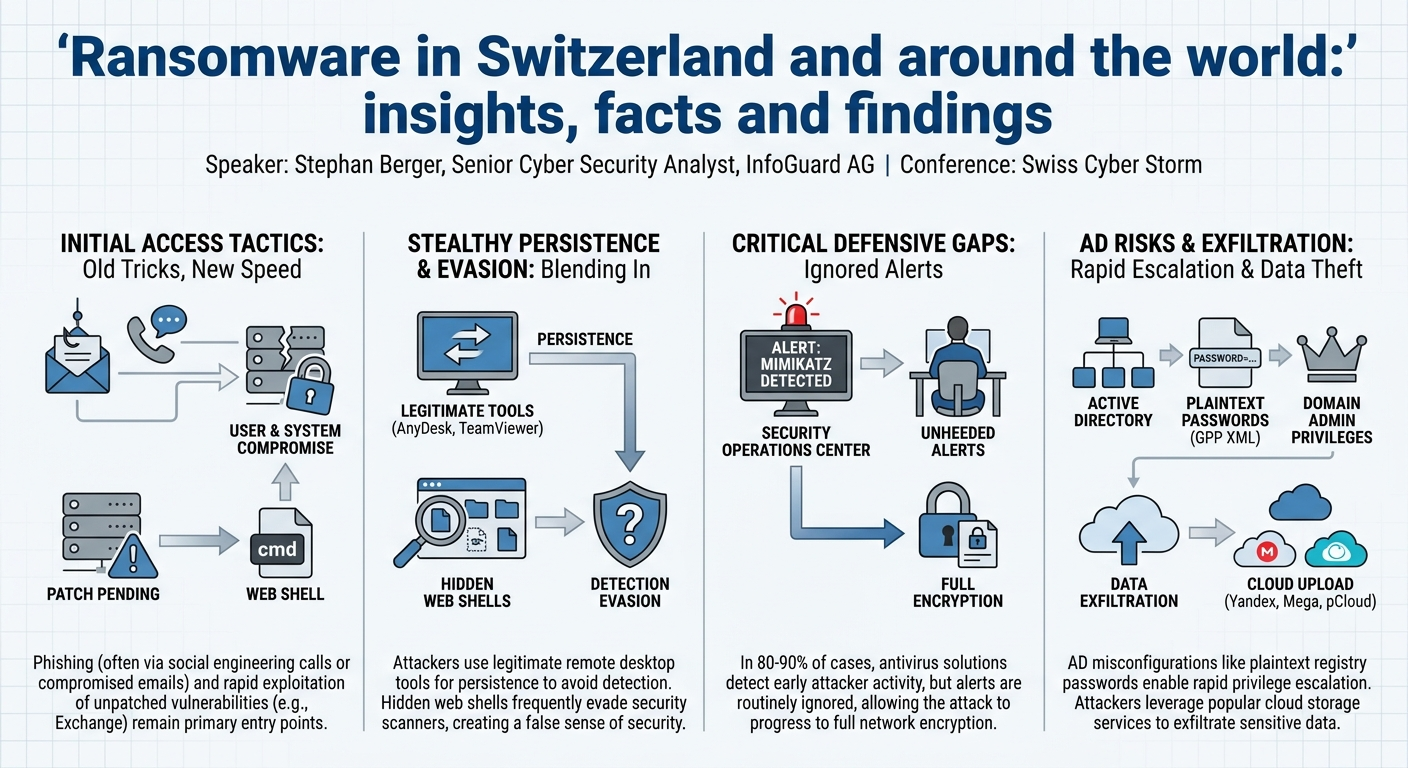
Stephan Berger's presentation distills critical observations from a high volume of real-world ransomware incidents, offering a sobering look at the commonalities in attack methodologies and defensive shortcomings. One of the most striking findings is the enduring effectiveness of traditional initial access vectors. Despite decades of awareness, phishing remains a primary entry point, often combined with sophisticated social engineering tactics like phone calls to guide victims, or leveraging compromised mailboxes to bypass user suspicion. This underscores that human vulnerability persists as a significant attack surface.
A second crucial finding revolves around the rapid exploitation of critical vulnerabilities. Berger specifically cites the Microsoft Exchange vulnerabilities (e.g., ProxyLogon) in March, noting that attackers were observed exploiting these within 6-7 hours of patches being released. This aggressive timeline highlights the need for immediate patching and, more importantly, an "assume breach" mentality, as patching alone does not guarantee a clean system. Berger provided examples where even Microsoft's own scanning tools failed to detect hidden web shells left by attackers, giving organizations a false sense of security. Similarly, Fortinet VPN credential leaks led to network compromises where organizations failed to reset passwords even after patching.
Perhaps the most alarming finding is the widespread failure in monitoring and responding to existing security alerts. Berger states that in 80-90% of all cases, the organization's antivirus (AV) solution picked up "one or maybe more steps of the attackers inside the network," yet "nobody was really paying attention to the antivirus logs." This critical oversight allows adversaries to progress through the kill chain unimpeded, leading to full network encryption. This highlights a fundamental gap between technology deployment and operational security, where valuable telemetry is collected but left unanalyzed.
Finally, Berger revealed that attackers consistently leverage legitimate tools and common IT services for persistence, internal reconnaissance, and data exfiltration. Tools like AnyDesk, TeamViewer, SoftPerfect Network Scanner, and Advanced IP Scanner are widely used by adversaries, blending in with normal network traffic. This tactic makes detection challenging for both automated systems and human analysts, requiring a deeper understanding of baseline network behavior and forensic artifacts to identify malicious activity. The ease with which attackers can elevate privileges through Active Directory misconfigurations, such as plaintext passwords stored in the registry, also represents a recurring and critical vulnerability that often leads to rapid domain compromise.
Technical Deep Dive
▶ Watch: Detecting network scanning via high CPU load (13:40)
Stephan Berger’s presentation offers a granular look into the technical tactics, techniques, and procedures (TTPs) employed by ransomware gangs, drawn directly from incident response cases. The attack chain typically commences with initial access, frequently achieved through phishing campaigns that deploy malicious documents. Berger showcased examples like a fake "Transfer24" parcel notification, where an employee was even telephoned by a German-speaking attacker to ensure they clicked the link and installed malicious software disguised as a parcel tracker. Another method involves compromising an organization's mailbox to send malicious OneDrive links to trusted third parties, leveraging established communication channels to bypass suspicion.
Beyond phishing, exploitation of severe vulnerabilities is a major entry point. The Microsoft Exchange vulnerabilities in March were particularly impactful, enabling remote code execution and the deployment of web shells on Outlook Web Access (OWA) paths. Berger demonstrated a case where a web shell was hidden using the attrib +h command, rendering it invisible to standard directory listings and even some security scanners, including Microsoft's own tool. Attackers also modified the file attributes to prevent deletion, further cementing their persistence. Similarly, Fortinet VPN credential leaks provided direct access, with attackers exploiting organizations that failed to enforce password resets even after patching the underlying vulnerability. In cloud environments, misconfigured Azure virtual machines with exposed RDP port 3389 were routinely brute-forced, leading to administrator access, credential dumping, and subsequent compromise of on-premises networks via network-joined machines.
Once inside, attackers focus on maintaining persistence. A common technique involves installing legitimate remote desktop solutions such as AnyDesk, TeamViewer, Atera, and Splashtop on compromised servers. These tools blend seamlessly with legitimate network traffic, making them difficult to detect by antivirus solutions or network defenders. Berger stressed the importance of monitoring for connections to these providers from unusual hosts (e.g., domain controllers) and analyzing their connection logs for forensic insights, including the adversary's real IP address. The Cobalt Strike attack framework is also ubiquitous, used in "nearly every case" Berger encountered. He highlighted the value of leveraging freely available threat intelligence (e.g., Twitter feeds listing known Cobalt Strike C2 servers) to monitor proxy and firewall logs for suspicious outbound connections.
Internal reconnaissance is crucial for attackers to locate "juicy data" like finance and HR shares. They commonly deploy SoftPerfect Network Scanner and Advanced IP Scanner. These tools, while legitimate, generate noticeable CPU spikes on servers, especially domain controllers, which can serve as a critical detection indicator. Forensic artifacts left by these scanners are invaluable: SoftPerfect Network Scanner may leave a license file on disk, which can potentially link adversaries across different breaches, while Advanced IP Scanner stores the last scanned IP range within the user's registry hive. This registry entry not only reveals the scanned network segments but also identifies the specific user account compromised and used for reconnaissance.
For data exfiltration, attackers leverage popular cloud upload providers such as Yandex, Mega, and pCloud. Berger presented a screenshot of data exfiltrated to Mega, emphasizing that forensic analysis can often recover the credentials (username and password) used by attackers to upload the data. These recovered credentials can provide a significant advantage during ransom negotiations. Monitoring and blocking connections to these known upload providers from internal networks is a key defensive measure, and blocked connection logs can indicate attempted exfiltration.
The final stage often involves Active Directory (AD) manipulation and the deployment of the ransomware payload. Attackers frequently modify Group Policy Objects (GPOs) to disable antivirus products, giving them an unimpeded path to encryption. Berger showcased PingCastle, a free AD assessment tool, as an essential resource for identifying critical vulnerabilities. A prime example is plaintext passwords stored in the registry, particularly within group policy preferences (GPP) XML files. Berger demonstrated how a "support" user's plaintext password, found in a readable groups.xml file, could grant an attacker immediate Domain Administrator privileges, allowing a network to be "burned down within an hour." These AD misconfigurations represent low-hanging fruit for attackers and a critical blind spot for many organizations.
Demo / Proof of Concept
▶ Watch: PingCastle reveals stored domain admin passwords (21:00)
While Stephan Berger's presentation did not feature a live, interactive demo or proof of concept in the traditional sense, it was heavily substantiated with numerous screenshots and real-world examples drawn directly from InfoGuard AG's incident response cases. These visual aids served as compelling evidence of the attack techniques and defensive oversights discussed, offering concrete illustrations of phishing attempts, hidden web shells, exposed RDP ports in Azure, attacker-used network scanners, and exfiltrated data on cloud platforms. The inclusion of actual AV alert logs and PingCastle outputs provided a tangible representation of the attacker's progression and the critical indicators often missed by organizations.
Defensive Implications
▶ Watch: Ransomware tactics: Disabling AV, weekend attacks (25:00)
Stephan Berger's talk provides a wealth of actionable intelligence for defenders seeking to bolster their defenses against ransomware. The recommendations span proactive measures, enhanced detection capabilities, and robust incident response strategies.
Proactive and Preventative Measures:
- Enforce Multi-Factor Authentication (MFA) Everywhere: Berger cannot stress this enough: "Multi-factor all the things." This includes VPN access, remote desktop services exposed to the internet, and all critical internal systems. MFA is repeatedly highlighted as a fundamental control that could save networks from compromise, even when initial credentials are breached.
- Aggressive Patching & "Assume Breach" Mentality: While patching critical vulnerabilities (e.g., Microsoft Exchange) is paramount, it is not sufficient. Organizations must assume breach even after applying patches and conduct thorough forensic analysis by experts to confirm that no persistent artifacts (like hidden web shells) remain. As Berger demonstrated, standard tools might miss sophisticated attacker persistence.
- Secure Cloud Perimeters: When moving systems to the cloud (e.g., Azure), organizations must actively monitor their exposed perimeter. Utilize command-line access tools provided by major cloud providers to regularly scan and generate reports on exposed ports and services. This prevents accidental exposure of services like RDP to the internet.
- Robust Active Directory (AD) Hygiene: Berger strongly recommends using tools like PingCastle (a free software from a French researcher) to assess AD environments for pain points. Specifically, organizations must eliminate plaintext passwords stored in the registry, particularly within Group Policy Preferences XML files. This single vulnerability can allow an attacker to escalate privileges from a low-level user to Domain Administrator "instantly within minutes." He also mentioned BloodHound as a complementary tool for in-depth AD analysis.
Enhanced Detection and Monitoring:
- Diligent Antivirus (AV) Log Monitoring: This is perhaps the most critical takeaway. Berger states that in 80-90% of cases, AV solutions detected attacker activity (e.g., Mimikatz, Meterpreter, password dumps), but alerts were ignored. Organizations must dedicate resources to monitoring AV logs, setting up keyword searches for highly relevant alerts, and treating these alerts as immediate calls to action.
- Monitor for Legitimate Remote Desktop Tool Usage: Track network connections for unauthorized use of legitimate remote desktop solutions (e.g., AnyDesk, TeamViewer, Atera, Splashtop) from unusual hosts like domain controllers or critical servers. These tools are frequently used by adversaries for persistence.
- Monitor for Network Scanner Artifacts: Be alert for unusual CPU load spikes on servers, especially domain controllers, which can indicate internal reconnaissance activity. Forensic teams should search for SoftPerfect license files and Advanced IP Scanner registry entries (containing last scanned IP ranges and user hives) on compromised systems.
- Block and Monitor Cloud Upload Providers: Implement firewall or proxy rules to block connections to known data exfiltration platforms like Yandex, Mega, and pCloud. Crucially, monitor logs for attempted or blocked connections to these services, as they can signal an ongoing data theft attempt.
- Leverage Open-Source Intelligence (OSINT): Utilize freely available data, such as lists of known Cobalt Strike Command and Control (C2) servers published on platforms like Twitter. Integrate these indicators into proxy and firewall logs for daily or hourly monitoring to detect connections to malicious infrastructure.
By implementing these defensive strategies, organizations can significantly reduce their attack surface, improve their ability to detect adversaries early in the kill chain, and ultimately minimize the impact of ransomware incidents.
Key Takeaways
- MFA is Non-Negotiable: Implement Multi-Factor Authentication (MFA) across all critical access points, including VPNs, remote desktop services, and cloud environments, as it is a primary defense against credential compromise.
- Assume Breach, Always: Patching systems is essential but not a guarantee of security. Always assume a breach following critical vulnerability disclosures and conduct thorough forensic analysis by experts to detect and remove hidden attacker persistence.
- Monitor AV Logs Diligently: Organizations are routinely failing to monitor antivirus (AV) logs, missing critical alerts (e.g., Mimikatz, password dumps) that signal active compromise. Prioritize AV log review and immediate response to highly relevant alerts.
- Secure Active Directory: Active Directory (AD) hygiene is paramount. Use tools like PingCastle to identify and remediate vulnerabilities such as plaintext passwords stored in the registry, which allow for rapid privilege escalation to Domain Administrator.
- Beware of Legitimate Tools: Attackers frequently leverage legitimate remote desktop tools (AnyDesk, TeamViewer) and network scanners (SoftPerfect, Advanced IP Scanner) for persistence and reconnaissance. Monitor for their unauthorized use and the forensic artifacts they leave behind.
- Leverage Threat Intelligence & Monitor Outbound Traffic: Utilize open-source intelligence (e.g., Cobalt Strike C2 lists) to monitor proxy and firewall logs. Block and monitor connections to known cloud upload providers (Yandex, Mega) to detect and prevent data exfiltration.
About the Speaker(s)
Stephan Berger is a Senior Cyber Security Analyst at InfoGuard AG, a leading cybersecurity company. With a career in cybersecurity spanning over 10 years, Berger has extensive hands-on experience in incident response and forensic analysis. His role involves actively working on a high volume of ransomware cases for companies across Switzerland and Europe, providing him with unique insights into the latest attack methodologies and defensive challenges. Berger is dedicated to sharing his practical findings to help organizations strengthen their security posture, often publishing his research and insights through InfoGuard AG's blog.
Reviews
Dr. Zero (Offensive Security Researcher) — SOLID
This is a trench-level IR briefing that hits the right operational notes but zero novel research notes. Berger is essentially reading the riot act to defenders about basic hygiene. Solid talk for a blue team audience, but it's mostly an exasperated incident responder begging you to do the basics.
Heather Calloway (CISO) — STRONG ACCEPT
Berger's incident response retrospective is a stark reminder of how security programs actually fail in practice. He provides hard data showing that in almost every ransomware case, the victim's antivirus caught the intrusion early, but the organization simply wasn't watching. It’s a highly credible operational briefing that gives you the exact metrics you need to challenge your own security operations.