Living Cybersecurity - Understanding and Defending against the Unknown Unknowns
Florian Hartmann (Senior Sales Engineer · CrowdStrike)
Swiss Cyber Storm 2021 · Day 1 · Scenario_1
Overview
In this insightful presentation at Swiss Cyber Storm, Florian Hartmann, a Senior Sales Engineer at CrowdStrike, delved into the critical domain of threat hunting, offering a frontline perspective on the ever-evolving landscape of cyber threats. Titled "Living Cybersecurity - Understanding and Defending against the Unknown Unknowns," the talk underscored the limitations of automated security solutions alone and championed the indispensable role of human expertise in uncovering sophisticated, stealthy attacks. Hartmann leveraged CrowdStrike's extensive real-world data and their proprietary threat hunting report to illustrate current adversary tactics, techniques, and procedures (TTPs) observed in customer environments.
Key moments
- 0:00 Introduction to Threat Hunting and CrowdStrike's Role
- 4:20 Understanding Threat Hunting and the Overwatch Team
- 7:30 Key Trends: Faster Lateral Movement and E-Crime
- 12:00 Popular Attack Tools and Adversary Attribution
- 15:45 Case Study: Silent Polymer Attack Walkthrough
- 20:45 Practical Recommendations for Enhancing Defense
- 26:30 Q&A: CrowdStrike's Breach Disclosure and Law Enforcement
- 30:00 Q&A: Pandemic's Influence on Initial Attack Vectors
Living Cybersecurity - Understanding and Defending against the Unknown Unknowns
Speakers: Florian Hartmann, Senior Sales Engineer, CrowdStrike
Conference: Swiss Cyber Storm
YouTube: https://www.youtube.com/watch?v=jUaWXOfQ-lw
Overview
In this insightful presentation at Swiss Cyber Storm, Florian Hartmann, a Senior Sales Engineer at CrowdStrike, delved into the critical domain of threat hunting, offering a frontline perspective on the ever-evolving landscape of cyber threats. Titled "Living Cybersecurity - Understanding and Defending against the Unknown Unknowns," the talk underscored the limitations of automated security solutions alone and championed the indispensable role of human expertise in uncovering sophisticated, stealthy attacks. Hartmann leveraged CrowdStrike's extensive real-world data and their proprietary threat hunting report to illustrate current adversary tactics, techniques, and procedures (TTPs) observed in customer environments.
The core message of the presentation revolved around the idea that while technology provides essential tools, it cannot fully address the "unknown unknowns"—those novel or highly evasive attacks that bypass traditional machine learning and signature-based detections. Hartmann highlighted CrowdStrike's Overwatch team, a dedicated group of human threat hunters who actively search for these elusive threats within vast datasets. By sharing concrete examples and statistical trends, the talk aimed to equip security professionals with actionable intelligence to refine their defensive strategies and bolster their resilience against the most advanced cyber adversaries.
This discussion is particularly pertinent in an era where cybercriminals and state-sponsored actors are continuously innovating, often leveraging stolen credentials and native system tools to blend in with legitimate activity. The insights provided by CrowdStrike, derived from observing trillions of events weekly across their customer base, offer a unique lens into the practical realities of modern cybersecurity, emphasizing the need for proactive, human-driven analysis to stay ahead of persistent threats.
Background
▶ Watch: Introduction to Threat Hunting and CrowdStrike's Role (0:00)
The pervasive challenge in cybersecurity stems from the relentless efforts of cybercriminals, state-sponsored adversaries, and other malicious actors who constantly seek to exploit vulnerabilities in systems and networks worldwide. Traditional security approaches, heavily reliant on signature-based detection or even advanced machine learning models, often struggle to identify novel attack methodologies or highly evasive techniques. This gap highlights the need for a more proactive and human-centric approach: threat hunting.
CrowdStrike's philosophy, as articulated by Hartmann, extends beyond merely offering a product. They emphasize a comprehensive security ecosystem comprising robust technology, highly trained hunters and experts, and sophisticated incident response and threat intelligence capabilities. The adage "technology can't do everything" forms the bedrock of their approach, acknowledging that many breaches—especially those involving stolen credentials or the misuse of native tools—require more than just an automated detection.
Threat hunting, in this context, is defined as an active, iterative process involving statistical methods, a deep understanding of adversary psychology, rigorous data analysis, and the creation of custom tools. Its primary objective is to go beyond standard machine learning detections to actively search for "unknown unknowns" within vast repositories of event data. CrowdStrike's dedicated threat hunting team, Overwatch, embodies this philosophy. Operating 24/7, the Overwatch team processes an astounding 6 trillion events per week from customer environments. Their methodology, dubbed SEARCH, involves statistical analysis and initial searches to generate hunting leads. These leads are then meticulously investigated by human hunters, enriched with threat intelligence, and analyzed to identify stealthy, hands-on-keyboard intrusions. The outcome is not direct remediation but the creation of a detailed detection or incident within the CrowdStrike product, informing customers about suspicious activity and potential adversary attribution.
Key Findings
▶ Watch: Key Trends: Faster Lateral Movement and E-Crime (7:30)
CrowdStrike's 2021 Threat Hunting Report, a comprehensive 60-70 page document based on real-world observations, forms the statistical backbone of Florian Hartmann's presentation. Several critical trends and findings emerged from this report, providing a stark picture of the current threat landscape:
- Accelerated Lateral Movement: A significant observation is the dramatic reduction in the time from initial access to lateral movement. On average, this critical phase occurs within approximately 1.5 hours, with more than 30% of intrusions achieving lateral movement in less than 30 minutes. This acceleration is largely attributed to adversaries leveraging stolen and compromised accounts readily available on black markets, allowing them to bypass initial access steps and immediately establish a foothold for internal network traversal.
- Dominant E-Crime Actors: Wizard Spider remains one of the most active e-crime adversaries, known for its sophisticated and impactful operations. CrowdStrike tracks a vast array of these e-crime groups, with "Spider" nomenclature denoting these entities (e.g., Carbon Spider, Pinchy Spider), totaling 150-160 distinct adversaries.
- Rise of Crypto-Jacking: Beyond traditional e-crime, crypto-jacking has seen a notable increase. Interestingly, this activity is not confined to e-crime groups but is also observed among nation-state actors, including those from North Korea, indicating diversified revenue streams or strategic objectives.
- Targeted Intrusion Trends (Nation-States): While there's a current spike in activity from Vietnam and North Korea, the overall trend over the past year shows China (identified by CrowdStrike as Panda adversaries) as the most prolific source of targeted attacks. The presentation also highlighted a clear spike in attacks targeting Microsoft Exchange servers, a trend widely acknowledged across the security industry.
- Affected Verticals: From a vertical perspective, technology, IT communications (especially for targeted attacks), healthcare, and academic institutions are frequently targeted. The healthcare and academic sectors, in particular, have seen increased nation-state interest, likely linked to the COVID-19 pandemic and research into vaccinations and treatments.
- Regional Threat Landscape (Europe/EMEA): In the European and EMEA regions, Windows operating systems remain the primary target. E-crime constitutes the dominant threat type, with the aforementioned "Spider" groups being particularly active.
- Popular Adversary Tools: Adversaries consistently rely on a mix of well-known tools and native operating system utilities. Frequently observed tools include Cobalt Strike, Mimikatz, Procdump, PsExec, Nmap, and OpenSSL. The critical aspect is not the tools themselves, but how they are used, as specific command patterns can often be attributed to particular adversary groups, akin to reading a "hand signature."
- MITRE ATT&CK Framework Insights: Analysis against the MITRE ATT&CK framework reveals heightened activity in specific tactics. Notably, the use of valid accounts (often stolen) is prevalent, reducing the need for adversaries to perform initial access steps. Account discovery and various other tactics focused on reconnaissance and privilege escalation are also frequently observed.
These findings collectively emphasize a landscape dominated by rapid, adaptable adversaries who effectively blend commodity tools with sophisticated operational security, demanding a proactive and intelligent defensive posture.
Technical Deep Dive
▶ Watch: Case Study: Silent Polymer Attack Walkthrough (15:45)
To illustrate the practical application of threat hunting, Florian Hartmann presented a detailed case study from CrowdStrike’s threat hunting report, focusing on an intrusion dubbed "Silent Polymer." This attack targeted a pharmaceutical company, specifically a Windows endpoint, showcasing how subtle adversary actions can be detected through meticulous human analysis.
The Silent Polymer adversary, though named by CrowdStrike, exhibited tactics that allowed for attribution based on observed patterns. The attack unfolded through several stages, each leaving discernible traces for the hunting team:
- Initial Access: The intrusion began with extensive reconnaissance, generating a high volume of events under a standard Windows service account. This activity, while potentially benign in isolation, raised a flag for the threat hunters due to its unusual volume and context. Specifically, the use of SMBExec commands was identified during this reconnaissance phase, indicating an attempt to enumerate and interact with network shares and services.
- Execution: Following reconnaissance, the adversary utilized SMBExec tools for execution. The hunting team observed specific command-line activities that pointed to the use of these tools, facilitating remote execution. This was coupled with general SMB activity and the deployment of malware code, along with RPC (Remote Procedure Call) indicators, suggesting inter-process communication or lateral movement attempts within the network.
- Defense Evasion: A particularly interesting aspect was the adversary's defense evasion techniques. The attackers were observed storing binaries on the compromised system and then overwriting existing files. An example cited was the use of the
pingcommand to redirect its output into other files, a technique often used to create or modify files while masquerading as legitimate system activity. The way these evasion tactics were executed, specifically the unique command patterns and sequence of operations, allowed CrowdStrike to attribute this to Silent Polymer, as similar methods had been observed in previous attacks by this adversary. - Command and Control (C2): For Command and Control (C2), the adversary primarily relied on PowerShell requests communicating over HTTP. While this attack specifically used HTTP, Hartmann noted that in other observed intrusions, DNS traffic is also frequently employed for C2. CrowdStrike's EDR (Endpoint Detection and Response) system is capable of detecting anomalies in DNS traffic, such as unusually large data payloads within DNS events, which can be indicative of covert C2 channels or data exfiltration. Another specific tool mentioned in this context was "while four," which was part of the C2 or post-exploitation toolkit.
The detection of this attack was not based on a single signature or a simple machine learning alert. Instead, it was the aggregation and contextual analysis of seemingly disparate events—unusual SMB activity, specific command-line arguments, and file manipulation techniques—that allowed the human hunting team to piece together the intrusion. The combination of basic tools like cmd.exe and PowerShell, when used in these specific, attributable ways, highlighted the adversary's skill in leveraging native functionalities for malicious purposes. Upon confirmation, the Overwatch team generated a detection within the CrowdStrike UI, alerting the customer to the active intrusion and recommending network containment of the affected host and remediation steps, such as removing adversary-copied files.
Demo / Proof of Concept
▶ Watch: Practical Recommendations for Enhancing Defense (20:45)
This talk did not include a live demonstration or proof of concept. Instead, Florian Hartmann presented a detailed case study, "Silent Polymer," as an example of a real-world intrusion observed by CrowdStrike's threat hunting team. This case study, drawn from their comprehensive threat hunting report, meticulously walked through the stages of an attack, highlighting the adversary's tactics and the specific technical indicators that led to its detection. The emphasis was on illustrating past successes and observed TTPs rather than showcasing a live exploit or defensive capability in action.
Defensive Implications
▶ Watch: Q&A: Pandemic's Influence on Initial Attack Vectors (30:00)
The insights gleaned from CrowdStrike's threat hunting efforts provide several crucial defensive implications for organizations aiming to bolster their security posture against sophisticated adversaries. These recommendations span technology, processes, and human expertise:
- Comprehensive EDR Deployment: The foundational recommendation is to install Endpoint Detection and Response (EDR) sensors on all hosts within an environment. Eliminating blind spots is paramount, as adversaries will inevitably target unmonitored systems. EDR tools collect a vast amount of event data, which is essential for any effective hunting operation.
- Proactive Monitoring and Hunting:
- Monitor service account activity: Adversaries often compromise and misuse service accounts, so any unusual activity from these accounts warrants immediate investigation.
- Hunt for malicious services and specific commands: Look for services running with unusual configurations or commands executed by non-administrative users that are outside their normal job functions.
- Monitor remote user connections and share access: Anomalous remote access patterns or excessive access to network shares can indicate lateral movement or data exfiltration attempts.
- Effective Data Collection and Accessibility: Organizations should leverage tools that not only collect extensive event data but also make it easily accessible for analysis. Whether this involves integrating EDR data with a SIEM (Security Information and Event Management) system like Elastic or using other data exfiltration tools, the goal is to create a centralized, searchable repository for hunting.
- Embrace the Human Element: Technology, while critical, is insufficient on its own. Organizations must invest in trained security operators and threat hunters. Adversaries are human, with experience and adaptability, and only skilled human hunters can effectively counter their evolving TTPs, especially when dealing with "unknown unknowns." This means developing internal hunting capabilities or partnering with managed detection and response (MDR) services like CrowdStrike's Falcon Complete.
- Optimize Security Platform Utilization: Simply deploying a security platform is not enough; it must be used effectively. This involves configuring it optimally, ensuring agents are deployed everywhere, and integrating its capabilities into a broader security operations strategy.
- Robust IT Hygiene: Many successful attacks exploit basic weaknesses. Fundamental IT hygiene practices remain critical:
- Patch Management: Regularly patch and update all software and operating systems to remediate known vulnerabilities.
- Remove Unneeded Software: Minimize the attack surface by uninstalling unnecessary applications and services.
- Asset Inventory: Maintain an accurate inventory of all assets in the environment to understand what needs to be protected.
- Strong Password Policies and Multi-Factor Authentication (MFA): Implement and enforce strong password policies and mandate MFA for all user accounts, especially for privileged access and remote connections.
- Identity Protection: Utilize tools to check corporate passwords against public breaches (e.g., "Have I Been Pwned") to identify and force resets for compromised credentials.
- Restrict Non-Native Tools and Access: While full application whitelisting can be challenging to implement, organizations should aim to restrict the use of non-native tools where possible. More practically, robust monitoring of all executed applications, both native and third-party, is essential. Additionally, strictly control and restrict remote access mechanisms, implementing granular permissions and strong authentication.
By integrating these defensive strategies, organizations can move beyond reactive security and establish a proactive, intelligence-driven defense capable of detecting and responding to even the most sophisticated and stealthy cyber intrusions.
Key Takeaways
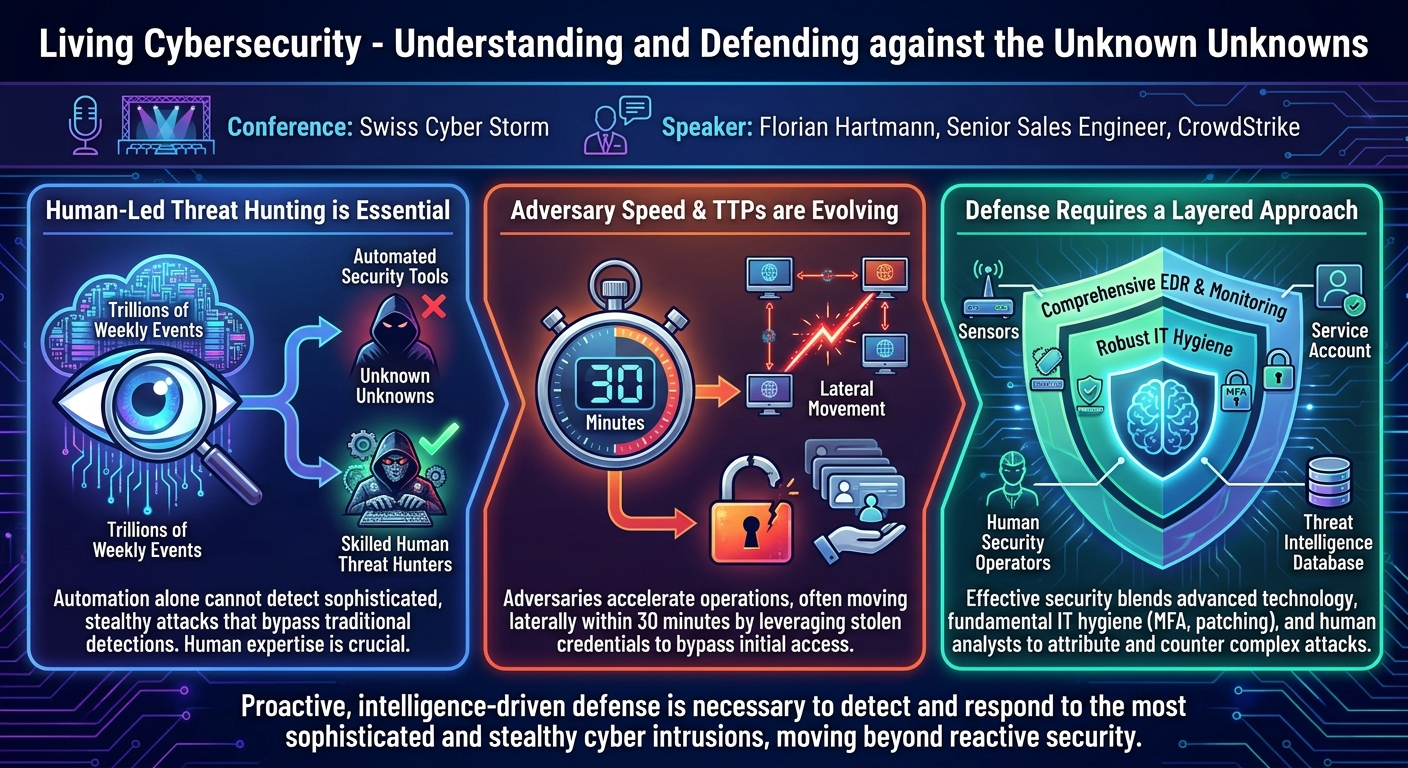
- Human-Led Threat Hunting is Essential: Automated security tools alone are insufficient to detect sophisticated, "unknown unknown" attacks; a dedicated team of human threat hunters is crucial for uncovering stealthy, hands-on-keyboard intrusions.
- Adversary Speed and TTPs are Evolving: Adversaries are accelerating their operations, with lateral movement often occurring within 30 minutes, frequently leveraging stolen credentials to bypass initial access and accelerate their objectives.
- Common Tools, Uncommon Exploitation: Tools like Cobalt Strike, Mimikatz, and native OS utilities (e.g., PowerShell, SMBExec) are consistently weaponized in novel and attributable ways by both e-crime and nation-state actors, demanding vigilance beyond simple signature matching.
- Comprehensive EDR and Monitoring are Foundational: Full deployment of EDR sensors across all hosts, coupled with diligent monitoring of service account activity, remote connections, and unusual command execution, provides the necessary data for effective threat hunting.
- Defense Requires a Layered Approach: Effective cybersecurity necessitates a blend of advanced technology, robust IT hygiene (patch management, MFA, strong passwords), and skilled human security operators who can analyze and attribute complex attack patterns.
- Attribution Informs Strategy: While challenging, attributing attacks to specific e-crime groups or nation-states (e.g., CrowdStrike's Spider or Panda adversaries) provides invaluable intelligence on their motives, capabilities, and preferred TTPs, enabling more targeted and effective defensive strategies.
About the Speaker(s)
Florian Hartmann is a Senior Sales Engineer at CrowdStrike, focusing on the Germany, Austria, and Switzerland (DACH) region. With a tenure of about one and a half years at CrowdStrike at the time of this presentation, he brings a wealth of experience from the front lines of cybersecurity. Hartmann specializes in providing real-world insights into adversary tactics and threat hunting methodologies, drawing directly from CrowdStrike's extensive data and incident response experiences. His expertise helps organizations understand and defend against advanced cyber threats by leveraging CrowdStrike's platform and threat intelligence.
Reviews
Dr. Zero (Offensive Security Researcher) — HARD PASS
This isn't a research talk. It's a 45-minute sales pitch for CrowdStrike's Overwatch managed service dressed up as threat intelligence. Reading statistics from a vendor marketing report about how fast ransomware operators move laterally does not teach defenders how to catch them.
Heather Calloway (CISO) — WEAK
A CrowdStrike sales engineer recaps their annual threat report, emphasizing the compression of lateral movement timelines and the need for human threat hunters. The underlying data on adversary speed is useful for benchmarking your SOC, but the presentation itself is primarily a vehicle for selling managed detection and response services.