Security Automation: Reduce workload und speed up your incident response
Rolf Hefti (Head of Product Management in Cyber Defense · terra active)
Swiss Cyber Storm 2021 · Day 1 · Scenario_1
Overview
In an era defined by a persistent shortage of skilled cybersecurity professionals and an ever-increasing volume of sophisticated threats, the quest for scalable and efficient security operations is paramount. This talk by Rolf Hefti, Head of Product Management in Cyber Defense at terra active, addresses a critical question: Can Security Orchestration, Automation, and Response (SOAR) tools truly deliver on their promise, or are they merely "snake oil"? Hefti presents a compelling case for SOAR, arguing that it is an indispensable component of modern security, capable of significantly reducing the workload on security analysts and dramatically accelerating incident response times.
Key moments
- 0:00 Introduction to SOAR and the talent shortage problem
- 3:20 Terra Active's secure SOAR implementation strategy
- 7:00 SOAR's benefits for security analysts and hybrid SOCs
- 11:00 Integrating SOAR into a comprehensive cyber defense platform
- 12:40 Automating phishing attack response workflows
- 17:00 Making SOAR affordable with modular services
- 19:00 Quantifiable benefits: time savings and improved response
- 22:30 When to implement SOAR: early adoption vs. maturity
Security Automation: Reduce workload und speed up your incident response
Speakers: Rolf Hefti, Head of Product Management in Cyber Defense, terra active
Conference: Swiss Cyber Storm
YouTube: https://www.youtube.com/watch?v=0QoJRRqqE7A
Overview
In an era defined by a persistent shortage of skilled cybersecurity professionals and an ever-increasing volume of sophisticated threats, the quest for scalable and efficient security operations is paramount. This talk by Rolf Hefti, Head of Product Management in Cyber Defense at terra active, addresses a critical question: Can Security Orchestration, Automation, and Response (SOAR) tools truly deliver on their promise, or are they merely "snake oil"? Hefti presents a compelling case for SOAR, arguing that it is an indispensable component of modern security, capable of significantly reducing the workload on security analysts and dramatically accelerating incident response times.
Hefti, representing terra active, a Swiss cyber defense provider, highlights the core challenges faced by organizations today: the difficulty in hiring and retaining top security talent, the need to scale security operations without proportional increases in headcount, and the desire to provide engaging, less repetitive work for analysts. SOAR, in his view, is the answer to these dilemmas, transforming tedious manual tasks into automated workflows, thereby freeing up human experts for more complex, analytical work. The talk delves into how SOAR can bridge the gap between detection and effective, timely response, a crucial capability in a landscape where threats like phishing attacks are daily occurrences.
The presentation emphasizes that successful SOAR adoption requires careful planning, a deep understanding of organizational context, and a commitment to integrating automation into the very fabric of security operations. Hefti shares terra active's experience in deploying SOAR, specifically leveraging Palo Alto XSOAR, to serve a diverse customer base ranging from hospitals and banks to industrial companies. His insights extend beyond the technical implementation, touching upon the strategic considerations of making advanced security automation affordable and accessible to organizations of all sizes, ultimately proving that SOAR is a vital tool for achieving a higher maturity level in cyber defense.
Background
▶ Watch: Introduction to SOAR and the talent shortage problem (0:00)
The journey towards robust security automation, as Rolf Hefti explains, is often met with initial skepticism, particularly from Chief Information Security Officers (CISOs). While analysts may envision the efficiency gains, CISOs frequently perceive the inherent risks associated with powerful automation tools, viewing them as potential points of failure or misuse rather than enablers of agility. This dichotomy underscores a fundamental challenge in introducing transformative security technologies: balancing innovation with risk management and demonstrating tangible value beyond theoretical capabilities.
Terra active approaches this challenge from a unique vantage point. As a dedicated Security Operations Center (SOC) provider, their internal culture is inherently security-first, contrasting with many customer organizations where security often competes with performance, availability, and usability for priority. This security-centric ethos allows terra active to rigorously evaluate and integrate new tools like SOAR. Their internal development of a comprehensive SOC management framework, which has evolved over 20 years, serves as a testament to their commitment to secure and effective operations. This framework not only monitors all tools used internally and by customers but also incorporates continuous penetration testing by their in-house experts, ensuring that any new technology, including SOAR, is introduced in the safest possible manner and continuously monitored for emerging risks.
The problem SOAR addresses is deeply rooted in the current state of cybersecurity operations. Many organizations, even those with advanced detection capabilities like Security Information and Event Management (SIEM) and Endpoint Detection and Response (EDR), struggle with the "respond" phase of the incident lifecycle. Once a threat is detected, the manual steps involved in gathering context, coordinating across teams, and executing remediation actions are often slow, inconsistent, and prone to human error. This is exacerbated in hybrid SOC models, where security responsibilities are shared between internal teams, external providers like terra active, and sometimes third-party partners. The lack of a streamlined, automated information flow in such environments leads to unnecessary costs, delays, and a fragmented understanding of critical assets or "crown jewels."
Hefti illustrates the evolution of the cyber defense platform, noting that what was once primarily a SIEM solution has expanded significantly. Modern platforms, mapped against industry standards like the NIST Cybersecurity Framework attack phases, now demand a broader array of tools. Specifically, for the Response and Recover phases, SOAR has become an essential component. Without it, organizations are left to manage complex incidents manually, a method deemed insufficient for the maturity levels required in the current threat landscape (e.g., in 2021). The challenge, then, for terra active was not just to implement SOAR but to engineer a solution that was robust, effective, and, crucially, affordable for their diverse Swiss customer base, enabling even smaller organizations to benefit from advanced automation. This led to their development of a shared vSOAR solution and a modular service offering.
Key Findings
▶ Watch: SOAR's benefits for security analysts and hybrid SOCs (7:00)
Rolf Hefti's presentation firmly establishes that SOAR is a transformative technology, debunking any notion of it being merely "snake oil." His key findings, derived from terra active's extensive experience, highlight several critical contributions and benefits:
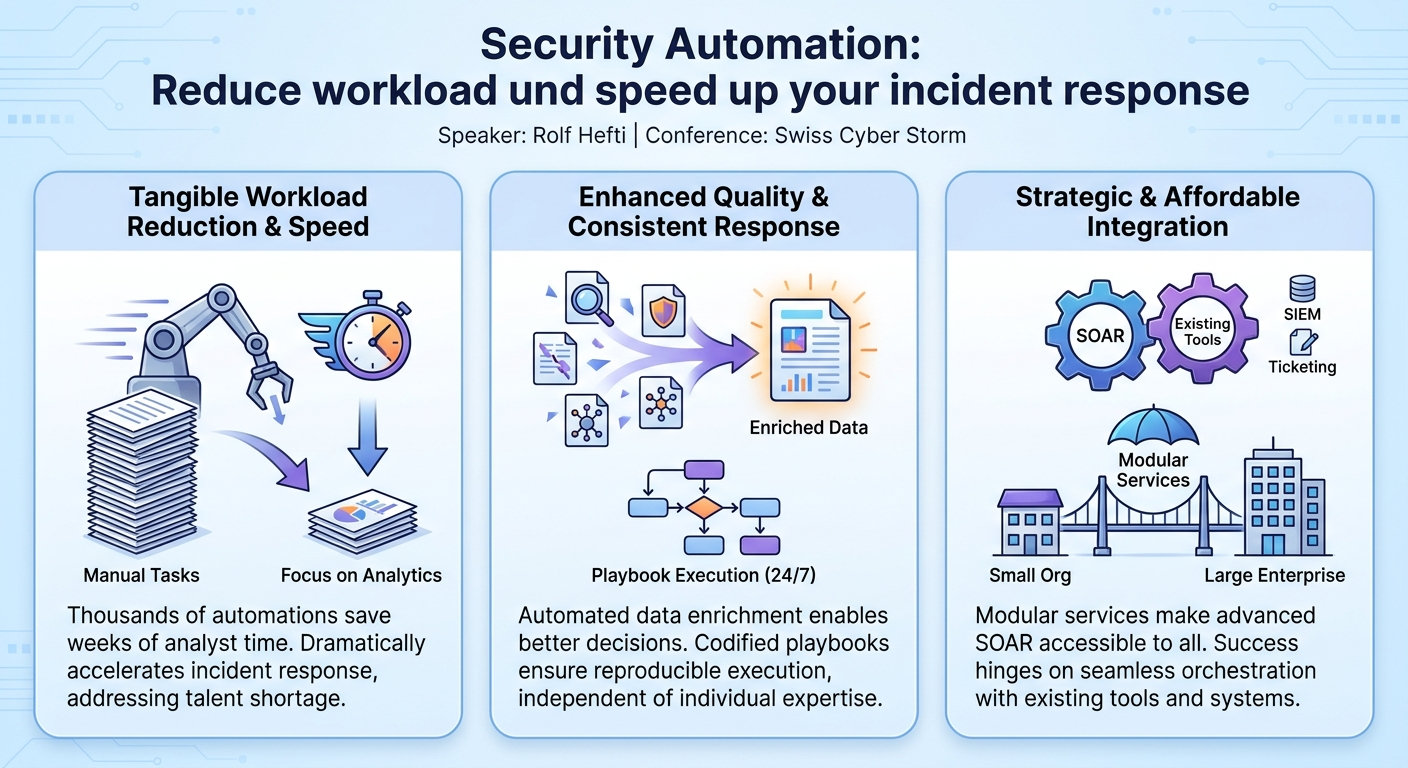
- Tangible Workload Reduction: SOAR demonstrably reduces the manual workload on security analysts. Hefti cites an impressive figure of over 9,000 automations for larger customers in a single quarter. Projecting this, if each automated task saved just one minute, it translates to approximately 19 working days (based on an 8.4-hour workday) saved per quarter. This frees analysts from tedious, repetitive tasks, allowing them to focus on more complex, analytical work that requires human intuition and expertise.
- Accelerated and Consistent Incident Response: Automation drastically speeds up incident response processes. Beyond mere speed, SOAR ensures a higher quality and consistency of response by codifying expert-designed workflows. This means that even if a key expert is on holiday or unavailable, the response process proceeds reliably and effectively, maintaining a high standard of quality.
- Enhanced Incident Information Quality: SOAR platforms excel at automatically gathering and correlating vast amounts of information from disparate security tools and IT components. This provides human analysts with a richer, more comprehensive data set upon which to make decisions, leading to more accurate incident triage and response. Hefti notes that without automation, obtaining this level of qualified information manually is significantly more difficult.
- Improved Cross-Organizational Collaboration: In complex hybrid SOC environments involving internal teams, external providers, and partners, SOAR acts as a central hub for information exchange and coordinated action. It helps design clear, reproducible processes that ensure all stakeholders react as a unified team, minimizing misunderstandings and unnecessary costs associated with fragmented communication.
- Expanded Scope for SOC Providers: SOAR allows SOC providers like terra active to extend their service capabilities without requiring direct, broad access to customer systems (e.g., firewalls, clients, applications). By granting SOAR specific, controlled access, the provider can design and execute response actions on behalf of the customer, offering a more comprehensive security service.
- Affordable and Accessible Security Automation: Through a modular service offering and a shared vSOAR solution, terra active has successfully made advanced security automation accessible and affordable for a wide range of organizations, not just large enterprises. This tiered approach allows customers to start with basic integrations and gradually add more sophisticated automation based on their maturity and resources.
- Challenges in Case Management Integration: While SOAR platforms offer robust case management functionalities, Hefti highlights a practical challenge: these often introduce another ticketing system. For customers already using internal IT ticketing tools, adopting a separate SOAR case management system can create process breaks and hinder user adoption, particularly for smaller teams. The solution lies in seamless integration with existing ticketing systems rather than outright replacement.
Technical Deep Dive
▶ Watch: Automating phishing attack response workflows (12:40)
Rolf Hefti's discussion on the technical aspects of SOAR centers on its core capabilities and how they are leveraged by terra active, specifically through the Palo Alto XSOAR platform. He emphasizes that while XSOAR (and similar platforms) offers a multitude of features, terra active prioritizes specific functionalities based on their operational needs and customer value.
The foundational capabilities of SOAR, as prioritized by terra active, are:
- Orchestration: This is the primary driver for SOAR adoption. Orchestration involves the seamless integration of various security tools, IT components, and infrastructure elements into a unified workflow. Historically, integrating disparate systems required significant custom development. SOAR platforms, with their extensive libraries of pre-built integrations, eliminate this burden, allowing for rapid deployment and interconnection of security solutions such as SIEMs, EDRs, firewalls, threat intelligence platforms, and ticketing systems. This capability is crucial for gathering comprehensive context during an incident and for coordinating actions across the security ecosystem.
- Automation: Building upon orchestration, automation focuses on executing repetitive and time-consuming tasks without human intervention. Hefti illustrates this with the example of phishing attack response, a daily or weekly occurrence for many organizations. Manually responding to phishing involves numerous human interactions – asking for information, waiting for responses, potential misunderstandings, and delays if key personnel are unavailable. SOAR automates these steps, such as analyzing email headers, checking sender reputation, scanning attachments, blocking malicious URLs, and isolating affected endpoints. This not only significantly speeds up the process but also eliminates human error and ensures a consistent, optimized response every time.
- Incident Response: SOAR platforms provide structured frameworks for managing security incidents from detection to resolution. They allow security experts to design and codify specific playbooks for various attack scenarios. These playbooks, once defined, can be executed automatically or semi-automatically, ensuring that the organization's best practices are consistently applied. This is particularly vital in the Response and Recover phases of the NIST Cybersecurity Framework, where timely and accurate actions are critical. SOAR helps overcome the challenge of limited access rights; while terra active might not have direct access to a customer's firewall, SOAR can be granted granular access to execute predefined actions, extending the provider's response capabilities.
- Collaboration: In complex security environments, especially hybrid SOCs, effective collaboration between different teams (customer IT, internal security, external SOC providers) is paramount. SOAR facilitates this by providing a shared platform where incident details, actions taken, and progress can be tracked transparently. It ensures that information flows correctly and that all parties are working from the same, up-to-date context, preventing miscommunications and streamlining coordinated efforts during an active incident.
- Reporting: While a standard SOAR feature, Hefti notes that reporting is less critical for terra active's internal priorities. This suggests that their existing SOC management framework or other tools already handle comprehensive reporting needs, allowing them to focus SOAR on its core operational benefits.
Terra active's implementation strategy for SOAR is designed for broad applicability and affordability. They offer a shared vSOAR solution where the underlying infrastructure and components can be distributed across terra active's premises or the customer's, depending on data residency requirements. A key design principle is to minimize terra active's direct handling of customer data, ensuring that sensitive information remains primarily with the customer.
To cater to varying customer maturities and budgets, terra active provides different service modules:
- Base: Basic integration, often starting with connecting existing ticketing systems.
- Orchestration: Integrating various security and IT tools.
- Automation: Implementing specific automated use cases.
- Users: Allowing customer teams to directly interact with the SOAR platform.
- Case Management: While a powerful feature, Hefti highlights its integration challenges. Many customers already have internal ticketing systems, and introducing a separate SOAR-native case management tool can create friction and hinder adoption. Terra active found that integrating with existing ticketing tools (e.g., ServiceNow, Jira) was often more practical than forcing a switch to the SOAR's native case management, especially for smaller teams or those with hybrid responsibilities. This pragmatic approach ensures usability and avoids process breaks.
In essence, the technical deep dive reveals SOAR as an intelligent integration and automation engine. It transforms disparate security tools into a cohesive defense mechanism, enabling predefined, expert-driven responses to be executed with machine speed and consistency, thereby elevating the overall security posture of an organization.
Demo / Proof of Concept
▶ Watch: Making SOAR affordable with modular services (17:00)
While the talk did not feature a live demonstration or a specific proof-of-concept during the presentation, Rolf Hefti effectively illustrated the operational benefits of SOAR through conceptual diagrams and real-world results from terra active's customer engagements. He described how SOAR, leveraging platforms like Palo Alto XSOAR, functions as an integration and automation engine, connecting various security tools and IT components to streamline incident response workflows.
Hefti used "nice pictures" to visualize the dramatic reduction in human interaction points within an incident response process when SOAR is employed. For instance, he depicted the numerous manual steps and potential points of failure (e.g., misunderstandings, unavailable personnel) involved in a traditional phishing attack response. In contrast, the SOAR-driven process showed a much stronger, faster, and optimized workflow, where automated tasks handled the initial triage, information gathering, and even remediation actions, significantly reducing the dependency on constant human intervention.
Furthermore, Hefti provided concrete metrics, such as over 9,000 automations in a quarter for larger customers, translating to approximately 19 days of saved analyst work. These figures serve as a powerful real-world proof of concept, demonstrating the tangible efficiency gains and workload reduction achieved through SOAR implementation in terra active's customer base. The modular service offerings and the shared vSOAR solution also implicitly act as a proof of concept for making advanced security automation financially viable and technically scalable for diverse organizations.
Defensive Implications
▶ Watch: When to implement SOAR: early adoption vs. maturity (22:30)
The insights shared by Rolf Hefti offer clear and actionable defensive implications for organizations looking to bolster their cybersecurity posture. Embracing SOAR is no longer a luxury but a necessity for achieving a mature and resilient defense.
- Prioritize SOAR Adoption for Response and Recovery: Organizations must recognize that effective security extends beyond detection. While SIEM and EDR are crucial for identifying threats, SOAR is indispensable for the Response and Recover phases of the incident lifecycle. Investing in SOAR enables rapid, consistent, and high-quality actions when an attack occurs, minimizing its impact.
- Focus on Orchestration for Tool Integration: Defenders should prioritize SOAR platforms that offer extensive pre-built integrations with their existing security stack (firewalls, EDR, SIEM, threat intelligence, vulnerability scanners, etc.). This orchestration capability is critical for breaking down silos between tools, automating data enrichment, and coordinating actions across the entire security ecosystem. It eliminates the need for costly and time-consuming custom integrations.
- Automate Repetitive and High-Volume Tasks: Identify and automate common, high-volume incidents like phishing attacks, malware alerts, or unauthorized access attempts. By automating these "daily business" tasks, security teams can free up valuable human resources, reduce analyst burnout, and ensure consistent responses that adhere to best practices 24/7.
- Codify Expert Knowledge into Playbooks: Leverage SOAR to capture and codify the knowledge of experienced security analysts and incident responders into automated playbooks. This ensures that even when key personnel are unavailable, the organization's best-in-class response procedures are executed reliably and consistently, maintaining operational quality and speed.
- Improve Incident Information Quality for Better Decisions: Utilize SOAR's data aggregation and enrichment capabilities to provide human analysts with a comprehensive and qualified information base for every incident. This enables faster, more accurate decision-making and reduces the likelihood of misidentifying or mishandling a real attack.
- Streamline Hybrid SOC Operations: For organizations operating hybrid SOCs (combining internal teams with external providers), SOAR is crucial for improving information flow and collaboration. It acts as a central platform to coordinate activities, share context, and ensure a unified response across all participating entities, ultimately reducing communication overhead and potential for errors.
- Adopt a Modular and Scalable Approach: Don't aim for a "big bang" SOAR implementation. Instead, adopt a modular approach, starting with basic integrations and automation of high-impact use cases. Gradually expand SOAR capabilities as organizational maturity grows and resources permit, making advanced security automation accessible even for smaller teams.
- Integrate with Existing IT Systems Pragmatically: When implementing SOAR, carefully consider its integration with existing IT systems, especially ticketing and case management tools. Rather than forcing a switch to the SOAR platform's native case management, prioritize seamless integration with current systems to ensure user adoption and avoid creating new process hurdles.
- Proactive Risk Assessment and Continuous Monitoring: Emulate terra active's approach by conducting thorough internal risk assessments and continuous monitoring of new security tools, including SOAR. Understand the risks associated with automation, ensure secure configurations, and monitor the platform's performance and security posture over time.
By embracing these defensive implications, organizations can leverage SOAR to move beyond reactive security, creating a more proactive, efficient, and resilient cyber defense posture capable of addressing the complex challenges of the modern threat landscape.
Key Takeaways
- SOAR is not "snake oil"; it delivers quantifiable benefits: It significantly reduces the manual workload on security analysts (e.g., over 9,000 automations per quarter, saving ~19 working days) and dramatically speeds up incident response, addressing the critical shortage of cybersecurity talent.
- Enhanced Incident Information Quality: SOAR platforms excel at automatically gathering and enriching incident data, providing human analysts with a superior information base for making faster, more accurate decisions.
- Consistent and Reproducible Response: By codifying expert knowledge into automated playbooks, SOAR ensures that incident response processes are executed with consistent quality and speed 24/7, irrespective of human availability or individual expertise.
- Affordability and Accessibility for All: Through modular service offerings and shared vSOAR solutions, advanced security automation can be made accessible and cost-effective for organizations of all sizes, enabling them to achieve higher levels of cyber defense maturity.
- Strategic Integration is Key: Successful SOAR adoption hinges on effective orchestration and seamless integration with existing security tools and IT systems. Pragmatic approaches, like integrating with existing ticketing systems rather than replacing them, are crucial for user adoption and avoiding process breaks.
- Crucial for Modern SOC Operations: SOAR is an indispensable component for mature cyber defense platforms, particularly in the Response and Recover phases of the NIST framework, and is vital for streamlining operations in complex hybrid SOC environments.
About the Speaker(s)
Rolf Hefti is the Head of Product Management in Cyber Defense at terra active, a prominent cyber defense provider. As one of the four partners of terra active, he plays a significant role in the company's strategic direction, particularly in the areas of SOC organization and the development of security automation solutions. With extensive experience, Hefti focuses on leveraging advanced technologies like SOAR to enhance security operations, reduce workload, and accelerate incident response for a diverse customer base in Switzerland, including critical sectors such as hospitals, banks, and industrial companies. His work emphasizes making sophisticated cyber defense capabilities both effective and affordable for a wide range of organizations.
Reviews
Dr. Zero (Offensive Security Researcher) — HARD PASS
This is an MSSP pitching their managed wrapper around Palo Alto XSOAR. Explaining that automation saves time isn't a conference talk, it's a sales brochure, and there is zero technical depth here to justify the stage time.
Heather Calloway (CISO) — SOLID
A baseline defense of SOAR adoption from an MSSP perspective. It covers the standard talking points of automating phishing, integrating ticketing, and saving Tier 1 analyst time, but frames the value around time efficiency rather than structural consistency.