ICT4Peace and the quest for norms and rules in interstate cyber conflicts
Serge Droz (ICT for Peace)
Swiss Cyber Storm 2021 · Day 1 · Arena
Overview
In an era where technology permeates every aspect of society, the line between technical innovation and political consequence has become increasingly blurred. Serge Droz of ICT for Peace, in his talk at Swiss Cyber Storm, challenges the notion that technologists can remain neutral observers in the rapidly evolving landscape of interstate cyber conflicts. He argues that the digital realm, far from being a lawless frontier, is increasingly subject to international law and norms of responsible state behavior, which directly impact the work and responsibilities of security professionals and tech companies alike.
Key moments
- 0:00 Introduction: Technologists cannot ignore policy in cyberspace.
- 5:45 Stuxnet: Cyber operations causing real-world damage and state awareness.
- 10:00 Understanding 'norms': voluntary rules that can become international law.
- 13:30 Norms directly impacting industry: supply chain, vulnerability disclosure.
- 19:45 Key challenges: sovereignty and humanitarian law in cyberspace.
- 23:00 Attribution: complex reasons and political effects for identifying attackers.
- 27:15 Audience Q&A: Questioning the reliability of attribution methodologies.
ICT4Peace and the quest for norms and rules in interstate cyber conflicts
Speakers: Serge Droz (ICT for Peace)
Conference: Swiss Cyber Storm
YouTube: https://www.youtube.com/watch?v=5swmCibtqfc
Overview
In an era where technology permeates every aspect of society, the line between technical innovation and political consequence has become increasingly blurred. Serge Droz of ICT for Peace, in his talk at Swiss Cyber Storm, challenges the notion that technologists can remain neutral observers in the rapidly evolving landscape of interstate cyber conflicts. He argues that the digital realm, far from being a lawless frontier, is increasingly subject to international law and norms of responsible state behavior, which directly impact the work and responsibilities of security professionals and tech companies alike.
Droz’s presentation serves as a crucial bridge between the technical and diplomatic worlds, highlighting why engineers, developers, and security experts must engage with policy discussions traditionally relegated to politicians and diplomats. By tracing the history of nation-state cyber operations and the subsequent efforts to establish global governance in cyberspace, he underscores the urgent need for a shared understanding of acceptable conduct. This is not merely an academic exercise; the speaker emphasizes that the choices made by states, and the evolving norms governing those choices, have tangible, real-world implications for supply chain security, vulnerability disclosure, and the very nature of cyber attribution.
The talk ultimately advocates for a more integrated, multi-stakeholder approach to securing cyberspace. It posits that the future stability of the internet hinges on the active participation of all actors – states, private industry, and civil society – in shaping the rules of engagement. Droz’s insights are particularly vital for those in the cybersecurity community who often view policy as outside their domain, demonstrating that ignoring these developments is no longer a viable option in a world where a company's actions can have geopolitical repercussions.
Background
▶ Watch: Introduction: Technologists cannot ignore policy in cyberspace. (0:00)
The journey to establish norms in cyberspace is a relatively recent one, contrasting sharply with John Perry Barlow's optimistic 1996 "Declaration of Independence of Cyberspace," which envisioned an internet free from governmental interference. Droz points out that this ideal was never truly realized. The reality of nation-state activity quickly emerged, demonstrating that cyberspace would not remain an ungoverned frontier.
Early incidents set the stage for this realization. As early as 2003, Titan Rain, a Chinese-based cyber operation, was observed attacking U.S. defense contractors, stealing classified materials. While perhaps expected in a military context, the landscape shifted dramatically with the discovery of Operation GhostNet in 2009. Canadian think tank Citizen Lab uncovered a Chinese cyber espionage campaign targeting the Dalai Lama and Tibetan exiles, leading to the compromise of their computers. Critically, Google also discovered that its infrastructure had been targeted, not for search algorithms, but to access the emails of dissidents. This incident was a turning point, leading to Google's withdrawal from China and highlighting the profound geopolitical implications of cyber operations.
Just a year later, in 2010, the world witnessed Stuxnet, a sophisticated cyber weapon designed to sabotage Iran's uranium enrichment plant at Natanz. While celebrated by some as a success in non-kinetic warfare, Stuxnet also had the unintended consequence of catalyzing Iran's own cyber capabilities, transforming it into a significant malicious player in cyberspace. These events underscored a critical need for international dialogue on acceptable behavior.
Droz notes that the primary activity of states in cyberspace is, unsurprisingly, espionage. Data collected by organizations like the Center for Foreign Relations consistently show espionage as the dominant category of publicly available nation-state-sponsored operations. Espionage, unlike many other forms of state-sponsored cyber activity, is generally considered legal under international law, with even countries like Switzerland having provisions for their secret services to compromise foreign computers under certain conditions. This accepted legality of espionage, however, creates a dilemma: if states profit more from cyber operations than they risk, what incentive do they have to agree to limitations?
This question led to the formation of the United Nations Group of Governmental Experts (UNGGE) in 2004, a group of 25 countries, including Switzerland, tasked with discussing "norms for responsible state behavior in cyberspace." It took the UNGGE six years, until 2013, to reach consensus on a foundational principle: international law applies in cyberspace. This seemingly obvious conclusion was a significant diplomatic hurdle, demonstrating the complexities of international consensus-building. The subsequent 2015 UNGGE report, however, proved to be the most productive, laying out 11 specific norms for state conduct.
Key Findings
▶ Watch: Understanding 'norms': voluntary rules that can become international law. (10:00)
The core of Droz's talk revolves around the establishment and implications of norms for responsible state behavior in cyberspace. He clarifies that norms are voluntary rules that, while not legally binding initially, are followed because of collective expectation and the desire to maintain international goodwill. Over time, if consistently adhered to, these norms can evolve into customary international law, making them de facto binding. This process, though slow, is the bedrock of much international law.
A significant finding from the UNGGE's work, particularly the 2015 report, was the articulation of 11 specific norms. Several of these have direct and profound implications for the private sector and individual technologists:
- Supply Chain Integrity: Norm (i) explicitly states that "States should take reasonable steps to ensure the integrity of the supply chain so end users can have confidence in the security of ICT works." Furthermore, it mandates that "States should seek to prevent the proliferation of malicious ICT tools and technique to use the harmful hidden functions." This translates directly into a call for states not to build backdoors into technology and to ensure proper vulnerability disclosure. Droz highlights that this responsibility largely falls on private companies, making them critical actors in upholding this norm.
- Protection of Incident Response Teams: Droz emphasizes norm (k), which dictates that "States should not attack incident response teams." He likens these teams to "firefighters of the internet," stressing that they should be immune from targeting. This norm has a direct consequence for how nations structure their Computer Security Incident Response Teams (CSIRTs). If a state's CSIRT is perceived as engaging in offensive operations, it undermines its neutrality and potentially makes it a legitimate target, violating the spirit of the norm. Droz critically points out instances, like the UK placing its national CSIRT within its secret service, as "not a very smart move" in this context.
Beyond the UNGGE, Droz notes a proliferation of bodies working on cyber norms. These include the Russian-initiated Open-Ended Working Group (OEWG), which aimed for broader participation (125 nations) but often conflicted with the UNGGE's agenda. Other initiatives like the Organization for Security and Co-operation in Europe (OSCE), the Tech Accord (driven by industry), the Paris Call for Trust and Security in Cyberspace (initiated by France and significantly influenced by Microsoft), and even the African Union are all contributing to the complex tapestry of cyber norms. This multi-faceted approach, while demonstrating broad engagement, also highlights the challenge of achieving global consensus.
The speaker vividly illustrates the impact of these norms, or their absence, on private industry. He cites Google's disruption of a U.S. nation-state operation by patching zero-days in Chrome as an example of a tech company acting on principles related to the non-proliferation of malicious tools, despite receiving "flack" for it. Conversely, Facebook is cited as "the first ever private company that has the dubious honor to be named guilty aiding to a genocide," a consequence typically reserved for states, demonstrating the severe repercussions when platforms fail to uphold responsible behavior, even if not explicitly codified as law. These examples underscore Droz's central argument: technologists cannot afford to ignore these policy discussions, as their work is inextricably linked to the geopolitical landscape of cyberspace.
Technical Deep Dive
▶ Watch: Norms directly impacting industry: supply chain, vulnerability disclosure. (13:30)
While Serge Droz's talk is not a deep dive into code or network protocols, it meticulously details the "technicalities" of international diplomacy and how these processes directly intersect with technical practices in cybersecurity. The "technical deep dive" here refers to the intricate mechanisms of norm creation, the specific technical implications of these norms, and the complex challenge of attribution in cyberspace.
One of the most significant "technical" elements discussed is vulnerability disclosure and the supply chain integrity norm. The UNGGE norm (i) explicitly states that states should prevent the proliferation of malicious ICT tools and ensure the integrity of the supply chain. This directly imposes a responsibility on tech companies. Droz highlights Google's action earlier in the year, where it "disrupted a nation-state operation by patching a couple of zero days in Google Chrome." This wasn't merely a technical fix; it was a political act. By patching vulnerabilities (effectively closing off access to a malicious tool) and making it public, Google directly interfered with a U.S. government operation. This demonstrates that vulnerability disclosure, a seemingly technical process, has profound geopolitical ramifications and aligns with the emerging norm against weaponizing commodity IT. The political effect of such disclosures makes it clear that decisions around bug bounty programs, zero-day sales, and patch management are no longer purely technical or commercial, but also diplomatic.
Another critical "technical" implication arises from the norm (k) against attacking incident response teams (CSIRTs). For this norm to be effective, CSIRTs must be perceived as neutral. Droz explains that this implies a technical and organizational structure where security teams are not involved in offensive operations. He criticizes national CSIRTs that are integrated into intelligence agencies (e.g., the UK's placement of its national CSIRT into the secret service), arguing such structures undermine the perceived neutrality of these teams and could make them legitimate targets in a conflict, directly contravening the spirit of the norm. This "technical" aspect isn't about the code of a CSIRT tool, but the organizational architecture and operational mandate that govern how incident response is conducted, to ensure its protective role is respected internationally.
The most challenging "technical" aspect, and one that underpins the enforceability of any cyber norm, is attribution. Droz acknowledges that historically, attribution was considered "really hard" – akin to the internet meme "on the internet, nobody knows you're a dog." However, he argues that this perception has changed. The U.S. government, large tech companies like Microsoft and Google, and even civil society organizations like Citizen Lab have become "pretty good in attributing" cyber incidents, often taking "very little time." Examples include Citizen Lab's regular attribution reports on entities like the NSO Group and their Pegasus spyware.
Despite these advancements, Droz delves into why attribution remains complex and contested:
- Motivation: Attribution is often driven by political gain, signaling capabilities ("hey we actually know what you do"), or de-escalation. For instance, U.S. indictments of Chinese military officials, while unlikely to lead to actual arrests, serve to de-escalate by framing cyberattacks as criminal acts rather than acts of war, thereby avoiding the "shoot back kinetically" implications of international humanitarian law.
- Legal Framing: The distinction between criminal law and international law is crucial. If an attack is framed as a criminal act, the response is typically law enforcement. If it's an act of war under international law, it could justify kinetic retaliation, as seen with Israel's kinetic attacks against Hamas's cyber operations. The decision to attribute, therefore, carries immense legal and military weight.
- Unequal Resources: While major powers and large tech companies possess sophisticated attribution capabilities, smaller countries and civil society organizations often lack the resources to identify attackers, even when they are clear victims of state-sponsored operations.
- Lack of Standards: A critical point, highlighted by an audience question from Nadine, is the absence of agreed-upon standards for proof in attribution. Nadine pushed back on Citizen Lab's methodology, suggesting it sometimes extrapolates from "very bad evidence" like self-signed SSL certificates or IP addresses, leading to "political and diplomatic turmoil" without sufficient justification. Droz fully conceded this point, stating that "we haven't established these standards" and that "a lot of discussion needs to be done." This lack of agreed-upon technical and evidentiary standards for attributing cyberattacks remains a significant hurdle in holding states accountable and enforcing norms.
Ultimately, the "technical deep dive" reveals that the efficacy of cyber norms is deeply intertwined with the technical capabilities and practices of all stakeholders, especially in areas like vulnerability management, organizational security, and the rigorous, verifiable process of cyber attribution.
Demo / Proof of Concept
▶ Watch: Attribution: complex reasons and political effects for identifying attackers. (23:00)
This talk, being focused on international policy, diplomacy, and the establishment of norms for state behavior in cyberspace, did not feature a live technical demonstration or proof of concept. Instead, Serge Droz presented real-world historical and contemporary examples of nation-state cyber operations and their policy implications to illustrate the urgent need for and impact of international norms. The "proof" of his assertions lay in the documented history of cyber conflicts and the ongoing efforts within the United Nations and other international bodies.
Defensive Implications
▶ Watch: Audience Q&A: Questioning the reliability of attribution methodologies. (27:15)
Serge Droz's talk offers crucial defensive implications for a wide range of stakeholders, from individual technologists to national governments. The overarching message is that ignoring the evolving landscape of international cyber norms is no longer an option, as these norms directly shape the operational environment for cybersecurity.
For Technologists and Private Industry:
- Embrace Policy Awareness: The most fundamental implication is the need for technologists to move beyond a purely technical mindset and engage with policy discussions. As Droz demonstrates with Apple and Facebook, company decisions and technical actions have profound political and legal consequences. Understanding international law and norms is no longer a "nice-to-have" but a critical component of risk management and ethical operation.
- Responsible Vulnerability Disclosure: Companies must adopt and adhere to robust responsible vulnerability disclosure policies. The norm against the proliferation of malicious ICT tools implies that hoarding zero-days or creating backdoors is an irresponsible practice. Google's action of patching U.S.-used zero-days serves as a precedent: tech companies may be increasingly expected to prioritize global security over the strategic interests of individual states, even their own.
- Strengthen Supply Chain Security: The norm emphasizing supply chain integrity means that companies must implement comprehensive security measures throughout their product lifecycle. This includes secure development practices, rigorous auditing of third-party components, and a commitment to prevent "harmful hidden functions." Defenders should demand transparency from suppliers and build resilience against state-sponsored tampering.
- Ensure CSIRT Neutrality: Organizations operating Computer Security Incident Response Teams (CSIRTs) should ensure these teams are strictly defensive and perceived as neutral. Aligning CSIRTs with offensive cyber operations or intelligence agencies could make them legitimate targets under international law, undermining their protective mission. Defensive strategies should focus on transparency and a clear mandate of incident response, not offensive capabilities.
- Contribute to Norm Development: Industry players, particularly large tech companies that operate much of the internet's infrastructure, should actively participate in multi-stakeholder initiatives like the Geneva Dialogue. Their technical expertise is invaluable in translating abstract diplomatic norms into practical, implementable guidelines.
For Governments and National Security Agencies:
- Clarify Attribution Standards: The ongoing debate about attribution methodology, particularly highlighted by the audience question regarding Citizen Lab, underscores the need for states to develop clearer, internationally agreed-upon standards for attributing cyberattacks. This would lend legitimacy to accusations and facilitate more effective responses, whether diplomatic or legal.
- Harmonize National and International Law: Governments must work to harmonize their national laws and operational doctrines with emerging international cyber norms. This includes clearly defining what constitutes an "armed attack" in cyberspace and how international humanitarian law applies to cyber warfare, to avoid dangerous escalatory misinterpretations.
- Promote Multi-Stakeholder Engagement: States, especially those that advocate for a "big boys club" approach, must recognize that they "don't own the internet." Effective governance requires genuine engagement with private industry and civil society. Defensive postures are strengthened when all stakeholders contribute to shared understanding and collective security.
For Civil Society and Non-Governmental Organizations (NGOs):
- Advocate for Inclusion: Civil society organizations, particularly those representing vulnerable groups or working on human rights, must continue to advocate for their inclusion in norm-setting discussions. Their unique perspectives on the impact of cyber operations on individuals and communities are crucial for developing truly inclusive and effective norms.
- Utilize and Refine Attribution: Organizations like Citizen Lab play a vital role in attributing attacks against civil society. While acknowledging the methodological challenges, they should continue to develop and refine their attribution techniques, contributing to the public understanding of threats and holding malicious actors accountable.
In conclusion, the defensive implications are clear: a proactive, collaborative, and policy-aware approach is essential. Technologists are no longer just building tools; they are shaping the geopolitical landscape, and their actions must align with a growing body of international expectations and rules.
Key Takeaways
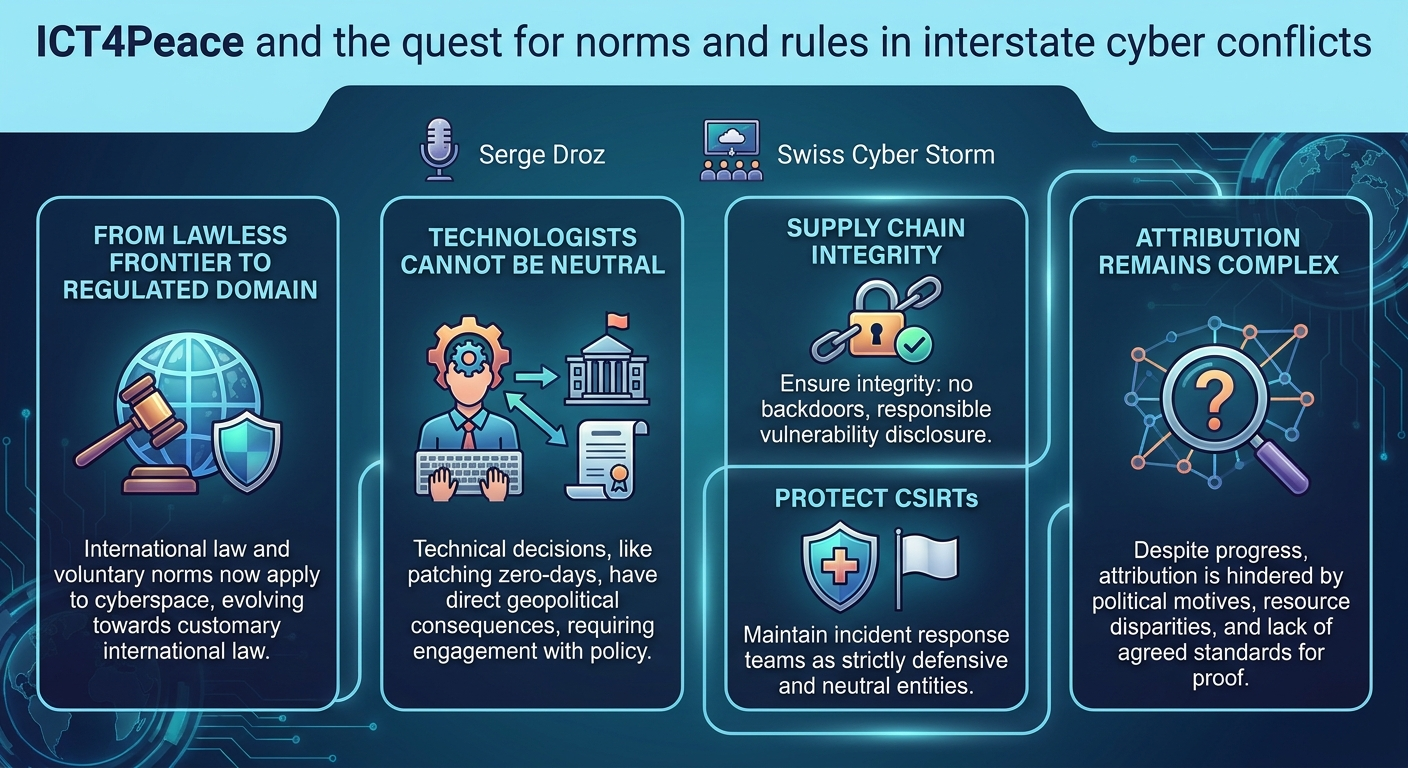
- Cyberspace is Regulated: The notion of cyberspace as a lawless frontier is outdated. International law applies, and a growing body of voluntary norms is slowly becoming customary international law, directly affecting all users, including technologists and private companies.
- Technologists Must Engage with Policy: Security professionals and tech companies cannot remain neutral. Their technical decisions and actions (e.g., vulnerability disclosure, platform moderation) have significant geopolitical implications and can lead to political "flack" or even legal accountability.
- Specific Norms Have Practical Consequences: Established norms, such as ensuring supply chain integrity (no backdoors, responsible vulnerability disclosure) and protecting incident response teams (CSIRTs must be neutral and non-offensive), demand concrete changes in technical practices and organizational structures.
- Attribution Remains Complex but Critical: While attribution capabilities have advanced significantly, particularly for major powers and large tech companies, it remains challenging due to varied political motivations, unequal resources, and a lack of universally agreed-upon standards for proof. Transparent and verifiable attribution is essential for enforcing norms.
- Multi-Stakeholder Collaboration is Essential but Insufficient: While there's a growing recognition that states, industry, and civil society must work together, genuine multi-stakeholder engagement in norm-setting bodies is often limited. Many voices, particularly from civil society, are still excluded from crucial discussions.
- Significant Challenges Remain: Key areas like the definition of sovereignty in cyberspace and the applicability of international humanitarian law to cyber conflicts are still heavily debated, hindering further progress in establishing comprehensive global norms.
About the Speaker(s)
Serge Droz is a representative of ICT for Peace, a Swiss Geneva-based foundation. Established over a decade ago to support the United Nations in adopting Information and Communication Technologies (ICT), ICT for Peace has evolved its mission. Today, it focuses on two primary objectives: promoting the peaceful use of ICT for peacebuilding efforts and actively working to prevent the misuse of ICT for malicious operations. Droz's role within ICT for Peace involves bridging the gap between the technical community and the diplomatic world, explaining the complexities of cyber policy to technologists and the intricacies of technology to policymakers. His expertise lies in translating abstract international norms into tangible implications for the cybersecurity industry and advocating for a multi-stakeholder approach to securing cyberspace.
Reviews
Dr. Zero (Offensive Security Researcher) — SOLID
Serge Droz walks through how UN cyber norms actually impact the engineers running incident response, rather than just the diplomats in Geneva. It's a competent policy briefing that correctly flags the UK putting its national CSIRT under an intelligence agency as a massive unforced error. Solid primer for practitioners, though it relies heavily on decade-old history to make its points.
Heather Calloway (CISO) — SOLID
Serge Droz delivers a competent but high-level overview of UNGGE norms and international cyber law. It is a useful primer for engineers waking up to geopolitical reality, but for a mature security leadership team, it stops right where the actual hard work begins.