Access management turned around
Dr. Alex Rhomberg, Giampaolo Trenta
Swiss Cyber Storm 2021 · Day 1 · Scenario_1
Overview
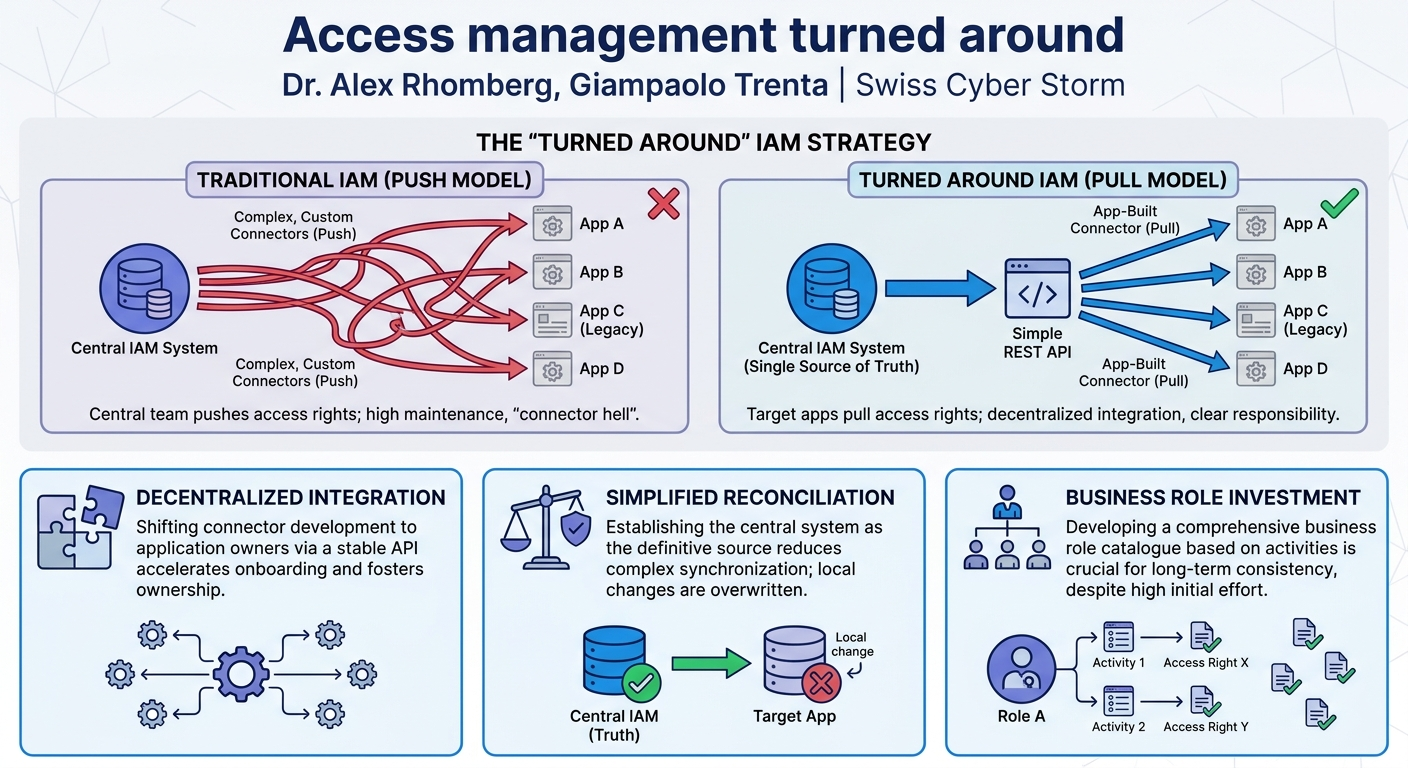
In "Access management turned around," Dr. Alex Rhomberg and Giampaolo Trenta present a compelling case study on a radical shift in Identity and Access Management (IAM) strategy. The talk details a large organization's journey to overcome the complexities and failures associated with traditional commercial IAM solutions by developing a bespoke system. Their approach challenges conventional wisdom, advocating for a "turned around" model where the central IAM system provides a simple interface, and target applications are responsible for pulling and implementing access rights.
Key moments
- 0:43 The "Dream Solution" and its core goals
- 4:26 Initial failure with commercial products; decided to build their own
- 9:40 Deconstructing IAM products and the central connector problem
- 12:00 Their radical "no central connectors" and simple API approach
- 16:30 Applications voluntarily asking for automation, proving pull strategy
- 18:20 Implementing "no reconciliation" policy and securing audit acceptance
- 22:00 Quantifiable results: 665 applications, 30 custom connectors built
- 28:30 Tackling business role mining and cleanup challenges (Q&A)
Access management turned around
Speakers: Dr. Alex Rhomberg, Lead Designer & Architect; Giampaolo Trenta, Former CISO
Conference: Swiss Cyber Storm
YouTube: https://www.youtube.com/watch?v=fB0NKjotZz0
Overview
In "Access management turned around," Dr. Alex Rhomberg and Giampaolo Trenta present a compelling case study on a radical shift in Identity and Access Management (IAM) strategy. The talk details a large organization's journey to overcome the complexities and failures associated with traditional commercial IAM solutions by developing a bespoke system. Their approach challenges conventional wisdom, advocating for a "turned around" model where the central IAM system provides a simple interface, and target applications are responsible for pulling and implementing access rights.
This presentation is highly relevant for security professionals, enterprise architects, and IT leaders grappling with the challenges of managing access in large, heterogeneous environments laden with legacy systems. The speakers, originating from a background of disillusionment with off-the-shelf products, demonstrate that a pragmatic, custom-built solution, even without the extensive features of commercial offerings, can deliver superior results in terms of cost, efficiency, and clarity of responsibility. Their methodology offers a fresh perspective on how to achieve comprehensive access control and compliance without succumbing to the "connector hell" often associated with complex IAM deployments.
The core of their innovation lies in decentralizing the integration effort, empowering application owners to manage their own access provisioning against a simplified central authority. This not only streamlines the onboarding of applications but also fosters a stronger sense of ownership and accountability among application teams. By sharing their three-year journey and the tangible benefits realized, Rhomberg and Trenta provide a blueprint for organizations considering unconventional paths to solve intractable access management problems.
Background
▶ Watch: The "Dream Solution" and its core goals (0:43)
The genesis of this "crazy way" access management solution stemmed from a fundamental vision: to bridge the chasm between business needs and IT capabilities. The speakers envisioned an Enterprise Identity Management (EIM) system that would allow business users to understand their existing and required access rights, support access assignment via business roles to reduce individual requests, and ultimately increase productivity, user satisfaction, and consistency. Such a system would also need to generate precise technical instructions for IT, responding to authorization requests and employee lifecycle events like joiners, movers, and leavers, while providing transparent oversight of all employee access rights.
However, realizing this dream was fraught with challenges inherent to a large enterprise environment. A significant hurdle was the prevalence of legacy applications, many with suboptimal authorization models or managed solely through closed graphical user interfaces (GUIs), making programmatic instruction impossible. Furthermore, the knowledge required to connect these disparate systems to a modern EIM was often lacking or inconsistent among the support staff.
The initial roadmap involved phases: establishing transparency, introducing automatism, cleaning inconsistencies, optimizing security models, and finally, integrating IAM with enterprise business architecture, recognizing IAM as a business, not just an IT, topic. In their first attempt, the organization evaluated promising commercial products, including a "top-right" quadrant winner from market analyses, and conducted a proof of concept (PoC). Despite the promising prospects of these solutions, the project ultimately failed to deliver on its promises. The speakers candidly admit that "what you see in the glance prospect of the product is not always the truth." This significant setback, coupled with the inability to find an implementation partner that could effectively deploy the chosen commercial product for access rights management (beyond basic recertification), led to a critical juncture. Faced with the unpalatable option of evaluating yet another commercial product, the team decided to embark on an ambitious path: to design and build their own EIM system based on a pure mathematical model for access management. This decision, though initially met with skepticism and resistance, was driven by a deep disillusionment with commercial offerings and a belief that they could engineer a more effective, tailored solution.
Key Findings
▶ Watch: Deconstructing IAM products and the central connector problem (9:40)
The development and deployment of their custom EIM system yielded several transformative findings, fundamentally challenging prevailing notions in IAM.
Firstly, the speakers discovered that the perceived ease of integration touted by commercial IAM vendors, often demonstrated with "five-minute" connector setups in PoCs, rarely translates to real-world, complex enterprise environments. Their experience indicated that connecting a single application using commercial connectors could take months for a central IAM team, due to customizations, coordination overhead, and the unique configurations of target systems. This led to a critical insight: the traditional model of the central IAM team being responsible for building and maintaining a vast array of connectors is inefficient and unsustainable.
Secondly, their "turned around" approach, where the central IAM system provides a simple, stable REST API for target applications to pull access rights, proved remarkably effective. This strategy shifted the integration burden from the central IAM team to the application owners, who were incentivized to build their own connectors. This decentralization not only accelerated the onboarding process—with connectors being built in an average of three to five person-days—but also enabled parallel development across multiple applications, drastically reducing overall project timelines. A testament to this efficiency is that approximately 30 custom connectors were built by application teams without direct support from the central IAM team.
Thirdly, the project demonstrated that comprehensive reconciliation (the process of continuously comparing and synchronizing access rights between the IAM system and target applications) is not strictly necessary for compliance and security. Instead, they established the central IAM system as the single source of truth. Any discrepancy meant the target application was incorrect. For automated connectors, this implied an expectation that local changes would be overwritten. For applications with manual access provisioning, quarterly attestations were required from application owners to confirm alignment with the central system's calculated state. This simplified approach, initially met with auditor skepticism, was ultimately accepted under specific conditions, proving that pragmatic solutions can satisfy compliance requirements without immense complexity.
Finally, the project highlighted the immense value, and corresponding effort, in defining a robust business role catalogue. Giampaolo Trenta noted that defining this catalogue alone cost approximately 1.5 million Swiss Francs, underscoring its strategic importance and complexity. This investment, combined with their custom role mining algorithm (based on mathematical statistics, not AI), allowed them to identify patterns and consolidate individually assigned access rights into structured business roles. This shift from individual, often trial-and-error, access assignments to role-based provisioning is crucial for long-term consistency and manageability, with a goal to achieve 80% of access assignments via business roles.
Technical Deep Dive
▶ Watch: Applications voluntarily asking for automation, proving pull strategy (16:30)
The technical foundation of the custom EIM system developed by Dr. Rhomberg and Giampaolo Trenta represents a deliberate departure from the architecture of typical commercial IAM products. Their pure mathematical model for access management formed the core of a bespoke solution, designed to circumvent the pitfalls experienced with off-the-shelf offerings.
Commercial IAM products, as described by Dr. Rhomberg, typically comprise several key components: a central management engine for calculating and tracking access rights, a kiosk for self-service access requests, a reporting engine for compliance and audit, and crucially, a vast array of connectors. These connectors, often marketed as "crown jewels," promise rapid integration with diverse target systems like Active Directory (AD) and SAP. However, the speakers found these connectors to be the primary source of complexity and project delays in real-world deployments, requiring extensive customization and coordination.
Their custom EIM system, built with the support of an external company to embed necessary know-how, intentionally omitted several of these traditional components. They recognized that a dedicated self-service kiosk was redundant, as the organization already had a central business request fulfillment tool where users could order everything from office chairs to access rights. The most significant architectural divergence, however, was in their approach to connectors. Instead of building a "box of connectors" for every target application, they adopted a "turned around" strategy:
- Direct Provisioning to Active Directory: The only connector explicitly provided by the central IAM team was to LDAP for Active Directory. This ensured that foundational identity and group memberships were managed centrally.
- Simple REST API for Target Applications: For all other applications, the central IAM system exposed a stable, fixed, and simple REST API. Application owners were then responsible for developing their own connectors to consume access rights from this API and implement them within their respective systems. This fundamentally shifted the burden of integration, eliminating the need for the central IAM team to possess deep knowledge of every application's internal data model, APIs, or release cycles. It also meant the central team did not require highly privileged service accounts to write directly into application databases, significantly reducing the central attack surface.
This architectural decision had profound implications for incident response and responsibility. If an access issue arose, the diagnostic path was clear: check the central IAM system's GUI for the access right, then check if it's available on the API interface. If both are true, the problem unequivocally lies with the target application's connector or configuration, making it "really very simple to pinpoint the location where a problem is or who is responsible for resolving the problem."
A cornerstone of their technical approach was the redefinition of reconciliation. Rejecting the traditional, complex process of continuous synchronization and discrepancy resolution, they declared the central EIM system as the sole valid position for access rights. If a target application diverged, it was deemed "wrong." To satisfy audit requirements, a pragmatic two-tiered approach was implemented:
- For applications with automated connectors, a contractual agreement stipulated that local changes must be overwritten by the IAM system. Test cases were implemented to prove this functionality.
- For applications with manual access provisioning, application owners were required to quarterly confirm that their local access rights matched the calculated state of the EIM system. This manual attestation, while not real-time reconciliation, provided the necessary audit trail and incentivized application owners to consider automation for frequently changing systems.
The process of populating the EIM system with meaningful access data involved significant analytical work. Starting from a regime of individually requested access rights, they initially onboarded applications "as they are," without immediately discussing correctness. Subsequently, a custom role mining algorithm, described as "pure mathematical statistic" rather than artificial intelligence, was employed to identify patterns in existing access assignments. These patterns were then analyzed by business analysts (like Giampaolo Trenta, a former CISO) to define the business role catalogue. This catalogue, a critical investment costing 1.5 million Swiss Francs to build and even more to maintain due to organizational changes, describes roles based on activities performed, not just names, ensuring deep alignment with business processes.
The results of this custom implementation are impressive: within approximately three years, the system onboarded 665 applications and managed 7,000 orderable access rights through the central kiosk. An additional 10,000+ access rights are automatically generated for privileged access management (PAM). The system now manages approximately half a million access right assignments in total, with half of those in production assigned through business roles. The team is actively working to increase this ratio to 80% via business roles. The average investment per attached application was estimated at five person-days, or about half a day per orderable access right, achieved with "no license cost" for the core system. This efficiency, combined with the successful parallel development of 30 custom connectors by application teams, underscores the technical and organizational efficacy of their "turned around" approach.
Demo / Proof of Concept
▶ Watch: Implementing "no reconciliation" policy and securing audit acceptance (18:20)
While the talk meticulously describes the initial proof-of-concept phase with commercial IAM products and the subsequent development and implementation of their custom EIM system, it does not feature a live demonstration or explicit proof-of-concept walkthrough of their bespoke solution. Instead, the speakers present the architectural design, the methodology, and the statistical results of their operational system as evidence of its efficacy and success. The "proof of concept" for their custom system lies in the successful onboarding of hundreds of applications and the tangible metrics presented regarding integration effort and managed access rights, rather than a real-time system demonstration.
Defensive Implications
▶ Watch: Tackling business role mining and cleanup challenges (Q&A) (28:30)
The "turned around" approach to access management presented by Dr. Rhomberg and Giampaolo Trenta offers significant defensive implications for organizations. By decentralizing integration responsibility and establishing a clear source of truth, this model enhances an organization's security posture in several ways:
Firstly, it leads to a reduction in the central attack surface. In traditional IAM deployments, the central IAM team often requires highly privileged service accounts or direct database access to provision and manage access within numerous target applications. By having target application owners build connectors that pull access rights from a simple, stable API, the central IAM system avoids needing these extensive, high-privilege credentials. This minimizes the risk associated with a single point of compromise within the IAM infrastructure.
Secondly, the strategy fosters improved accountability and ownership for access management at the application level. When application teams are responsible for integrating their systems with the central IAM via a defined API, they become inherently more engaged in understanding and managing their application's access model. This shift can lead to better configured and more secure applications, as the expertise resides with those who manage the system daily. The speakers noted that applications that initially resisted automation eventually sought it out once they experienced the burden of manual access provisioning, demonstrating a powerful pull towards better security practices.
Thirdly, the simplified reconciliation model and clear delineation of responsibility significantly streamline audit processes and incident response. With the central IAM system as the "single source of truth," auditors have a definitive reference point for compliance checks. Any discrepancies can be quickly attributed to either the central system or the target application, facilitating faster resolution and reducing the "ticket-chucking" common in complex IAM environments. This clarity is invaluable during security incidents involving unauthorized access or privilege escalation.
Finally, the emphasis on a robust business role catalogue and role mining directly contributes to better Segregation of Duties (SoD) and least privilege principles. By structuring access based on defined business activities, organizations can systematically reduce over-privileging and identify potential conflicts of interest. Although the initial onboarding might capture existing inconsistencies, the ongoing work to refine roles and assign access through them ensures a continuous improvement in the granularity and appropriateness of access rights, making the overall environment more resilient against insider threats and external attacks leveraging excessive privileges.
Key Takeaways
- Rethink Traditional IAM: Commercial IAM products often overpromise on integration ease, leading to costly and complex deployments. Custom solutions, tailored to an organization's unique legacy environment, can be more effective.
- Decentralize Integration Responsibility: Shifting the burden of connector development from a central IAM team to individual application owners, via a simple and stable API, dramatically accelerates IAM rollout and fosters greater application-level ownership and accountability.
- Establish a Single Source of Truth: A pragmatic approach to reconciliation, where the central IAM system is the definitive source for access rights, simplifies audit and compliance, even without continuous, real-time synchronization across all systems.
- Invest in Business Role Definition: Developing a comprehensive business role catalogue, aligned with organizational activities and processes, is critical for long-term access management consistency, though it requires significant analytical effort and investment.
- Leverage Incremental Automation: Even complex legacy applications can be onboarded, initially with manual processes, then gradually automated as application owners recognize the benefits and are motivated to streamline their operations.
- Achieve Significant Cost and Time Savings: By avoiding expensive commercial licenses and the extensive coordination overhead associated with traditional connector development, organizations can realize substantial cost reductions and faster project delivery.
About the Speaker(s)
Dr. Alex Rhomberg served as the lead designer and architect for the custom Identity and Access Management (IAM) project discussed in the talk. His involvement began after the initial disillusionment with commercial products, where he was tasked with steering the team towards a successful, in-house built solution. Dr. Rhomberg focused heavily on the architectural methodology and technical approach, particularly the design of the simplified API and the "turned around" model for application integration, emphasizing clear responsibilities and efficient implementation.
Giampaolo Trenta initiated the project with a clear "dream" for a unified access management solution that bridged business and IT. As a former Chief Information Security Officer (CISO), he brought a crucial business perspective to the initiative, understanding the strategic importance of aligning access rights with organizational processes. Giampaolo was instrumental in defining the business role catalogue and grappling with the complexities of legacy applications and their suboptimal authorization models, advocating for the pragmatic solutions that ultimately led to the project's success.
Reviews
Dr. Zero (Offensive Security Researcher) — STRONG ACCEPT
This is the rare enterprise case study that actually admits commercial IAM is a scam. Rhomberg and Trenta dumped their vendor, built a single REST API, and forced application owners to do their own connector work—a beautifully brutal, highly transferable architecture for anyone drowning in integration hell.
Heather Calloway (CISO) — STRONG ACCEPT
An uncommonly honest teardown of why commercial IAM deployments fail in enterprise environments. Rhomberg and Trenta abandoned connector hell to build an API-first pull model, shifting the integration burden from the security team to the application owners. Required watching for anyone staring down an expensive IAM vendor renewal.