International cooperation and the Europol Joint Cybercrime Action Taskforce (J-CAT)
Philipp Amann (Head of Strategy · Europol)
Swiss Cyber Storm 2021 · Day 1 · Arena
Overview
In an insightful presentation at Swiss Cyber Storm, Philipp Amann, Head of Strategy at Europol's European Cybercrime Centre (EC3), illuminated the critical role of international cooperation in the relentless fight against cybercrime. His talk, "International cooperation and the Europol Joint Cybercrime Action Taskforce (J-CAT)," underscored the borderless nature of cyber threats and the imperative for law enforcement agencies, industry, and academia to forge robust "networks of networks" to effectively counter them. Amann provided a comprehensive overview of Europol's strategic initiatives, operational successes, and forward-looking approaches to enhancing global cybersecurity.
Key moments
- 2:00 Europol's services and "networks of networks" approach
- 5:00 Joint Cybercrime Action Taskforce (J-CAT) explained
- 11:00 Emerging threats: AI abuse and deepfakes
- 13:00 Emotet botnet takedown: a "gold standard" operation
- 17:00 No More Ransom initiative: preventing cybercrime
- 20:00 Law enforcement innovation: decryption & crypto tools
- 24:00 Q&A: COVID challenges & Apple photo scanning
- 29:00 Q&A: Encryption dilemma – seeking middle ground solutions
International cooperation and the Europol Joint Cybercrime Action Taskforce (J-CAT)
Speakers: Philipp Amann, Head of Strategy, Europol
Conference: Swiss Cyber Storm
YouTube: https://www.youtube.com/watch?v=xaevG591l00
Overview
In an insightful presentation at Swiss Cyber Storm, Philipp Amann, Head of Strategy at Europol's European Cybercrime Centre (EC3), illuminated the critical role of international cooperation in the relentless fight against cybercrime. His talk, "International cooperation and the Europol Joint Cybercrime Action Taskforce (J-CAT)," underscored the borderless nature of cyber threats and the imperative for law enforcement agencies, industry, and academia to forge robust "networks of networks" to effectively counter them. Amann provided a comprehensive overview of Europol's strategic initiatives, operational successes, and forward-looking approaches to enhancing global cybersecurity.
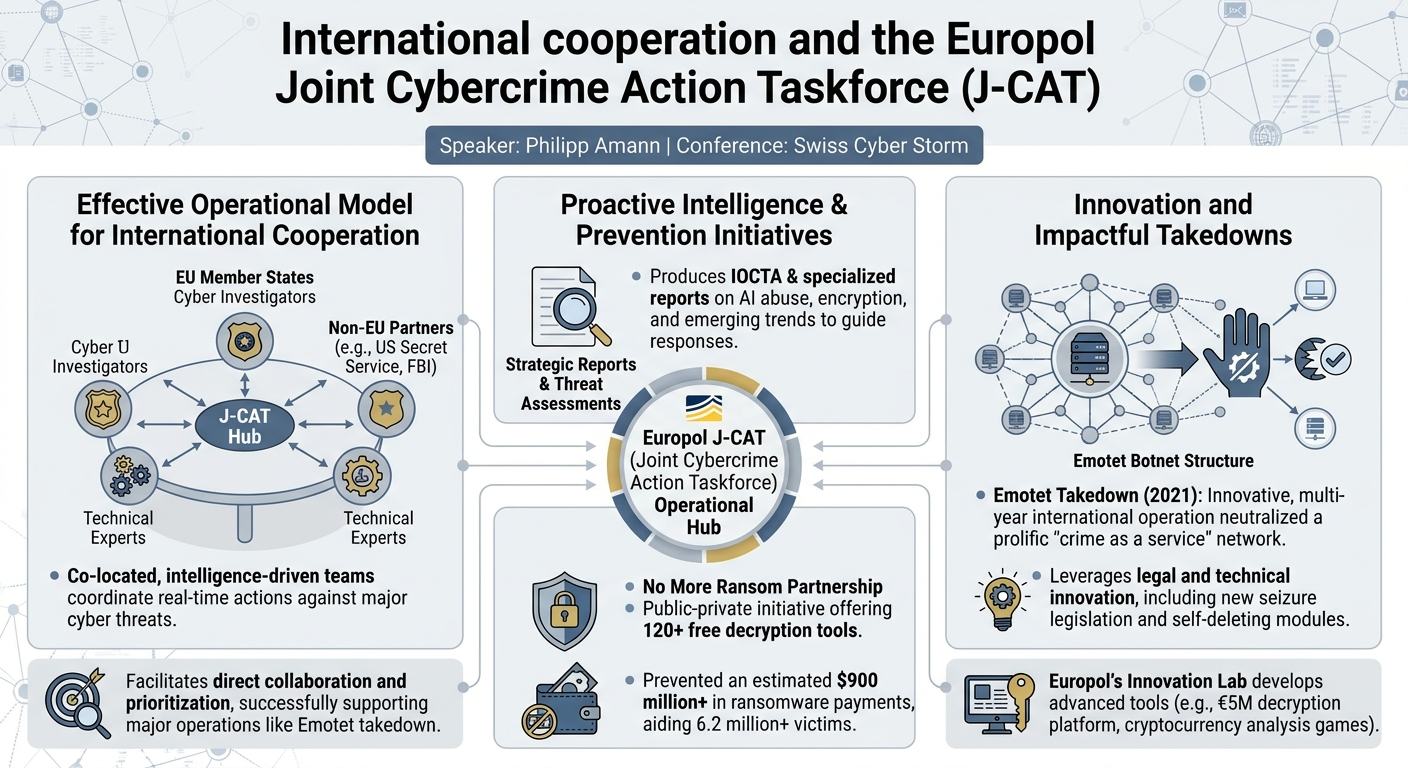
The core of Amann's discussion revolved around the Joint Cybercrime Action Taskforce (J-CAT), a unique and highly effective operational hub hosted by Europol. This initiative brings together specialized cybercrime investigators and technical experts from across EU member states and key non-EU partners, including Switzerland and the United States, to coordinate actions against the most pressing cyber threats. The talk highlighted J-CAT's intelligence-driven approach, its significant impact on major cybercrime operations like the Emotet takedown, and Europol's broader efforts in intelligence gathering, prevention, and technological innovation.
Amann emphasized that no single entity—neither a country, a law enforcement agency, nor an industry organization—can tackle the multifaceted challenges of cybercrime in isolation. The presentation served as a powerful call to action for increased collaboration, transparency, and shared responsibility in building a more secure digital landscape. It also shed light on Europol's commitment to innovation, from developing advanced decryption platforms to pioneering educational games for cryptocurrency tracing, all while navigating the complex ethical considerations surrounding privacy and law enforcement access to digital evidence.
Background
▶ Watch: Europol's services and "networks of networks" approach (2:00)
The genesis of Europol's EC3 in January 2013 was driven by a foundational understanding: cybercrime is inherently transnational, rendering traditional, geographically confined law enforcement efforts largely ineffective. The rapid evolution of the digital landscape, coupled with the emergence of the crime as a service model, has transformed cybercrime into a sophisticated, industrialized enterprise. This global reach and rapid adaptability necessitate a paradigm shift in law enforcement strategy, moving from isolated national investigations to integrated, international collaborative frameworks.
Prior to the establishment of J-CAT, Europol provided a platform for general law enforcement cooperation, but recognized a specific need for a dedicated, expert-driven unit focused solely on cybercrime. The problem stemmed from the fact that while liaison officers from various countries were present at Europol, not all possessed specialized cybercrime investigative skills. This gap highlighted the necessity for a more focused and technically proficient task force capable of rapid, coordinated responses to complex cyber threats. The digital realm's anonymity, the ease of cross-border operations, and the constant development of new attack vectors (such as advanced ransomware, mobile malware, and the potential abuse of artificial intelligence) further exacerbated the challenge, creating an urgent demand for specialized units like J-CAT to pool resources, expertise, and intelligence. Moreover, the increasing use of encryption by criminals introduced significant hurdles for investigations, prompting Europol to actively research and engage with the privacy-versus-security dilemma.
Key Findings
▶ Watch: Emerging threats: AI abuse and deepfakes (11:00)
Europol's approach to combating cybercrime is characterized by a multi-layered strategy encompassing intelligence, operations, prevention, and innovation, with several key findings and contributions:
- The Effectiveness of J-CAT: The Joint Cybercrime Action Taskforce (J-CAT), established in 2014, has proven to be a uniquely successful model for international law enforcement cooperation. It fosters direct collaboration among cybercrime investigators and technical experts from member states and non-EU partners (like the US Secret Service, IRS, and FBI). The task force operates on an intelligence-driven basis, leading to the successful completion of 23 operations even during the 2020 pandemic, and has been instrumental in supporting all major cybercrime cases Europol has been involved in over recent years.
- Impact of No More Ransom Initiative: The No More Ransom initiative, a public-private partnership launched five years prior to the talk, represents a "platinum standard" in crime prevention. It offers 120 free decryption tools for victims of 170 different ransomware families, available in 37 languages. This initiative has reached an estimated 6.2 million victims and, crucially, has prevented over 900 million US dollars in ransomware payments from reaching criminals, showcasing the immense power of collective corporate social responsibility.
- Strategic Intelligence and Threat Assessment: Europol consistently produces high-value intelligence reports that shape strategic and operational responses. The Internet Organized Crime Threat Assessment (IOCTA) provides a law enforcement perspective on the cybercrime landscape, identifying top threats such as ransomware, increased mobile malware, and the exploitation of the COVID-19 pandemic by criminals. Dedicated reports also address the challenges and opportunities of encryption and the emerging threat of criminals abusing artificial intelligence (e.g., deepfakes, CEO voice emulation for scams).
- Innovation in Law Enforcement: Europol demonstrates a strong commitment to innovation, exemplified by its dedicated innovation lab. This includes the development of a new decryption platform with a 5 million euro budget, utilizing state-of-the-art cooling technology, and an advanced game for law enforcement investigators to master cryptocurrency analysis and asset seizure. These initiatives highlight Europol's proactive stance in leveraging technology to enhance investigative capabilities.
- The Emotet Takedown as a Gold Standard: The January 2021 takedown of the Emotet botnet was presented as a "gold standard" operation. This complex, three-year international effort not only disrupted the infrastructure of what was considered one of the most prolific "crime as a service" networks (responsible for over 60% of all malicious emails globally in 2019) but also innovatively used new German and Dutch legislation to seize the malware on infected machines and replace it with a self-deleting version, effectively neutralizing the threat.
Technical Deep Dive
▶ Watch: No More Ransom initiative: preventing cybercrime (17:00)
Europol's operational framework is built on a "platform economy" model for law enforcement, providing advanced services and tools to member states. This includes top-level expertise in complex areas such as cryptocurrencies, the criminal abuse of encryption, and sophisticated analytical skills to support investigations. The agency aggregates intelligence from EU and non-EU partners, providing crucial operational support and analytical insights.
The Joint Cybercrime Action Taskforce (J-CAT) is a physical hub where cybercrime investigators and technical experts from various agencies are co-located. This includes representatives from EU member states and non-EU countries like the United States, with agencies such as the Secret Service, IRS, and FBI maintaining a physical presence. This direct co-location facilitates real-time deconfliction, coordination, and intelligence-driven prioritization of international actions against cybercrime. Their work is integrated into broader Operational Action Plans (OAPs), which translate high-level strategic objectives (like combating ransomware) into concrete annual activities, often with direct support from non-EU partners like Switzerland.
Europol's intelligence output is critical for understanding and responding to the evolving threat landscape. The Internet Organized Crime Threat Assessment (IOCTA) provides a detailed law enforcement perspective on cybercrime trends, highlighting threats such as the rise of ransomware attacks targeting critical infrastructure, the surge in mobile malware, and criminals exploiting global events like the COVID-19 pandemic through themed attacks. Beyond general threat assessments, Europol produces specialized reports, such as the Observative Function Report on Encryption. This report delves into the technical aspects of privacy-enhancing technologies (PETs), discussing concepts like homomorphic encryption, DNS over HTTPS, oblivious DNS over HTTPS, 5G security implications, quantum computing, and quantum encryption. It meticulously outlines the challenges these technologies pose for law enforcement investigations while also acknowledging their potential benefits and the need for a balanced approach.
Another significant technical deep dive involves Europol's report on the criminal abuse of artificial intelligence. This research categorizes current criminal applications, such as the use of openly available tools to emulate a CEO's voice for CEO fraud (a case reported in Germany), and the widespread use of deepfakes for misinformation and scams. It also explores future scenarios where criminals might leverage AI to enhance attacks or target AI defense systems. The report emphasizes the need for awareness to build more robust and secure AI systems.
The Emotet takedown operation in January 2021 serves as a prime example of technical and legal innovation. What started as a relatively simple piece of malware targeting the financial sector evolved into a sophisticated botnet offered as a crime as a service platform. At its peak in 2019, Emotet was estimated to be responsible for over 60% of all malicious email attachments globally. The takedown involved not only disrupting its command and control (C2) infrastructure but also pioneering a novel legal approach under new German and Dutch legislation. This allowed law enforcement to remotely seize the Emotet malware on infected machines and replace it with a legitimate module designed to uninstall itself after a few months, effectively neutralizing the threat on a massive scale. This operation demonstrated an unprecedented level of international coordination and legal ingenuity, showcasing how law enforcement can adapt to the technical complexities of modern cybercrime. Furthermore, the Dutch police established a public service where individuals could check if their email addresses were compromised by Emotet, providing a direct public benefit from the operational success.
Demo / Proof of Concept
▶ Watch: Law enforcement innovation: decryption & crypto tools (20:00)
While the talk did not feature a live, interactive demonstration of a new tool or exploit, Philipp Amann effectively presented several "proofs of concept" in the form of successful operations and innovative initiatives that demonstrate Europol's capabilities and strategic vision. These include:
- The Emotet Takedown: This operation served as a powerful demonstration of Europol's ability to coordinate complex, international cybercrime investigations, leveraging both technical disruption and innovative legal strategies. The success in neutralizing a major botnet and the subsequent public service offered by the Dutch police to check for compromise illustrated the tangible impact of their work.
- The No More Ransom Initiative: Presented as a "platinum standard" in prevention, this initiative is a living proof of concept for effective public-private partnership. The platform, offering 120 free decryption tools and actively preventing hundreds of millions of dollars in payments to criminals, demonstrates a scalable and impactful model for cybercrime mitigation.
- Europol's Innovation Lab: Amann highlighted internal innovations, such as a new decryption platform funded with a 5 million euro budget, using "state-of-the-art cooling technology." He also described an engaging game developed for law enforcement investigators to train them in cryptocurrency analysis and asset seizure. These examples showcase Europol's commitment to developing and implementing advanced technical solutions to enhance their investigative prowess.
These examples collectively underscore Europol's operational efficacy, its commitment to leveraging technology for both investigation and prevention, and its philosophy of driving concrete results through collaborative action.
Defensive Implications
▶ Watch: Q&A: Encryption dilemma – seeking middle ground solutions (29:00)
The insights shared by Philipp Amann offer crucial guidance for cybersecurity defenders across all sectors. The overarching message is that effective cyber defense, much like effective cybercrime prosecution, requires a collaborative, multi-stakeholder approach.
Firstly, international cooperation is paramount. Organizations should view law enforcement, industry peers, academia, and CERT communities not as adversaries but as essential partners in the fight against cybercrime. Europol's "networks of networks" philosophy extends to defenders, emphasizing the need for information sharing, coordinated responses, and joint initiatives.
Secondly, proactive intelligence gathering is vital. Defenders should actively consult Europol's publications, such as the Internet Organized Crime Threat Assessment (IOCTA) and specialized reports on encryption and AI abuse. These reports provide a law enforcement perspective on emerging threats, criminal methodologies, and technological trends, enabling organizations to anticipate attacks and bolster their defenses against threats like advanced ransomware, mobile malware, and deepfake-based social engineering.
Thirdly, robust ransomware defense and incident reporting are critical. The success of the No More Ransom initiative underscores the importance of not paying ransoms and leveraging available free decryption tools. Furthermore, organizations must understand that law enforcement needs electronic evidence and access to compromised infrastructure to conduct successful investigations and takedowns like Emotet. Reporting incidents to law enforcement, therefore, is not just a regulatory obligation but a crucial contribution to the collective defense ecosystem.
Fourthly, staying abreast of innovative law enforcement techniques can inform defensive strategies. Europol's development of a decryption platform and advanced cryptocurrency tracing tools indicates the evolving capabilities of law enforcement. Understanding these capabilities can help organizations better prepare for forensic investigations and understand the value of immutable digital evidence.
Finally, the discussion around encryption and privacy highlights a critical societal dialogue that defenders must engage with. While strong encryption is a cornerstone of cybersecurity, Amann's plea for constructive dialogue to find "feasible, acceptable technical solutions" for law enforcement access to electronic evidence without "breaking encryption" is significant. Defenders should contribute to this discussion, advocating for solutions that balance privacy with the imperative to investigate serious crime, rather than retreating to extreme positions. This includes supporting research into technologies like homomorphic encryption that could offer a middle ground.
Key Takeaways
- Cybercrime demands a "networks of networks" approach: No single entity can effectively combat global cybercrime; sustained, multi-stakeholder collaboration among law enforcement, industry, academia, and CERTs is essential.
- J-CAT is a highly effective operational model: The Joint Cybercrime Action Taskforce demonstrates the power of co-located, intelligence-driven international teams of cybercrime experts in coordinating successful operations against major threats.
- Intelligence and prevention are proactive defenses: Europol's IOCTA and specialized reports on AI abuse and encryption provide crucial intelligence for understanding evolving threats, while initiatives like No More Ransom offer tangible, impactful prevention and victim support, saving hundreds of millions of dollars.
- Law enforcement is innovating and needs industry partnership: Europol is actively developing advanced tools like a decryption platform and cryptocurrency tracing games. They require industry cooperation to access electronic evidence and abused infrastructure to disrupt criminal networks.
- The Emotet takedown showcases innovation and impact: The successful neutralization of the Emotet botnet through innovative legal and technical means highlights what can be achieved with international collaboration and a proactive approach to criminal infrastructure.
- Constructive dialogue on encryption is vital: The debate around privacy and law enforcement access to encrypted data requires finding a "middle ground" with "feasible, acceptable technical solutions" that protect privacy while enabling the investigation of serious crimes, rather than advocating for "breaking encryption."
About the Speaker(s)
Philipp Amann serves as the Head of Strategy at Europol, specifically within the European Cybercrime Centre (EC3). In this role, he is responsible for shaping Europol's strategic direction in combating cybercrime and enhancing cybersecurity across Europe and with international partners. Amann is a vocal advocate for international cooperation, emphasizing the need for collaborative efforts between law enforcement, industry, and academia to tackle the complex challenges posed by the digital threat landscape. His work involves driving initiatives like the Joint Cybercrime Action Taskforce (J-CAT) and overseeing the production of critical intelligence reports such as the Internet Organized Crime Threat Assessment (IOCTA). He is also actively involved in discussions surrounding the ethical and technical challenges of encryption and law enforcement access to digital evidence, co-authoring position papers like "The Cyber Blue Line."
Reviews
Dr. Zero (Offensive Security Researcher) — SOLID
Philipp Amann's overview of J-CAT is a classic law enforcement victory lap, but at least Europol actually has real wins to run laps for. The Emotet takedown remains a masterclass in legal and technical maneuvering, even if the rest of the briefing is standard bureaucratic padding.
Heather Calloway (CISO) — SOLID
A standard Europol overview that buries a massive precedent: law enforcement is now legally pushing code to infected enterprise endpoints. Essential context for your incident response and legal teams, even if the policy arguments on encryption fall flat.