How Zoom is Building End-to-End Encryption
Merry Ember Mou (Security Engineer · Zoom)
Swiss Cyber Storm 2021 · Day 1 · Scenario_2
Overview
In this insightful talk from Swiss Cyber Storm, Merry Ember Mou, a Security Engineer at Zoom, provides a comprehensive look into the development and ongoing evolution of End-to-End Encryption (E2E) for Zoom's video conferencing platform. The presentation details the architectural decisions and cryptographic protocols implemented to integrate E2E into an existing, widely-used product, ensuring properties on par with other secure communication applications. Mou also outlines Zoom's ambitious future plans to enhance user identity verification, aiming to make meeting security intuitive and verifiable without sole reliance on Zoom's servers.
Key moments
- 2:00 Why Zoom needed end-to-end encryption
- 5:35 Core design of Zoom's E2E key management
- 12:00 Solving user identity verification in E2E meetings
- 16:00 Auditable user identities with Sig Chains and Transparency Tree
- 19:30 Preventing impersonation with IdP-backed identities
- 32:00 Zoom's ability to intercept E2E meetings
- 36:00 Why Zoom didn't use Signal Protocol for E2E
How Zoom is Building End-to-End Encryption
Speakers: Merry Ember Mou, Security Engineer, Zoom
Conference: Swiss Cyber Storm
YouTube: https://www.youtube.com/watch?v=o5G7SrTYx5M
Overview
In this insightful talk from Swiss Cyber Storm, Merry Ember Mou, a Security Engineer at Zoom, provides a comprehensive look into the development and ongoing evolution of End-to-End Encryption (E2E) for Zoom's video conferencing platform. The presentation details the architectural decisions and cryptographic protocols implemented to integrate E2E into an existing, widely-used product, ensuring properties on par with other secure communication applications. Mou also outlines Zoom's ambitious future plans to enhance user identity verification, aiming to make meeting security intuitive and verifiable without sole reliance on Zoom's servers.
The talk addresses the critical need for E2E in a world increasingly dependent on virtual communication, especially in the wake of Zoom's explosive growth during the 2020 pandemic. Mou explains how Zoom rapidly retrofitted E2E into its platform, tackling the complex challenges of balancing robust security with core functionality and performance requirements for meetings scaling up to 1,000 participants. This deep dive into Zoom's E2E strategy offers valuable lessons for developers and security professionals grappling with similar challenges in large-scale, synchronous communication systems.
Background
▶ Watch: Why Zoom needed end-to-end encryption (2:00)
Zoom's meteoric rise in popularity during early 2020 brought unprecedented scrutiny to its security and privacy practices. While Zoom meetings initially offered encryption in transit, the fact that Zoom's servers held the symmetric meeting encryption key meant that the company itself, or an attacker compromising its infrastructure, could potentially access meeting content. This architecture was necessary to support widely used features such as joining a meeting from a telephone, cloud recording, and live transcription, which required server-side access to plaintext data or the encryption key.
The public debate highlighted a crucial distinction between encryption in transit (where data is encrypted between client and server, and between servers, but the server holds the key) and true end-to-end encryption (where only the communicating endpoints hold the keys, making intermediaries unable to decrypt content). Recognizing this, Zoom committed to implementing true E2E, a significant undertaking for an existing product designed for encryption in transit. The challenge was to move key generation and management entirely to the clients while preserving essential functionality and maintaining performance for large, synchronous video meetings. This talk details Zoom's multi-phase approach to address these security gaps, starting with an initial Minimum Viable Product (MVP) release in October 2020.
Key Findings
▶ Watch: Solving user identity verification in E2E meetings (12:00)
The talk highlights several key findings and strategic decisions in Zoom's E2E journey:
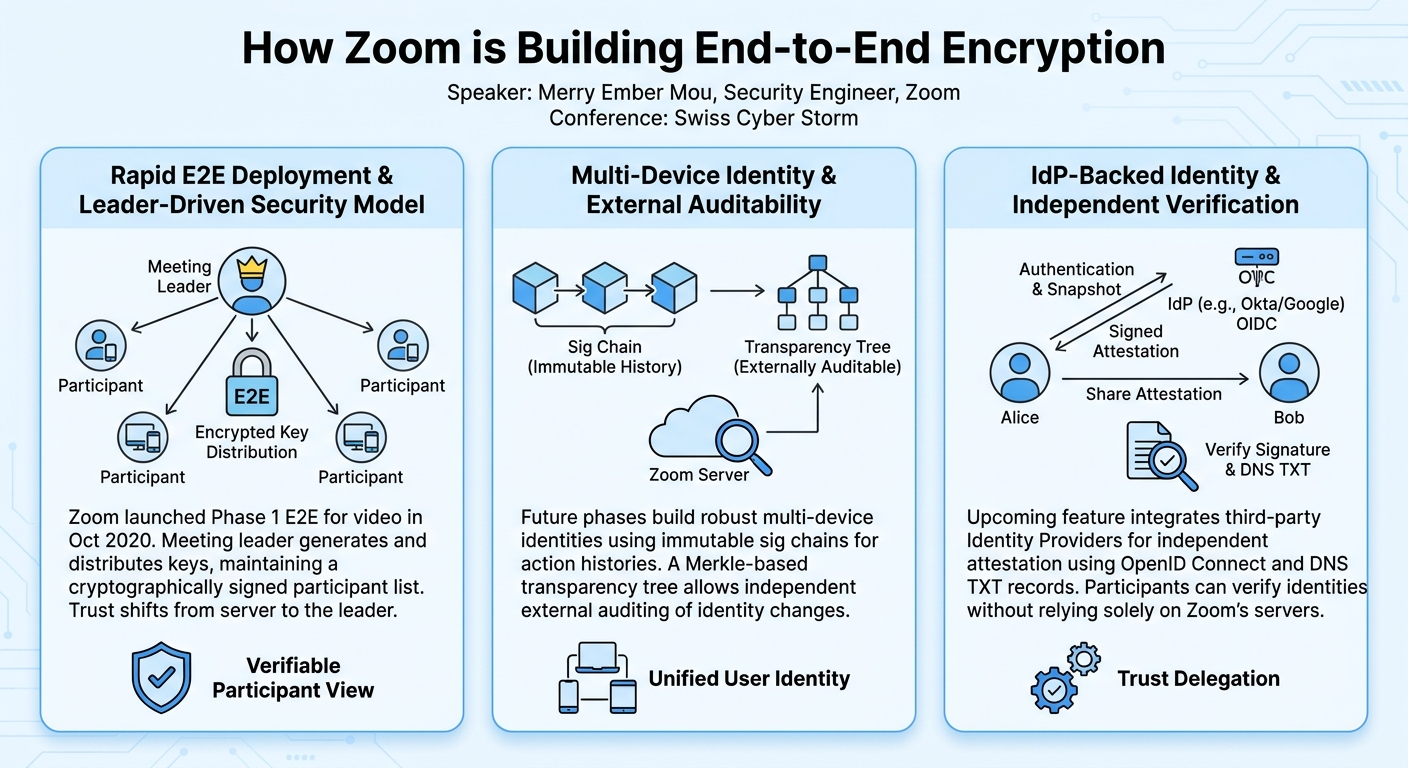
- Rapid E2E Deployment: Zoom successfully launched its first phase of E2E for video conferencing in October 2020, just five months after publishing its initial white paper. This involved moving key generation from Zoom's servers to the clients, leveraging an existing architecture that didn't strictly require server operation on plaintext video streams.
- Leader-Driven Security Model: The initial E2E design designates the meeting leader as responsible for generating and distributing the meeting key, as well as maintaining a leader-driven participant list. This model ensures all participants have a consistent, cryptographically verifiable view of who can decrypt meeting contents, reducing reliance on server trust.
- Phased Approach for Identity Verification: Recognizing that E2E is "only as secure as its ends," Zoom's subsequent work focuses heavily on enhancing user identity verification. This includes developing cryptographically defined user identities that are externally auditable and can be backed by trusted third-party identity providers (IdPs).
- Performance-Conscious Design: Despite the introduction of new cryptographic messages, Zoom prioritized performance. Cryptographic operations (using algorithms like EdDSA and X25519) were not identified as bottlenecks. Instead, the focus was on managing network traffic, throttling re-keys to within 15 seconds, and optimizing participant list heartbeat frequency to ensure a smooth user experience, even on bad networks or older devices.
- Robust Identity Framework: Future plans involve a sophisticated framework for multi-device user identity, utilizing sig chains for immutable action histories and a transparency tree for external auditability. This aims to minimize "trust on first use" (TOFU) warnings and combat alert fatigue by providing a more user-centric identity experience.
- IdP-Backed Attestations: A significant upcoming feature is the integration with IdPs (e.g., Okta, Google) to allow independent attestation of user identities. This leverages existing IdP trust, preventing impersonations even if Zoom's servers are compromised, and allows participants to verify identity claims through established mechanisms like DNS TXT records and OpenID Connect (OIDC).
Technical Deep Dive
▶ Watch: Auditable user identities with Sig Chains and Transparency Tree (16:00)
Zoom's E2E implementation is a multi-layered system designed to secure synchronous video communications while maintaining scalability and performance.
Phase 1: Initial E2E Release (October 2020)
- Key Management:
- Long-Term Key Pair: Each user device possesses a unique long-term signing key pair. The private key for this pair never leaves the device. The public key is posted to Zoom's key servers, forming a directory of user IDs and associated device public keys.
- Ephemeral Key Pair: For each meeting, the user generates a new ephemeral encryption key pair. The ephemeral public key, along with meeting-specific context, is signed using the device's private key. This signed binding is then shared with all other meeting participants via Zoom's existing infrastructure, which acts as a bulletin board.
- Meeting Key Generation and Distribution: The meeting leader, who is already trusted for administrative functions, generates a new random symmetric meeting key. To securely distribute this key to each participant, the leader computes a Diffie-Hellman shared secret using their own ephemeral key and each participant's ephemeral key. This shared secret is then used to encrypt the meeting key for that specific participant.
- Key Rotation: When participants join or leave a meeting, the meeting leader rotates the meeting key to a new random key. This ensures that participants can only decrypt the portions of the meeting they were actively present for, preventing expelled or departed participants from continuing to eavesdrop. To manage traffic spikes, re-keys are throttled, but a new key is guaranteed within 15 seconds of a join or leave event.
- Participant List Management:
- In an E2E meeting, the participant list displayed in the UI is no longer solely server-driven. Instead, it is a leader-driven participant list, generated and cryptographically signed by the meeting leader.
- The leader sends out regular heartbeats (at least every 10 seconds) containing updates to this participant list. This ensures all participants see a consistent view of who has been shared the current meeting key.
- Clients monitor these heartbeats. If a client misses enough heartbeats, it drops out of the meeting, preventing it from using an old encryption key that might be known to a recently expelled participant.
- If the meeting leader changes (e.g., the original leader leaves), a notification is shown, the new leader rotates the meeting key, and takes responsibility for updating the participant list.
- Meeting Leader Security Code: A hash of the leader's long-term device key is displayed as a security code. Participants are encouraged to read this code out loud to each other to detect Man-in-the-Middle (MITM) attacks attempting to intercept the meeting key. This code changes if the leader changes, requiring re-verification.
- Performance and Implementation:
- While video data streams over UDP, the new E2E control messages (key exchanges, heartbeats) are sent over a reliable TCP channel.
- Zoom engineers built a new client-side library to handle E2E logic, exposing a minimal interface to the main Zoom client code.
- Dedicated key servers were built to store device public keys and other identity information, designed to be as standalone as possible to minimize dependencies on existing Zoom server infrastructure.
Phase 2: Enhanced User Identity Verification (Upcoming)
This phase aims to reduce the cognitive load of verifying identities and build a more robust, human-friendly notion of trust.
- Multi-Device User Identity:
- A user's identity will encompass a set of devices (e.g., laptop, cell phone) and their public keys.
- Two human-friendly identifiers are introduced: the user's email address (used with Zoom) and an Account Domain Name (ADN) for the user's organization. ADNs are unique per account and selected by account admins.
- Device Approval and Revocation: Users can cryptographically approve new devices using older, trusted devices. Devices can also be revoked if lost, stolen, or no longer in use.
- Sig Chains and Transparency Tree:
- User identity changes (device approvals/revocations, email changes, account changes) are recorded in an append-only list called a sig chain. Each sig chain link contains a hash of its preceding link, creating an immutable history.
- These user identities are then committed to a transparency tree, which is built on top of a Merkle tree. The hash of the tree root commits to all Zoom user identities at a given time.
- Hosted by Zoom, the transparency tree is externally auditable in a privacy-preserving way. This prevents the server from "forking" a user's sig chain (showing different versions to different users) and ensures that any server misbehavior (e.g., adding an unauthorized device) is detectable by auditors and by the user themselves when they review their identity changes. This concept is similar to Certificate Transparency and Keybase.
- Contact Sync (Trust on First Use - TOFU):
- Clients will remember device keys of meeting participants. If a participant joins with a device never seen before, a TOFU warning will be displayed.
- To mitigate alert fatigue associated with TOFU warnings (common in chat apps), the multi-device identity construction minimizes warnings by allowing trusted devices to approve new ones, making the UI more user-centric.
- IdP-Backed Identities:
- This feature allows Identity Providers (IdPs) like Okta or Google to independently attest to a user's identity, leveraging existing trust relationships.
- Delegation of Trust: The account's ADN publishes a delegation of trust to its specific IdP (e.g.,
company.idp.com). This is implemented using DNS TXT records, configured by the account admins, making it verifiable by meeting participants without relying on Zoom's server. - Attestation Process:
- Alice (the user) authenticates to her IdP using OAuth. The authentication flow ensures only Alice's client, not Zoom's server, can make identity changes.
- Alice posts a snapshot of her identity (e.g., current device key or sig chain tail) to the IdP.
- Alice requests an attestation – her identity snapshot signed by the IdP's OpenID Connect (OIDC) key.
- Verification Process (by Bob, another participant):
- Bob's client requests
company.com's DNS TXT record to confirm the authorized IdP domain. - Bob's client fetches the IdP's public signing key from the standard OIDC key path (all requests to other users' IdPs go through an HTTPS proxy to hide client IPs).
- Bob's client verifies the IdP's signature on Alice's attestation.
- Bob's client also cross-references the attestation with the user identity information stored on Zoom's servers to ensure consistency. This allows Bob to trust not only Alice's email but also that the ADN legitimately authorized her.
Demo / Proof of Concept
▶ Watch: Zoom's ability to intercept E2E meetings (32:00)
The talk provided a detailed architectural and protocol-level explanation of Zoom's E2E implementation and future plans. It did not include a live demonstration or a proof of concept of the described features. The focus was on the design, implementation challenges, and the security properties achieved.
Defensive Implications
▶ Watch: Why Zoom didn't use Signal Protocol for E2E (36:00)
The advancements in Zoom's E2E encryption offer several critical implications for security defenders and users:
- For End Users:
- Enable E2E: Users must actively turn on the E2E feature in their Zoom settings and ensure it's enabled for specific meetings. The presence of a green shield with a lock icon in the top left corner confirms E2E is active.
- Verify Security Code (Phase 1): In the current E2E implementation, the most crucial defensive action for users is to verbally verify the meeting leader security code with all participants. This is the primary mechanism to detect a Man-in-the-Middle (MITM) attack, as the server cannot intercept the meeting key without altering this code.
- Heed TOFU Warnings (Phase 2): While Zoom aims to minimize alert fatigue, users should pay attention to "trust on first use" (TOFU) warnings indicating a participant is using a previously unseen device.
- Review Identity Changes (Phase 2): Users should regularly review any changes made to their multi-device identity via the transparency tree, watching for unexpected device additions or modifications.
- Leverage IdP-Backed Identities (Phase 2): When communicating with new contacts, especially in professional or sensitive contexts (e.g., tech support, HR), users should prioritize meetings requiring IdP-backed identities to confirm the person's affiliation and legitimacy. Be suspicious if an unexpected Account Domain Name (ADN) is displayed for a seemingly legitimate email address.
- For Account Administrators:
- Configure ADN and IdP Delegation (Phase 2): To leverage the full benefits of IdP-backed identities, account admins must select a unique Account Domain Name (ADN) and configure DNS TXT records to delegate trust to their chosen Identity Provider. This is a critical step for enabling robust, externally verifiable identity.
- Monitor Transparency Tree: Admins should be aware of and utilize the external auditability of the transparency tree to monitor for any unauthorized changes to user identities within their organization, acting as an early detection mechanism for potential compromises.
- For Security Architects and Developers:
- Balance Security with Usability: Zoom's approach highlights the challenge of introducing strong security features without overwhelming users or degrading performance. The phased rollout, focus on reducing cognitive load, and thoughtful UI design are key.
- External Auditability: The commitment to externally auditable mechanisms like the transparency tree and IdP attestations sets a high bar for trust, demonstrating that detection of misbehavior can be as powerful as prevention.
- Open Standards Integration: Leveraging OpenID Connect (OIDC) and DNS TXT records for IdP integration promotes interoperability and allows for broader adoption by various IdPs, including open-source on-premise solutions. Zoom plans to publish an API specification for this integration.
- Architectural Considerations: Retrofitting E2E into an existing synchronous communication product requires careful separation of concerns (e.g., dedicated client-side libraries, standalone key servers) to manage complexity and risk. The choice of EdDSA and X25519 for cryptographic operations, known for their speed, underscores the importance of performance-aware cryptographic choices.
Key Takeaways
- E2E Security is Endpoint-Centric: The core principle of E2E is that security depends entirely on knowing and trusting the endpoints. Zoom's multi-phase approach builds a human-centric notion of identity, starting from device public keys to ensure verifiable ends.
- Phased Rollout for Complex Features: Introducing E2E into a large, existing application requires a phased strategy, starting with an MVP (October 2020) and iteratively adding more sophisticated features like identity verification and IdP integration, balancing immediate security gains with careful development.
- Balancing Functionality, Performance, and Security: Retrofitting E2E into Zoom's architecture presented challenges in maintaining core functionalities, scalability (up to 1,000 participants), and performance. Design choices, such as throttling re-keys and optimizing heartbeat frequency, were crucial for real-world usability.
- Multi-Layered Identity Verification: Achieving robust identity verification is complex and involves multiple complementary mechanisms: device-centric TOFU warnings, immutable sig chains, externally auditable transparency trees, and IdP-backed attestations via OIDC and DNS TXT records.
- User Experience is Paramount for Security Effectiveness: The practical effectiveness of E2E features ultimately depends on how well they are conveyed and understood by users. Designing intuitive UIs that minimize alert fatigue and cognitive load is as critical as the underlying cryptographic protocols.
- Minimizing Server Trust and Maximizing Auditability: Zoom's E2E protocol aims to minimize reliance on Zoom's servers for trust, shifting verification to clients and leveraging external auditability through mechanisms like the transparency tree and IdP attestations.
About the Speaker(s)
Merry Ember Mou is a Security Engineer at Zoom. In her role, she focuses on developing and implementing end-to-end encryption features for Zoom's video conferencing platform. Her work involves addressing the complex technical challenges of integrating advanced cryptographic protocols into a widely-used application, with a strong emphasis on balancing security, performance, and user experience.
Reviews
Dr. Zero (Offensive Security Researcher) — STRONG ACCEPT
Zoom got caught lying about E2E in 2020, so they went out, bought Keybase, and actually built the real thing. Mou walks through the plumbing of retrofitting true client-side key generation onto a massive synchronous UDP video firehose. It's a surprisingly honest look at the ugly engineering trade-offs required to make cryptographically verifiable identities work at this scale.
Heather Calloway (CISO) — STRONG ACCEPT
Zoom is finally solving the hardest part of enterprise end-to-end encryption: identity management. This talk details their architecture for shifting cryptographic trust away from their own servers and back to customer Identity Providers, making it required viewing for teams managing corporate communications risk.