Closing Keynote
Dr.-Ing. Mario Heiderich (Lecturer · Roar University in Bochum)
Swiss Cyber Storm 2021 · Day 1 · Arena
Overview
In his closing keynote at Swiss Cyber Storm 2021, Dr.-Ing. Mario Heiderich delivered a deeply personal yet incisive reflection on the profound impact of the COVID-19 pandemic on the cybersecurity industry and society at large. Diverging from his usual technical talks on subjects like cross-site scripting, Heiderich presented a candid assessment of the "two years of nothing" – a period characterized by forced remote work, unprecedented cybercrime, societal fracturing, and significant mental health challenges. This talk serves as a crucial retrospective, analyzing how the global crisis reshaped professional environments, degraded software quality, and underscored the critical importance of human connection and well-being in maintaining a robust security posture.
Key moments
- 0:00 Reflecting on two years of pandemic nothingness
- 6:00 Cybercrime surged, exploiting pandemic fears and uncertainty
- 9:45 Societal fractures: gut feeling versus scientific consensus
- 14:00 Forced home office fueled a mental health crisis
- 18:00 Dramatic increase in critical software bugs during pandemic
- 21:00 Speaker's personal burnout and coping strategies
- 27:30 Future of conferences: more small, local, safe events
- 29:30 Host's personal reflections and closing remarks
Closing Keynote
Speakers: Dr.-Ing. Mario Heiderich, Lecturer, Roar University in Bochum
Conference: Swiss Cyber Storm
YouTube: https://www.youtube.com/watch?v=t4KCqV0wiT0
Overview
In his closing keynote at Swiss Cyber Storm 2021, Dr.-Ing. Mario Heiderich delivered a deeply personal yet incisive reflection on the profound impact of the COVID-19 pandemic on the cybersecurity industry and society at large. Diverging from his usual technical talks on subjects like cross-site scripting, Heiderich presented a candid assessment of the "two years of nothing" – a period characterized by forced remote work, unprecedented cybercrime, societal fracturing, and significant mental health challenges. This talk serves as a crucial retrospective, analyzing how the global crisis reshaped professional environments, degraded software quality, and underscored the critical importance of human connection and well-being in maintaining a robust security posture.
Heiderich, a lecturer at Roar University in Bochum and head of a security company, framed his observations across general societal shifts, professional industry changes, and personal experiences. His analysis highlights the stark contrasts between industries that suffered immensely and those, like penetration testing, that saw an unexpected surge in demand. More importantly, he meticulously details the detrimental effects on developer productivity, software security, and the pervasive rise of pandemic-themed cyberattacks. The keynote ultimately serves as a call to action, urging the cybersecurity community to learn from the past, prioritize mental health, and foster safer, more mindful approaches to collaboration and knowledge exchange in a post-pandemic world.
Background
▶ Watch: Reflecting on two years of pandemic nothingness (0:00)
The problems discussed in Dr. Heiderich's keynote are deeply rooted in the unprecedented global health crisis that began in late 2019 and escalated throughout 2020 and 2021. The rapid spread of COVID-19 forced governments worldwide to implement lockdowns, travel restrictions, and mandates for remote work, fundamentally altering daily life and professional operations. This sudden and drastic shift created a fertile ground for the issues Heiderich describes, from the erosion of social interactions to significant changes in working conditions and a surge in malicious cyber activities.
Prior to the pandemic, discussions around the benefits and drawbacks of remote work often focused on flexibility and work-life balance. However, the forced nature of remote work during the pandemic, coupled with the immense stress of a global crisis, exposed and exacerbated existing vulnerabilities. Heiderich highlights a Forbes article from April 2019, pre-pandemic, that questioned, "Are Home Offices Fueling a Mental Health Crisis?" This foresight underscores that the problems of isolation and mental strain in remote work were not new, but rather intensified dramatically when it became the only option for millions. The speaker himself confessed to making an ill-fated, humorous prediction in 2019 about all conferences being cancelled until 2050, a jest that ironically came true for a significant period, highlighting the unforeseen scale of the disruption.
The problem of increased cybercrime during times of crisis is also not novel, but the pandemic provided a uniquely potent environment. Public fear, uncertainty, and a desperate need for information made individuals highly susceptible to social engineering tactics. Cybercriminals swiftly adapted their techniques, leveraging pandemic-themed lures to exploit human psychology for financial gain, data theft, or disruption. Simultaneously, systemic issues within society, such as inadequate digital infrastructure for education or outdated governmental communication methods (e.g., fax machines), were laid bare, demonstrating a broader lack of crisis preparedness that directly impacted the ability of organizations to function securely and effectively. The confluence of these factors created a perfect storm, where human vulnerability, technological shifts, and opportunistic adversaries converged to challenge the very foundations of digital security.
Key Findings
▶ Watch: Societal fractures: gut feeling versus scientific consensus (9:45)
Dr. Mario Heiderich's keynote meticulously detailed several critical findings that emerged from the pandemic era, impacting both the cybersecurity industry and broader society:
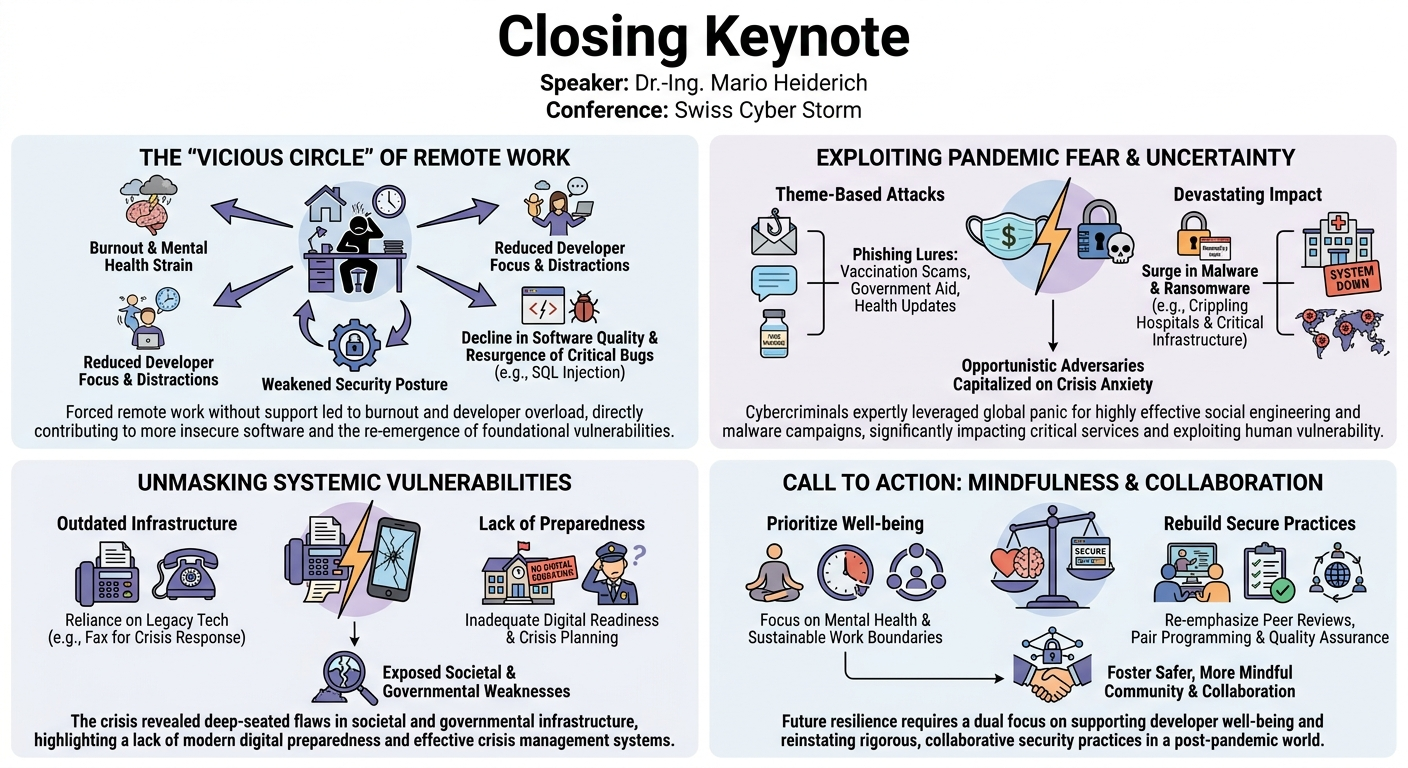
- Stark Imbalances in Industry Impact: The pandemic created severe economic disparities. While industries reliant on physical presence (e.g., on-site trainers, consultants, event organizers) suffered immense job losses and business closures, sectors like penetration testing, which primarily operate remotely, experienced a "ridiculously high" surge in demand, often reaching "burnout level." This was attributed to companies redirecting security budgets from on-site services to remote-friendly activities.
- Explosive Growth of Cybercrime: Cybercriminals immediately capitalized on the pandemic, using COVID-19 themes for a massive spike in phishing, malware (including crypto trojans and ransomware), vaccination scams, fake medication sales, and fake news campaigns. Hospitals, for instance, were crippled by ransomware attacks exploiting pandemic fears, demonstrating the critical impact of these campaigns. Heiderich noted that even ethical hacking campaigns found COVID-19 themes highly effective for raising awareness.
- Societal Fracturing and "Gut Feeling over Science": The speaker observed a significant societal divide, where public trust in scientific consensus eroded, replaced by a reliance on "gut feeling." This manifested in widespread fake news dissemination, anti-lockdown protests, and general anger, leading to a "big fracture and a big crack in society."
- Unmasking Systemic Vulnerabilities: The pandemic exposed pre-existing flaws in governmental and societal infrastructure. Heiderich cited examples like the German state's reliance on fax devices for crisis response and schools being "completely unprepared for digital education," highlighting a general lack of readiness for any form of crisis.
- The Dark Side of Forced Home Office: While initially perceived as a dream, mandatory remote work led to significant challenges. Collaboration became a "nightmare" due to increased stress, "thin-skinned" interactions, and colleagues disappearing due to illness or long COVID. Developers faced constant distractions (e.g., homeschooling), leading to extended working hours (8 AM to 8 PM) and severe burnout, impacting mental health, sleep, and overall well-being.
- Measurable Decline in Software Quality: A "dramatic" increase in critical bugs was observed during penetration tests. Vulnerabilities like SQL injection, once considered "mostly dead" due to framework protections, reappeared "all over the place." This degradation was attributed to developers being overworked and distracted, but more critically, to the absence of traditional quality assurance mechanisms such as peer reviews, pair programming, and in-person team discussions.
- A Vicious Cycle of Insecurity: Heiderich summarized these professional observations into a "vicious circle": forced home office creates "bad vibes" for many, leading to "overran developers," which results in "more insecure software," consequently causing "more cyber attacks" and "more fallout." Breaking this cycle requires intentional effort in future lockdowns.
- Personal Transformation and the Need for Mindfulness: On a personal level, Heiderich described his own struggle with burnout and cabin fever, leading him to make significant lifestyle changes, including quitting smoking and incorporating regular walks. He emphasized the collective need for "mindfulness" and "strictness" in maintaining mental health and work-life boundaries.
Technical Deep Dive
▶ Watch: Dramatic increase in critical software bugs during pandemic (18:00)
While Dr. Heiderich's keynote was intentionally "not so technical" in its delivery, its core observations carry profound technical implications for the cybersecurity industry. The talk highlighted a direct correlation between the societal and personal stresses of the pandemic and tangible degradations in technical security posture.
The most striking technical finding was the measurable decline in software quality. Heiderich noted a significant increase in critical vulnerabilities discovered during penetration tests. Specifically, he mentioned the resurgence of SQL injection, a class of vulnerability long thought to be largely mitigated by modern web frameworks and secure coding practices. The re-emergence of such foundational flaws suggests a breakdown in the development lifecycle, allowing previously addressed issues to resurface. The speaker posited several technical and operational reasons for this:
- Developer Overload and Distraction: Developers, grappling with the pressures of working from home—often while simultaneously managing childcare and homeschooling—found it "hard enough to kind of focus on that at work with like your headphones on for eight hours and getting into the flow, but at home with your kids running around... how it's impossible." This reduced focus directly impacts the ability to write secure code and adhere to security best practices.
- Absence of Collaborative Security Practices: Crucially, Heiderich emphasized the loss of informal yet effective security mechanisms: "no more peer reviews and missing quality assurance." The lack of someone "sitting down next to you and looking at the concept" or engaging in pair programming meant that security flaws were less likely to be caught early. Remote equivalents, like GitHub pull requests, were "just not the same" as immediate, in-person collaboration. The absence of "morning sessions where you discuss your latest commits" further eroded collective vigilance over code quality and security. This highlights that security is not just about individual skill but also about the collective, iterative process of development.
On the offensive side, the talk provided a clear technical overview of how cybercriminals exploited the pandemic. The core technique was social engineering, specifically through phishing and malware distribution, heavily themed around COVID-19.
- Phishing Campaigns: Attackers crafted highly convincing lures leveraging public fear and the urgent need for information. Examples included:
- Vaccination scams: Impersonating health authorities to collect personal data or distribute malware.
- Master scams: Broad-spectrum attacks leveraging general pandemic anxiety.
- Government impersonation: Fake official letters or tweets promising aid or demanding action.
- Tax credit scams: Exploiting financial anxieties with fake offers.
- WhatsApp messages and SMS scams: Spreading malicious links or information through popular messaging platforms.
- Voucher phishing: Promising pandemic-related relief vouchers.
- Heiderich mentioned an "amazing website from Australia" collecting screenshots of these diverse, themed attacks, underscoring their prevalence and variety. Even ethical hacking teams (during pentest campaigns) found that using COVID-19 themes for white-hat phishing yielded high click rates and credential compromises, demonstrating the sheer effectiveness of these tactics.
- Malware and Ransomware: The fear generated by the pandemic made individuals "more likely to click on things and execute things." This directly led to a "significant boost" in crypto trojans and ransomware attacks. Heiderich cited instances of "whole hospitals being sent down" due to employees clicking on malicious links related to COVID-19, illustrating the devastating impact on critical infrastructure. This points to the technical vulnerability of organizations when their human element is under extreme psychological duress.
The "Technical Deep Dive" into this keynote isn't about specific exploits or novel attack vectors, but rather about the environmental factors that technically enabled a decline in security and a surge in successful attacks. It's a testament to the fact that human factors, organizational processes, and even global crises have direct and profound technical consequences on software security and the efficacy of defensive measures.
Demo / Proof of Concept
▶ Watch: Speaker's personal burnout and coping strategies (21:00)
This keynote address, being a reflective and observational discussion on the societal and professional impacts of the pandemic, did not feature a live technical demonstration or proof of concept. Instead, Dr. Heiderich presented real-world observations and trends, referencing existing research and collections of cybercrime evidence (such as the Australian website with screenshots of COVID-19-themed malware and phishing campaigns) to substantiate his findings. His "demonstration" was an analytical portrayal of the effects of the pandemic on security, rather than a live technical exploit.
Defensive Implications
▶ Watch: Host's personal reflections and closing remarks (29:30)
Dr. Mario Heiderich's observations carry critical defensive implications for organizations and individuals navigating the ongoing challenges of remote work, increased cyber threats, and societal stress. Defenders must recognize that the "vicious circle" of forced home office, developer burnout, and insecure software is a tangible threat that requires a multi-faceted response.
- Enhanced Security Awareness Training: The massive surge in COVID-19 themed phishing and malware underscores the need for highly effective and continuously updated security awareness programs. These programs must go beyond generic advice, specifically addressing emotionally charged social engineering tactics that exploit fear and uncertainty. Organizations should conduct regular, tailored phishing simulations (as Heiderich noted, even ethical hackers found these themes highly effective) to educate employees about identifying and reporting suspicious communications, particularly those related to health crises, government aid, or urgent information.
- Re-evaluating Secure Development Lifecycle (SDLC) Practices for Remote Work: The observed decline in software quality and the resurgence of vulnerabilities like SQL injection demand a re-emphasis on fundamental secure coding practices. Organizations must explicitly adapt their SDLC to remote or hybrid environments, ensuring that crucial security gates like peer reviews, pair programming, and quality assurance (QA) are not bypassed or diluted. This might involve:
- Implementing more rigorous code review tools and processes with mandatory security checks.
- Scheduling dedicated virtual pair programming sessions.
- Investing in static application security testing (SAST) and dynamic application security testing (DAST) tools to automate vulnerability detection.
- Prioritizing security training for developers, focusing on common pitfalls exacerbated by remote work.
- Prioritizing Developer Well-being as a Security Measure: Heiderich's personal and professional accounts highlight the profound impact of burnout and mental health struggles on productivity and code quality. Organizations must recognize that supporting developer well-being is not just an HR issue but a critical security defense. This includes:
- Establishing clear boundaries for working hours to prevent 8 AM to 8 PM workdays.
- Providing mental health resources and support.
- Fostering a culture that encourages breaks and discourages "nitpicking" that adds unnecessary stress.
- Understanding that distracted, exhausted developers are more prone to introducing security flaws.
- Strengthening Crisis Response and Resilience: The revelation of systemic unpreparedness (e.g., fax machines in government, inadequate digital education) indicates a broader need for robust crisis management and digital resilience planning. Defenders should advocate for:
- Modernizing critical infrastructure and communication systems.
- Developing comprehensive business continuity plans that account for prolonged remote work scenarios and widespread societal disruption.
- Ensuring incident response plans are robust enough to handle simultaneous crises (e.g., a pandemic coinciding with a major ransomware attack on critical services like hospitals).
- Fostering Community and Collaboration: The speaker's emphasis on the loss of social interaction and its negative effects points to the value of community. While large events may remain risky, supporting smaller, local, and mindful gatherings (as Heiderich suggests) can help rebuild professional networks, facilitate informal knowledge sharing, and combat isolation. This indirectly strengthens the collective defensive posture by fostering a more engaged and informed security community.
- Advocating for Public Health Measures: While seemingly outside the technical domain, Heiderich's call for increased vaccination rates and rational public discourse directly relates to defensive capabilities. He argues that these measures enable a return to safer in-person interactions, which can alleviate the mental health burdens of remote work, improve collaboration, and ultimately contribute to better software quality and a more resilient security industry.
In essence, the defensive implications of this talk extend beyond technical controls to encompass human factors, organizational culture, and broader societal resilience. Security is not just about technology; it's about the well-being and preparedness of the people who build, defend, and use it.
Key Takeaways
- The COVID-19 pandemic acted as a catalyst, drastically altering the cybersecurity landscape by fueling a massive surge in cybercrime while simultaneously degrading software quality.
- Forced remote work, despite initial perceptions, led to widespread mental health challenges, burnout, and reduced developer focus, directly contributing to an increase in critical vulnerabilities like SQL injection.
- Cybercriminals expertly exploited global fear and uncertainty through highly effective, pandemic-themed phishing, malware, and ransomware campaigns, significantly impacting critical infrastructure like hospitals.
- The crisis exposed systemic weaknesses in societal and governmental crisis preparedness, highlighting the urgent need for modernization of digital infrastructure and robust crisis response planning.
- Rebuilding social connections, prioritizing mental well-being for employees, and re-emphasizing fundamental secure development practices (like peer reviews and pair programming) are crucial for the industry's future resilience.
- A conscious shift towards smaller, local, and more mindful conferences and social gatherings can help restore vital community connections and knowledge sharing in a safer, more sustainable manner.
About the Speaker(s)
Dr.-Ing. Mario Heiderich is a distinguished figure in the cybersecurity community, known for his engaging presentations and deep technical expertise, particularly in areas like cross-site scripting. He is a Lecturer at the Roar University in Bochum, where he contributes to academic research and education in security. Beyond his academic role, Dr. Heiderich runs his own security company and actively maintains several open-source projects, demonstrating his commitment to practical security solutions and community contributions. Based in Berlin, he is recognized for his "flamboyant predictions about the future" and his ability to deliver both highly technical and profoundly reflective talks.
Reviews
Dr. Zero (Offensive Security Researcher) — SOLID
Mario Heiderich steps away from web app research to deliver a 2021 pandemic retrospective. Most of this is the same WFH burnout commentary we all lived through, but his specific observations about how remote isolation caused regressions in legacy bug classes elevate it. It's a weary, honest closing keynote from a real practitioner.
Heather Calloway (CISO) — STRONG ACCEPT
Heiderich explicitly connects remote developer burnout to the degradation of our SDLC security gates. This isn't just an HR retrospective about pandemic stress, but a root-cause analysis of why bugs we thought we killed a decade ago are showing back up in production. Worth your engineering leadership's time.