Attacking Ultra-Wideband: Security Analysis of UWB Applications in Smartphones
Alexander Heinrich (PhD Student · Secure Mobile Networking Lab), Jiska Classen
TROOPERS23 · Day 1 · Attack & Research · Attack & Research
Overview
This talk, presented by Alexander Heinrich and Jiska Classen at TROOPERS, delves into the security vulnerabilities of Ultra-Wideband (UWB) technology, a rapidly emerging wireless communication standard. Often touted as "hacker-proof" due to its unique physical layer characteristics, UWB is increasingly integrated into modern devices like the iPhone 11 and newer, Google Pixel, Samsung phones, and digital car keys. The speakers meticulously dissect UWB's ranging mechanisms, application-layer implementations, and underlying security assumptions, ultimately demonstrating two distinct attacks that undermine its core promise of secure distance measurement.
Key moments
- 0:00 Introduction to Ultra-Wideband and its security
- 2:40 Understanding Ultra-Wideband ranging mechanisms and security
- 7:20 Apple's AirTag and Digital Car Key applications
- 20:30 Video demonstration of legacy car key relay theft
- 28:00 Ghost Peak Attack: How to exploit UWB ranging
- 30:30 Ghost Peak Attack demonstrated on an iPhone U1 chip
- 36:00 "Time For Change" Attack: Exploiting clock drift
- 41:30 Conclusion: The criticality of physical layer attacks
Attacking Ultra-Wideband: Security Analysis of UWB Applications in Smartphones
Speakers: Alexander Heinrich (PhD Student, Secure Mobile Networking Lab), Jiska Classen
Conference: TROOPERS
YouTube: https://www.youtube.com/watch?v=xDy_gdkcFDA
Overview
This talk, presented by Alexander Heinrich and Jiska Classen at TROOPERS, delves into the security vulnerabilities of Ultra-Wideband (UWB) technology, a rapidly emerging wireless communication standard. Often touted as "hacker-proof" due to its unique physical layer characteristics, UWB is increasingly integrated into modern devices like the iPhone 11 and newer, Google Pixel, Samsung phones, and digital car keys. The speakers meticulously dissect UWB's ranging mechanisms, application-layer implementations, and underlying security assumptions, ultimately demonstrating two distinct attacks that undermine its core promise of secure distance measurement.
The research highlights a critical disconnect between theoretical cryptographic security and practical physical layer vulnerabilities. By showcasing how UWB’s distance calculations can be manipulated through signal interference or clock drift exploitation, the talk challenges the notion of UWB as an inherently secure solution for proximity-based access. This work is particularly timely and relevant as UWB is poised for widespread adoption in security-critical applications such as passive keyless entry systems for vehicles, smart home automation, and secure payment solutions, making the discovered vulnerabilities a pressing concern for manufacturers and users alike.
Background
▶ Watch: Introduction to Ultra-Wideband and its security (0:00)
Ultra-Wideband operates on a fundamentally different principle than traditional narrow-band wireless technologies like Wi-Fi or GPS. While Wi-Fi and GPS occupy specific, narrow frequency bands (e.g., 2.4 GHz, 5 GHz for Wi-Fi), UWB spreads its signal across a very broad spectrum, ranging from below 1 GHz up to 8 GHz. Crucially, UWB transmits with extremely low power, often just above the noise floor. This low power, combined with its wide bandwidth, allows UWB to coexist with other wireless technologies without causing interference, making it permissible across various frequency bands.
The unique characteristic of UWB lies in its signal pulses: each pulse is 500 MHz wide, very narrow, and exceptionally steep. These precise pulses contain minimal information beyond indicating their presence, but their sharp amplitude peaks allow for highly accurate timestamping of signal arrival. This precision is fundamental to UWB's primary function: ranging, or measuring the distance between two devices.
Two main mechanisms for ranging are employed:
- Single-Sided Two-Way Ranging (SS-TWR): An initiator device sends a packet to a responder, which then replies after a predefined delay. The initiator measures the total round-trip time, subtracts the responder's known reply delay, and calculates the propagation delay (the time the signal took to travel one way). Since UWB signals travel at the speed of light, the distance can be accurately derived. A limitation of SS-TWR is its susceptibility to clock drift between devices, which can introduce inaccuracies.
- Double-Sided Two-Way Ranging (DS-TWR): This method involves both devices sending and receiving signals, essentially performing SS-TWR twice. The key advantage of DS-TWR is its ability to automatically eliminate clock drift, leading to more robust and accurate distance measurements, and ensuring both devices know the distance.
Security in UWB, particularly in its latest iterations found in smartphones, relies on a Scrambled Timestamp Sequence (STS). This STS is generated from a shared key established between the two communicating devices via a secure mechanism, ensuring mutual authentication and trust. The STS is embedded in every UWB packet, confirming that the ranging measurements are indeed originating from the expected, authenticated devices.
UWB is being integrated into a growing number of applications:
- Apple Ecosystem: Initial integration in iOS 13 with the iPhone 11 saw UWB enabling features like improved Airdrop target selection. The Nearby Interaction framework (iOS 14) allowed developers access to angular and distance information. Handoff with HomePod provides haptic feedback as users approach, enabling seamless music transfer. A highly practical use case is AirTags (iOS 14.5), which leverage UWB for precise "Find My" functionality, guiding users to lost items within meters. The most security-critical application to date is Digital Car Keys, where UWB facilitates secure, passive keyless entry. Apple's journey from basic integration to car keys took two years and multiple iOS releases, indicating the complexity of ensuring reliability.
- Android Ecosystem: Android followed with Nearby Share, a file-sharing feature similar to Airdrop, initially on Samsung and Google Pixel devices. An SDK exists for developers to use UWB ranging.
The implementation of STS generation varies between platforms:
- iOS: The
Nearby Interactionframework requires devices to generate and securely exchange an NIDiscoveryToken. This token, containing an identity resolving key and identifier data, is used with asiphashfunction, the Bluetooth MAC address, and the resolving key to generate an authentication tag. This tag facilitates device discovery over Bluetooth Low Energy, where the UWB address is directly derived from the Bluetooth MAC address. The 16-byte STS is then formed by combining 8 bytes from each exchanged token, adhering to standard compliance. This method is considered secure provided the initial token exchange is handled securely by developers. - Android: Developers receive the UWB address and are responsible for securely exchanging it (e.g., via authenticated Bluetooth LE). While Android offers a
Session Key Infofor encrypting ranging sessions, publicly available profiles use a static STS (containing a static IV and vendor ID). This design choice means that developers cannot manually set the STS, effectively rendering the ranging "reliable" but not "secure" in the cryptographic sense. A deeper, low-level API is available to smartphone manufacturers, allowing them to configure the STS and enable true secure ranging.
Key Findings
▶ Watch: Apple's AirTag and Digital Car Key applications (7:20)
The research uncovered significant findings regarding both the practical reliability and fundamental security of UWB ranging.
Accuracy and Reliability of UWB Ranging:
To assess UWB's real-world performance, the researchers built a robotic testing platform named "Gwen." This machine precisely rotates devices (iPhone, Google Pixel, Samsung) across two axes while measuring their distance to an AirTag. Tests were conducted in three environments: outdoors (ground truth), a cluttered lab (reflections), and a parking garage (car key scenario).
- Outdoor Environment: When devices were pointed directly at each other, UWB measurements were highly accurate. However, if a device was turned away, signals started breaking at 5 meters and became significantly worse at 10 meters, making ranging impossible in certain orientations.
- Indoor (Lab) Environment: The presence of walls and other objects caused signal reflections, leading to longer signal paths. When devices were pointed away, the measured distance often increased due to these reflections. Crucially, in reflective environments, UWB proved more reliable, working "all the time" as long as the devices were not too far apart.
- Parking Garage Environment: This setting presented a mix of outdoor and indoor characteristics. Long, open spaces showed signal failures similar to outdoor tests, while the presence of cars (acting as reflectors) led to distance enlargements and significant fluctuations in measurements.
Overall, the average measurement errors remained below 50 centimeters, which is generally considered sufficient for applications like car keys (e.g., preventing accidental unlocks when a car is parked outside a house). While large outliers (2-3 meters off) were observed, they were typically very short-lived (single measurements). This suggests that implementations that filter anomalous readings (e.g., by trusting only consistent measurements) can achieve reliable ranging.
The "Ghost Peak" Attack:
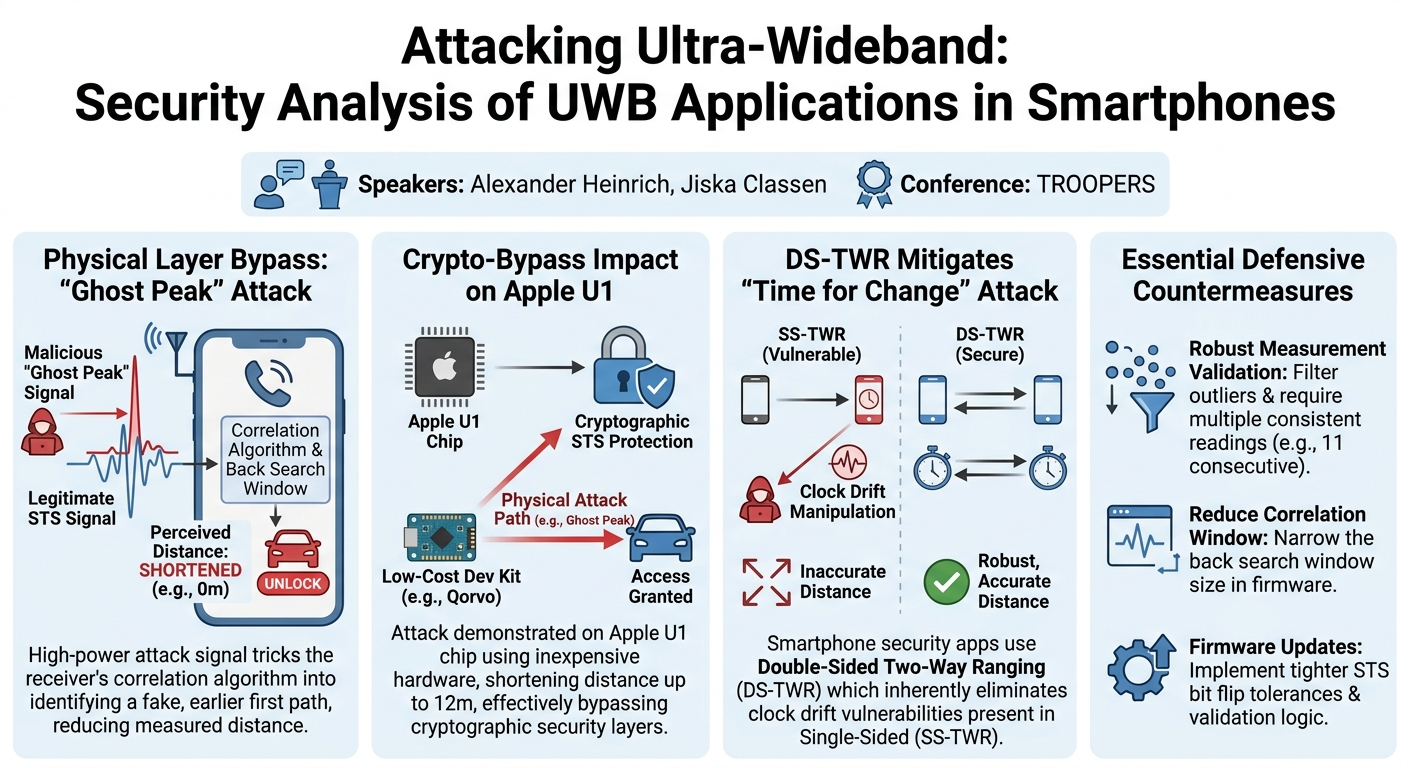
This novel attack directly targets UWB's physical layer signal processing, specifically how it identifies the "first path" for distance measurement in environments with reflections (e.g., a key fob in a pocket). UWB receivers use a correlation algorithm to find the sharpest, earliest peak in the received signal, ideally corresponding to the direct line-of-sight path. To account for real-world scenarios, implementations employ a back search window (to find the earliest strong signal) and a power threshold (to filter out weak noise).
The "Ghost Peak" attack exploits this by injecting a malicious signal. The attacker uses a cheap Qorvo dev kit (approximately 50 euros) to transmit a carefully timed, high-power signal that overshadows the legitimate Scrambled Timestamp Sequence (STS) portion of a UWB packet. If this injected "ghost peak" falls within the receiver's back search window and exceeds the power threshold, the correlation algorithm can mistakenly identify it as the true first path, even if it arrived earlier than the legitimate signal.
- Impact: This attack primarily affected the Apple U1 chip, achieving a maximum distance shortening of 12 meters with a success rate of approximately 4%. While other chipsets (e.g., NXP) are theoretically vulnerable due to standard-compliant correlation algorithms, they showed less reliable results, often only producing sporadic outliers. The key insight is that even if only one device in the communication chain (e.g., the car or the phone) is susceptible, the distance measurement can be manipulated. A single successful "ghost peak" could be sufficient to open a car, especially if the system relies on a single measurement.
The "Time for Change" (Clock Drift Manipulation) Attack:
This attack, discovered by researchers collaborating with the speakers, targets implementations relying on Single-Sided Two-Way Ranging (SS-TWR). While some chip manufacturers, like Qorvo, claim SS-TWR is secure and power-efficient, this attack proves otherwise. SS-TWR devices measure clock drift (the difference between an expected and received signal frequency) to correct distance calculations.
The "Time for Change" attack involves an attacker's Software-Defined Radio (SDR) device intercepting the UWB signal. The SDR subtly shifts the frequency of the signal before retransmitting it. This manipulation causes the receiving device to perceive an artificial clock drift (e.g., shifting it to the standard's maximum tolerance of -40).
- Impact: This attack results in a distance shortening of 12 meters and boasts a 100% success rate once the signal is intercepted and manipulated. Crucially, the attacker can even control the degree of clock drift to simulate a person gradually approaching a door, making the attack difficult to detect based solely on distance changes. Fortunately, **Android and Apple devices are not affected by this specific attack because their security-critical applications (like car keys) exclusively use Double-Sided Two-Way Ranging (DS-TWR)**, which inherently mitigates clock drift issues. However, any system or device manufacturer opting for SS-TWR (perhaps for power efficiency) with other UWB chipsets would be vulnerable.
Technical Deep Dive
▶ Watch: Ghost Peak Attack: How to exploit UWB ranging (28:00)
Ultra-Wideband's inherent characteristics, while making traditional sniffing difficult, also open avenues for sophisticated physical layer attacks. The signals, spanning wide frequency ranges (e.g., 6.5 GHz to 8 GHz channels) and operating at very low power, appear as short, sharp pulses. These 500 MHz wide pulses are fundamental to UWB’s precise timing capabilities. Unlike traditional radio, where signal strength directly correlates with perceived distance, UWB relies on the exact time-of-arrival of these steep pulses to measure propagation delay, which is then converted to distance using the speed of light.
The security of UWB ranging fundamentally relies on the Scrambled Timestamp Sequence (STS). This 16-byte (or optionally 32-byte) sequence is a cryptographically derived value, generated from a shared secret key established between authenticated devices. For instance, in iOS, the Nearby Interaction framework facilitates this by requiring devices to exchange an NIDiscoveryToken. This token is not merely an identifier but contains an identity resolving key and identifier data. Apple's implementation uses a siphash function, combining the device's Bluetooth MAC address with this identity resolving key to generate an authentication tag. This tag is broadcast over Bluetooth Low Energy, allowing devices to discover and authenticate each other. A key design choice by Apple is to equate the UWB address with the Bluetooth MAC address, simplifying cross-layer discovery. The actual 16-byte STS is then constructed by concatenating 8 bytes from each device's discovery token, ensuring a shared, secret-derived sequence for ranging.
Android's approach, while similar in principle, exposes a critical security gap for public developers. While it also requires UWB address exchange (e.g., via authenticated Bluetooth LE), the Session Key Info mechanism, which sounds like it would enable secure STS generation, is restricted. Publicly accessible UWB profiles in Android utilize a static STS, meaning developers cannot provide a dynamic, shared secret. This results in ranging sessions that are reliable but lack cryptographic assurance against active manipulation. Only smartphone manufacturers with access to deeper, low-level APIs can configure a custom STS, enabling true secure ranging.
The Ghost Peak Attack exploits the UWB receiver's correlation algorithm used to determine the first path of a signal. In a multipath environment (e.g., a phone in a pocket, reflections off walls), multiple signal peaks arrive at the receiver. The algorithm’s goal is to identify the earliest, strongest peak corresponding to the direct line-of-sight path, even if it's weaker than later reflected paths. This is achieved using a back search window (a time-window to search for the earliest peak) and a power threshold (minimum signal strength for a peak to be considered valid). The attack leverages a low-cost Qorvo dev kit to transmit a high-power, malicious signal precisely timed to overshadow the STS field of a legitimate UWB packet. By stopping the malicious transmission immediately after the STS, the attacker inserts a fabricated "ghost peak" into the correlation process. If this injected peak is stronger than the legitimate first path, falls within the back search window, and exceeds the power threshold, the receiver incorrectly attributes the ghost peak's arrival time as the true first path, leading to a shortened perceived distance. The effectiveness of this attack relies heavily on the specific implementation of the correlation algorithm, particularly the size of the back search window and the thresholding logic, which are often proprietary.
The Time for Change Attack targets the clock drift compensation mechanism, specifically in SS-TWR. Devices constantly monitor the frequency of incoming UWB signals. If the received frequency deviates from the expected frequency, this difference indicates a clock drift between the transmitting and receiving devices. UWB implementations correct the measured distance based on this calculated drift to maintain accuracy. The attack involves an attacker using an SDR device to intercept a legitimate UWB signal. The SDR then performs a precise frequency shift on this signal, artificially altering the perceived clock drift. For example, by shifting the frequency to induce a clock drift of -40 (the maximum allowed by the UWB standard), the attacker can cause the receiving device to apply a significant negative correction to the distance, effectively shortening it by up to 12 meters. This attack is highly effective because it manipulates a fundamental physical property that UWB systems are designed to compensate for, making the malicious manipulation appear as a legitimate clock synchronization issue.
Demo / Proof of Concept
▶ Watch: Ghost Peak Attack demonstrated on an iPhone U1 chip (30:30)
The talk incorporated several demonstrations and explanations of proof-of-concept setups to illustrate the findings.
Firstly, to establish the baseline accuracy and reliability of UWB in various real-world conditions, the speakers introduced their custom-built robotic testing platform, "Gwen." A short video demonstrated Gwen's operation, showing an iPhone mounted on its arm, precisely rotating across two axes while performing ranging measurements with an AirTag. This setup allowed for systematic collection of distance data in different orientations and environments (outdoor, lab, parking garage), providing empirical evidence for UWB's performance nuances. The results, visualized in graphs, clearly showed the directional sensitivity of UWB antennas and the impact of reflections on distance measurements.
For context on the motivation behind UWB's secure ranging, a video of a legacy car theft was shown. This clip depicted a modern BMW being stolen in seconds using a traditional relay attack on its NFC/Bluetooth-based key fob. This served to highlight the vulnerability UWB was designed to prevent, emphasizing the need for robust distance measurement that cannot be easily spoofed.
The Ghost Peak Attack was demonstrated with a practical setup. An iPhone and an NXP dev kit were configured to perform UWB ranging, displaying a measured distance of 8 meters. An attacker's device, a low-cost Qorvo dev kit (estimated at 50 euros), was then introduced into the communication path. Upon activation of the attack, the measured distance on the iPhone was shown to jump erratically, often dropping to zero meters. This live demonstration vividly illustrated how a simple, inexpensive hardware setup could confuse UWB's correlation algorithm and manipulate perceived distance.
While the "Time for Change" attack was discovered by other researchers, the speakers provided a clear explanation of its mechanism. They described the attacker's setup as an SDR device acting as a "frequency shift machine" that intercepts and retransmits UWB signals with altered clock drift parameters. Although not a live demo during this talk, the concept of manipulating a perceived clock drift to shorten distance by 12 meters with 100% success was thoroughly detailed, showing its potent impact on SS-TWR implementations.
Defensive Implications
▶ Watch: Conclusion: The criticality of physical layer attacks (41:30)
The findings from this research underscore that while UWB offers a significant leap in secure ranging, it is not impervious to attack. Defenders must implement robust countermeasures, moving beyond the assumption of inherent physical layer security.
For the Ghost Peak Attack, which primarily affects the Apple U1 chip and other specification-compliant implementations:
- Robust Measurement Validation: The most immediate and critical defense is to implement sophisticated filtering and validation of UWB measurements. As observed in Apple's own frameworks, taking multiple measurements (e.g., 11 consecutive readings) and discarding outliers (e.g., measurements deviating by more than 1 meter from the mean) can significantly improve reliability and reduce the attack's success rate. Systems should not rely on single, instantaneous distance readings for security-critical actions.
- Reduce Back Search Window Size: The "back search window" parameter in the UWB correlation algorithm dictates how far back in time the receiver searches for the earliest strong signal. Reducing this window would make it harder for an attacker to insert a "ghost peak" early enough to win the correlation. However, this is a trade-off with usability; a smaller window might hinder functionality in scenarios where the key fob is deep in a pocket or behind an obstacle. A careful balance, perhaps reducing it from 12 meters to 5-6 meters, needs to be determined by vendors.
- STS Validation with Bit Flip Tolerance: While the STS is derived from a shared key, the physical transmission can be noisy. Implementations should meticulously double-check that the received STS matches the expected STS. While some minor bit flips due to noise are normal and can be tolerated, allowing for an excessive number of discrepancies can open a window for attackers to inject manipulated STS data. Tighter tolerances for bit flips should be enforced.
- Firmware Updates: As the correlation algorithms are often embedded in the UWB chip's firmware, manufacturers must push updates to address these vulnerabilities, incorporating the aforementioned validation and filtering logic at the lowest possible layer.
For the Time for Change Attack, which targets Single-Sided Two-Way Ranging (SS-TWR):
- Avoid Single-Sided Ranging for Security-Critical Applications: The most effective countermeasure is to never use SS-TWR for applications where distance measurement directly impacts security (e.g., car keys, access control). The inherent vulnerability to clock drift manipulation in SS-TWR makes it unsuitable. Apple and Android already use Double-Sided Two-Way Ranging (DS-TWR) for these applications, which intrinsically eliminates clock drift issues.
- Clock Drift Monitoring (If SS-TWR is Unavoidable): If SS-TWR absolutely must be used (e.g., for extreme power conservation), devices should monitor incoming signals for anomalous or sudden changes in perceived clock drift. However, distinguishing malicious manipulation from legitimate environmental factors (like temperature changes affecting crystal oscillators) is challenging.
- Duplicate Signal Detection: During the "Time for Change" attack, both the legitimate UWB signal and the attacker's frequency-shifted signal are present. Advanced hardware-level analysis might be able to detect these duplicate signals, signaling a potential attack.
- Reduce Clock Drift Tolerance: The UWB standard allows for a certain tolerance in clock drift. Reducing this tolerance could make the attack harder to execute effectively, as the attacker would have less room to manipulate the perceived drift.
- No Clock Drift Authentication: It's crucial to understand that clock drift is a physical phenomenon and cannot be cryptographically authenticated or signed. This means that unlike the STS, there's no way to verify if a perceived clock drift is legitimate or malicious at the protocol level.
In conclusion, the research highlights that even with strong cryptographic designs at higher layers, physical layer vulnerabilities can entirely bypass these protections. A multi-layered defense strategy, combining robust software validation, careful protocol selection, and potentially revised standard tolerances, is essential to secure UWB deployments.
Key Takeaways
- UWB is Not "Hacker-Proof": Despite its novel physical characteristics and low power emissions, UWB is susceptible to sophisticated physical layer attacks that can manipulate its core function of secure distance measurement.
- Physical Layer Attacks Bypass Cryptography: Even when UWB protocols implement secure key exchange and scrambled timestamp sequences (STS), vulnerabilities at the physical layer can allow attackers to bypass these cryptographic protections without needing to compromise secrets.
- "Ghost Peak" Attack Affects Apple U1: The "Ghost Peak" attack, using a low-cost Qorvo dev kit, can shorten perceived distances by up to 12 meters on Apple U1 chips, with a ~4% success rate. This attack exploits how UWB correlation algorithms identify the "first path" in reflective environments.
- "Time for Change" Attack Targets SS-TWR: The "Time for Change" attack leverages clock drift manipulation in Single-Sided Two-Way Ranging (SS-TWR) to achieve a 100% success rate in shortening distances by 12 meters. This attack is critical for any manufacturer using SS-TWR for security-sensitive applications, though Apple and Android are unaffected due to their use of Double-Sided Two-Way Ranging (DS-TWR).
- Robust Defenses are Crucial: Effective countermeasures include implementing strong measurement validation (filtering outliers, taking multiple readings), carefully choosing ranging protocols (preferring DS-TWR), reducing correlation window sizes, and rigorously validating STS with tight bit flip tolerances.
- Proactive Security Research is Vital: This research, conducted before the widespread rollout of UWB in critical applications like digital car keys, provides valuable insights that can help manufacturers and developers harden their implementations against known vulnerabilities.
About the Speaker(s)
Jiska Classen is a researcher who, as she humorously puts it, "likes to break things" but emphasizes that she and her colleagues are "the good guys" who help people after discovering vulnerabilities. She is known for her work in wireless security, exploring the intricacies of communication protocols and their real-world implications.
Alexander Heinrich is a PhD Student at the Secure Mobile Networking Lab. His research focuses on the security of mobile and wireless technologies, as demonstrated by his detailed technical analysis of Ultra-Wideband. Together, Jiska and Alex bring a blend of practical attack methodology and in-depth protocol understanding to the field of security research.
Reviews
Dr. Zero (Offensive Security Researcher) — MUST SEE
Vendors love to claim UWB is the unhackable silver bullet for proximity auth. Heinrich and Classen just shot that bullet out of the air using physics and a fifty-euro dev kit. If you're building passive entry systems or digital car keys, this talk is mandatory viewing.
Heather Calloway (CISO) — SOLID
Vendors are aggressively pitching Ultra-Wideband (UWB) as the unhackable successor to Bluetooth and NFC for enterprise physical access and fleet management. This research proves that physical-layer attacks can still bypass UWB's cryptographic controls, making it required reading for your physical security architects before you approve the next procurement cycle.