Hidden Pathways: Exploring the Anatomy of ACL-Based Active Directory Attacks and Building Strong Defenses
Jonas Bülow Knudsen (Product Architect · SpecterOps), Alexander Schmitt (Teal)
TROOPERS23 · Day 1 · Active Directory & Azure Security · Active Directory & Azure Security
Overview
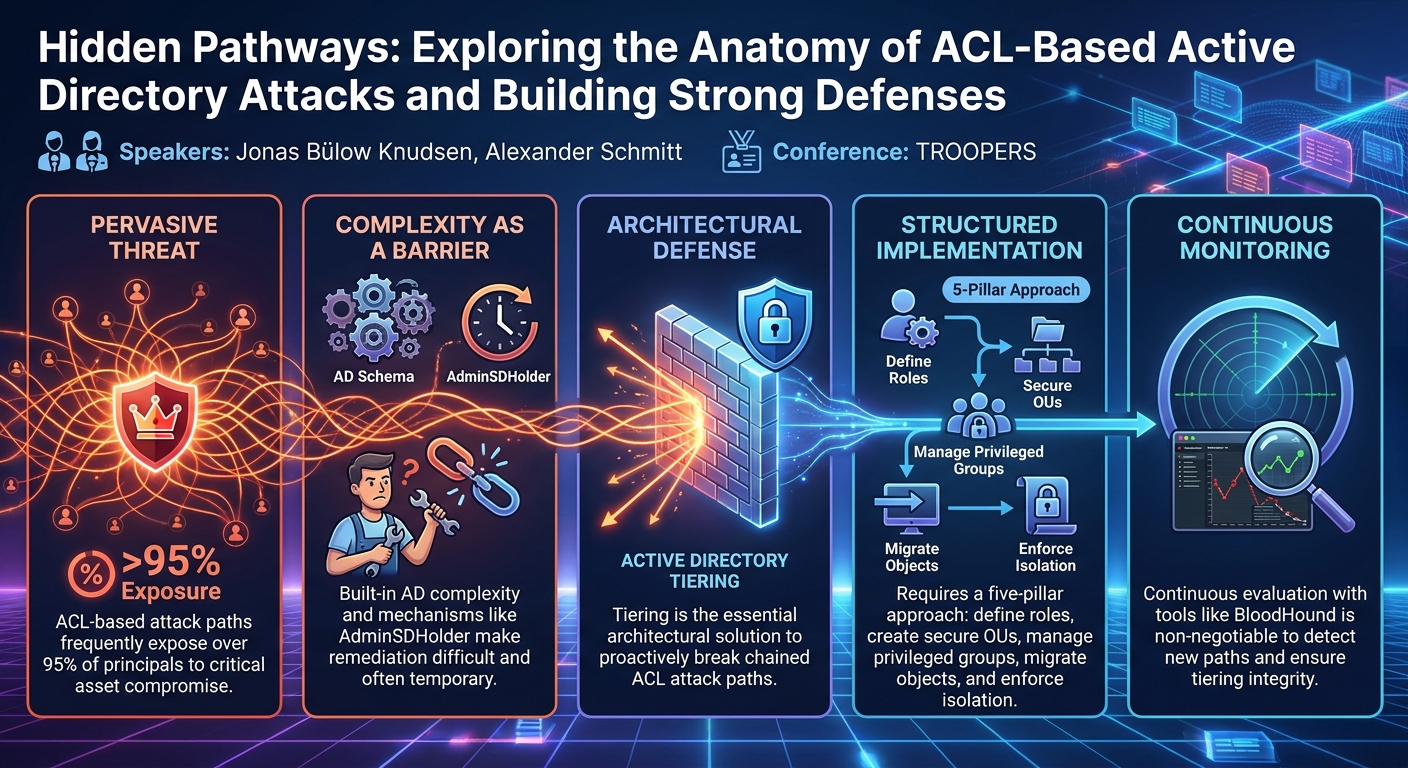
In the current threat landscape, Active Directory (AD) remains a primary target for attackers seeking to escalate privileges and establish persistence within enterprise networks. This talk, "Hidden Pathways: Exploring the Anatomy of ACL-Based Active Directory Attacks and Building Strong Defenses," delivered by Alexander Schmitt and Jonas Bülow Knudsen at TROOPERS, delves deep into the intricate world of ACL-based attack paths within AD. The speakers illuminate why these attack vectors, despite being known for years, continue to pose a significant and pervasive threat to organizations. They argue that the complexity of AD, coupled with evolving attack narratives and the sheer scale of modern environments, makes traditional remediation efforts insufficient. The core of their presentation lies in proposing a structured, five-pillar approach to implementing Active Directory tiering as a robust defense mechanism, aiming to break these insidious attack chains and significantly reduce an organization's attack surface.
Key moments
- 0:00 Introduction and speaker backgrounds
- 3:00 Understanding Active Directory Security Descriptors and ACLs
- 6:00 Using Bloodhound to identify abusable ACL paths
- 10:00 Why ACL-based attack paths remain a problem
- 19:00 The 5-pillar approach for building strong ACL defenses
- 31:00 Recommendations for handling 'Account Operators' group permissions
- 37:00 Demonstrating how proposed defenses break attack paths
- 40:00 Q&A: Removing 'Authenticated Users' from Pre-Windows 2000
Hidden Pathways: Exploring the Anatomy of ACL-Based Active Directory Attacks and Building Strong Defenses
Speakers: Jonas Bülow Knudsen (Product Architect, SpecterOps), Alexander Schmitt (Teal)
Conference: TROOPERS
YouTube: https://www.youtube.com/watch?v=4aQZUdpmQno
Overview
In the current threat landscape, Active Directory (AD) remains a primary target for attackers seeking to escalate privileges and establish persistence within enterprise networks. This talk, "Hidden Pathways: Exploring the Anatomy of ACL-Based Active Directory Attacks and Building Strong Defenses," delivered by Alexander Schmitt and Jonas Bülow Knudsen at TROOPERS, delves deep into the intricate world of ACL-based attack paths within AD. The speakers illuminate why these attack vectors, despite being known for years, continue to pose a significant and pervasive threat to organizations. They argue that the complexity of AD, coupled with evolving attack narratives and the sheer scale of modern environments, makes traditional remediation efforts insufficient. The core of their presentation lies in proposing a structured, five-pillar approach to implementing Active Directory tiering as a robust defense mechanism, aiming to break these insidious attack chains and significantly reduce an organization's attack surface.
The presentation provides a crucial perspective for security professionals, particularly those responsible for AD administration and defense. Schmitt and Knudsen, drawing from their extensive experience in security consulting and BloodHound development, respectively, underscore the critical need to understand not just individual permissions but how they chain together to form exploitable pathways. Their insights are invaluable for organizations struggling to mitigate complex AD risks, offering a clear, actionable framework for moving beyond reactive patching to proactive, architectural defense.
Background
▶ Watch: Introduction and speaker backgrounds (0:00)
The foundation of security within Active Directory is built upon Access Control Lists (ACLs). These lists define precisely which security principals (users, groups, computers) can perform specific actions on AD objects. Each AD object, such as a user account like "Andy," possesses a security descriptor that includes a DACL (Discretionary Access Control List). The DACL, in turn, is composed of multiple ACEs (Access Control Entries), which are individual rules specifying an "allow" or "deny" permission for a given principal on a particular object or property. Permissions can be highly granular, affecting specific attributes, or broad, granting "Full Control." A critical aspect of ACLs is inheritance, where permissions set on a parent object (e.g., an Organizational Unit or OU) automatically apply to its child objects unless explicitly blocked.
While individual ACEs might appear benign, attackers often chain these permissions to create powerful attack paths. For instance, an account with the ability to add members to a group, combined with that group having broad control over a critical server, forms a direct route to privilege escalation. Tools like BloodHound have revolutionized the discovery and visualization of these complex relationships. BloodHound works by collecting data from AD and constructing a graph database where AD objects are nodes and abusable permissions or relationships are represented as edges. This allows defenders and attackers alike to quickly identify paths from low-privilege users to high-value targets, often leveraging ACL-based permissions. BloodHound has supported the identification of ACL-based edges since 2017, highlighting that this is not a new problem.
Despite this long-standing awareness and the availability of powerful analysis tools, ACL-based attack paths remain a persistent and widespread issue. The speakers identify four primary reasons for this: the inherent complexity of AD's permission model, the continuous discovery of new attack narratives, the difficulty in assessing the risk of individual permissions, and the sheer scale of relationships in typical enterprise AD environments. These factors collectively make it challenging for organizations to effectively identify, remediate, and prevent the resurgence of these critical vulnerabilities, necessitating a more structured and architectural approach to AD security, such as tiering.
Key Findings
▶ Watch: Using Bloodhound to identify abusable ACL paths (6:00)
The central finding presented by Schmitt and Knudsen is that ACL-based attack paths are not merely theoretical vulnerabilities but are actively exploited and alarmingly pervasive in real-world Active Directory environments. They illustrate this with concrete examples, including a BloodHound Enterprise screenshot showing two ACL-based attack paths (GenericWrite and WriteDACL) leading to an organization's crown jewels, with an exposure level "above 95%." This means that over 95% of the security principals in that environment possess a path to compromise critical assets, underscoring the severity and widespread nature of the problem. Another example, a "cool looking attack path" shared on Twitter, demonstrated that almost all edges in a complex attack chain were ACL-based, further reinforcing that this issue is widely observed "out in the wild."
The speakers attribute this persistent vulnerability to four key factors:
- Complexity of AD ACLs: The default AD schema and security descriptors often grant unintended broad permissions. For example, the Account Operators group is given "Full Control" over newly created users by default, a permission not directly configured by an admin but inherited from the schema. Similarly, AdminSDHolder objects and the Security Descriptor Propagator (SDProp) process automatically restore specific security descriptors for privileged groups (like Domain Admins) every hour, thwarting manual remediation efforts if not understood.
- Evolving Attack Narratives: The landscape of AD attack techniques is constantly changing. BloodHound continuously adds support for new ACL-based edges as researchers discover novel ways to abuse permissions. This means that an organization that remediated all known ACL paths three years ago might still be vulnerable today due to newly discovered techniques.
- Difficulty in Assessing Permissions: Individual permissions, when viewed in isolation, may appear legitimate or even necessary for operational functions. For instance, granting a help desk group the
AddMemberspermission on a specific group might seem reasonable. However, when chained with other seemingly innocuous permissions (e.g., the target group havingGenericAllon a critical server), a critical attack path emerges, which is not obvious from examining single ACEs. - Sheer Scale of AD Environments: Even a moderately sized company with around 5,000 users can have hundreds of thousands of ACLs and relationships (e.g., 350,000 ACLs and 480,000 relationships in one small example). Manually reviewing and understanding every single permission and its potential impact on attack paths is an impossible task, making automated analysis tools like BloodHound indispensable but also highlighting the overwhelming nature of the problem.
To counter these challenges, the talk proposes a structured, architectural defense strategy centered on Active Directory tiering. This approach aims to systematically define, isolate, and protect critical assets by breaking the chained ACL-based permissions that attackers exploit, moving beyond fragmented, reactive remediation to a holistic, proactive security posture.
Technical Deep Dive
▶ Watch: The 5-pillar approach for building strong ACL defenses (19:00)
The technical core of the talk revolves around understanding how ACLs function within Active Directory and how tools like BloodHound reveal their exploitable nature. An Active Directory object, such as a user, computer, or group, has a security descriptor that dictates who can access it and what actions they can perform. Within this descriptor, the DACL (Discretionary Access Control List) is a crucial component, comprising a list of ACEs (Access Control Entries). Each ACE specifies a trustee (a user, group, or computer), a permission type (allow or deny), and a set of access rights (e.g., "Full Control," "Read Property," "Write Property," "Reset Password").
The speakers use the example of a user named "Andy" to illustrate these concepts. They show a security descriptor with 32 ACEs. Key examples include:
- An ACE allowing the Account Operators group "Full Control" over Andy, meaning any member of this group can read/write properties, reset Andy's password, or even delete the account.
- More granular ACEs, such as one allowing "Cert Publishers" to read and write a specific certificate-related property.
- An ACE granting a "Service Desk" group the specific permission to "Reset Password" for Andy. This particular ACE is highlighted as inherited, indicating it's not set directly on Andy but on a parent object (e.g., an OU where Andy resides), affecting all users within that container.
From an attacker's perspective, the goal is to identify and abuse these ACEs to gain control over a target, like Andy. From a defender's perspective, the objective is to prevent such abuse. This is where BloodHound becomes indispensable. BloodHound connects to AD, collects security-relevant data, and builds a graph database. In this graph, AD objects are nodes, and abusable relationships (derived from ACLs, group memberships, GPOs, etc.) are edges. BloodHound analyzes the DACLs of objects to identify ACEs that can be leveraged by attackers and then creates corresponding edges in its graph.
For instance, if a user can add members to a group, BloodHound creates an AddMembers edge. If a group has "Full Control" over a computer object, it might create a GenericAll edge. The power of BloodHound lies in its pathfinding capabilities, allowing users to trace attack paths from a low-privilege starting point to a high-value target. An example attack path shown in the presentation is: Andy -> AddMembers -> Helpdesk Admins -> GenericAll -> Admin Computer.
Let's break down this example:
AddMembers: This edge signifies that Andy can add any member to theHelpdesk Adminsgroup. This action is often considered legitimate for helpdesk roles and will not trigger alerts in typical AV or EDR software because it's a valid AD operation.GenericAll: This edge indicates thatHelpdesk Adminshas full control over theAdmin Computer. The speakers elaborate on howGenericAllcan be abused. The simplest method is if the organization uses a Local Admin Password Solution (LAPS). WithGenericAll, an attacker can read the password of the local administrator account on the computer object and then log in. Even without LAPS, more complex narratives exist, such as those described by Elad Shamir, involving manipulating service principals or resource-based constrained delegation, demonstrating that "Full Control" often offers multiple avenues for compromise. The key takeaway is that the meaning and abuse potential of permissions are not always obvious.
The persistence of these ACL-based attack paths stems from several technical and operational challenges:
- AD Complexity and Defaults:
- Default Security Descriptors: When a new user is created, its security descriptor is populated from a default stored in the AD schema. This often grants
Account Operators"Full Control" over the new user, even if no administrator explicitly configures it. If defenders only remove this permission from existing users, it will reappear for new ones, creating a recurring vulnerability. - AdminSDHolder: This special object, located in the AD, has a security descriptor that is periodically applied to highly privileged groups like
Domain Admins,Schema Admins, andEnterprise Admins. The SDProp process runs hourly, overwriting any manual changes to the ACLs of these protected groups. An administrator attempting to remove an ACL-based attack path from aDomain Adminsgroup might find it restored within an hour, making remediation efforts futile without understanding AdminSDHolder.
- Continuous Discovery of New Narratives: The timeline of BloodHound's ACL-based edge support (since 2017) shows a consistent addition of new techniques. This means that a remediation strategy based on a snapshot of known attacks quickly becomes outdated, necessitating continuous evaluation.
- Difficulty in Assessing Chained Permissions: Individual permissions (e.g., a help desk user being able to add members to a group) might be operationally necessary. However, when these permissions are chained together across different objects, they can form critical attack paths. The challenge is that the sum of the parts (the attack path) is far more dangerous than the individual parts (single permissions), making it hard for administrators to identify risk without a holistic view.
- Sheer Scale: With hundreds of thousands of ACLs and relationships in even small AD environments, manual auditing is simply not feasible. Automated tools can identify these, but the sheer volume of potential paths can still overwhelm remediation efforts if not approached systematically.
These technical intricacies and operational realities underline why a fundamental architectural shift, like Active Directory tiering, is required to effectively mitigate ACL-based attack paths.
Demo / Proof of Concept
▶ Watch: Recommendations for handling 'Account Operators' group permissions (31:00)
While the talk did not feature a live, interactive demonstration of an exploit, it effectively served as a conceptual "demo" through the robust visualization capabilities of BloodHound. The speakers presented screenshots from both the open-source and Enterprise versions of BloodHound to illustrate the pervasive nature of ACL-based attack paths. These visuals included:
- A BloodHound Enterprise graph depicting "crown jewels" (critical assets) and multiple attack paths leading to them. The striking detail here was the purple coloring of the edges, indicating an exposure level "above 95%," visually demonstrating how easily an attacker could compromise the environment via ACLs.
- An example of a complex, rocket-shaped attack path from a public Twitter post, where "almost all the edges... are ACL based edges." This served as a compelling visual testament that such intricate, ACL-driven attack chains are not isolated incidents but a common occurrence observed by the broader security community.
Crucially, the speakers used a specific, simplified attack path (Andy -> AddMembers -> Helpdesk Admins -> GenericAll -> Admin Computer) to "demo" how their proposed tiering strategy would dismantle it. They walked through the before-and-after scenario:
- Before Tiering: The full attack path exists, leveraging the legitimate but abusable
AddMembersandGenericAllpermissions. - After Tiering: By classifying
Andyas a Tier 2 user,Helpdesk Adminsas a Tier 2 group, and theAdmin ComputerandServer Adminsgroup as Tier 1 objects, andFabian(aDomain Admin) as a Tier 0 user, the path is broken at multiple points. TheAddMembersedge is remediated because Tier 2 users cannot manage Tier 1 groups. TheGenericAlledge is broken because Tier 1 groups no longer have full control over Tier 1 servers in a properly tiered environment. Furthermore, theDomain Admin(Fabian) is restricted from logging into a Tier 1 system, preventing lateral movement even if control over the server were gained.
This conceptual demonstration, supported by BloodHound's visual language and a clear step-by-step breakdown of how tiering disrupts attack logic, effectively conveyed the "proof of concept" for their defensive methodology without requiring a live hacking demo. It illustrated that comprehensive architectural changes, rather than piecemeal fixes, are necessary to break these "hidden pathways."
Defensive Implications
▶ Watch: Q&A: Removing 'Authenticated Users' from Pre-Windows 2000 (40:00)
The core of the talk's defensive implications lies in a structured, five-pillar approach to implementing Active Directory tiering, heavily inspired by Microsoft's "Best Practice Guide for Securing Active Directory Installations" (2011), albeit with modern adaptations. This strategy aims to systematically break ACL-based attack paths by isolating assets based on criticality.
The five pillars are:
- Define Roles and Responsibilities: This foundational step is often the most challenging due to organizational politics and historical practices. It involves explicitly mapping out who needs to do what, on which systems, and with what permissions. The goal is to move away from broad "I'm an admin, I need full control on everything" mentalities to a principle of least privilege. This process defines specific roles (e.g., Tier 0 admin, Tier 1 server admin, Tier 2 help desk), their scope (e.g., specific OUs, data centers), tasks, and the exact accounts and permissions required. This clarity is essential for designing an effective OU structure and delegation model.
- Create a Tiering Structure: Once roles are defined, a new OU structure must be built to reflect the chosen tiering model (e.g., Microsoft's three tiers: Tier 0 for critical infrastructure, Tier 1 for servers, Tier 2 for workstations and users, or more granular tiers as needed). Key technical steps include:
- Creating new OUs (e.g.,
T0,T1,T2containers for users, groups, and computers within each tier). - Crucially, disabling inheritance on the top-level objects of this new OU structure. This prevents legacy, potentially insecure permissions from the domain root from propagating down to the newly secured tiers.
- Applying a baseline of Microsoft-recommended minimal permissions directly to these new OUs. These permissions then inherit down the structure, providing a clean slate.
- Implementing delegated control at lower levels, allowing specific roles (e.g., a Tier 2 help desk group) to manage objects only within their designated tier (e.g., reset passwords for Tier 2 users). Teal Technology Consulting provides PowerShell scripts to assist with building this OU structure and configuring these baseline permissions.
- Move Default High-Privilege Groups: Microsoft's guide recommends moving
Domain Admins,Schema Admins, andEnterprise Adminsinto the new Tier 0 OU. However, the speakers highlight a divergence: Microsoft states that other built-in groups (likeAdministrators,Server Operators) cannot be moved because they are protected by AdminSDHolder. The presenters argue that with modern knowledge, it's beneficial to attempt to move as many built-in groups from the defaultUserscontainer as possible, especially if they are not actively used. They recommend creating custom groups with clear naming conventions and delegating permissions as appropriate, leaving built-in groups as empty as possible. This requires significant testing, as different software might rely on these groups. The question of modifying the AD schema or AdminSDHolder directly to change default permissions was raised, but the speakers caution against it due to unknown side effects, preferring to maintain default permissions and move objects to secured OUs.
- Remove Account Operators (and Print Operators): The
Account Operatorsgroup is a highly privileged built-in group. By default, via the AD schema, it holds "Full Control" over all new user, computer, and group objects, unless they are protected by AdminSDHolder. This meansAccount Operatorsoften has broad control over most Tier 1 and Tier 2 objects, making it a critical attack vector. The speakers strongly recommend not using this group and instead creating custom, granularly delegated groups. While changing the AD schema to removeAccount Operatorsfrom default security descriptors is an option, it's generally discouraged due to potential unforeseen side effects. A more pragmatic approach is to use scheduled tasks (e.g., running every 15 minutes) with PowerShell scripts (like those developed by Teal) to automatically clean upAccount Operators(andPrint Operators) permissions from objects within the secured OU structure whenever new objects are created or permissions are misconfigured.
- Move All Objects into the Right Tier: This is the most complex and time-consuming step, requiring significant project management and collaboration. It involves:
- Account Creation and Training: Creating new user accounts for administrators based on their tiered roles (e.g., a Tier 0 admin might have separate accounts for Tier 0 and Tier 2 duties) and training them on the new operational model.
- Login Restriction Policies: Implementing policies like logon restriction policies or Kerberos authentication Silos to prevent Tier 0 admins from logging onto Tier 1 or Tier 2 systems, thus enforcing isolation.
- Application Owner Support: Moving service accounts, computer objects, and users into the new tiered structure often breaks applications. This requires close coordination with application owners to test functionality, reconfigure LDAP queries that might be hardcoded to specific OUs, and adjust permissions for service accounts.
- Cleaning Up Directly Set Permissions: When objects are moved, directly set (non-inherited) ACLs move with them. It's crucial to review these and often use the "Restore Default" button in ADUC to remove them, ensuring only inherited, tier-appropriate permissions remain.
- GPO Review: Group Policy Objects (GPOs) also have ACLs. Existing GPOs need to be linked to the new OU structure, and their permissions must be reviewed to align with the tiering model.
Finally, the speakers emphasize the need for continuous evaluation. Implementing tiering is not a one-time fix. Misconfigurations can occur, and new attack techniques may emerge. Regular audits using tools like BloodHound are essential to ensure the tiering structure remains robust and effective against evolving threats.
Key Takeaways
- ACL-based attack paths are pervasive and critical: Despite being known for years, ACL-based vulnerabilities remain a primary threat vector, often allowing over 95% of principals to reach "crown jewels" in AD environments.
- AD complexity fuels the problem: Default security descriptors (e.g.,
Account Operatorsfull control on new users) and mechanisms likeAdminSDHolder(hourly restoration of privileged group ACLs) make remediation difficult and often temporary. - Tiering is the architectural solution: A structured approach to Active Directory tiering is essential to break complex attack chains that leverage chained ACL permissions, moving beyond reactive patching to proactive defense.
- Five pillars for effective defense: Implementing tiering requires a methodical approach: defining roles, creating a secure OU structure, moving/managing default privileged groups, removing problematic groups like
Account Operators, and carefully migrating all AD objects. - Continuous evaluation is non-negotiable: AD environments are dynamic. Ongoing monitoring with tools like BloodHound is crucial to detect new attack paths, misconfigurations, and ensure the long-term effectiveness of tiering.
- Collaboration and planning are key: The most challenging steps, like defining roles and moving objects, require significant organizational buy-in, cross-departmental collaboration (especially with application owners), and meticulous project planning.
About the Speaker(s)
Alexander Schmitt is a co-founder of Teal Technology Consulting, a company specializing in Active Directory security. With six years of experience in this field, Alexander focuses on translating cutting-edge research into actionable defense strategies for customers. His work involves understanding complex AD attack primitives and developing practical plans for remediation and security enhancement. He has a personal interest in raising his bike and acoustics.
Jonas Bülow Knudsen serves as a Product Architect in the BloodHound Enterprise team at SpecterOps. In this role, he contributes to the implementation of new features for both the open-source and Enterprise versions of BloodHound. Jonas brings a strong background in security consulting, where he assisted organizations in identifying and remediating attack paths within Active Directory and building robust defenses, including the implementation of the tiering model. He is based in Copenhagen, Denmark, and enjoys hiking and being outdoors.
Reviews
Dr. Zero (Offensive Security Researcher) — SOLID
This is an 'eat your vegetables' session on Active Directory tiering. It doesn't drop any novel primitives, but it provides a painfully necessary roadmap for fixing the exact same ACL misconfigurations offensive teams have been exploiting since 2016. Solid architectural defense, even if the core concepts are old enough to drive.
Heather Calloway (CISO) — MUST SEE
This talk proves that playing whack-a-mole with Active Directory permissions is a failed strategy. The speakers outline a structural tiering approach that is the only mathematical way to break identity-based attack paths. It outlines a multi-year IAM overhaul that will require your political capital to execute.