Priority for Effective Action - A Practical Model for quantifying the Risk of Active Directory Attacks
Mars Cheng (Threat Research Manager · TXOne Networks), Dexter Chen (Threat Researcher · TXOne Networks)
TROOPERS23 · Day 1 · Active Directory & Azure Security · Active Directory & Azure Security
Overview
In this insightful TROOPERS talk, Mars Cheng and Dexter Chen from TXOne Networks introduce a novel, practical model for quantifying the risk of Active Directory (AD) attacks. Titled "Priority for Effective Action," their presentation addresses a critical challenge faced by blue teams and defenders: the overwhelming complexity of AD environments and the difficulty in prioritizing mitigation efforts against a vast array of potential attack techniques. With AD serving as the backbone for over 90% of enterprises, its compromise often leads to full domain takeover, as evidenced by major cyberattacks like LockBit 2.0.
Key moments
- 0:00 Introduction: The AD attack prioritization challenge
- 4:00 Proposing a practical AD risk quantification model
- 6:00 Defining risk: Likelihood (initiation, occurrence, conditions) x Impact
- 12:15 Kerberoasting example: Calculating risk for a common attack
- 24:00 Why attack paths are crucial for comprehensive risk
- 31:00 Attack path example: Local Admin to DC Sync
- 47:00 Strategies for effective AD risk management and mitigation
- 51:30 Q&A: Assessing risk for mixed user access on servers
Priority for Effective Action - A Practical Model for quantifying the Risk of Active Directory Attacks
Speakers: Mars Cheng (Threat Research Manager, TXOne Networks), Dexter Chen (Threat Researcher, TXOne Networks)
Conference: TROOPERS
YouTube: https://www.youtube.com/watch?v=GwnRkcimmdE
Overview
In this insightful TROOPERS talk, Mars Cheng and Dexter Chen from TXOne Networks introduce a novel, practical model for quantifying the risk of Active Directory (AD) attacks. Titled "Priority for Effective Action," their presentation addresses a critical challenge faced by blue teams and defenders: the overwhelming complexity of AD environments and the difficulty in prioritizing mitigation efforts against a vast array of potential attack techniques. With AD serving as the backbone for over 90% of enterprises, its compromise often leads to full domain takeover, as evidenced by major cyberattacks like LockBit 2.0.
The core problem, as highlighted by the speakers, is not a lack of awareness regarding AD's importance or the prevalence of attacks, but rather the inability of security teams to effectively identify, enumerate, and prioritize the most significant attack paths within their unique environments. This leads to a reactive and often inefficient use of limited defensive resources. Cheng and Chen propose a quantitative risk model designed to simplify this prioritization, enabling organizations to make data-driven decisions on where to focus their defensive actions first, thereby maximizing the benefit of their security investments.
Their model specifically targets misconfigurations and abusable primitives within AD, rather than server vulnerabilities, aiming to provide a clear, actionable framework for risk assessment. By breaking down risk into quantifiable components of likelihood and impact, the speakers offer a systematic approach to understanding which AD attack vectors and paths pose the greatest threat, allowing defenders to shift from a reactive stance to a proactive, prioritized defense strategy.
Background
▶ Watch: Introduction: The AD attack prioritization challenge (0:00)
Active Directory remains the cornerstone of identity and access management for the vast majority of modern enterprises, irrespective of whether their infrastructure is on-premises or cloud-based. Its pervasive use makes it an irresistible target for attackers, with numerous advanced persistent threat (APT) groups and ransomware operations consistently exploiting AD weaknesses to achieve persistence, lateral movement, and ultimately, domain compromise. Despite this well-established threat landscape, defenders frequently find themselves struggling to mount an effective defense.
The speakers identify several key reasons for this persistent challenge. Firstly, misconfigurations are endemic in large AD environments, often numbering in the hundreds of thousands of objects (users, computers, groups). Discovering and cataloging all misconfigurations across such a vast attack surface is a monumental task. Even when discovered, implementing detection and prevention mechanisms across a complex AD infrastructure presents significant hurdles. Secondly, the sheer number of potential attack paths within a typical AD environment is immense. Tools like BloodHound have illuminated the intricate web of relationships that attackers can abuse, but enumerating and understanding all these paths, let alone prioritizing them, remains a daunting exercise for blue teams. This complexity often leads to a state of paralysis, where defenders are unsure which actions will yield the most significant security improvements.
Current risk assessment methodologies, while valuable, often prove too complex or abstract for practical, day-to-day application in dynamic AD environments. The need for a straightforward, easily implementable model that focuses specifically on AD's unique characteristics – particularly its abusable features and common misconfigurations – is paramount. This talk aims to fill that gap, providing a clear, quantitative method for risk assessment that can guide defenders in allocating their limited resources more effectively.
Key Findings
▶ Watch: Defining risk: Likelihood (initiation, occurrence, conditions) x Impact (6:00)
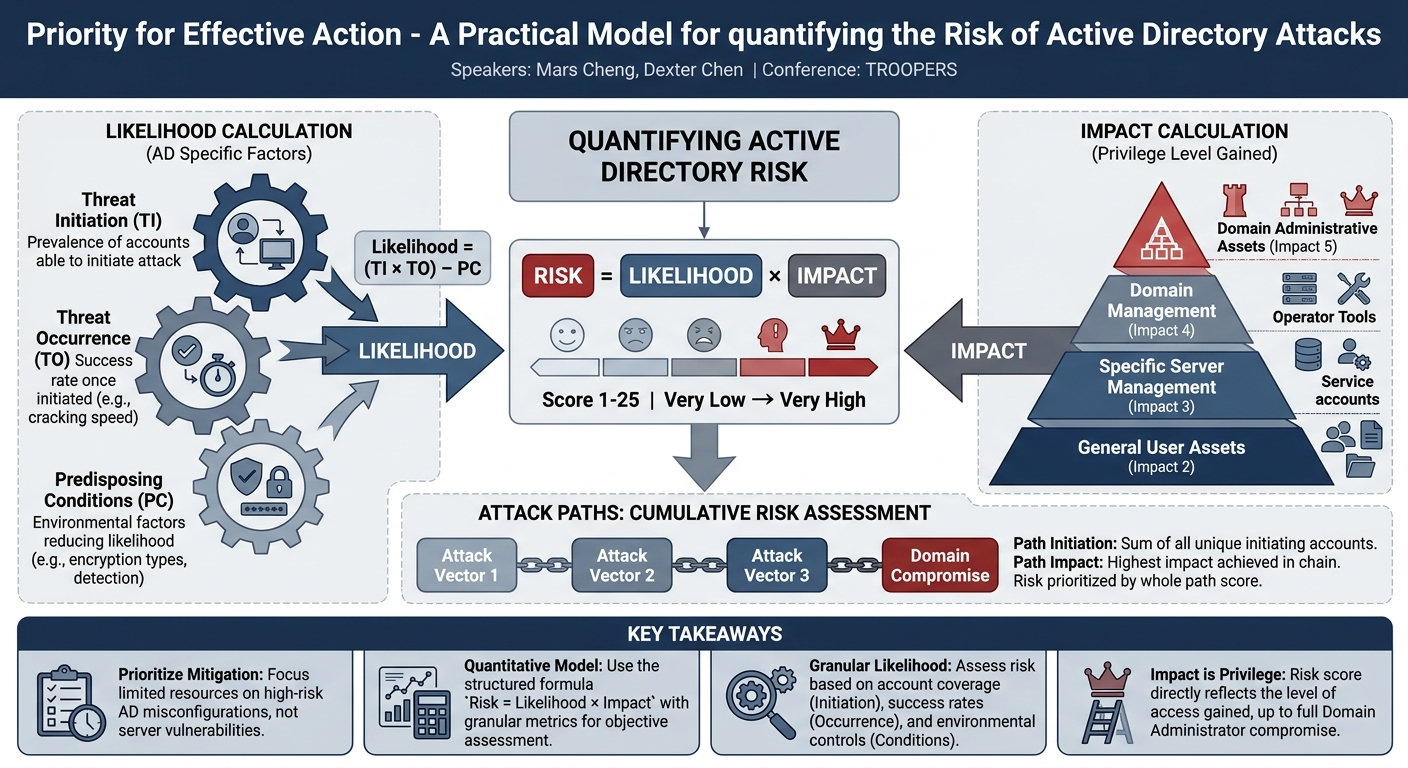
The central contribution of this talk is the introduction of a practical model for quantifying the risk of Active Directory attacks, designed for ease of application by blue teams and security practitioners. The model focuses on assessing risks associated with AD misconfigurations and abusable primitives, explicitly excluding server vulnerabilities to maintain a focused scope.
The core formula for risk quantification is derived from traditional risk management principles:
Risk = Likelihood × Impact
This model is notable for its granular breakdown of both likelihood and impact into specific, quantifiable factors relevant to AD environments:
- Likelihood Calculation: This is determined by combining Threat Initiation and Threat Occurrence, with an adjustment for Predisposing Conditions.
- Threat Initiation: Quantifies the percentage of accounts (users or computers) within the domain that can initiate a specific attack vector. If 90% or more accounts can initiate an attack, it's rated "Very High" (level 5).
- Threat Occurrence: Represents the success rate of the attack once initiated. A 100% success rate is "Very High" (level 5).
- Predisposing Conditions: These are environmental factors that can adjust the likelihood. Examples include password policies, specific AD settings (e.g., Kerberos encryption types), or existing detection mechanisms. These conditions can reduce the overall likelihood score.
- Impact Calculation: This assesses the level of privilege or access an attacker gains upon successful execution of an attack vector.
- Impact scores range from 1 to 5, where 5 signifies obtaining Domain Administrator assets (e.g., domain controller access, password hashes for the entire domain), 4 for Domain Management privileges (e.g., Account Operator), 3 for Specific Server Management, and 2 for General User assets.
Crucially, the model extends beyond individual attack vectors to encompass attack paths, which are defined as chains of multiple attack vectors. This allows for a more comprehensive risk assessment that reflects how attackers typically achieve higher-level privileges by combining several lower-impact techniques. For attack paths, the model modifies the likelihood calculation to consider the aggregate of all accounts capable of initiating any vector in the path, and the impact is taken as the highest impact achieved at any point within the path. This holistic view enables defenders to prioritize not just individual weaknesses, but the most dangerous sequences of attacks an adversary might pursue.
The model's emphasis on quantifiable metrics (percentages, success rates, defined privilege levels) aims to provide objective scores that facilitate clear prioritization, moving away from subjective assessments that often hinder effective action.
Technical Deep Dive
▶ Watch: Why attack paths are crucial for comprehensive risk (24:00)
The proposed risk model provides a structured, quantitative approach to assessing Active Directory attack risks, breaking down complex scenarios into manageable, measurable components.
The Risk Quantification Formula
The foundation of the model is Risk = Likelihood × Impact. Both Likelihood and Impact are assigned quantitative values from 1 to 5, where 1 is "Very Low" and 5 is "Very High." This results in a total risk score ranging from 1 to 25.
Likelihood Components:
- Threat Initiation (TI): This metric measures the prevalence of accounts that can initiate a given attack. It's calculated as the coverage percentage of accounts that possess the necessary rights or configurations.
- <25% coverage: TI = 1 (Very Low)
- 25-49% coverage: TI = 2 (Low)
- 50-69% coverage: TI = 3 (Moderate)
- 70-89% coverage: TI = 4 (High)
- 90-100% coverage: TI = 5 (Very High)
- Threat Occurrence (TO): This measures the success rate of the attack once initiated.
- <25% success: TO = 1 (Very Low)
- 25-49% success: TO = 2 (Low)
- 50-69% success: TO = 3 (Moderate)
- 70-89% success: TO = 4 (High)
- 90-100% success: TO = 5 (Very High)
- Predisposing Conditions (PC): These are environmental factors that can adjust the likelihood. They are assigned a value from 0 to 5, with higher values indicating stronger mitigating controls that reduce likelihood.
- Examples: strong password policy, disabling insecure Kerberos encryption types (like RC4), presence of detection mechanisms.
- The formula for Likelihood becomes:
Likelihood = (TI × TO) - PC.
Impact Components:
Impact is determined by the highest level of privilege or access gained by the attacker upon successful execution of the attack vector or path.
- Domain Administrative Assets (e.g., Domain Controller, full domain compromise): Impact = 5 (Very High)
- Domain Management Assets (e.g., Account Operators, Server Operators): Impact = 4 (High)
- Specific Server Management Assets (e.g., MS SQL service account): Impact = 3 (Moderate)
- Domain Privilege Assets (e.g., specific user account compromise): Impact = 2 (Low)
- No Privilege Escalation: Impact = 1 (Very Low)
Applying the Model to Attack Vectors
The speakers provide detailed examples for common AD attack vectors:
- Kerberoasting:
- Definition: Abusing Service Principal Names (SPNs) registered to user or computer accounts. Any domain user can request a service ticket (TGS) for these SPNs, which can then be cracked offline to recover the account's password hash.
- Threat Initiation: 100% of domain users can request a service ticket for an SPN, so TI = 5.
- Threat Occurrence: Depends on password cracking success rate. In a default domain with a 7-character password length and RC4 encryption (changed every 42 days), the success rate might be 64% in 265 days, leading to TO = 3 (Moderate).
- Predisposing Conditions: Assuming default settings, PC = 0.
- Likelihood: (5 × 3) - 0 = 15 (High).
- Impact: Varies based on the target account. If the target is a Domain Administrator account, Impact = 5. If it's an MS SQL Service Account, Impact = 3.
- Risk: For a DA account: 15 (Likelihood) × 5 (Impact) = 20 (Very High). For an MS SQL service account: 15 (Likelihood) × 3 (Impact) = 12 (Moderate).
- Mitigation Example: Disabling RC4 encryption (e.g., by forcing AES-128) would change Predisposing Conditions, reducing the Threat Occurrence and thus the overall likelihood and risk.
- ACL Abuse:
- Definition: Exploiting misconfigured Access Control Lists (ACLs) on AD objects, granting excessive permissions like
GenericAll,WriteDACL,WriteOwner, orUser-Force-Change-Password. - Scenario 1: User with
User-Force-Change-Passwordto a general user account. - Threat Initiation: If only 1 user out of 1000 has this right (<25% coverage), TI = 1.
- Threat Occurrence: If successfully abused, TO = 5.
- Likelihood: (1 × 5) - 0 = 5.
- Impact: Target is a general user, Impact = 2.
- Risk: 5 (Likelihood) × 2 (Impact) = 6 (Low).
- Scenario 2: "Everyone" group has
GenericAllto a general user account. - Threat Initiation: 100% of domain users can abuse this, TI = 5.
- Threat Occurrence: TO = 5.
- Likelihood: (5 × 5) - 0 = 25.
- Impact: Target is a general user, Impact = 2.
- Risk: 25 (Likelihood) × 2 (Impact) = 10 (Moderate).
- Scenario 3: "IT Group" (30% of accounts) has
GenericAllto a Domain Administrator account. - Threat Initiation: 30% coverage, TI = 3.
- Threat Occurrence: TO = 5.
- Likelihood: (3 × 5) - 0 = 15.
- Impact: Target is a Domain Administrator, Impact = 5.
- Risk: 15 (Likelihood) × 5 (Impact) = 20 (Very High).
Applying the Model to Attack Paths
The model extends to attack paths, which chain multiple attack vectors. The risk factors are slightly modified for this holistic view:
- Threat Initiation (Path): Sum of all unique accounts that can initiate any attack vector within the path.
- Threat Occurrence (Path): Assumed to be 100% (TO = 5), as attackers are presumed to follow the path to its objective.
- Predisposing Conditions (Path): Taken from the final attack vector in the path.
- Impact (Path): The highest impact value achieved by any vector within the path.
Example Attack Path: Local Admin → Local Session Dump → ACL Abuse (to DC Sync user) → DC Sync (Domain Compromise)
- Overall Attack Path Risk:
- Threat Initiation (Path): Assume 156 unique accounts (out of 1000 total) can initiate any vector in this path. Coverage = 15.6%, so TI = 3 (Moderate).
- Threat Occurrence (Path): Assume 100% success, TO = 5.
- Likelihood: (3 × 5) - 0 = 15 (High).
- Impact (Path): The final vector, DC Sync, results in Domain Administrator access, so Impact = 5.
- Risk (Path): 15 (Likelihood) × 5 (Impact) = 20 (Very High).
- Prioritizing Vectors within the Path: After identifying a high-risk path, defenders need to prioritize which specific vector within that path to mitigate first. This requires assessing each vector's risk in the context of the path.
- Local Admin:
- Definition: A domain user or computer account is a member of the local administrators group on a target machine.
- TI: 35 users (out of 156 path-initiating users) have local admin rights to relevant computers. Coverage = 22%, TI = 2.
- TO: 100% (assumed for remote command execution), TO = 5.
- Likelihood: (2 × 5) - 0 = 10 (Moderate).
- Impact: Compromises a service-hosting computer, Impact = 3.
- Risk: 10 (Likelihood) × 3 (Impact) = 9 (Low).
- Local Session Dump:
- Definition: Dumping credentials from
lsass.exeon a compromised machine where users have active sessions. - TI: 30 computers (out of 60 from previous vector) have active local sessions. Coverage = 50%, TI = 3.
- TO: 100% (dumping credentials), TO = 5.
- Likelihood: (3 × 5) - 0 = 15 (High).
- Impact: Gains access to regular domain user credentials, Impact = 2.
- Risk: 15 (Likelihood) × 2 (Impact) = 10 (Moderate).
- ACL Abuse (to DC Sync User):
- Definition: Abusing ACLs to gain privileges over a user account that has
DC Syncrights. - TI: 30 users (out of 40 from previous vector) have abusable ACLs. Coverage = 75%, TI = 4.
- TO: 100% (if ACL exists), TO = 5.
- Likelihood: (4 × 5) - 0 = 20 (Very High).
- Impact: Target user has
DC Syncrights, leading to DA-level access, Impact = 5. - Risk: 20 (Likelihood) × 5 (Impact) = 25 (Very High).
- DC Sync:
- Definition: Abusing domain replication privileges to synchronize and extract the entire AD database, including password hashes.
- TI: 10 users (out of 30 from previous vector) have
DC Syncrights. Coverage = 33%, TI = 3. - TO: 100% (if privilege exists), TO = 5.
- Likelihood: (3 × 5) - 0 = 15 (High).
- Impact: Leads to full domain compromise, Impact = 5.
- Risk: 15 (Likelihood) × 5 (Impact) = 20 (Very High).
By assessing each vector within the path, defenders can see that ACL Abuse (Risk 25) is the most critical point to address, followed by DC Sync (Risk 20). This granular prioritization ensures that limited resources are directed to the most impactful mitigation efforts.
Demo / Proof of Concept
▶ Watch: Attack path example: Local Admin to DC Sync (31:00)
While the talk did not feature a live software demonstration, Mars Cheng and Dexter Chen effectively provided a proof of concept for their model through detailed, step-by-step calculations and realistic Active Directory scenarios. These examples served as practical demonstrations of how their quantitative risk model can be applied to both individual attack vectors and complex attack paths within an enterprise environment.
The first demonstration involved calculating the risk associated with Kerberoasting. The speakers walked through how to determine the Threat Initiation (100% of users can request service tickets), Threat Occurrence (based on password cracking success rates for common hash types like RC4), and the resulting Likelihood. They then showed how the Impact differs based on the privilege level of the targeted service account (e.g., a Domain Administrator account versus an MS SQL service account), leading to distinct risk scores. They further illustrated how defensive actions, such as disabling RC4 encryption, could directly alter the Predisposing Conditions and consequently reduce the calculated risk.
The second set of examples focused on ACL Abuse, showcasing how various configurations of Access Control Lists could lead to different risk levels. They demonstrated scenarios ranging from a single user having a User-Force-Change-Password right over a general user, to an "IT Group" having GenericAll rights over a Domain Administrator account. These calculations clearly highlighted how the breadth of Threat Initiation (account coverage) and the Impact of the target object significantly influence the final risk score.
Finally, the most comprehensive demonstration was the attack path qualification, where the speakers analyzed a multi-stage attack: Local Admin → Local Session Dump → ACL Abuse (to DC Sync user) → DC Sync. They first calculated the overall risk of the entire path and then, critically, broke down the risk calculation for each individual vector within that specific path. This part of the demonstration vividly illustrated how the model enables defenders to not only identify high-risk attack chains but also pinpoint the most vulnerable "links" in those chains, allowing for highly targeted and efficient mitigation strategies. These detailed examples served as a robust proof of concept for the model's practical utility and effectiveness.
Defensive Implications
▶ Watch: Q&A: Assessing risk for mixed user access on servers (51:30)
The "Priority for Effective Action" model offers clear, actionable guidance for defenders grappling with Active Directory security. By quantifying risk, it moves beyond generic recommendations to provide a data-driven framework for prioritizing mitigation efforts.
- Prioritize High-Risk Areas: The primary implication is the ability to identify and prioritize the attack vectors and paths with the highest calculated risk scores. This enables blue teams with limited resources to focus their efforts where they will have the maximum impact on reducing overall organizational risk. For instance, if an ACL Abuse path leading to Domain Admin compromise yields a risk score of 25, while a Kerberoasting attack on a low-privilege service account scores 12, the former should clearly be addressed first.
- Risk Avoidance through Configuration Management: The model inherently encourages risk avoidance by highlighting misconfigurations. Defenders should proactively remove unnecessary configurations and excessive rights.
- For Kerberoasting, this means removing Service Principal Names (SPNs) from accounts that don't require them or ensuring SPNs are registered to strong, dedicated service accounts with complex passwords.
- For ACL Abuse, it implies rigorously auditing and correcting overly permissive Access Control Lists (ACLs). Removing
GenericAll,WriteDACL,WriteOwner, orUser-Force-Change-Passwordrights from non-administrative users or groups is crucial.
- Risk Reduction by Modifying Likelihood Factors:
- Reduce Threat Initiation: Proactively limit the number of accounts that can initiate an attack. This involves implementing the principle of least privilege, ensuring users and computers only have the necessary rights and no more. For example, reducing the number of users with local administrator privileges on workstations directly reduces the Threat Initiation for local admin attacks.
- Decrease Threat Occurrence: Improve the success rate of defensive controls. For Kerberoasting, this means disabling weaker Kerberos encryption types like RC4 in favor of stronger AES-128 or AES-256. Implementing robust password policies (length, complexity, rotation) directly impacts the success rate of offline password cracking.
- Leverage Predisposing Conditions: Deploy and configure detection mechanisms that can identify attack attempts. For Kerberoasting, monitoring for requests of RC4-encrypted service tickets can be an indicator of compromise. For ACL Abuse, monitoring for suspicious modifications to ACLs or unusual privilege grants can provide early warning. These detection capabilities reduce the overall likelihood by increasing the chances of early intervention.
- Reduce Impact through Least Privilege: A fundamental defensive strategy is to minimize the impact of a successful attack. This means applying least privilege to all Active Directory objects, especially high-value targets. If a critical service account or an administrative account is compromised, the impact should be as limited as possible. Regularly review and restrict the privileges of Domain Administrator accounts, service accounts, and any accounts that possess highly sensitive rights like
DC Sync. By reducing the potential impact, even if an attack vector is exploited, the overall risk remains lower.
By systematically applying these strategies based on the quantified risk scores, organizations can transform their Active Directory security posture from a reactive, overwhelmed state to a proactive, highly targeted, and efficient defense.
Key Takeaways
- Prioritization is Paramount: Active Directory environments are complex with numerous attack vectors and paths. Quantifying risk is essential for blue teams to prioritize mitigation efforts effectively, especially with limited resources.
- Practical Risk Model for AD: The presented model offers a straightforward, quantitative approach to assess risk for AD misconfigurations and abusable primitives, focusing on
Risk = Likelihood × Impact. - Likelihood is Granular: Likelihood is determined by Threat Initiation (percentage of accounts that can initiate an attack), Threat Occurrence (success rate), and adjusted by Predisposing Conditions (environmental controls like password policy or detection).
- Impact Reflects Privilege: Impact is directly tied to the level of privilege an attacker gains, ranging from general user access to full Domain Administrator compromise.
- Attack Paths Provide Context: The model extends to chaining multiple attack vectors into attack paths, allowing for a holistic risk assessment and the identification of the most critical "links" within complex attack chains.
- Actionable Mitigation Strategies: The risk factors (Threat Initiation, Threat Occurrence, Predisposing Conditions, Impact) directly guide defensive actions, from removing unnecessary rights (risk avoidance) to strengthening security settings and deploying detection mechanisms (risk reduction).
About the Speaker(s)
Mars Cheng is a Threat Research Manager at TXOne Networks, based in Taiwan. He brings extensive experience in cybersecurity, having also served as a security director for the Association of Hackers in Taiwan. Mars is a prominent figure in the cybersecurity community, known for organizing the HITCON conference. His research interests are diverse, focusing on ICS, SCADA, IoT, malware analysis, and various aspects of enterprise security. He is a recognized speaker at major international conferences, including Black Hat USA, Black Hat Europe, HITCON, and SecTor. Furthermore, Mars is an instructor for HITCON training and contributes to the Ministry of National Defense in Taiwan.
Dexter Chen is a Threat Researcher at TXOne Networks and works alongside Mars Cheng. He serves as a supervisor for the Association of Hackers in Taiwan, demonstrating his commitment to the security community. Dexter's expertise lies particularly in red teaming and Active Directory security, making him a valuable contributor to the development of practical defense strategies. He has shared his insights and research at several notable conferences, including Black Hat Middle East & Africa, Cybersec and HITCON.
Reviews
Dr. Zero (Offensive Security Researcher) — WEAK
They brought an Excel risk matrix to TROOPERS. Cheng and Chen repackaged a decade of well-understood Active Directory attacks into a 1-to-5 scoring rubric that tells you Domain Admin compromise is bad. It's CISSP day-one math masquerading as offensive research.
Heather Calloway (CISO) — SOLID
This talk offers a structured, heuristic model for prioritizing Active Directory remediation over simply admiring the problem via attack-path graphs. While the methodology relies on ordinal scales rather than true probabilistic risk, it gives IAM and security engineering teams a defensible method for allocating limited sprint capacity. It’s a highly practical operational framework that translates technical sprawl into an actionable hardening roadmap.