Security Heroes versus the Power of Privacy
Avi D (Founder and CEO · Bounce Security), Kim Wuyts (Senior Privacy Researcher · imec-DistriNet, KU Leuven)
TROOPERS23 · Day 1 · Defense & Management · Defense & Management
Overview
In a world increasingly reliant on digital systems, the often-perceived conflict between security and privacy stands as a critical challenge. This engaging talk, "Security Heroes versus the Power of Privacy," presented by Avi D (Captain Security) and Kim Wuyts (Professor Privacy) at TROOPERS, masterfully dismantles common misconceptions, arguing that security and privacy are not opposing forces but rather potent allies. Through a dynamic, role-playing narrative, the speakers illustrate how combining these disciplines creates a synergistic "superpower" that significantly enhances overall system resilience and trustworthiness.
Key moments
- 2:00 Professor Privacy meets Captain Security
- 4:45 Why 'nothing to hide' is a misconception
- 9:00 Privacy has unique protection goals (not just security)
- 12:30 The strong business case for privacy investment
- 23:00 Understanding security threats with STRIDE framework
- 27:00 LINDDUN framework for privacy threat modeling
- 42:00 Combining security and privacy threat modeling (Q&A)
Security Heroes versus the Power of Privacy
Speakers: Avi D (Founder and CEO, Bounce Security), Kim Wuyts (Senior Privacy Researcher, imec-DistriNet, KU Leuven)
Conference: TROOPERS
YouTube: https://www.youtube.com/watch?v=rBdcupIhkDc
Overview
In a world increasingly reliant on digital systems, the often-perceived conflict between security and privacy stands as a critical challenge. This engaging talk, "Security Heroes versus the Power of Privacy," presented by Avi D (Captain Security) and Kim Wuyts (Professor Privacy) at TROOPERS, masterfully dismantles common misconceptions, arguing that security and privacy are not opposing forces but rather potent allies. Through a dynamic, role-playing narrative, the speakers illustrate how combining these disciplines creates a synergistic "superpower" that significantly enhances overall system resilience and trustworthiness.
The core premise of the talk is that by leveraging security superpowers to defend privacy, privacy itself transforms into a force multiplier for security battles. The speakers, embodying their respective superhero personas, challenge the prevailing notion that privacy is an optional, costly, or functionality-breaking endeavor. Instead, they advocate for a holistic approach where privacy is integrated early and deeply into the system design lifecycle, not as an afterthought, but as a foundational element alongside security.
This article delves into the critical insights shared, exploring the distinct goals of privacy, the tangible benefits of investing in it, and the practical methodologies – particularly combined threat modeling – that enable organizations to build systems that are both robustly secure and inherently privacy-respecting. The presentation makes a compelling case for a paradigm shift, urging security professionals to embrace privacy as an indispensable component of their defensive arsenal, ultimately leading to stronger systems, increased user trust, and greater business value.
Background
▶ Watch: Professor Privacy meets Captain Security (2:00)
The talk opens by addressing fundamental misunderstandings surrounding privacy, particularly from a traditional security perspective. Captain Security, initially embodying the "nothing to hide" mentality, represents a common viewpoint that privacy is either unnecessary or merely a subset of confidentiality. Professor Privacy systematically debunks these notions, asserting that privacy extends far beyond simply protecting secrets. It encompasses personal information like medical history, financial details, and even browser activity, which individuals have a right to control, regardless of its "secret" nature.
A critical point of context is the pervasive collection of personal data by modern technologies. Examples like the Roomba robot vacuum cleaner, which collected and shared intimate photos of users in their homes during beta tests, and Tesla workers sharing "intimate scenes" captured by car cameras, highlight the profound risks of unchecked data collection, even when the data itself isn't traditionally considered "secret." These incidents underscore that privacy breaches can occur not just through malicious external attacks, but also through negligent internal practices or a lack of robust data governance.
Furthermore, the talk challenges the misconception that privacy is synonymous with confidentiality, a core tenet of the CIA triad (Confidentiality, Integrity, Availability) in security. While confidentiality is about protecting data from unauthorized disclosure, privacy has its own distinct set of protection goals: unlinkability, transparency, and intervenability (also referred to as disassociability, predictability, and manageability in US-based terminology). This distinction is crucial because a system can be confidential (data not leaked) but still fail on privacy (e.g., by linking disparate data points to infer sensitive information, or by lacking transparency in data processing). The "Target pregnancy inference" story, where a retail store deduced a teenager's pregnancy based on subtle changes in shopping habits, serves as a powerful illustration of how seemingly innocuous, non-secret data, when linked, can reveal highly private information. This background sets the stage for the argument that privacy requires a distinct mindset and dedicated methodologies.
Key Findings
▶ Watch: Privacy has unique protection goals (not just security) (9:00)
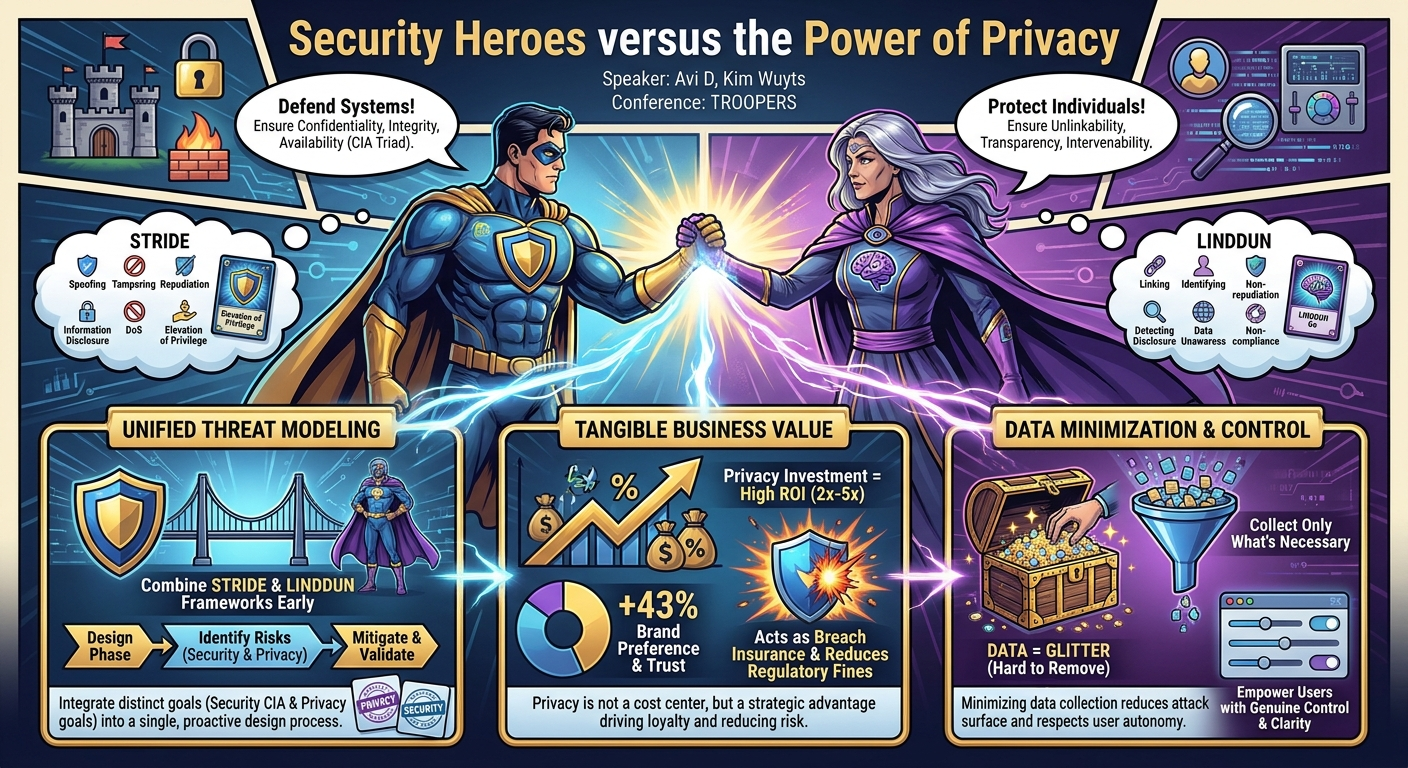
The central revelation of the talk is that security and privacy, far from being at odds, are mutually reinforcing disciplines whose combined application leads to significantly more robust and trustworthy systems. Professor Privacy articulates that privacy possesses its own distinct set of protection goals, which are not merely extensions of security's CIA triad. These goals—unlinkability, transparency, and intervenability—address the fundamental rights of individuals regarding their personal data, ensuring that information cannot be easily tied together, that data processing is clear and understandable, and that individuals have control over their data. This reframing highlights privacy as a proactive design principle rather than a reactive security measure.
The speakers also challenge the prevailing corporate skepticism that investing in privacy is prohibitively expensive or detrimental to business models. They present compelling evidence to the contrary: companies that prioritize privacy experience, on average, a two-fold return on investment, with some reporting three to five times the ROI. Furthermore, a positive privacy experience can boost brand preference by 43%. This financial and reputational benefit stems from increased customer trust and loyalty, which are highly valued by investors. Moreover, a privacy-centric approach acts as a form of "insurance" against data breaches. By minimizing the collection and retention of personal data, organizations inherently reduce the potential impact of a breach and can better demonstrate compliance with regulations like GDPR, thereby mitigating the risk of substantial regulatory fines.
Perhaps the most significant finding is the proposed methodology for integrating security and privacy: threat modeling. The talk posits that by adopting a "Privacy by Design" and "Security by Design" approach, organizations can proactively identify and mitigate risks for both domains early in the development lifecycle. Threat modeling, as a structured approach to thinking about what can go wrong, becomes the shared language and process through which security and privacy professionals can collaborate effectively. This collaborative framework allows for the identification of nuanced threats that might be missed by a siloed approach, ultimately leading to the design of solutions that satisfy the requirements of both security and privacy simultaneously.
Technical Deep Dive
▶ Watch: The strong business case for privacy investment (12:30)
The core of the technical discussion revolves around the distinct yet complementary nature of security and privacy, and how threat modeling serves as the critical bridge for their integration. The talk emphasizes that while security primarily focuses on protecting assets from malicious external actors (confidentiality, integrity, availability), privacy is concerned with the organization's responsible handling of personal data, focusing on the individual's rights.
Privacy's distinct protection goals are elaborated:
- Unlinkability: The inability to link different pieces of personal information concerning an individual, preventing the inference of new, sensitive data. The example of tracking a superhero to their home by linking multiple sightings directly illustrates how disparate data points can reveal a secret identity. Similarly, the Target pregnancy inference case highlights how buying certain vitamins and unscented soaps can be linked to predict pregnancy.
- Transparency: Individuals should be informed about what data is collected, why, and with whom it is shared. This directly counters dark patterns in user interfaces, which are designed to nudge users towards less privacy-friendly options by obscuring information or making opt-out difficult.
- Intervenability (Control): Individuals should have control over their personal data, including access, update, and preference setting. Dark patterns also undermine this by hiding fine-tuning options.
The talk champions Privacy by Design, a concept dating back to the mid-90s, which advocates for embedding privacy considerations early in the development lifecycle. This parallels Security by Design, where security engineering principles are applied from the outset. Both approaches emphasize proactive, rather than reactive, risk mitigation.
The speakers introduce threat modeling as the unified methodology. They refer to the Threat Modeling Manifesto (threatmodelingmanifesto.org), which defines threat modeling as "analyzing representations of a system to highlight concerns about security and privacy characteristics." The process is structured around four fundamental questions:
- What are we working on? This involves understanding the system's architecture, components, interfaces, and data flows, often visualized through a Data Flow Diagram (DFD). The speakers emphasize that raw, imperfect diagrams are often more productive than polished ones, as they invite discussion and challenge, enriching shared understanding.
- What can go wrong? This is where specific threat frameworks are applied.
- For security, the STRIDE mnemonic is used:
- Spoofing: Attacks on identity (e.g., getting a password, changing a cookie, The Chameleon stealing Spider-Man's mask).
- Tampering: Attacks on integrity, modifying data (e.g., changing product prices, installing a rootkit like The Penguin in the Batmobile, Professor X implanting false memories).
- Repudiation: Attacks on provability, denying an action (e.g., denying a bank transfer, Mysterio faking a video to frame Spider-Man).
- Information Disclosure: Attacks on confidentiality, revealing secret data (e.g., passwords, credit card details, Ultron trying to steal nuclear codes).
- Denial of Service (DoS): Attacks on availability, preventing system function (e.g., crashing a server, flooding a firewall, using Kryptonite on Superman, Dr. Trask's serum, Mr. Burns' sunblocker).
- Elevation of Privilege: Doing things without authorization (e.g., accessing an admin console, Dr. Doom sucking up powers).
- For privacy, the LINDDUN mnemonic is proposed:
- Linking: Tying disparate pieces of information together to infer new, sensitive data (e.g., the Target pregnancy story, tracking a superhero).
- Identifying: Revealing an individual's identity, even without direct identifiers like an SSN. Linking can lead to identifying (e.g., pulling off Spider-Man's mask, identifying "the blonde girl talking about superheroes").
- Non-repudiation: This is a threat for privacy, as it removes plausible deniability (e.g., proving how someone voted in an online system, finding Captain Security's outfit in a backpack). This highlights a key clash, as non-repudiation is often a goal for security.
- Detecting: Inferring information without direct access to data or communication, akin to side-channel attacks (e.g., sending mail by owl implies Hogwarts membership, finding Themyscira because it's a "dark spot on the map").
- Data Disclosure: Unnecessary collection, processing, or sharing of data, emphasizing minimality. The analogy "data is the new glitter" conveys its difficulty to get rid of once collected (e.g., Shield collecting data that Hydra abused, Syndrome collecting superhero power data, Batman collecting Justice League weaknesses).
- Unawareness: Lack of transparency and control for individuals regarding their data (e.g., dark patterns, Syndrome's lack of transparency for hired superheroes).
- Non-compliance: A reminder that privacy needs security, confidentiality, and legal data protection compliance; it cannot be done in isolation. This calls for a "team-up" with other "Justice League" members like legal experts.
- What are we going to do about it? This involves defining countermeasures based on risk prioritization, understanding context, and considering compensating controls.
- Did we do a good enough job? This final step involves reviewing countermeasures, assessing residual risk, and determining if further deep dives into sub-parts of the system are needed.
During threat modeling, crucial metadata must be tracked:
- Assets: Not just data as a whole, but specific data items, their purpose, and how they are stored (e.g., flat text file vs. distributed database).
- Controls: Existing solutions (protocols, encryption, key management, access control, consent mechanisms) and Privacy Enhancing Technologies (PETs) like differential privacy or k-anonymity.
- Actors: Users, roles, potential attackers, and critically, individuals for privacy contexts.
- Assumptions: Explicitly tracking implicit assumptions and open questions for later validation.
Finally, the talk introduces a value-driven approach to threat modeling, focusing on three questions:
- Why are we building this component/feature? What value does it provide to the business and users?
- How does it produce that value? How does the value chain work?
- What countermeasures are needed to protect that value chain and ensure users get what they need?
This comprehensive technical deep dive demonstrates that by combining the security and privacy perspectives within a structured threat modeling process, organizations can develop more secure, privacy-respecting, and ultimately, more valuable systems.
Demo / Proof of Concept
▶ Watch: LINDDUN framework for privacy threat modeling (27:00)
While the talk did not feature a live software demonstration, it highlighted practical tools that embody the principles discussed and facilitate the combined security and privacy threat modeling process. The speakers showcased how card games can be used as effective, engaging mechanisms to brainstorm and identify threats.
For security threats, the talk references Elevation of Privilege (EoP), an open-source card game created by Adam Shostack. This game allows participants to creatively explore how a system might be abused or exploited by systematically thinking through the different categories of the STRIDE framework. Players draw cards representing elements of a system and potential threats, encouraging them to find vulnerabilities in a structured yet playful manner. The availability of EoP cards on GitHub or for online order makes it an accessible tool for teams.
Mirroring this, Professor Privacy introduced LINDDUN Go, a similar deck of cards specifically designed for privacy threat modeling. Inspired by Elevation of Privilege, LINDDUN Go provides additional information and guidance structured according to the LINDDUN categories (Linking, Identifying, Non-repudiation, Detecting, Data Disclosure, Unawareness, Non-compliance). These cards help teams reason about potential privacy issues, facilitating discussions and determining whether specific privacy threats apply to their system.
These card games serve as a tangible proof of concept for the utility of structured brainstorming and framework application. They demonstrate that threat modeling doesn't have to be a dry, overly academic exercise but can be an interactive, collaborative, and even fun activity that effectively surfaces critical security and privacy concerns early in the development process. By providing structured prompts and a shared language, these tools empower diverse teams to collectively understand and mitigate risks.
Defensive Implications
▶ Watch: Combining security and privacy threat modeling (Q&A) (42:00)
For security professionals and organizations, the implications of this talk are profound and actionable. The primary call to action is to threat model everything, and crucially, to do so with both security and privacy in mind, from the earliest stages of design.
- Integrate Privacy Early and By Design: Defenders must move beyond viewing privacy as a compliance checklist or a post-development add-on. It needs to be embedded into the foundational architecture and design principles, following the Privacy by Design ethos. This means involving privacy experts alongside security architects from the initial concept phase, not just before deployment.
- Adopt Combined Threat Modeling Frameworks: Instead of separate security and privacy assessments, organizations should implement a unified threat modeling approach. Utilizing frameworks like STRIDE for security and LINDDUN for privacy in conjunction, perhaps even simultaneously, allows teams to identify overlapping and unique risks. This ensures that countermeasures address both types of threats holistically. The talk explicitly discourages simplistic extensions like adding a 'P' to STRIDE, emphasizing the need for the distinct, nuanced perspective offered by LINDDUN.
- Understand Distinct Protection Goals: Security teams need to recognize that privacy has its own set of protection goals—unlinkability, transparency, and intervenability—which are separate from, though complementary to, confidentiality, integrity, and availability. A system can be secure by CIA standards but still violate privacy principles. For instance, strong authentication (security) can coexist with plausible deniability (privacy) in voting systems.
- Embrace Data Minimization: The principle of "data is the new glitter" highlights that collecting more data than necessary creates significant liabilities. Defenders should advocate for and implement strict data minimization practices, collecting, processing, and retaining only the data absolutely required for a specific purpose. This inherently reduces the attack surface and the impact of any potential breach, acting as a form of "insurance."
- Leverage Metadata for Holistic Understanding: During threat modeling, meticulously tracking metadata about data items (purpose, storage), controls (PETs, consent management), and actors (individuals, roles) is crucial. This detailed understanding enables more precise risk assessment and the design of targeted countermeasures that protect both the system and the individual's rights.
- Foster Cross-Functional Collaboration: The "clash of perspectives" should evolve into a collaborative partnership. Security professionals, traditionally focused on the system and attackers, must team up with privacy researchers and legal experts, who focus on data, individuals, and organizational responsibilities. This varied viewpoint, as highlighted in the Threat Modeling Manifesto, strengthens both disciplines.
- Utilize Practical Tools: Tools like the Elevation of Privilege and LINDDUN Go card games can make threat modeling more accessible and engaging for diverse teams, fostering creativity in identifying complex threats.
By adopting these defensive implications, organizations can build systems that not only repel external threats but also respect user autonomy, build trust, and ensure compliance, ultimately creating a more resilient and ethical digital environment.
Key Takeaways
- Privacy is a Superpower for Security: Integrating privacy into security practices doesn't just protect individuals; it strengthens overall system security, acting as a force multiplier.
- Privacy Has Unique Protection Goals: Beyond confidentiality, privacy aims for unlinkability, transparency, and intervenability, which require a distinct mindset and dedicated approaches.
- Investing in Privacy Delivers ROI: Companies that prioritize privacy see significant returns on investment (2x to 5x), increased brand preference (43%), and reduced impact/fines from data breaches.
- Threat Modeling is the Bridge: A combined approach to threat modeling, utilizing frameworks like STRIDE (for security) and LINDDUN (for privacy), enables early identification and mitigation of both types of risks.
- Data Minimization is Key: Collecting and retaining only necessary data (data minimization) significantly reduces the attack surface and the potential damage from a breach, emphasizing that "data is the new glitter."
- Collaboration is Essential: Security and privacy professionals must team up, leveraging their distinct perspectives and expertise to build systems that are robustly secure and inherently privacy-respecting from design.
About the Speaker(s)
Dr. Kim Wuyts, playfully known as "Professor Privacy" during the talk, is a Senior Privacy Researcher at imec-DistriNet, KU Leuven. While not an actual professor, her deep expertise in privacy research is evident throughout the presentation. Kim is a vocal advocate for integrating privacy early in the development lifecycle and is a co-author of the influential Threat Modeling Manifesto. Her mission, as articulated in the talk, is to protect individuals and their rights by minimizing data abuse through system analysis and remediation. She brings a nuanced understanding of privacy's distinct goals and methodologies.
Avi D, who dramatically embodies "Captain Security" on stage, is the Founder and CEO of Bounce Security. Avi presents himself as a seasoned security professional dedicated to protecting systems, finding weaknesses, and exploiting them. He is a self-proclaimed "card-carrying member of OWASP" (referring to the Open Worldwide Application Security Project) and is also a co-author of the Threat Modeling Manifesto. Avi's stage persona, initially skeptical of privacy, effectively illustrates common security-centric viewpoints and misconceptions, making his eventual embrace of privacy a powerful narrative arc for the audience. Together, Kim and Avi demonstrate a compelling blend of academic rigor and practical industry experience, making them uniquely qualified to advocate for the synergistic relationship between security and privacy.
Reviews
Dr. Zero (Offensive Security Researcher) — PASS
Avi D and Kim Wuyts put on superhero capes to explain that privacy isn't the exact same thing as confidentiality. It’s a basic awareness session about combining STRIDE and LINDDUN using threat modeling card games. If you're a junior compliance analyst, you might learn something, but this has no business taking up a slot at a heavy-hitting con.
Heather Calloway (CISO) — SOLID
A practical framework for formally integrating privacy threat modeling into standard security architecture reviews. It successfully separates privacy engineering from mere compliance checklists. Worth your AppSec and architecture leaders' time.