All your parcel are belong to us
Dennis Kniel, Klaus Kiehne (IT Architect · Deutsche Post)
TROOPERS23 · Day 1 · Attack & Research · Attack & Research
Overview
In this insightful talk from TROOPERS, "All your parcel are belong to us," Dennis Kniel, a former incident responder and pen tester, along with Klaus Kiehne, an IT Systems Architect at DHL, shed light on a critical vulnerability discovered within DHL's parcel tracking system. The presentation, which also credits Florian Bausch for significant research contributions, details how predictable tracking numbers, combined with readily available public information, could be exploited to access sensitive shipment data and even manipulate delivery processes. This seemingly niche topic of parcel tracking is revealed to harbor significant security implications, demonstrating how seemingly innocuous data points can be chained together to form a potent attack vector.
Key moments
- 0:00 How a remote wine tasting led to a security discovery
- 4:00 The ZIP code vulnerability: Unlocking sensitive data and options
- 7:30 Leveraging census data to efficiently guess ZIP codes
- 11:30 Potential for delivery manipulation and targeted fraud
- 15:00 DHL's first remediation: Removing destination parcel center info
- 28:00 Why tracking ID enumeration is an industry standard
- 30:00 DHL's second remediation: Time lock per tracking number
- 31:45 Positive outcome: DHL's security.txt and bug bounty program
All your parcel are belong to us
Speakers: Dennis Kniel; Klaus Kiehne (IT Architect, Deutsche Post)
Conference: TROOPERS
YouTube: https://www.youtube.com/watch?v=bZd8Ls4VqQs
Overview
In this insightful talk from TROOPERS, "All your parcel are belong to us," Dennis Kniel, a former incident responder and pen tester, along with Klaus Kiehne, an IT Systems Architect at DHL, shed light on a critical vulnerability discovered within DHL's parcel tracking system. The presentation, which also credits Florian Bausch for significant research contributions, details how predictable tracking numbers, combined with readily available public information, could be exploited to access sensitive shipment data and even manipulate delivery processes. This seemingly niche topic of parcel tracking is revealed to harbor significant security implications, demonstrating how seemingly innocuous data points can be chained together to form a potent attack vector.
The research originated during a remote team event, where the simple act of receiving wine parcels exposed a pattern in tracking numbers. This initial observation spiraled into a comprehensive investigation, uncovering a flaw where the system relied on the recipient's ZIP code as a weak form of authentication. The talk meticulously outlines the methodology used to bypass security measures, including bot detection, and highlights the potential for widespread data gathering and malicious delivery manipulation.
The significance of this discovery extends beyond a single logistics provider. It serves as a stark reminder of the broader challenges in securing highly distributed, publicly accessible systems that handle vast amounts of personal and commercial data. The presentation not only details the technical intricacies of the attack but also offers a rare "blue team" perspective from DHL, discussing their responsible disclosure process and the subsequent security enhancements implemented, emphasizing the importance of secure-by-design principles over reliance on superficial security controls like bot detection.
Background
▶ Watch: How a remote wine tasting led to a security discovery (0:00)
Parcel tracking has become an indispensable feature of modern logistics, allowing senders and recipients to monitor the journey of their packages from dispatch to delivery. These systems typically assign a unique tracking number to each shipment, which can be entered into a web portal or mobile application to retrieve status updates. While the primary purpose is convenience and transparency, these systems often link to more sensitive information, including the destination address, recipient's name, and various delivery options such as live tracking, preferred neighbors, or redirection to parcel shops.
The problem identified by the researchers stemmed from the fundamental design of DHL's tracking number generation and the subsequent use of the recipient's ZIP code as a "shared secret" to unlock additional, sensitive features. The initial trigger for the research was a batch of wine parcels, where the tracking numbers exhibited a clear pattern: a fixed sender prefix, followed by an iterator that simply counted up, and finally a publicly calculable checksum. This predictability meant that once a single tracking number from a sender was known, an attacker could easily enumerate subsequent (or prior) tracking numbers for that same sender.
While basic tracking history (timestamps and delivery steps) was publicly accessible, more granular details and delivery modification options were locked behind a ZIP code prompt. The core vulnerability lay in this design: using a five-digit ZIP code, a piece of information that is relatively easy to guess or narrow down, as the sole gatekeeper for confidential data and critical delivery controls. This approach inherently creates a brute-forcible secret that, when combined with enumerative tracking numbers and various Open Source Intelligence (OSINT) techniques, becomes a critical attack surface.
Key Findings
▶ Watch: Leveraging census data to efficiently guess ZIP codes (7:30)
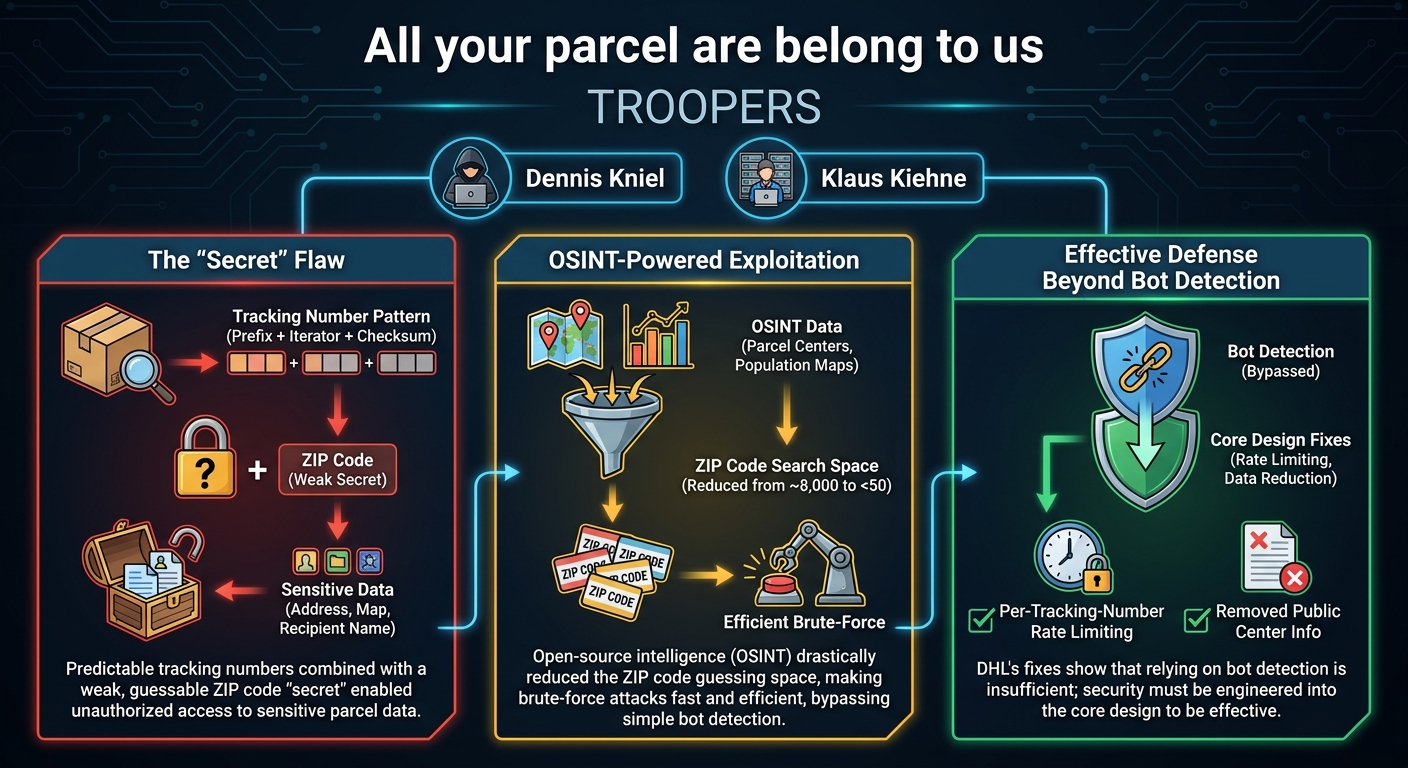
The central discovery of this research is the effective exploitation of predictable parcel tracking numbers in combination with guessable ZIP codes to gain unauthorized access to sensitive delivery information and manipulate package logistics. The researchers demonstrated that DHL's system, at the time of discovery, effectively used the recipient's ZIP code as a weak secret, which could be bypassed through a series of intelligent brute-force and OSINT techniques.
The key findings can be summarized as follows:
- Predictable Tracking Numbers: DHL's tracking numbers for business customers followed a predictable pattern: a fixed prefix, an incrementing iterator, and a publicly known checksum. This allowed for the easy enumeration of valid tracking numbers once one was known for a specific sender.
- ZIP Code as a Weak Secret: The recipient's five-digit ZIP code acted as the sole authentication factor to unlock detailed parcel information (recipient name, exact address, live map) and delivery modification options. With 100,000 theoretical combinations, and around 8,000 residential ZIP codes in Germany, this secret was deemed brute-forcible, especially with additional hints.
- OSINT-Aided ZIP Code Reduction: The researchers significantly reduced the ZIP code guessing space by leveraging:
- Destination Parcel Center Information: The public tracking history revealed the parcel center where the package would be delivered from. By cross-referencing this with publicly available maps and public services that map ZIP codes to parcel centers, the number of possible ZIP codes for a given package could be drastically reduced (e.g., from 8,000 to an average of 227, or as low as 128 for specific centers like Speyer).
- Population Density Data: Utilizing public websites that provide population data per ZIP code, the researchers prioritized guessing the most populated ZIP codes first. This strategy allowed them to correctly guess the ZIP code for approximately 50% of packages within just 50 tries.
- Circumvention of Bot Detection: While DHL employed Akamai for bot detection, the low number of required guesses (around 50) meant that manual attempts were feasible. For automation, techniques like slowing down requests, implementing sleep calls, and using "undetectable" Selenium drivers proved effective in bypassing the detection mechanisms, rendering them insufficient as a primary security control.
- High Impact Potential: The ability to enumerate tracking numbers and unlock sensitive data allowed for:
- Extensive Data Gathering: Estimating sales numbers, understanding shopping behavior (e.g., regular online pharmacy orders implying medical conditions), and inferring customer demographics.
- Delivery Manipulation: Redirecting high-value packages to preferred drop-off locations, designating preferred neighbors for unauthorized pickup, or even declining acceptance of packages en masse to disrupt businesses or specific recipients (e.g., for critical medication).
These findings collectively painted a picture of a system where a combination of design choices and insufficient authentication created a significant security blind spot, impacting both customer privacy and the integrity of delivery services.
Technical Deep Dive
▶ Watch: DHL's first remediation: Removing destination parcel center info (15:00)
The attack against DHL's parcel tracking system hinged on two fundamental weaknesses: the predictability of tracking numbers and the use of the recipient's ZIP code as a weak, brute-forcible secret.
Tracking Number Enumeration
The researchers discovered that tracking numbers issued by DHL to business senders followed a consistent, predictable structure:
- Fixed Prefix: A unique identifier for the sender, common across all their shipments.
- Iterator: A sequential number that simply increments with each new parcel sent by that specific sender.
- Checksum: A publicly known, easily calculable digit or sequence of digits derived from the preceding numbers. The calculation for this checksum was readily available online, making it trivial to validate guessed tracking numbers.
This structure meant that if an attacker obtained just one valid tracking number from a particular sender (e.g., from a discarded label, a phishing email, or a leaked database), they could then generate a vast number of other valid tracking numbers for that same sender by simply incrementing or decrementing the iterator and recalculating the checksum. This capability allowed for the creation of targeted lists of active shipments.
ZIP Code as an Authentication Secret
To access sensitive information beyond basic tracking history (like the recipient's full address, name, or live delivery maps), the DHL system required the input of the recipient's five-digit ZIP code. The critical flaw here was using a piece of publicly available, geographically constrained, and limited entropy information as a security secret.
Initially, trying all 100,000 possible five-digit ZIP codes would be computationally intensive. However, the researchers quickly narrowed this down:
- Geographic Scope: In Germany, only about 28,000 ZIP codes are actively in use. Further, only around 8,000 of these correspond to normal residential addresses, which are the primary target for this attack.
- Destination Parcel Center Hint: Crucially, the public tracking history often revealed the name of the destination parcel center where the package would be processed for final delivery (e.g., "Speyer"). This piece of information was a powerful OSINT tool. By consulting public maps of DHL parcel centers and cross-referencing with public services that map ZIP codes to their corresponding parcel centers, the researchers could drastically reduce the pool of potential ZIP codes. For instance, the Speyer parcel center served only 128 ZIP codes, significantly less than the average of 227 ZIP codes served by a typical center.
- Population-Based Prioritization: To further optimize the brute-force, the researchers leveraged population data associated with ZIP codes, sourced from public websites. The assumption was that more packages would be delivered to more populated areas. By prioritizing ZIP codes with higher populations, they found that approximately 50% of package ZIP codes could be guessed correctly within just 50 attempts. This extremely low number of attempts made the attack highly efficient, even feasible for manual execution.
Bypassing Bot Detection
DHL utilized Akamai, a leading CDN and web security platform, which includes sophisticated bot detection capabilities. However, due to the highly efficient nature of the ZIP code guessing, Akamai's defenses proved insufficient:
- Low Threshold for Success: The fact that only around 50 attempts were needed for a 50% success rate meant that the volume of requests was often too low to trigger aggressive bot detection mechanisms designed for high-volume brute-force attacks.
- Stealthy Automation: For automated attacks, the researchers employed techniques to mimic legitimate user behavior:
- Slowed Requests: Introducing delays (
sleepcalls) between attempts. - "Undetectable" Selenium Drivers: Using modified or carefully configured browser automation tools (like Selenium) that could bypass common fingerprinting and behavioral analysis techniques employed by bot detection systems. While these drivers are never truly "undetectable" indefinitely, they provided sufficient stealth for the attack's low-volume requirements.
The combination of predictable tracking numbers, a weak secret (ZIP code) that could be heavily constrained by OSINT, and the ability to circumvent bot detection, created a potent attack chain. This allowed unauthorized parties to gather extensive data on shipments and even interfere with the delivery process, raising significant privacy and security concerns.
Demo / Proof of Concept
▶ Watch: Why tracking ID enumeration is an industry standard (28:00)
During their disclosure process with DHL, the researchers initially presented their findings as a theoretical vulnerability, outlining the flawed process and the potential for exploitation. However, DHL's initial response referred to existing technical measures, primarily implying their bot detection systems, as sufficient to prevent such an attack.
In response, the research team developed an automated Proof of Concept (PoC). They created a video demonstration that clearly showcased the full attack chain in action. This PoC likely involved:
- Enumerating Tracking Numbers: Starting with a known sender prefix and one valid tracking number, the PoC would systematically generate new valid tracking numbers by incrementing the iterator and calculating the checksum.
- Gathering OSINT: For each enumerated tracking number, the PoC would query the public tracking page to extract the destination parcel center information.
- Prioritized Brute-Force: Using the destination parcel center data, the PoC would narrow down the list of potential ZIP codes and then apply population-based prioritization. It would then systematically attempt these ZIP codes against the DHL tracking portal.
- Unlocking Sensitive Data: Upon successfully guessing the correct ZIP code, the PoC would demonstrate access to the unlocked sensitive information, such as the recipient's full name, exact delivery address, and potentially a live map of the delivery vehicle.
- Simulating Delivery Manipulation: While not explicitly detailed, the PoC could have shown the interface for changing delivery options (e.g., redirecting to a different location or declining acceptance), illustrating the potential for malicious interference.
- Bot Detection Bypass: The PoC was executed using techniques like a custom Selenium driver with built-in delays, effectively bypassing Akamai's bot detection, thereby disproving the claim that existing technical measures were sufficient.
The creation and submission of this video PoC proved to be a turning point in the disclosure, leading to a prompt and positive reaction from DHL, who then recognized the severity of the issue and initiated rapid implementation of security measures. The PoC effectively translated a theoretical vulnerability into a tangible, demonstrable threat, solidifying the researchers' claims.
Defensive Implications
▶ Watch: Positive outcome: DHL's security.txt and bug bounty program (31:45)
The findings from this talk offer critical insights for both logistics providers and security professionals on how to better secure publicly accessible systems that handle sensitive data. DHL's response to the disclosure provides a practical example of immediate and long-term mitigation strategies.
DHL's Immediate and Subsequent Actions:
- Removal of Destination Parcel Center Information: As a "quick win," DHL promptly removed the display of the destination parcel center from the publicly accessible tracking information. This significantly limited the attackers' ability to geographically narrow down the ZIP code search space, forcing them to guess from a much larger pool (up to 8,000 residential ZIP codes in Germany) and making the attack far less efficient.
- Implementation of Time Lock/Rate Limiting on Tracking Numbers: More recently, DHL implemented a time lock mechanism. If an attacker provides three incorrect ZIP codes for a specific tracking number, that particular tracking number is locked out for approximately 20 minutes. Crucially, this rate limiting is tied to the tracking number itself, not to an IP address or session. This prevents distributed brute-force attacks from working effectively, as all attackers would hit the same global lock for a given parcel.
- Establishing a Security Contact (
security.txt): Recognizing the difficulty researchers faced in finding a contact person, DHL has since implemented asecurity.txtfile on their domain. This provides a clear, standardized channel for security researchers to report vulnerabilities, streamlining the responsible disclosure process. - Initiating a Bug Bounty Program: DHL is in the process of launching a bug bounty program, initially private, to engage the security community in proactively identifying and reporting vulnerabilities.
General Defensive Recommendations:
Based on the talk, several key defensive implications emerge:
- Do Not Rely on Weak Secrets: The primary lesson is to avoid using easily guessable or publicly available information (like ZIP codes, birth dates, or simple account numbers) as primary authentication or authorization secrets, especially when unlocking sensitive data or critical functionality.
- Principle of Least Privilege for Information Disclosure: Only display information that is absolutely necessary to an unauthenticated user. Information like internal parcel center names, which are not relevant to the recipient's direct needs, should be withheld unless authenticated.
- Bot Detection is Not a Security Control: While bot detection (e.g., Akamai) can help mitigate scraping or high-volume attacks, it should never be considered a primary security mechanism for preventing exploitation. If the underlying process is flawed (e.g., a brute-forcible secret), bot detection merely delays, rather than prevents, successful attacks. Security should be designed into the process itself.
- Robust Rate Limiting on Business Objects: If brute-forcing is a risk, implement rate limiting not just on IP addresses or sessions, but on the business object being attacked (e.g., a specific tracking number, account ID). This prevents distributed attacks from bypassing the limits.
- Multi-Layered Defense: As Klaus Kiehne emphasized, security requires at least two levels of defense. No single control is foolproof.
- Accessible Responsible Disclosure Channels: Organizations should establish clear, well-known contact points for security researchers (e.g.,
security.txtfile, dedicated security email). This fosters trust and encourages responsible reporting rather than public disclosure or malicious exploitation. - Prompt and Transparent Response: A quick, cooperative response to vulnerability reports, including clear communication and rapid implementation of fixes, is crucial for building good relationships with the security community and enhancing overall security posture.
The talk underscores that even seemingly minor data points, when combined with OSINT and systematic exploitation, can lead to significant security breaches. A proactive, defense-in-depth approach, focusing on strong authentication and authorization, minimal data exposure, and effective incident response, is paramount for any organization handling sensitive customer data.
Key Takeaways
- Weak Secrets are Critical Vulnerabilities: Using easily guessable or publicly available data like a recipient's ZIP code as a secret to unlock sensitive information creates a significant security flaw.
- OSINT Amplifies Brute-Force Attacks: Open Source Intelligence (OSINT), such as destination parcel center names and population data, can drastically reduce the search space for secrets, making otherwise infeasible brute-force attacks highly efficient.
- Predictable IDs Enable Enumeration: Tracking numbers with predictable structures (fixed prefix, iterator, calculable checksum) allow attackers to easily enumerate valid IDs once a single example is known.
- Bot Detection is Not a Primary Security Control: While useful for general traffic management and mitigating scraping, bot detection mechanisms (like Akamai) are insufficient to prevent exploitation of fundamental design flaws, especially when attack volumes are low and techniques to bypass detection are available.
- Responsible Disclosure is Effective: Engaging with security researchers through clear channels (like
security.txt) and responding quickly and cooperatively can lead to rapid fixes and improved security for all. - Secure-by-Design is Paramount: Security must be engineered into the core design of systems, rather than relying on reactive measures or superficial controls. This includes implementing robust rate limiting on business objects and adhering to the principle of least privilege for information disclosure.
About the Speaker(s)
Dennis Kniel is a former incident responder and penetration tester, currently engaged in academic studies. His research focuses on identifying and catching various types of "bugs," including those in software systems as demonstrated in this talk. He was a primary presenter and researcher for this topic.
Klaus Kiehne is an IT Systems Architect at Deutsche Post DHL. He represents the "blue team" perspective in this presentation, detailing DHL's internal IT organization, security measures, and their response to the responsible disclosure. His role involves fixing bugs and improving processes at DHL, highlighting the practical challenges and solutions in a large-scale enterprise. Klaus Kiehne's LinkedIn profile indicates his role at Deutsche Post.
Florian Bausch (who was not on stage but contributed significantly) was also heavily involved in the research. He is described as someone who finds "bugs you are used to see all the time" and is also a speaker at TROOPERS. His contributions were integral to the research efforts.
Reviews
Dr. Zero (Offensive Security Researcher) — STRONG ACCEPT
This is exactly what a joint red/blue talk should look like. Kniel and Kiehne take a pedestrian predictable-ID flaw and turn it into a masterclass on how OSINT destroys weak entropy, followed by the vendor actually fixing the underlying architecture. It won't melt your brain with low-level exploitation, but it’s a perfectly executed real-world attack chain with zero marketing bullshit.
Heather Calloway (CISO) — STRONG ACCEPT
This is a highly practical case study on business logic flaws, proving why weak authentication tied to predictable IDs cannot be papered over with bot management solutions. The joint presentation with DHL’s architecture team elevates it from a standard vulnerability disclosure to a clear lesson in architectural remediation. It's required viewing for any team building customer-facing portals or APIs.