Two Sparks Walk Into a Lab
Roei Sherman (Mitiga)
[un]prompted II 2026 — The AI Security Practitioner Conference · Day 2 · Stage 2
Overview
In his [un]prompted II talk, "Two Sparks Walk Into a Lab," Roei Sherman, the Head of Research at Mitiga, dives deep into the intriguing question of whether local large language models (LLMs) can effectively perform comprehensive red team operations. Moving beyond the common discourse around AI vulnerabilities and zero-days, Sherman explores the practical application of AI in offensive security, specifically focusing on the entire lifecycle of a red team engagement—from initial target reconnaissance to exploitation and reporting. This talk is particularly significant as it directly challenges the limitations imposed by commercial LLMs like OpenAI and Anthropic, which often refuse requests related to offensive security due to their built-in safety mechanisms.
Key moments
- 2:00 Can local models actually red team?
- 4:00 AI's role in red team tasks and judgment
- 6:00 Five key questions: scope, hallucination, cost
- 10:00 BloodHound test: models confident about wrong paths
- 13:30 Top performing local models for red teaming
- 18:00 Limitations of initial research and future plans
- 21:30 Q&A: Monitoring and securing local AI models
Two Sparks Walk Into a Lab
Speakers: Roei Sherman (Mitiga)
Conference: [un]prompted II
YouTube: https://www.youtube.com/watch?v=KRoBC1Sv6rM
Overview
In his [un]prompted II talk, "Two Sparks Walk Into a Lab," Roei Sherman, the Head of Research at Mitiga, dives deep into the intriguing question of whether local large language models (LLMs) can effectively perform comprehensive red team operations. Moving beyond the common discourse around AI vulnerabilities and zero-days, Sherman explores the practical application of AI in offensive security, specifically focusing on the entire lifecycle of a red team engagement—from initial target reconnaissance to exploitation and reporting. This talk is particularly significant as it directly challenges the limitations imposed by commercial LLMs like OpenAI and Anthropic, which often refuse requests related to offensive security due to their built-in safety mechanisms.
Sherman's research provides a compelling narrative of taking control over the AI models by running them locally on dedicated hardware, thereby bypassing censorship and enabling direct experimentation with offensive capabilities. He meticulously details his journey of learning about local AI, selecting appropriate models, and benchmarking their performance against realistic red team scenarios. The findings offer crucial insights into the current state of AI's capability in adversarial simulations, highlighting both unexpected successes in technical execution and critical shortcomings in nuanced areas like operational security (opsec) and judgment calls. This article will dissect Sherman's methodology, key findings, and the profound implications for both offensive and defensive cybersecurity strategies in an increasingly AI-driven landscape.
Background
▶ Watch: Can local models actually red team? (2:00)
The landscape of AI security often revolves around theoretical discussions concerning the potential for AI to discover or create new vulnerabilities, or its role in a hypothetical "vulnapocalypse." However, Roei Sherman, with his extensive background in offensive operations and red teaming, approached the subject from a different angle. His primary interest lay in understanding if AI, specifically large language models (LLMs), could autonomously execute an entire red team operation. This encompasses everything from initial target reconnaissance and enumeration, through planning and executing multi-step attacks, to achieving defined objectives and even generating comprehensive reports.
Sherman's initial attempts to explore this with commercially available, frontier models like those from Anthropic and OpenAI were met with immediate refusal. These models, designed with robust safety and ethical guidelines, consistently declined to engage in activities perceived as offensive or harmful. This refusal, despite his authorized engagement context, led Sherman to a pivotal decision: "My hardware, my models." This marked the genesis of his research into local models, where he could control the environment and the models' behavior without external constraints.
Before embarking on the research, Sherman outlined several areas where he expected AI to excel and others where he anticipated significant challenges. He hypothesized that AI would be highly effective in data-intensive tasks such as reconnaissance (gathering vast amounts of information), enumeration, tooling (generating specific scripts or small software for tasks not readily available on GitHub), and reporting (synthesizing actions and findings). However, he harbored strong doubts about AI's ability to handle multi-step attacks that require complex logical chaining, fearing it would hallucinate or make incorrect assumptions. Furthermore, he questioned AI's capacity for making critical judgment calls—decisions involving trade-offs between visibility, detection risk (opsec), and objective achievement, which typically rely on human experience and team consultation.
To systematically investigate his core question, Sherman distilled it into five smaller, manageable inquiries:
- Scope: How much of a red team operation can AI truly perform autonomously versus requiring human intervention?
- Hallucination: What are the consequences of AI making wrong decisions or fabricating information during an engagement?
- Effectiveness: Can AI genuinely be a potent red team asset, or would it merely function as an advanced vulnerability scanner?
- Cost: What are the practical costs associated with running local models, including hardware, electricity, and the human time required for oversight?
- Willingness: How do open-weight models behave regarding refusal, especially when compared to their commercial counterparts?
Lacking extensive prior knowledge in local AI and model benchmarking, Sherman leveraged frontier models like Claude to help define test cases and benchmarks, highlighting an interesting meta-use of AI in designing its own evaluation. This foundational approach set the stage for a comprehensive, hands-on exploration of local LLMs in offensive security.
Key Findings
▶ Watch: Five key questions: scope, hallucination, cost (6:00)
Sherman's research yielded several crucial findings that challenge conventional wisdom regarding AI's role in offensive security and the capabilities of local models.
Firstly, the hardware infrastructure was foundational. He utilized two DGX Sparks, each equipped with 128GB of memory and interconnected with a fast link. This setup allowed him to run a variety of models, including some that required both nodes due to their size. He also delved into quantization, a technique that creates smaller versions of models by reducing precision, acknowledging that this often comes with a trade-off in capabilities.
The process of model selection proved to be a significant initial hurdle. Expecting a curated list, Sherman was confronted with "thousands of different models, thousands of versions" on Hugging Face. Through careful evaluation, often guided by Claude for initial filtering, he narrowed down a list of approximately 33 models that could be effectively deployed on his Spark cluster, balancing performance (tokens per second) with resource requirements.
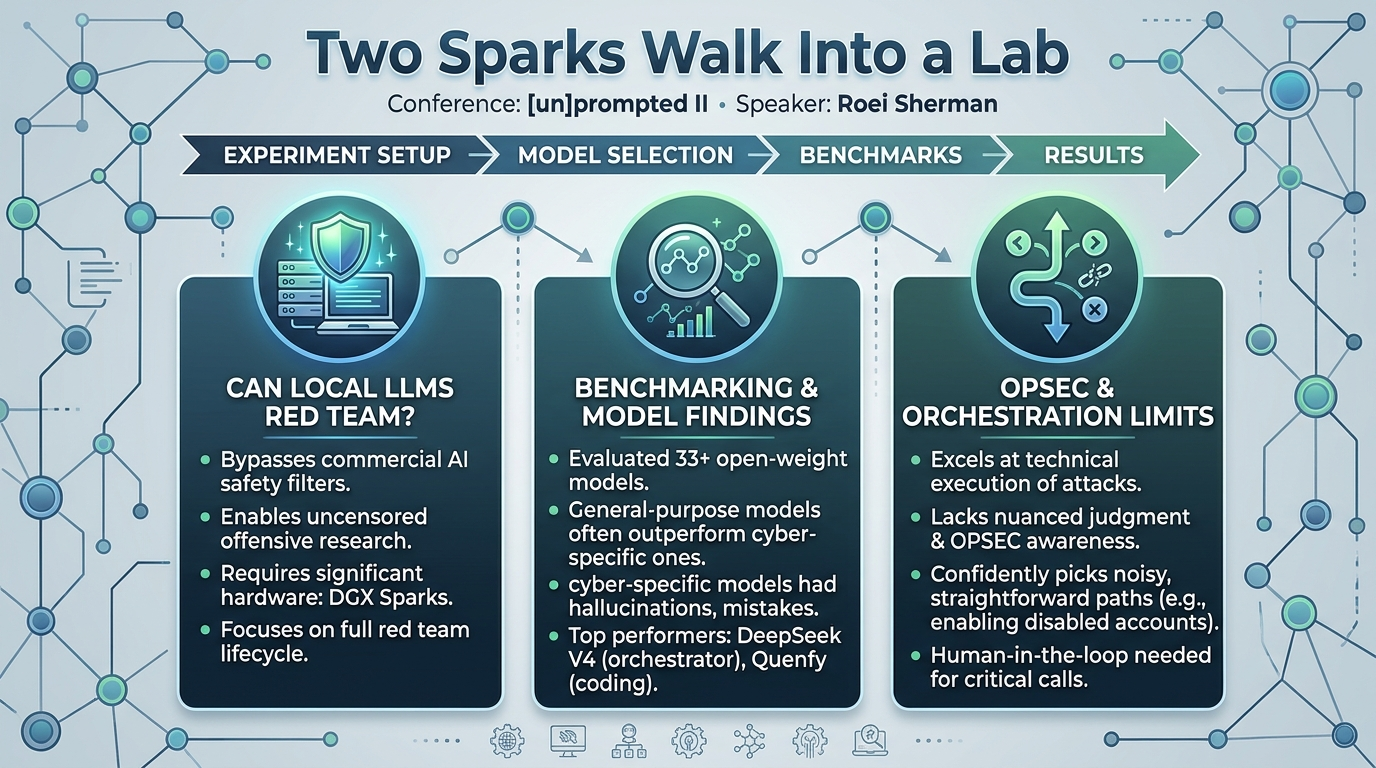
For benchmarking, Sherman created a diverse set of test cases. Some were built within a controlled lab environment, while others involved manually generated logs or content from security tools. A particularly insightful benchmark involved BloodHound output, a tool that maps Active Directory relationships. This specific test included a "trap"—a path that appeared exploitable but involved a disabled account, designed to test the models' judgment. Many models, despite their confidence, frequently chose the less optimal and more visible path of attempting to enable the disabled account, rather than identifying quieter, equally effective alternatives present in the data set.
One of the most surprising findings was the performance of cyber-specific models. Sherman noted that "None of them was at the top of the performance or the results or the quality of the output," despite some being larger or advertised for security tasks. Many made mistakes, invented information not present in the dataset, or confidently suggested impossible actions. This suggests that general-purpose, well-trained models might currently offer superior capabilities for red teaming tasks compared to niche, domain-specific models.
Regarding refusal, Sherman observed almost no resistance from open-weight models, whether "obliterated" (modified to remove refusal mechanisms) or not. A simple declaration of an "authorized engagement" was usually sufficient to bypass any initial hesitation. However, he noted that the quality of output generally suffered in obliterated models, indicating a trade-off between censorship resistance and performance.
The research identified a shortlist of top-performing models for different aspects of red teaming:
3.6 at 33 billion: This model stood out for its excellent performance and speed (very fast tokens per second), delivering high-quality results. It was described as "value for money" and could fit on a single node.Quenfy: Proved highly effective for coding tasks, including generating quick scripts, adaptations, and implants for C2 frameworks.GLM 4.6: Achieved the "most correct" results among all tested models, though it exhibited the poorest performance in terms of speed.DeepSeek V4: Emerged as the preferred orchestrator model in Sherman's setup, tasking smaller agents in a manner akin to a human red team lead delegating tasks to operators.
For judgment of results, Sherman faced a challenge. Due to Anthropic's "cyber program" refusing to grade offensive security content, he had to use DeepSeek V4 locally to score the outputs of other models, acknowledging the inherent bias of having a model judge its own work and that of its peers.
Overall, Sherman concluded that the local models "exceeded [his] expectations" in their technical understanding of the red team process and their ability to maintain a "chain of thought." However, they notably lacked in opsec considerations, failing to account for visibility or quietness in their proposed actions, focusing instead on straightforward technical paths.
Technical Deep Dive
▶ Watch: BloodHound test: models confident about wrong paths (10:00)
Sherman's research was rooted in a practical, hands-on approach to deploying and evaluating local LLMs for red teaming. The core of his experimental setup revolved around specialized hardware and a methodical approach to model selection and benchmarking.
The foundational hardware comprised two DGX Sparks, powerful GPU-accelerated systems, each boasting 128GB of memory. These units were interconnected with a fast link, enabling them to collaboratively run larger models or host multiple smaller ones. This robust infrastructure was crucial for handling the computational demands of various LLMs. Sherman also explored quantization, a process that reduces a model's size and computational requirements by lowering the precision of its weights. While beneficial for fitting models onto limited hardware, he recognized that this often entails a trade-off in model capabilities.
The journey began with the daunting task of selecting suitable LLMs from Hugging Face, which hosts thousands of models. Sherman leveraged commercial LLMs like Claude to assist in the initial filtering, eventually narrowing down the candidates to approximately 33 models that were compatible with his Spark cluster and offered acceptable performance. A key metric in this selection was tokens per second, as slow generation rates (e.g., "four tokens a second") would significantly impede operational speed, especially in time-sensitive red team engagements.
The benchmark scenarios were designed to mimic real-world red team activities. These included:
- Lab-built environments: Specific, controlled scenarios from which data was extracted.
- Generated content: Manually created logs or outputs from common security tools.
- BloodHound output: This was a particularly illustrative test. BloodHound, a tool for mapping relationships in Active Directory, generates complex graphs of potential attack paths. Sherman introduced a deliberate "trap" within this data: a seemingly viable attack path that involved a disabled account. From a human red team perspective, exploiting a disabled account (e.g., by enabling it) is generally noisy and less desirable if quieter alternatives exist. The models' tendency to confidently propose enabling the disabled account, even when easier and more discreet paths were available within the same dataset, highlighted their current lack of nuanced operational security (opsec) considerations and preference for direct, albeit potentially visible, technical solutions.
For coding capabilities, Sherman did not invent a new benchmark but adopted an existing, effective online test suite. This focused on generating small, common offensive security tools rather than large software systems. Examples included:
- Small scanners: Tools for identifying specific vulnerabilities or configurations.
- Password sprayers: Scripts for attempting common passwords against multiple accounts.
- Implants for C2s: Custom code for command-and-control frameworks.
The results indicated that models like Quenfy performed exceptionally well in these rapid code generation tasks.
Sherman's envisioned "off stack stack" or technical architecture for an AI-driven red team operation involved a human-in-the-loop for high-level decision-making (target definition, scope, objectives). This human then tasks an AI agent, specifically Hermes in his current setup, running on a dedicated box. Hermes acts as an orchestration agent, leveraging a suite of other tools like strikes and Xstrike, and directing actions against the Spark cluster, which in turn interacts with the target environment. DeepSeek V4 (and later V4.1) was identified as the primary orchestrator model, responsible for tasking smaller, specialized agents, mirroring the delegation structure of a human red team. Hermes was chosen for its ease of configuration and stability during the initial benchmark phases.
A critical technical consideration, especially when dealing with open-weight models, was security and confidentiality. To mitigate concerns about data exfiltration or unintended "dialing out" to external servers (a common worry with models, especially those from potentially adversarial nations), Sherman implemented a straightforward but effective control: he air-gapped the Spark cluster. Once models were downloaded, all internet access for the machines was cut, ensuring that any tool calls (e.g., a curl command issued by the model) or internal attempts to communicate externally would be blocked and, if monitored, detected. This provided a secure sandbox for offensive experimentation without risking sensitive information or unauthorized external interactions.
The research also acknowledged its own limitations. Each test was run only once, despite AI's non-deterministic nature. The 32,000-token context window used was relatively small for complex, long-running engagements. Furthermore, the experiments relied on generated content rather than live exploitation against vulnerable assets. Sherman indicated that future phases of his research would address these limitations, moving towards live lab environments and larger context windows to further refine the understanding of AI's red teaming capabilities.
Demo / Proof of Concept
▶ Watch: Limitations of initial research and future plans (18:00)
While Roei Sherman's talk was a detailed presentation of his research methodology and findings, it did not feature a live, real-time demonstration or proof of concept of an AI agent actively performing red team operations. Instead, the "demo" aspect was implicitly covered through the rigorous benchmarking process he described.
The various test cases, such as the analysis of BloodHound output with its deliberate "trap" of a disabled account, served as conceptual demonstrations of the models' capabilities and limitations. Similarly, the discussion around coding benchmarks for generating small scanners, password sprayers, and C2 implants illustrated the practical application of these models in offensive tooling.
Sherman focused on presenting the results of these simulated engagements, detailing which models performed best in specific categories and where their current limitations lie. The emphasis was on the analytical evaluation of the models' outputs against predefined criteria, rather than a dynamic, interactive display of an AI agent in action. He explicitly mentioned that future phases of his research would involve setting up an "actual lab with actual vulnerable assets to mimic some sort of a small company" to allow models to "actually go after and attack some sort of an organization in a lab that won't go rogue," indicating that true live exploitation demos are a goal for subsequent research cycles.
Defensive Implications
▶ Watch: Q&A: Monitoring and securing local AI models (21:30)
Roei Sherman's research into local LLMs for red teaming carries significant implications for defensive cybersecurity strategies. The findings suggest that AI-powered adversarial capabilities are maturing rapidly, moving beyond theoretical concerns to practical, deployable tools, even for organizations without access to frontier models or extensive cloud resources.
Firstly, defenders must recognize that automated, multi-step attacks orchestrated by AI agents are an emerging threat. Sherman's work demonstrates that local LLMs can effectively handle reconnaissance, enumeration, and even the generation of exploitation code. This means blue teams need to anticipate faster, more scalable attacks that can process vast amounts of data and identify attack paths with unprecedented speed. Reliance solely on human-speed analysis will become increasingly insufficient.
A key defensive insight comes from the models' current limitations in operational security (opsec). Sherman observed that AI agents, while technically proficient, often prioritize direct, straightforward attack paths without considering their visibility or noisiness. For example, in the BloodHound scenario, models confidently suggested enabling a disabled account—an action that is typically highly visible to defenders—even when quieter alternatives existed. This presents an opportunity for defenders:
- Monitor for straightforward, noisy attack patterns: Implement robust logging and monitoring for actions that AI agents are currently prone to, such as mass password sprays, attempts to enable disabled accounts, or rapid, sequential tool calls.
- Focus on basic security hygiene: While AI can identify complex paths, many of its current "best" paths still rely on common misconfigurations or weak points. Strengthening fundamental security controls will make AI's job harder.
- Detect deviations from normal behavior: AI agents might generate new users or perform actions that, while technically valid, are unusual for the environment. Anomalous behavior detection becomes even more critical.
The ability of local models to generate custom implants and scripts (as demonstrated by models like Quenfy) means defenders must also enhance their endpoint detection and response (EDR) and network detection and response (NDR) capabilities to identify novel malicious code or unusual network traffic patterns that might not match known signatures.
Furthermore, the ease with which open-weight models can be used for offensive purposes, coupled with the simple bypass of refusal mechanisms (e.g., "authorized engagement"), underscores the importance of threat intelligence on emerging open-source AI tools and models. Defenders should track developments in the local LLM space to understand what capabilities adversaries might be leveraging.
Finally, the security measure Sherman implemented for his own lab—air-gapping the Spark cluster to prevent models from "dialing out"—highlights a critical control. Organizations deploying internal AI systems, especially those processing sensitive data, must ensure robust network segmentation and egress filtering to prevent potential data exfiltration by compromised or rogue AI agents, even if they are not explicitly performing offensive operations. Monitoring for unapproved tool calls, such as curl commands, even within an isolated environment, is a prudent measure.
In essence, Sherman's work serves as a stark warning and a guide: the future of red teaming will increasingly involve AI. Defenders must proactively adapt by enhancing their automated detection capabilities, focusing on the current behavioral patterns of AI adversaries, and securing their own AI infrastructure against similar threats.
Key Takeaways
- Local LLMs enable uncensored offensive security research: By running models on dedicated hardware like DGX Sparks, researchers can bypass the ethical safeguards and refusal mechanisms of commercial LLMs (e.g., OpenAI, Anthropic) to explore AI's full potential in red teaming.
- General-purpose models often outperform cyber-specific ones: Counterintuitively, well-trained general-purpose open-weight models frequently delivered better results for red teaming tasks than models specifically advertised for cybersecurity, which often exhibited hallucinations or inaccuracies.
- AI agents excel at technical execution but lack nuanced opsec: While current local LLMs can effectively identify and plan multi-step attack paths, they tend to prioritize direct, technically viable routes over stealth or operational security (opsec), often recommending noisy actions like enabling disabled accounts when quieter alternatives exist.
- Hardware and model optimization are critical: The choice of hardware (e.g., 128GB DGX Sparks) and techniques like quantization significantly impact which models can be run and their performance (tokens per second), directly affecting the practicality and speed of AI-driven red team operations.
- Orchestration is key for complex engagements: Models like DeepSeek V4 can act as orchestrators, tasking smaller, specialized agents, mimicking human red team leadership and enabling more complex, distributed attack simulations.
- The field is rapidly evolving: AI capabilities, models, and best practices are changing at an extremely fast pace; research findings from just "a few months ago" can quickly become outdated, necessitating continuous learning and adaptation.
About the Speaker(s)
Roei Sherman is the Head of Research at Mitiga, a position he holds after a distinguished career in offensive security. Prior to Mitiga, he led the offensive services team for Enel Zerubbabel and was the red team lead for EY. Sherman's journey into technology is particularly inspiring, as he started with no formal background in the field, initially working in physical roles. He transitioned into quality assurance (QA) and, through self-driven learning and mentorship from a mutual friend, Inbar Raz, he developed expertise in cybersecurity.
Sherman holds a bachelor's degree in Information Technologies and a master's degree in Criminology, reflecting his deep interest in understanding "bad guys" and adversarial thinking. He is a strong believer in community engagement and is highly regarded by his peers for his insights into red teaming and his unique ability to inject humor into complex technical discussions. His presentation at [un]prompted II perfectly embodies the conference's spirit of exploring unconventional approaches to security challenges, often born from personal curiosity and experimentation.
Reviews
→ Top-rated talks at [un]prompted II 2026 — The AI Security Practitioner Conference
All talks from [un]prompted II 2026 — The AI Security Practitioner Conference