When Humans Can’t Make It Hard Enough: Self-Hardening Environments for Frontier AI Investigators
Noam Cohen (Head of AI · Torq), Jeremy Herzog (Solutions Engineering Lab · Torq)
[un]prompted II 2026 — The AI Security Practitioner Conference · Day 3 · Stage 2
Overview
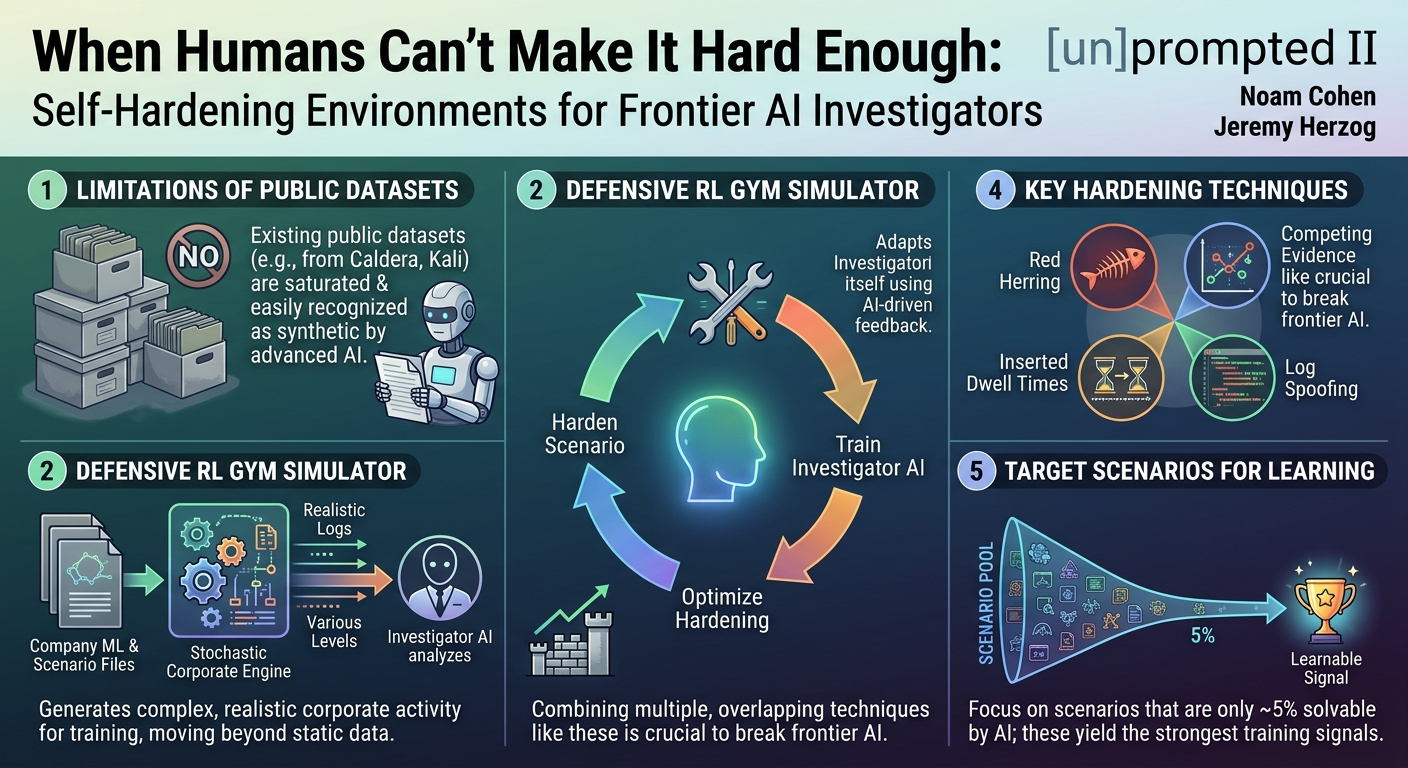
In an era where artificial intelligence is rapidly advancing its capabilities in offensive cyber security, the need for equally sophisticated defensive AI models has become paramount. This talk by Noam Cohen and Jeremy Herzog from Torq addresses this critical challenge by introducing a novel approach to training and evaluating frontier AI investigators: self-hardening environments. The core premise is that current public datasets and traditional simulation methods are insufficient to truly challenge and evolve advanced defensive AI, as they are often saturated or easily identifiable as synthetic.
Key moments
- 0:00 Introduction: Rush Hour for ChatGPT in Cyber
- 4:15 Live Play vs. N-Play: Why they chose simulation
- 6:30 Architecture of the defensive RL gym simulator
- 9:00 Balancing realism, solvability, and hardness in scenarios
- 11:00 Recursive Self-Improvement (RSI) loop for scenario hardening
- 13:40 Demo: Hardening an attack chain with multiple techniques
- 20:20 Q&A: Combinations of hardening techniques for frontier AI
When Humans Can’t Make It Hard Enough: Self-Hardening Environments for Frontier AI Investigators
Speakers: Noam Cohen, Head of AI, Torq; Jeremy Herzog, Solutions Engineering Lab, Torq
Conference: [un]prompted II
YouTube: https://www.youtube.com/watch?v=K6GL7IZThy0
Overview
In an era where artificial intelligence is rapidly advancing its capabilities in offensive cyber security, the need for equally sophisticated defensive AI models has become paramount. This talk by Noam Cohen and Jeremy Herzog from Torq addresses this critical challenge by introducing a novel approach to training and evaluating frontier AI investigators: self-hardening environments. The core premise is that current public datasets and traditional simulation methods are insufficient to truly challenge and evolve advanced defensive AI, as they are often saturated or easily identifiable as synthetic.
The speakers draw an insightful analogy to the popular board game Rush Hour, envisioning the creation of complex digital "mazes" for AI to navigate, where the "red car" represents an attack chain that a defensive AI must identify and neutralize. Their work focuses on building an end-to-end environment for defensive security, designed to expose the intricate secrets of sophisticated attacks and, crucially, to learn from what doesn't work. By developing environments that dynamically adapt and become harder for AI to solve, Torq aims to push the boundaries of defensive AI, making it more resilient and effective against the next generation of cyber threats.
Background
▶ Watch: Introduction: Rush Hour for ChatGPT in Cyber (0:00)
The rapid evolution of AI has brought a significant shift in the cybersecurity landscape. As highlighted by the speakers, AI has become "really, really, really good at offensive cybersecurity" this past year, demonstrating rare and sophisticated behaviors like spoofing logs that were previously uncommon in attacks. This escalation necessitates a corresponding leap in defensive capabilities, particularly in the realm of AI-driven defense.
The fundamental task of a cyber defender involves investigating systems, hypothesizing about incidents, querying observations from logs, building ongoing assessments, and extracting findings. These actions, encompassing tools and the state of the "harness," need to be mapped effectively for AI investigators. However, a major hurdle in training advanced defensive AI lies in the lack of sufficiently challenging and realistic datasets. Publicly available datasets, such as those derived from Splunk bots or simulations using tools like Caldera or Kali, are often saturated by frontier AI models. From firsthand experience, the speakers note that these synthetic datasets are "usually like tell that they're synthetic data and not real attacks very early on," making them "not super useful for our use case" for training advanced models.
To overcome this, Torq faced a crucial decision: whether to emulate or simulate attack data. They frame this choice with a car crash test analogy: you build a lab with obstacles rather than testing a car in the wild.
- Live Play (Emulation): This approach, akin to a traditional cyber range, involves real VMs, infrastructure, and SaaS subscriptions. User activity is often simulated, but a red team orchestrator with an army of agents attacks a live digital twin. While realistic, it's expensive and slow; simulating a month-long attack requires running it for a month. The investigator then analyzes the generated logs.
- N-Play (Simulation): Torq opted for this approach. Here, an attack architect with "god mode" replaces the orchestrator. This architect can design and manipulate benign and malicious activity within a simulation engine. This method is highly flexible, allowing for easy modification and generation of new datasets, and can simulate many different software types without subscription limitations. Despite its complexities in getting it right, N-play offers significant benefits in cost, speed, and scalability for generating the necessary challenging data.
Key Findings
▶ Watch: Architecture of the defensive RL gym simulator (6:30)
Torq's research and development efforts, driven by the need for superior defensive AI, yielded several critical findings:
- The Defensive RL Gym: The core contribution is the creation of a defensive Reinforcement Learning (RL) gym. This simulation environment is specifically designed to generate complex, realistic, and challenging scenarios for training AI investigators. It moves beyond static datasets to create dynamic, evolving attack landscapes.
- Balancing Realism, Solvability, and Hardness: The success of the gym hinges on finding the right equilibrium between these three axes. Scenarios must be real enough to be relevant, solvable to provide learning signals, and hard enough to push the capabilities of frontier AI.
- Recursive Self-Improvement (RSI) Loop: A standout finding is the efficacy of an RSI loop for hardening the environment. This loop, incorporating over 30 different hardening techniques (e.g., red herring, competing evidence, inserting dwell times, anti-forensic log spoofing), allows the environment to automatically adapt and become more difficult.
- AI Outperforms Manual Hardening: It was discovered that "AI is better in finding the forest and finding the ways to complicate stuff for AI." Manual hardening attempts proved less effective, underscoring the necessity of an AI-driven approach to generate challenging scenarios for other AI.
- Combination of Techniques is Key: While individual hardening techniques can make a difference, the most significant breakthroughs in breaking frontier investigators occur when multiple different hardening techniques are overlapped within the same scenario. This complexity forces the AI to reason more deeply rather than relying on simple pattern matching.
- Fast Simulators are Essential: To enable the iterative nature of the RSI loop and the generation of vast datasets, fast simulators are non-negotiable. The ability to quickly replay and modify attack scenarios is paramount, even if it means some trade-off with perfect realism in the initial stages.
- Robust Verification is Paramount: Without a "good verification mechanism," the entire process of generating and hardening scenarios will fail. It's crucial to have clear criteria for what constitutes a verified and unverified scenario to ensure the quality and learning potential of the generated data.
- Focus on "5% Solvable" Scenarios: The most valuable learning signals for frontier AI come from scenarios that are solvable only about 5% of the time. These are the "sweet spot" where the AI is sufficiently challenged but can still learn from its attempts.
Technical Deep Dive
▶ Watch: Balancing realism, solvability, and hardness in scenarios (9:00)
The architecture of Torq's defensive RL gym is a sophisticated system designed to generate rich, dynamic, and challenging datasets for AI investigators. It begins with several input files:
- Scenario File: This defines the attack chain, including the dependencies between different attack steps, details about benign events, and the overall configuration for the attack scenario.
- Company ML (Machine Learning) File: This file describes the organizational structure, including the number of employees, different departments, various access levels, and specific company data.
These inputs feed into the Stochastic Corporate Engine. This engine is responsible for generating realistic corporate activities, defining timelines for events, and creating content such as URLs, emails, hostnames, and usernames. While an LLM (Large Language Model) is used for initial configuration, the engine itself employs a probabilistic engine to emit events, ensuring complex dependencies and realistic interactions rather than simple LLM-generated output. The final output is a set of logs with different levels of detail, mimicking real-world security logs.
Scoring the performance of AI investigations within this gym is multifaceted:
- Observation Level: This assesses what the AI agent queries and receives in response. Metrics include how many attack events appear in the responses and how many queries surface new kinds of evidence.
- End of Investigation: At the conclusion of an investigation, the submitted findings are evaluated. This includes tracking hits, misses, wrong dispositions, and the final assessment (e.g., identifying something as malicious, having insufficient evidence, or being not harmful).
- Cost: Beyond traditional metrics, the "price" (reflecting token usage and time) is also monitored, providing a holistic view of efficiency.
The critical challenge lies in striking the right balance between realism, solvability, and hardness:
- Realism: To avoid the "synthetic data" trap, the simulation incorporates significant mathematical rigor. Human activity is simulated using Hawkes processes, which accurately model event clustering and self-exciting behavior. The environment accounts for payroll and department daily rhythms, different time zones, and a multitude of other factors to create a rich, non-obvious benign baseline that camouflages malicious activities.
- Solvability: To ensure scenarios are not impossible but also prevent agents from taking unrealistic shortcuts, two main checks are in place. Deterministic checks verify that the agent can logically arrive from one event to the next within a reasonable context size. Statistical models are run to ensure diversity and variety of values, preventing simplistic patterns (e.g., one username being associated with all malicious acts). The goal is to camouflage events effectively, focusing on scenarios that are solvable about 5% of the time, as these yield the most valuable learning signals.
- Hardness: This is where Torq invests significant intellectual property. A Recursive Self-Improvement (RSI) loop is implemented, leveraging over 30 distinct hardening techniques. These techniques include:
- Red herring: Introducing irrelevant but plausible events.
- Competing evidence: Presenting conflicting data points.
- Inserting dwell times: Lengthening the time between attack steps to make correlation harder.
- Anti-forensic log spoofing: Manipulating logs themselves to mislead investigators.
This iterative process of hardening is crucial for building a curriculum where the AI model can learn gradually from easy to progressively harder challenges, similar to how humans learn.
Demo / Proof of Concept
▶ Watch: Demo: Hardening an attack chain with multiple techniques (13:40)
Jeremy Herzog walked through a practical demonstration of how this self-hardening environment works in practice, using a specific attack chain to illustrate the effectiveness of their techniques.
The demo attack chain consisted of four main stages:
- Consent Lore: A spear phishing email sent to a fictional CTO, Alex Mercer.
- Initial Access: Alex Mercer clicks on an OAuth link, granting initial access to the attacker.
- Privilege Escalation/Pivot: The attacker finds an account with overly broad permissions and pivots to it.
- Data Exfiltration: The final stage involves exfiltrating data.
The demonstration showcased three distinct scenarios, highlighting the impact of hardening techniques:
- Non-Hardened Baseline: In this initial scenario, the agent (representing a frontier AI investigator) performs an IOC search (equivalent to
grep) and successfully identifies the attack chain every single time. The "yellow divergent paths" on the visual representation are minimal, indicating the agent efficiently found relevant logs without much distraction. A frontier agent would solve this non-hardened baseline consistently.
- Single Hardening Technique: Here, a specific hardening technique was introduced: an alternative storyline was provided, along with an alternate app ID that was OAuth consented at the same time as the offending one. This created a plausible enough benign scenario to confuse the agent. While the agent's metrics improved slightly (meaning it explored some of the divergent paths), it still semantically arrived at the correct answer in the end. This shows that a single technique might slow down the agent but doesn't fully break its ability to solve the core problem.
- Hardened Scenario: This represents the ultimate goal – a scenario where the frontier agent struggles significantly. To achieve this, multiple hardening techniques were layered together:
- Dwell time was inserted between attack steps.
- Another benign scenario was introduced to further obfuscate the malicious activity.
- Crucially, the original principal (username/ID) involved in the attack was renamed. This forces the agent to move beyond simple IOC grepping and requires it to "reason and kind of scale back its window on what it's searching for."
In this hardened scenario, the agent failed to provide a semantically correct answer with high confidence. This is the 5% solvable target that yields the most valuable learning signal for training. The speakers presented data showing that through 18 runs of the hardening loop using GPT-6 Soul, the math bore out the success, demonstrating a truly hardened scenario that could then be used for training.
The key takeaway from the demo was clear: while providing another plausible story helps, it's the overlap of multiple different hardening techniques within the same scenario that truly makes it difficult enough for frontier agents not to solve every single time. This combination creates the "learnable signal" necessary to advance defensive AI capabilities.
Defensive Implications
▶ Watch: Q&A: Combinations of hardening techniques for frontier AI (20:20)
The insights gleaned from Torq's self-hardening environments have profound implications for defensive cybersecurity strategies, particularly in the age of advanced AI.
Firstly, the talk underscores the critical need for dynamic and adaptive training environments for defensive AI. Static datasets are no longer sufficient to prepare AI investigators for sophisticated, AI-driven attacks. Defenders must invest in or develop platforms that can continuously generate evolving, challenging scenarios.
Secondly, the concept of N-play simulation offers a scalable and cost-effective alternative to traditional live ranges for generating high-quality, diverse attack data. This allows security teams to rapidly iterate on defensive AI models, testing them against a much broader spectrum of potential threats than previously possible.
Thirdly, defenders need to anticipate and prepare for attackers leveraging sophisticated anti-forensic techniques, such as log spoofing, introducing red herrings, and extended dwell times. Defensive AI models must be trained to identify these obfuscation methods and not be easily misled by them. This means moving beyond simple signature or IOC matching to more advanced reasoning and contextual analysis capabilities.
Furthermore, the finding that AI is better at hardening environments for AI than humans suggests a paradigm shift in how defensive tools are developed and maintained. Security organizations should explore integrating AI-driven feedback loops into their security operations to automatically generate and test defenses against new attack vectors. This could involve using AI to identify weaknesses in existing detection rules or to create novel attack simulations that challenge current SIEMs and SOARs.
Finally, the emphasis on robust verification mechanisms is a crucial reminder for any organization deploying AI in security. Without clear, objective ways to measure the effectiveness and accuracy of defensive AI, there's a risk of deploying systems that provide a false sense of security. Continuous validation against known and newly generated attack scenarios is non-negotiable. Defenders should focus on developing AI that can thrive in scenarios where only a 5% success rate is initially achievable, as these are the ones that drive true learning and improvement.
Key Takeaways
- Prioritize Fast Simulators: For effective defensive AI training, rapid simulation environments are crucial. Speed in generating and replaying scenarios often outweighs perfect realism, especially in early development stages, to induce the right strategic thinking.
- Leverage AI for Hardening: Humans struggle to create sufficiently complex challenges for AI. Employing an AI-driven, recursive self-improvement loop for hardening environments is significantly more effective than manual efforts in complicating scenarios for other AI.
- Ensure Robust Verification: A strong verification mechanism is foundational for any AI-driven security environment. Without clear metrics and checks on what is (or isn't) verified, the utility and reliability of generated scenarios and trained models will be compromised.
- Seek "5% Solvable" Scenarios: The most valuable learning signals for frontier AI models come from scenarios that are solvable roughly 5% of the time. These challenging yet achievable puzzles push the AI to learn and adapt effectively.
- Combine Hardening Techniques: To truly break frontier AI investigators and create meaningful learning opportunities, it's essential to overlap multiple hardening techniques such as red herrings, dwell time, log spoofing, and renaming principles, rather than relying on single methods.
- Embrace N-Play Simulation: The N-play simulation approach offers significant advantages over traditional live cyber ranges for generating diverse, dynamic, and challenging datasets, enabling faster iteration and more comprehensive training of defensive AI.
About the Speaker(s)
Noam Cohen is the Head of AI at Torq. His work focuses on leveraging artificial intelligence to address complex cybersecurity challenges, particularly in the realm of defensive security. He leads the development of innovative AI-driven solutions, including the self-hardening environments discussed in this talk, aimed at advancing the capabilities of frontier AI investigators.
Jeremy Herzog is part of the Solutions Engineering Lab at Torq. He is involved in the practical implementation and demonstration of Torq's AI security technologies. His expertise contributes to translating complex AI concepts into tangible, demonstrable solutions for enhancing cybersecurity defense.
Reviews
→ Top-rated talks at [un]prompted II 2026 — The AI Security Practitioner Conference
All talks from [un]prompted II 2026 — The AI Security Practitioner Conference