Securing the Front Lines: Protecting Front-End Applications from Overlooked Vulnerabilities
Dohyeon Kim (Full-stack Engineer and Product Manager · Theori), WooWon Kang (Security Researcher · Theori)
AppSec Village @ DEF CON 31 · Day 2 · AppSec Village
Overview
In "Securing the Front Lines: Protecting Front-End Applications from Overlooked Vulnerabilities," Dohyeon Kim and WooWon Kang from the cybersecurity startup Theori shed light on the often-neglected security landscape of modern front-end web applications. The talk argues that while significant attention and resources are typically allocated to backend security, the increasingly complex and business-critical front end has become a prime, yet overlooked, attack surface. The speakers underscore this point by sharing critical vulnerabilities they have discovered in real-world applications, emphasizing that many of these issues stem from common development mistakes and a lack of awareness regarding front-end specific threats.
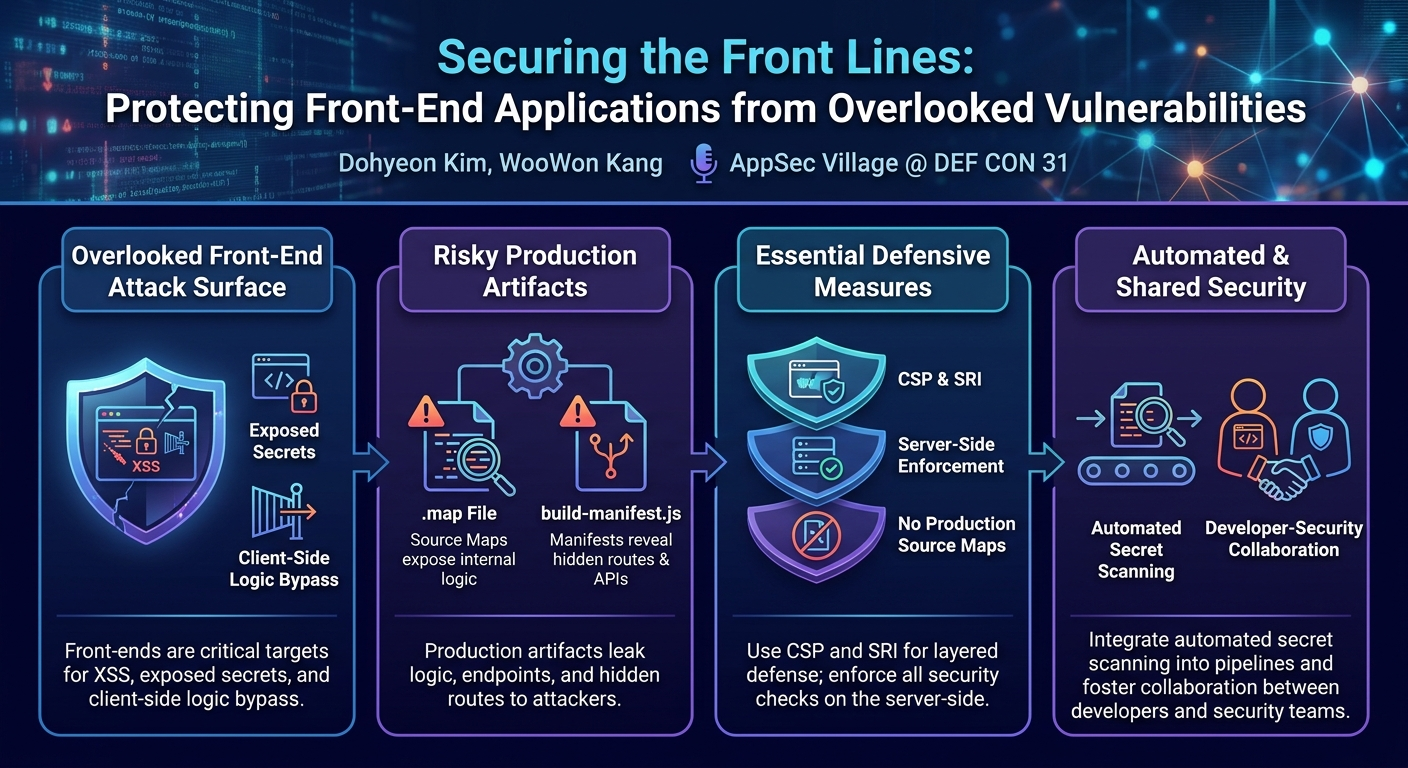
Key moments
- 4:45 Why front-end security is often overlooked
- 6:00 Discovering exposed secrets like API keys
- 9:00 Exploiting source maps to bypass client-side logic
- 14:00 Protecting content integrity with CSP and SRI
- 17:00 Introducing the Syn Frontend Scanner demo
- 20:45 Demo: Simulating a defacement attack with the scanner
- 22:30 Demo: Secret scanner for hidden application pages
- 24:30 Shared responsibilities and security as a management issue
Securing the Front Lines: Protecting Front-End Applications from Overlooked Vulnerabilities
Speakers: Dohyeon Kim (Full-stack Engineer and Product Manager, Theori); WooWon Kang (Security Researcher, Theori)
Conference: AppSec Village @ DEF CON 31
YouTube: https://www.youtube.com/watch?v=3WS4Iy14U3o
Overview
In "Securing the Front Lines: Protecting Front-End Applications from Overlooked Vulnerabilities," Dohyeon Kim and WooWon Kang from the cybersecurity startup Theori shed light on the often-neglected security landscape of modern front-end web applications. The talk argues that while significant attention and resources are typically allocated to backend security, the increasingly complex and business-critical front end has become a prime, yet overlooked, attack surface. The speakers underscore this point by sharing critical vulnerabilities they have discovered in real-world applications, emphasizing that many of these issues stem from common development mistakes and a lack of awareness regarding front-end specific threats.
The presentation provides a historical overview of web development, illustrating how the shift towards Single Page Applications (SPAs) has fundamentally altered the security responsibilities of the front end. With SPAs now handling complex logic, user experience, and direct business impact, the security implications of front-end vulnerabilities have dramatically increased. Kim and Kang not only detail various attack vectors, including enhanced Cross-Site Scripting (XSS), exposed secrets, and client-side logic bypasses, but also propose practical solutions and best practices. Their talk culminates in a demonstration of their custom tool, the Syn Frontend Scanner, designed to help organizations identify and mitigate these nuanced front-end risks.
This article delves into the core arguments, technical findings, and practical recommendations presented by Kim and Kang, providing a comprehensive analysis for security professionals and developers alike. It highlights the critical need for a paradigm shift in how front-end security is perceived and managed, advocating for proactive measures and continuous monitoring to safeguard the integrity and confidentiality of web applications.
Background
▶ Watch: Why front-end security is often overlooked (4:45)
The evolution of web programming has significantly reshaped the architecture and, consequently, the security landscape of modern applications. Historically, web applications were predominantly server-rendered, where the backend handled data fetching, rendering, and direct presentation to the client. In this model, the front end's role was minimal, often limited to displaying static content or simple interactions, and thus, its security implications were less emphasized. Vulnerabilities like Cross-Site Scripting (XSS) were prevalent, often stemming from direct server-side rendering of untrusted input.
However, with the emergence of powerful client-side frameworks like React, Vue, and Angular, and the proliferation of mobile devices, the industry shifted towards Single Page Applications (SPAs). SPAs dynamically update content on the current page without requiring full reloads, offering a smoother, more native-like user experience. This paradigm shift meant that much of the application logic, data presentation, and even sensitive operations migrated from the server to the client-side browser. As front-end applications grew in complexity, incorporating more business logic and directly influencing user experience and business outcomes, their responsibilities expanded dramatically. Simultaneously, web browsers themselves evolved, becoming more capable and performant, further enabling sophisticated client-side functionality.
Despite this profound transformation, a significant gap in security focus has emerged. As the speakers highlight, the cybersecurity community and development teams often remain heavily focused on backend security, dedicating substantial resources to protecting servers, databases, and APIs. This leaves the increasingly powerful and complex front end as an "overlooked attack surface." The speakers argue that this oversight is not merely theoretical; their real-world findings demonstrate that critical and valuable vulnerabilities are frequently present in front-end applications due to this imbalance in security attention. The core problem, therefore, is a misalignment between the evolving technical complexity and business criticality of the front end and the security practices applied to it.
Key Findings
▶ Watch: Exploiting source maps to bypass client-side logic (9:00)
Dohyeon Kim and WooWon Kang presented several categories of critical vulnerabilities they frequently encounter in real-world front-end applications, underscoring the severity of overlooked security issues.
First, Cross-Site Scripting (XSS) remains a threat, albeit in more nuanced forms. While modern frameworks and libraries like React and Vue.js have built-in mitigations (e.g., automatic escaping) that make classic XSS harder to achieve, developers can still introduce vulnerabilities. This often happens when developers explicitly use functions that bypass these protections, such as React's dangerouslySetInnerHTML or Vue's v-html directive, to render raw HTML. Although these functions are clearly named to warn developers, their misuse can still lead to exploitable XSS, allowing attackers to inject malicious scripts into web pages. The speakers emphasize that even with these framework-level protections, a robust Content Security Policy (CSP) remains essential as a layered defense.
Second, the pervasive issue of Exposed Secrets was highlighted as one of the simplest yet most impactful vulnerabilities. This involves sensitive information like API keys, database credentials, or even user passwords being hardcoded directly into front-end code or exposed via environment variables that are inadvertently bundled into production builds. The speakers showed examples where authorization tokens and Slack webhook URLs were discoverable. They specifically noted that even if developers don't explicitly hardcode secrets, misconfigurations in build processes (e.g., Node.js environment variables being exposed) can lead to their leakage. These secrets, once discovered, can grant attackers unauthorized access to backend systems, third-party services, or sensitive data.
Third, the talk addressed the danger of Client-Side Logic Bypass. Modern SPAs often implement various checks and business logic directly within the client-side JavaScript. Examples include verifying administrator status before displaying certain UI elements, or logic for processing payments or managing user accounts. If these critical checks are performed only on the client side without corresponding server-side validation, attackers can easily bypass them. By analyzing the front-end source code (especially if exposed via source maps, as discussed later), an attacker can understand the expected API calls or internal logic, then directly invoke backend APIs with manipulated parameters, potentially leading to unauthorized actions like refunding payments, creating/deleting users, or viewing sensitive information. The speakers stressed that such client-side logic should never be considered a security boundary.
Finally, the talk touched upon Content Integrity issues, which have become increasingly critical with the rise of Web3 and the handling of large digital assets. These attacks target the integrity of the content delivered to the user, often through supply chain compromises or network-level attacks like BGP hijacking. Malicious code can be injected into legitimate front-end content to perform actions such as stealing user input (e.g., private keys for cryptocurrency wallets) or exfiltrating sensitive data. These attacks bypass direct service attacks by tampering with third-party resources or the application's content itself. This underscores the need for mechanisms that validate the authenticity and integrity of all loaded resources.
Technical Deep Dive
▶ Watch: Introducing the Syn Frontend Scanner demo (17:00)
The speakers provided a detailed explanation of how these front-end vulnerabilities are discovered and exploited, focusing on specific technical artifacts that are often overlooked by developers.
A primary target for attackers is the build manifest, specifically files like build-manifest.js found in frameworks like Next.js. In production mode, Next.js pre-renders pages for efficient client-side navigation. This manifest often includes comprehensive routing information for the entire web application, encompassing not just public-facing URLs but also hidden or restricted paths like /admin, /about, /error, /dev, or /staging pages. By analyzing this manifest, attackers can enumerate all possible URLs within an application, uncovering "back-office" systems or development environments that are not intended for public access. This routing information serves as an invaluable roadmap for identifying potential attack surfaces.
Once potential targets are identified, the next step involves analyzing the application's code. This is where Source Maps become critical. Modern web applications are typically optimized and minimized for production, making their JavaScript code unreadable. However, source maps (.map files) provide a way to map the minimized, optimized code back to its original, human-readable source. While intended for debugging, source maps are a goldmine for attackers. They allow an attacker to:
- Reverse-engineer client-side logic: Understand how front-end checks (e.g., admin status, payment validation) are implemented and identify how to bypass them.
- Discover internal API endpoints: Identify the exact API calls made by the front-end, including their parameters and expected responses. This provides a direct path to interacting with the backend, potentially exploiting vulnerabilities in those APIs.
- Uncover sensitive information: In some cases, source maps or associated annotations can inadvertently reveal sensitive data like account IDs, passwords, or even details about planned security patches and vulnerable hosts.
The speakers shared an interesting anecdote about David Heinemeier Hansson (DHH), the founder of Rails, who advocated for keeping source maps enabled by default in Webpacker for Rails, arguing that he learned a lot about CSS and JavaScript from viewing source. While this promotes learning, it highlights the inherent risk when source maps are exposed in production.
To mitigate the risks associated with source maps, the speakers provided clear best practices:
- Do not upload source maps in production: This is the most crucial step and can often be achieved with a single configuration line in build tools (e.g.,
devtool: 'false'in webpack). - Restrict access if necessary: If source maps are essential for error tracking services, ensure they are only accessible to authenticated and authorized users.
- Make code robust: Ideally, client-side code should not contain sensitive logic or information that would be problematic if exposed.
Beyond code exposure, the talk emphasized the importance of Content Integrity to prevent malicious code injection or content manipulation. Two key technologies were highlighted:
- Subresource Integrity (SRI): SRI helps ensure that resources fetched from third-party servers (e.g., CDNs) are not tampered with. By including a cryptographic hash (e.g., SHA-256) of the expected resource in the HTML
<script>or<link>tag, the browser can verify the integrity of the downloaded file. If the content's hash does not match, the browser will block its execution, effectively preventing supply chain attacks. - Content Security Policy (CSP): CSP is a powerful security header that allows web application developers to control which resources (scripts, stylesheets, images, fonts, etc.) the user agent is allowed to load. By defining a whitelist of trusted sources, CSP can prevent various attacks, most notably XSS, by blocking the execution of scripts from untrusted domains. It can also restrict data exfiltration by limiting where data can be sent.
The speakers acknowledged that implementing CSP can be challenging due primarily to two factors: the difficulty in tracking all resources loaded by a complex SPA, and the potential for usability issues when new CSP rules are introduced, inadvertently blocking legitimate functionality. This complexity often leads to overly permissive or incomplete CSPs, rendering them less effective.
Demo / Proof of Concept
▶ Watch: Demo: Simulating a defacement attack with the scanner (20:45)
To address the challenges of identifying front-end vulnerabilities and implementing robust defenses like CSP and SRI, the speakers showcased their custom tool, the Syn Frontend Scanner. This tool, developed by their team at Theori, is designed to extract valuable insights from front-end applications, visualizing resource dependencies and scanning for exposed secrets.
The demo began by inputting a target application's URL into the scanner. After a brief analysis period, the tool presented its findings through several insightful views:
- Resource Insight Tab: This section provides a comprehensive summary of all resources loaded by the browser during a page load.
- Resource List: A detailed list of all loaded resources, which can be grouped by type (e.g., images, scripts, stylesheets). This allows security professionals to quickly identify any unusual or suspicious resources that might indicate malicious activity or misconfigurations.
- Domain Overview: This pane lists all unique domains from which resources are loaded, categorized by resource type. This feature is particularly useful for constructing an initial Content Security Policy (CSP), as it directly identifies all third-party domains that the application legitimately interacts with. The speakers noted that this overview captures resources from the initial page load, recommending the use of
Content-Security-Policy-Report-Onlyheader in production to catch any dynamically loaded resources not initially covered.
- Resource Graph View: Located on the right pane of the Resource Insight tab, this visual representation illustrates the dependencies between loaded resources.
- The graph shows resources loaded sequentially, with arrows indicating direct dependencies. This helps in understanding why a particular resource was loaded and its place in the application's loading chain.
- Users can click on any resource to inspect additional details about its request and response, including SRI hashes, request/response headers, and the initiator of the request. For POST requests, the tool also displays the POST data.
The speakers then presented a compelling simulation of a supply chain attack using the Syn Frontend Scanner. They used a simple Next.js blog application that loaded external resources from a hypothetical static.sinto.io domain. By simulating a compromise of this external static site, they "unloaded a raw copy of the script" onto static.sinto.io, which then defaced the blog post by hijacking its cover image. The Syn Frontend Scanner was then used to analyze the compromised page. In the images tab, the tool quickly identified the malicious image. Crucially, the scanner traced the image's origin back to the compromised analytic script, demonstrating how defenders could use the tool to pinpoint the source of a defacement attack. This highlighted the importance of SRI hashes for external scripts and a strong CSP to prevent such attacks.
Finally, the demo showcased the Secret Scanner component. Recognizing that manually finding exposed secrets is time-consuming, this feature automates the detection of high-severity credentials and API keys within the front-end code. A key advantage of their secret scanner is its ability to discover secrets on "hidden pages" by enumerating the build-manifest of the application. Even if a page isn't directly linked, if its route is in the manifest and it contains secrets, the scanner can find them. While acknowledging that secret scanners can produce false positives and negatives, the speakers emphasized their value as a quick and efficient way to detect potential security risks, especially since secrets are often grouped together. The demo page itself contained numerous high-severity credentials, proving the scanner's efficacy in finding these often-overlooked exposures in production applications.
The speakers concluded the demo by stating that while the Syn Frontend Scanner assists in creating CSP/SRI rules and identifying vulnerabilities, it is a powerful tool that they are not making publicly available due to its capabilities, instead offering it to vetted users.
Defensive Implications
▶ Watch: Shared responsibilities and security as a management issue (24:30)
The insights and demonstrations from Dohyeon Kim and WooWon Kang provide actionable guidance for defenders seeking to fortify their front-end applications against overlooked vulnerabilities. Implementing these defensive strategies requires a shift in mindset, acknowledging the front end as a critical attack surface.
- Strict Source Map Management: The most immediate and impactful action is to never upload source maps to production environments. Developers should configure their build tools (e.g., Webpack, Next.js build configurations) to ensure that
.mapfiles are not generated or are explicitly excluded from production deployments. If source maps are absolutely essential for error monitoring in production, access must be severely restricted, potentially requiring authentication or being hosted on an internal, tightly controlled service. - Robust Content Security Policy (CSP) Implementation: CSP is a cornerstone of modern front-end security. Organizations must:
- Develop a comprehensive CSP: This involves identifying all legitimate sources for scripts, styles, images, and other resources. The Syn Frontend Scanner can assist in this initial discovery phase.
- Avoid overly broad rules: Generic CSP directives like
script-src 'unsafe-inline'or allowing GitHub repositories as sources can negate the security benefits by permitting arbitrary code execution or file uploads. - Address internal/staging domains: Ensure that CSP rules account for internal or staging environments that might expose additional attack surfaces, preventing their exploitation even if they are not the primary target domain.
- Utilize
Content-Security-Policy-Report-Only: This header allows organizations to test new CSP rules in production without enforcing them, gathering reports on violations to refine the policy before full enforcement, thereby minimizing usability issues.
- Mandatory Subresource Integrity (SRI) for Third-Party Resources: For all external scripts and stylesheets loaded from CDNs or other third-party domains, Subresource Integrity (SRI) should be enforced. This involves including a cryptographic hash of the expected resource in the HTML tag. This prevents supply chain attacks where a third-party resource provider's infrastructure is compromised, leading to the injection of malicious code into your application.
- Eliminate Client-Side Security Logic: Any security-sensitive logic, such as authorization checks, payment processing validation, or user management operations, must be enforced on the server side. Client-side checks are easily bypassed and should only be used for enhancing user experience (e.g., form validation) or providing immediate feedback, never for security enforcement. All API endpoints must assume untrusted input and perform their own validation and authorization.
- Continuous Secret Scanning and Monitoring: Organizations should integrate automated secret scanning tools, similar to the Syn Frontend Scanner, into their CI/CD pipelines and production monitoring. These tools can proactively identify hardcoded API keys, credentials, and other sensitive information that might inadvertently be bundled into front-end assets or exposed via
build-manifestfiles. Regular scans are crucial as codebases evolve. - Foster a Culture of Shared Security Responsibility: The speakers emphasized that front-end security is not solely a technical problem but also a management and awareness issue.
- Developers must be educated on front-end security best practices, the dangers of client-side logic for security, and secure configuration of build tools.
- Security Engineers need to be equipped with tools and knowledge to assess front-end risks and guide development teams.
- Users also play a role through basic security awareness, though the primary burden rests on developers and security teams.
This collaborative approach ensures that security considerations are embedded throughout the development lifecycle, preventing vulnerabilities from being introduced in the first place and ensuring robust defenses.
By focusing on these areas, defenders can move beyond an exclusive backend security focus and build more resilient and secure front-end applications, protecting against the growing array of overlooked vulnerabilities.
Key Takeaways
- The Front End is a Critical, Overlooked Attack Surface: With the rise of Single Page Applications (SPAs) and increasingly complex client-side logic, the front end now carries significant business responsibility and directly impacts user experience, making it a prime target often neglected in favor of backend security.
- Build Manifests and Source Maps Expose Sensitive Information: Files like
build-manifest.jscan reveal hidden routes and internal application structure, while source maps (.mapfiles) allow attackers to reverse-engineer client-side logic, discover API endpoints, and uncover inadvertently exposed secrets. These should not be deployed to production. - Client-Side Logic is Not a Security Boundary: Relying on front-end code for security-critical checks (e.g., admin status, payment validation) is fundamentally flawed, as these can be easily bypassed by attackers. All security-sensitive logic must be enforced on the server side.
- Content Security Policy (CSP) and Subresource Integrity (SRI) are Essential: These mechanisms are crucial for preventing Cross-Site Scripting (XSS), supply chain attacks, and content defacement by whitelisting trusted resources and validating their integrity. However, their implementation requires careful planning to avoid usability issues and overly permissive rules.
- Automated Scanning Tools Enhance Front-End Security: Tools like the Syn Frontend Scanner can automate the discovery of exposed secrets, visualize resource dependencies, and assist in generating robust CSPs, significantly improving the efficiency and effectiveness of front-end security audits.
- Security is a Shared Responsibility: Effective front-end security requires collaboration between developers (writing secure code, configuring build processes correctly), security engineers (providing tools and guidance), and even users (maintaining basic security awareness).
About the Speaker(s)
Dohyeon Kim is a member of Theori, a cyber security startup. With a background as a hacker and a skilled CTF (Capture The Flag) player, he has been actively involved in hacking for over 10 years. He also serves as a web programmer and product manager at Theori. His expertise combines practical hacking experience with a deep understanding of web development and product management.
WooWon Kang is also a member of Theori, working as a cyber security researcher. He is an accomplished bug hunter and a notable CTF player, having won the DEF CON CTF in the previous year and aiming for another victory. His research focuses on identifying and understanding vulnerabilities in web applications, contributing to the development of security solutions.
Reviews
Dr. Zero (Offensive Security Researcher) — HARD PASS
Two guys from a startup gave an intro to React security just to pitch a closed-source scanner. If you've looked at a Next.js app in the last five years, you already know about source maps and leaked secrets, making this an elaborate 45-minute lead-gen exercise.
Heather Calloway (CISO) — SOLID
This is a solid AppSec reminder about the architectural shift toward Single Page Applications (SPAs). It’s worth routing to your head of product security, but it’s not a board-level briefing. The core message is accurate: moving business logic to the client side breaks traditional trust boundaries, and our CI/CD pipelines need to catch the resulting exposure.