Scoping for Success (Building a Great Bug Bounty program)
Jeffrey Guerra (Senior Security Engineer · GitHub), Logan MacLaren (Senior Security Engineer · GitHub)
AppSec Village @ DEF CON 31 · Day 3 · AppSec Village
Overview
In "Scoping for Success (Building a Great Bug Bounty program)," Jeffrey Guerra and Logan MacLaren, both Senior Security Engineers at GitHub, deliver a comprehensive guide to establishing, managing, and scaling bug bounty programs. Drawing from their extensive experience, including the "pain and suffering" involved in building such initiatives, the speakers offer invaluable insights designed to help organizations navigate the complexities of vulnerability disclosure and incentivized security research. The talk is intentionally platform and product agnostic, ensuring its principles are applicable whether an organization is just starting with a basic vulnerability disclosure program (VDP) or looking to mature an existing private or public bug bounty.
Key moments
- 0:00 Introduction and talk overview
- 2:55 Essential groundwork: asset inventory and remediation
- 6:00 Program maturity stages and platform selection
- 12:40 Operational transparency, communication, and dispute handling
- 21:00 Building strong relationships with bug bounty researchers
- 26:10 Program evolution, roadmap, and blameless culture
- 31:45 Engaging the community: feedback, swag, and gamification
- 33:00 Comprehensive resources for bug bounty program success
Scoping for Success (Building a Great Bug Bounty program)
Speakers: Jeffrey Guerra (Senior Security Engineer, GitHub); Logan MacLaren (Senior Security Engineer, GitHub)
Conference: AppSec Village @ DEF CON 31
YouTube: https://www.youtube.com/watch?v=OCKVjwLh8Hk
Overview
In "Scoping for Success (Building a Great Bug Bounty program)," Jeffrey Guerra and Logan MacLaren, both Senior Security Engineers at GitHub, deliver a comprehensive guide to establishing, managing, and scaling bug bounty programs. Drawing from their extensive experience, including the "pain and suffering" involved in building such initiatives, the speakers offer invaluable insights designed to help organizations navigate the complexities of vulnerability disclosure and incentivized security research. The talk is intentionally platform and product agnostic, ensuring its principles are applicable whether an organization is just starting with a basic vulnerability disclosure program (VDP) or looking to mature an existing private or public bug bounty.
The core premise of their presentation revolves around the idea that a successful bug bounty program is built on a foundation of clear scope, robust internal processes, and strong relationships with the security research community. Guerra and MacLaren emphasize the critical often-overlooked aspects of program management, from defining asset inventories and remediation practices to fostering transparency and empathetic communication with hackers. Their candid approach, sharing both triumphs and frustrations, aims to equip security professionals with the knowledge to build effective programs that not only identify vulnerabilities but also cultivate a positive, collaborative environment with external researchers.
Ultimately, this talk serves as a strategic playbook for anyone involved in product security, offering a structured progression from foundational elements to advanced operational considerations. It highlights that while technical expertise is crucial, the human element—transparency, communication, and relationship building—is equally vital for transforming a vulnerability reporting mechanism into a thriving, mutually beneficial security ecosystem. By outlining the necessary groundwork and ongoing operational refinements, Guerra and MacLaren empower organizations to scope their bug bounty efforts for sustained success, minimizing headaches and maximizing security posture.
Background
▶ Watch: Introduction and talk overview (0:00)
The landscape of modern software development is fraught with security challenges, making robust vulnerability management an imperative for any organization. While internal security testing, penetration testing, and static/dynamic analysis tools are essential, they often cannot fully replicate the ingenuity and diverse perspectives of the global security research community. This is where bug bounty programs enter the picture, offering a scalable and cost-effective mechanism to leverage external expertise for identifying security flaws. However, despite their clear benefits, many organizations struggle to implement these programs effectively, often due to a lack of foundational preparation and strategic planning.
Before delving into the specifics of building a bug bounty program, Guerra and MacLaren make a crucial assumption: organizations must have certain fundamental security practices already in place. These include vulnerability lifecycle tracking – a system for logging, prioritizing, and managing security issues from discovery to remediation – and a comprehensive asset inventory. Without a clear understanding of what assets are publicly exposed and their relative risk, effective scoping of a bug bounty program becomes impossible. As one of their colleagues wisely stated, "Own your assets before someone else owns them." This foundational layer ensures that when vulnerability reports begin to flow in, there is an established internal mechanism to handle them.
The problem often arises when organizations rush into launching a public bug bounty program without this groundwork. This can lead to a deluge of reports that cannot be efficiently triaged or remediated, resulting in frustrated researchers, significant backlogs, and ultimately, a tarnished reputation. The speakers highlight that the journey from an initial idea to a mature, successful program involves a deliberate progression: starting with a simple Vulnerability Disclosure Program (VDP), advancing to a private program, and finally, scaling to a public program. This phased approach allows organizations to develop and refine their internal processes, understand the financial implications, and build necessary tooling in a controlled environment before exposing themselves to the full breadth of the global hacking community. The existence of these challenges underscores the critical need for the strategic guidance provided in this talk, aiming to preempt common pitfalls and set organizations on a path to "scoping for success."
Key Findings
▶ Watch: Program maturity stages and platform selection (6:00)
The talk "Scoping for Success" delivers several key findings and principles essential for building and maintaining effective bug bounty programs:
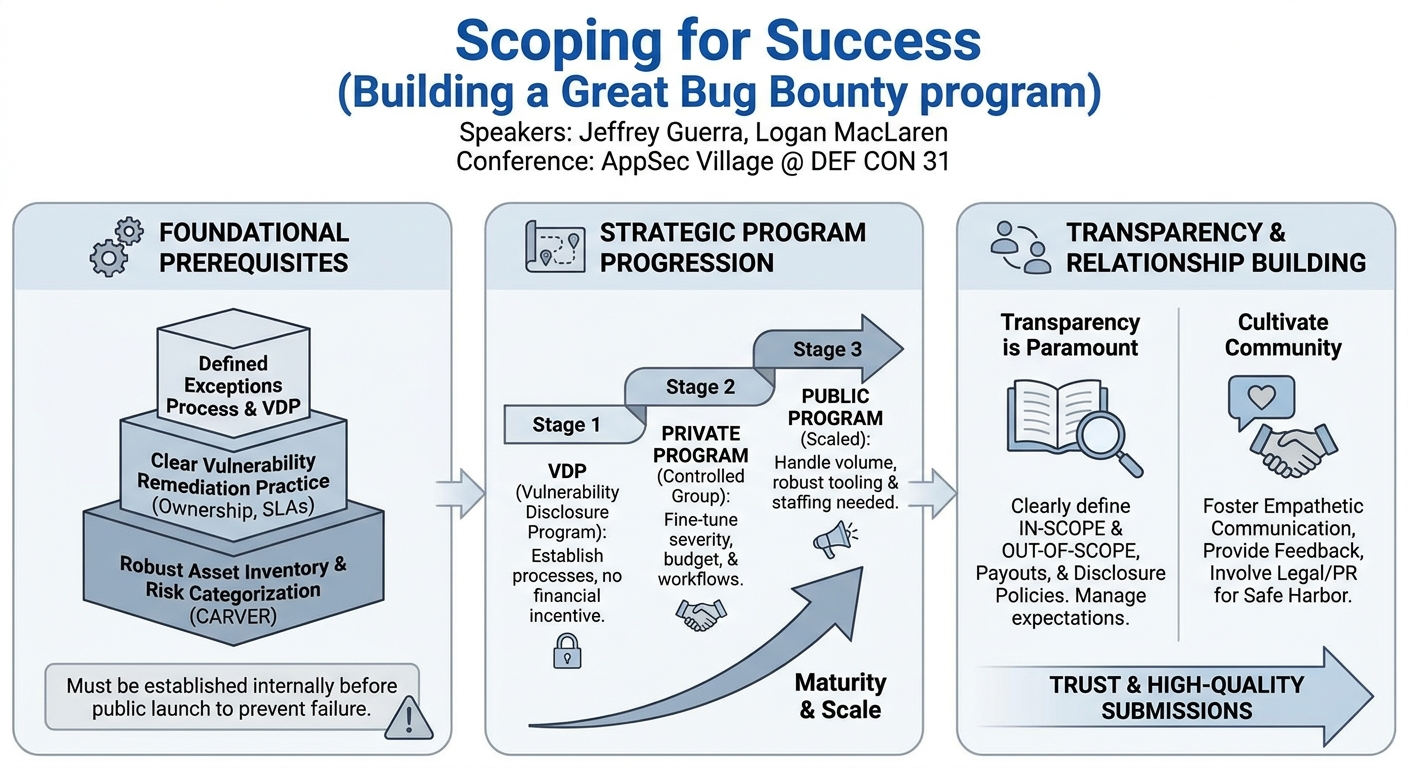
- Foundational Prerequisites are Non-Negotiable: Before launching any bug bounty initiative, organizations must establish a robust asset inventory and a clear vulnerability remediation practice. This includes understanding public attack surfaces, categorizing assets by risk (e.g., using CARVER), clearly defining what constitutes a security vulnerability, assigning clear ownership for remediation, and agreeing upon timelines and an exceptions process for issues that cannot be immediately fixed or are accepted risks. Without these, programs are destined for failure, leading to researcher frustration and internal chaos.
- Strategic Program Progression: The most effective path to a mature bug bounty program is a phased approach:
- Vulnerability Disclosure Program (VDP): Start here to establish internal processes for receiving, triaging, and remediating vulnerabilities without the pressure of financial incentives. This builds "reps" for the security team.
- Private Program: Once VDP processes are solid, move to a private program with a controlled group of researchers. This helps fine-tune severity models, estimate "cost per bug," and understand budgeting in a more manageable environment.
- Public Program: Only go public when internal processes, tooling, and staffing are robust enough to handle a significant increase in report volume and public scrutiny.
- Scope with Intention: Ambiguity is the enemy of a successful bug bounty program. Organizations must clearly define what is in scope and, equally important, what is out of scope. This clarity extends to vulnerability classes, specific assets, and detailed payout structures, potentially using established standards like CVSs or Viss. Providing examples and historical disclosure data further helps researchers manage expectations and focus their efforts productively.
- Transparency is Paramount: Openness regarding program policies, timelines, payout structures, and disclosure practices fosters trust and encourages high-quality submissions. The more information shared about how a program operates, the better researchers can align their efforts, reducing disputes and fostering a positive experience for all parties.
- Relationships are Key to Longevity: Beyond technical processes, the human element of building empathetic relationships with researchers is critical. This involves conscious communication, avoiding immediate "spam" closures, exploring "defense in depth" bounties for valuable but non-qualifying findings, and actively educating researchers. Showcasing researcher submissions through joint articles or spotlights and engaging with the broader bug bounty community are also powerful ways to retain talent and attract new contributors.
- Involve Legal and PR Early: Bug bounty programs are customer-facing initiatives with significant reputational and legal implications. Engaging legal and public relations teams from the outset is crucial for establishing Safe Harbor terms, managing disclosure policies, handling international payment regulations, and mitigating potential reputational damage. Partnering with a reputable bug bounty platform can greatly simplify these complex areas.
- Continuous Improvement and Internal Culture: A bug bounty program should be seen as a continuous feedback mechanism. Organizations should regularly update their roadmaps, explore opportunities for automation (e.g., CodeQL for variant analysis), and foster a blameless culture internally. This culture encourages learning from vulnerabilities rather than assigning fault, leading to more sustainable security improvements and preventing recurring issues.
Technical Deep Dive
▶ Watch: Building strong relationships with bug bounty researchers (21:00)
The technical depth of building a successful bug bounty program, as articulated by Guerra and MacLaren, lies not just in specific tools but in the architectural design of processes, policies, and supporting infrastructure. This involves several critical components that ensure efficiency, accuracy, and scalability.
At the foundation, a robust asset inventory is indispensable. This isn't merely a list of domains but a categorized, risk-prioritized map of an organization's public-facing attack surface. Tools like Detectify or HackerOne Assets can aid in initial discovery and enumeration. However, the real technical challenge lies in integrating this inventory with internal systems to maintain accuracy and assign relative risk. The speakers suggest using scoring or criticality systems like CARVER (Criticality, Accessibility, Recoverability, Vulnerability, Effect, and Recognizability) to objectively determine the risk posture of different assets. This technical classification directly informs the scoping of the bug bounty program, ensuring researchers focus on the most impactful areas.
Parallel to asset management is the establishment of a rigorous vulnerability remediation practice. This involves more than just fixing bugs; it's about defining a clear workflow with technical clarity. Key elements include:
- Issue Qualification: Technologically distinguishing what constitutes a "security vulnerability" versus a general bug or feature request.
- Clear Ownership: Precisely mapping assets and vulnerability types to specific engineering teams or code owners. This often requires integrations with internal ticketing systems and code repositories.
- Defined Timelines (SLAs): Setting realistic yet firm service level agreements for remediation based on severity.
- Exceptions Process: A structured technical and risk-based process for documenting and accepting risks for vulnerabilities that cannot be immediately fixed or are deemed acceptable within the organization's risk appetite. This prevents reports from "sitting there for a while," leading to researcher frustration.
When it comes to program options, the speakers outline a technical progression. A Vulnerability Disclosure Program (VDP) can start with minimal technical overhead, perhaps a dedicated mailing list or leveraging built-in features like private vulnerability reporting on GitHub or confidential issues on GitLab. These mechanisms provide a secure channel for initial reports. As the program matures, moving to a private program or then a public program necessitates a more sophisticated platform. Commercial platforms like HackerOne, Intigriti, or Bugcrowd offer a suite of technical features that are difficult to replicate in-house. These include:
- Standardized Report Submission: Streamlined forms and templates that guide researchers, ensuring all necessary technical details are captured.
- Triage Collaboration Tools: Features for security teams to collaborate on reports, assign severities (often integrating with CVSs or Viss calculators), and communicate with researchers.
- Mediation Processes: Structured dispute resolution mechanisms that leverage platform neutrality.
- Disclosure Management: Standardized workflows for coordinated, limited, or full public disclosure, including the generation of public advisories.
- Safe Harbor Terms: Legally vetted terms that protect researchers acting in good faith, which are often provided out-of-the-box by platforms.
- Payment Infrastructure: Handling currency conversion, international payments, and compliance (e.g., trade sanctions) which is a significant technical and legal burden for homegrown solutions.
For internal operations, the talk alludes to the importance of internal tooling, referencing Jeff Guerra's previous talk, "Life of a Bug," which details GitHub's sophisticated internal bug remediation and tracking systems. Such tooling often involves custom integrations between bug bounty platforms, internal ticketing systems (e.g., Jira), code repositories, and communication platforms. This automation can dramatically reduce manual effort, ensure consistency (e.g., through canned responses), and facilitate auditing.
Finally, looking ahead, the speakers emphasize the technical evolution of a program. Once bugs are being fixed, organizations should consider leveraging these findings for variant analysis. This involves using the root cause of a discovered vulnerability to identify similar patterns in the codebase, often through static analysis tools like CodeQL. This proactive approach, enabled by access to the codebase and internal expertise, turns individual bug fixes into systemic security improvements. The decision between in-house triage and platform-managed triage also has technical implications: while platforms offer spam filtering, in-house triage provides immediate business context and technical expertise for rapid, accurate severity assessment and payout decisions. This deep dive reveals that a successful bug bounty program is a complex interplay of organizational strategy, technical infrastructure, and continuous process refinement.
Demo / Proof of Concept
▶ Watch: Program evolution, roadmap, and blameless culture (26:10)
This technical article details a security conference talk focused on strategic program building and operational best practices for bug bounty initiatives. As such, the presentation by Jeffrey Guerra and Logan MacLaren did not feature a live demonstration or a proof of concept of a specific vulnerability or tool. Instead, the talk provided a comprehensive framework and practical advice, drawing from the speakers' extensive experience in managing bug bounty programs at GitHub. The content was centered on theoretical and experiential knowledge, covering methodologies, policy considerations, and relationship management rather than showcasing direct technical exploits or software functionality.
Defensive Implications
▶ Watch: Comprehensive resources for bug bounty program success (33:00)
The insights shared in "Scoping for Success" offer critical defensive implications for organizations at various stages of security maturity, aiming to bolster their defenses by effectively leveraging external security research.
- Build a Solid Foundation: Defenders must prioritize establishing a comprehensive and up-to-date asset inventory. This involves not just listing assets but categorizing them by risk using frameworks like CARVER. Without this, critical assets might be overlooked, or an unfocused scope could lead to wasted resources on low-impact findings. Simultaneously, a robust vulnerability remediation practice is non-negotiable. This includes clearly defined ownership for assets and vulnerabilities, agreed-upon SLAs for different severity levels, and a formal exceptions process for accepted risks. This ensures that when vulnerabilities are reported, there's a clear, efficient path to resolution, preventing backlog and frustration.
- Strategic Program Rollout: Instead of jumping directly into a public bug bounty, organizations should defensively stage their program rollout. Starting with a Vulnerability Disclosure Program (VDP) allows internal teams to gain "reps" in triage and remediation without financial pressure. Progressing to a private program with a select group of researchers provides a controlled environment to fine-tune processes, severity models, and budgeting before facing the full volume and scrutiny of a public program. This phased approach minimizes defensive overhead and maximizes learning.
- Clarity and Transparency as a Defensive Stance: Ambiguity is a defender's enemy. Programs must be hyper-transparent about their scope (what's in and out), vulnerability classes of interest, payout structures, and disclosure policies. This clarity guides researchers to focus on high-impact areas, reducing noise and irrelevant reports. Clearly stating what is out of scope (e.g., known accepted risks, specific low-impact findings) saves valuable triage time and sets appropriate expectations.
- Leverage Platforms and Legal Expertise: Defenders should not attempt to reinvent the wheel for program management. Partnering with established bug bounty platforms (e.g., HackerOne, Intigriti, Bugcrowd) provides access to standardized tooling, Safe Harbor terms, and mediation processes. Crucially, involve legal and PR teams from the outset to establish robust Safe Harbor clauses that protect good-faith researchers and manage public disclosures. This proactive legal and reputational defense mitigates significant risks.
- Cultivate Researcher Relationships: A key defensive strategy is to view researchers as an extension of the security team. Fostering empathetic communication, providing educational resources, and offering "defense in depth" bounties for valuable but non-qualifying findings encourages continued engagement. Avoiding abrupt "spam" closures and instead using "informative" or "duplicate" statuses preserves researcher reputation, making them more likely to continue contributing positively. Gamification, such as swag stores for valid submissions, can also build community loyalty.
- Internalize Learnings and Automate: Bug bounty reports are invaluable intelligence. Defenders should implement a blameless culture internally to ensure that vulnerability findings lead to systemic improvements rather than finger-pointing. This means focusing on "how do we not introduce it going forward?" rather than "who introduced it?" Furthermore, leverage the insights from reported bugs for variant analysis using tools like CodeQL to proactively identify similar flaws across the codebase. Automating aspects of triage and communication, where appropriate, can free up security engineers for deeper analysis and proactive defense initiatives. Regularly engaging with industry peers and researchers provides critical insights into emerging threat trends and best practices, allowing defenders to adapt their programs and strategies continuously.
Key Takeaways
- Build Strong Foundations First: A successful bug bounty program hinges on a solid asset inventory and a well-defined vulnerability remediation practice, including clear ownership, SLAs, and an exceptions process. Don't launch without these basics.
- Progress Systematically: Start with a low-overhead Vulnerability Disclosure Program (VDP), move to a controlled private program, and only then scale to a public program. This phased approach allows for process refinement and resource allocation in a manageable way.
- Embrace Transparency and Clarity: Clearly define your program's scope, payout structures, and disclosure policies. Ambiguity frustrates researchers and wastes resources; transparency builds trust and attracts high-quality submissions.
- Prioritize Researcher Relationships: Foster an empathetic approach through respectful communication, educational feedback, and fair treatment of reports. Engaging with the community, offering "defense in depth" bounties, and showcasing researcher work are vital for long-term engagement and program success.
- Integrate Legal, PR, and Internal Processes: Involve legal and PR teams early to establish Safe Harbor and manage public communications. Internally, cultivate a blameless culture around bug remediation and leverage bug data for variant analysis (e.g., with CodeQL) to drive continuous security improvements.
- Continuously Evolve and Engage: Regularly review your program's roadmap, explore automation opportunities, and actively seek feedback from both industry peers and the hacking community. Stay competitive not by outspending, but by being adaptable, responsive, and innovative in your engagement strategies, such as offering unique swag or bonuses.
About the Speaker(s)
Jeffrey Guerra is a Senior Security Engineer at GitHub. He brings a wealth of experience in building and managing bug bounty programs, a field he is deeply passionate about and where he started his career many years ago. Beyond his professional life in security research, Jeff enjoys driving fast cars, racing them professionally, and building cars. His insights in the talk are drawn from his hands-on experience navigating the complexities of bug bounty initiatives.
Logan MacLaren is also a Senior Security Engineer at GitHub, based out of Ottawa, Canada. Logan is a long-time enthusiast in the security world, contributing his expertise to the development and management of robust security programs. Together with Jeff, he shares practical advice and lessons learned from the "pain and suffering" involved in scaling bug bounty efforts, emphasizing the importance of strategic planning and community engagement.
Reviews
Dr. Zero (Offensive Security Researcher) — SOLID
Guerra and MacLaren from GitHub drop a competent, if elementary, playbook on how not to fuck up your bug bounty program. It won't melt your brain, but given how many Fortune 500s still argue over VDP scope or ghost researchers for six months, this operational hygiene is desperately needed.
Heather Calloway (CISO) — STRONG ACCEPT
This is a necessary operational playbook for any organization considering a bug bounty. It correctly identifies that the primary risk of a bounty program isn't the vulnerabilities found, but the internal collapse of your remediation pipelines if you launch prematurely.