The Future of Work
Dr. Rumman Chowdhury (Founder & CEO · Humane Intelligence)
Black Hat Middle East & Africa 2025 (Executive Summit) · Executive Summit
Overview
In "The Future of Work," Dr. Rumman Chowdhury, founder and CEO of Humane Intelligence, delivers a compelling and empirically-driven analysis that cuts through the pervasive hype and existential dread surrounding artificial intelligence. Addressing common fears of widespread job displacement and a future dictated by machines, Dr. Chowdhury meticulously unpacks the reality of AI's impact on the global workforce. Her talk, presented at Black Hat MEA, serves as a crucial intervention, urging the security community and beyond to move past sensationalized narratives and engage with AI on the basis of robust research and practical application.
Key moments
- 1:55 Debunking AI myths: public perception vs. reality
- 6:15 AI uniquely automates knowledge work, not manual labor
- 8:50 OpenAI study: 80% workforce, 10% tasks automated
- 12:30 AI significantly boosts expert productivity and quality
- 14:00 Top solutions emerge from teams leveraging AI tools
- 15:00 Understanding AI literacy: functional, critical, and ethical
- 19:00 Embrace techno-optimism, not techno-solutionism
The Future of Work
Speakers: Dr. Rumman Chowdhury, Founder & CEO, Humane Intelligence
Conference: Black Hat MEA
YouTube: https://www.youtube.com/watch?v=ZAYWJjbdVvc
Overview
In "The Future of Work," Dr. Rumman Chowdhury, founder and CEO of Humane Intelligence, delivers a compelling and empirically-driven analysis that cuts through the pervasive hype and existential dread surrounding artificial intelligence. Addressing common fears of widespread job displacement and a future dictated by machines, Dr. Chowdhury meticulously unpacks the reality of AI's impact on the global workforce. Her talk, presented at Black Hat MEA, serves as a crucial intervention, urging the security community and beyond to move past sensationalized narratives and engage with AI on the basis of robust research and practical application.
The presentation systematically dismantles the science fiction portrayal of AI, replacing it with a nuanced understanding derived from leading economic and social science studies. Dr. Chowdhury emphasizes that AI, while transformative, is primarily a tool for knowledge generation and synthesis, fundamentally different from previous waves of automation that focused on manual labor. This distinction is vital for understanding not only how AI will reshape industries and roles but also for identifying the critical skills—dubbed "AI literacy"—necessary for individuals and organizations to thrive in this evolving landscape.
The relevance of this discussion for a cybersecurity audience is profound. As AI permeates every layer of technology and business operations, understanding its true capabilities, limitations, and societal implications becomes paramount for designing secure systems, mitigating new threats, and leveraging AI for defensive purposes. Dr. Chowdhury's insights provide a foundational perspective for cybersecurity professionals to critically evaluate AI tools, develop resilient strategies, and champion responsible AI development that safeguards against both malicious actors and unintended consequences.
Background
▶ Watch: Debunking AI myths: public perception vs. reality (1:55)
The discourse surrounding artificial intelligence is frequently overshadowed by extreme narratives, oscillating between utopian visions of AI solving all humanity's problems and dystopian fears of widespread job loss and autonomous machines making all decisions. Dr. Chowdhury highlights this stark contrast, noting that while the public often envisions sentient, humanoid robots (like the one from a 1990s Björk music video), practitioners recognize AI as complex lines of code. This disconnect is exacerbated by sensational headlines and a general lack of understanding regarding the current state and fundamental limitations of AI.
Leading AI experts, including "AI Godfather" Yann LeCun and "AI Godmother" Fei-Fei Li, have openly stated that Large Language Models (LLMs), despite their impressive capabilities, are reaching their "upper limit." They argue that achieving human-level intelligence and contextual understanding will require radically new approaches beyond current LLM architectures. This expert consensus further underscores the need to temper expectations and ground discussions in reality, rather than speculative future scenarios.
Historically, technological advancements, from the steam engine to robotic process automation (RPA), have primarily focused on the automation of manual labor. Factories streamlined production, and industrial robots took over repetitive physical tasks. These innovations, while disruptive, often led to increased inequality by displacing blue-collar workers. Artificial intelligence, however, marks a significant departure. It is the first technology capable of automating knowledge generation and information synthesis, fundamentally impacting white-collar jobs—a paradigm shift that accounts for much of the current "existential dread" surrounding its advent.
This unique impact necessitates a new approach to AI development, giving rise to the field of responsible AI. This domain focuses not solely on preventing malicious exploitation but critically on understanding and mitigating unintended consequences. Dr. Chowdhury points to emerging phenomena such as AI psychosis (AI generating misleading or harmful information), cognitive offloading (humans delegating critical thinking entirely to AI), manipulation, and coercion as risks that can arise from poorly designed or inadequately safeguarded AI systems, even in the absence of malicious intent. Understanding this background is crucial for developing robust and ethical AI strategies.
Key Findings
▶ Watch: OpenAI study: 80% workforce, 10% tasks automated (8:50)
Dr. Chowdhury presented a synthesis of three critical studies that empirically delineate AI's macroeconomic and workforce impact, moving beyond speculative narratives.
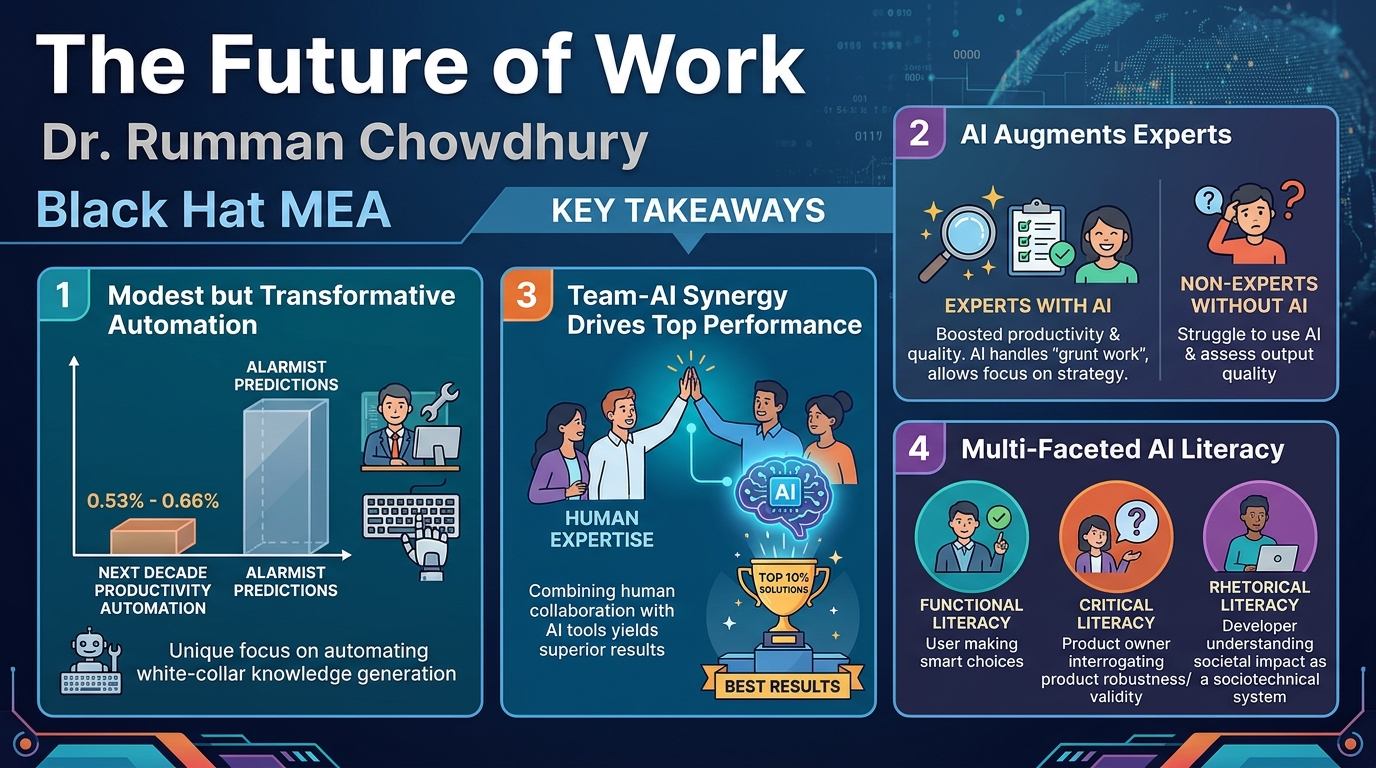
The first study, "The Simple Macroeconomics of AI" by renowned labor economist Daron Acemoglu of MIT, addresses the overarching question: how much work will AI automate in the next decade? Contrary to alarmist predictions, Acemoglu's research estimates that the total factor productivity automated by AI within the next 10 years will be sub-1%, specifically ranging from 0.53% to 0.66%. While this figure is described as "non-trivial but modest," it decisively refutes claims of near-total automation. A key insight from Acemoglu's work is that AI advances are less likely to increase inequality compared to previous technological shifts. This is attributed to AI's unique ability to automate white-collar knowledge generation, a departure from prior innovations that primarily automated manual labor. Dr. Chowdhury further emphasizes that work is not a finite pie; technological innovation historically creates more work, not less.
The second paper, published by OpenAI in collaboration with economists in spring 2023, offered a more granular view of AI's immediate workforce impact following the rise of ChatGPT. Its findings indicate that approximately 80% of the workforce could have around 10% of their tasks automated. More significantly, about 19% of workers could see roughly 50% of their tasks impacted. This study characterizes AI as a powerful knowledge generation and knowledge synthesis machine, identifying its immediate application in automating repetitive, junior-level tasks such as writing baseline code, creating simple applications, and performing tasks in fields like journalism and paralegal work. The implication is a significant augmentation of human capabilities, rather than wholesale replacement, particularly for tasks that involve information processing and content creation.
The third and most detailed study discussed was "The Cybernetic Teammate," which experimentally investigated the impact of generative AI on teamwork and expertise. This research stood out for its rigorous experimental design and its focus on metrics beyond mere productivity, including quality of work, time to completion, and the ability to assist non-expert workers.
Key findings from "The Cybernetic Teammate" include:
- An individual using AI outperformed a team with no AI in terms of average solution quality.
- Interestingly, an individual using AI and a team using AI performed about on par with each other for average solution quality, suggesting potential efficiency savings.
- Experts saw a massive boost in productivity and output quality when using AI. The tool helped them rapidly complete "grunt work," allowing them to focus on higher-order thinking, critical assessment of AI output, and strategic application.
- Conversely, non-experts struggled to effectively utilize AI and assess the quality of its output, highlighting the need for foundational understanding.
- An individual using AI saved the most time compared to teams or individuals without AI.
- Crucially, the top 10% solutions overwhelmingly came from teams using AI. This underscores the synergy created when capable individuals are equipped with appropriate AI tools and collaborate effectively.
These findings collectively paint a picture of AI as a powerful augmentative tool, particularly for skilled professionals, and emphasize that its most profound benefits are realized when integrated thoughtfully into human workflows and team structures.
Technical Deep Dive
▶ Watch: AI significantly boosts expert productivity and quality (12:30)
The technical core of Dr. Chowdhury's talk resides not in specific code implementations or architectural patterns, but in the conceptual and evaluative understanding of AI as a distinct technological force. The fundamental technical distinction she highlights is the shift from automation of manual labor to automation of knowledge generation. Previous automation technologies, from the assembly line to Robotic Process Automation (RPA), have primarily focused on standardizing and executing physical or highly repetitive, rule-based digital tasks. AI, particularly Large Language Models (LLMs), operates at a higher cognitive level, acting as a knowledge synthesis machine. This means it excels at tasks involving information retrieval, summarization, content creation (e.g., code snippets, reports), and pattern recognition across vast datasets.
The perceived "upper limits" of current LLMs, as noted by experts like Yann LeCun and Fei-Fei Li, are a critical technical consideration. While LLMs demonstrate impressive linguistic abilities, their lack of true contextual understanding, common sense reasoning, and ability to generalize beyond their training data poses fundamental challenges to achieving human-level intelligence. This implies that while AI can automate parts of knowledge work, the human element of discernment, judgment, and contextual application remains indispensable.
Dr. Chowdhury delves into the technical challenges of designing and safeguarding AI systems, even in the absence of malicious intent, through the lens of responsible AI. She introduces terms like AI psychosis, where an AI system generates nonsensical or fabricated information (akin to hallucinations), and cognitive offloading, where users excessively rely on AI for thinking, potentially degrading their own critical faculties. Other concerns include subtle forms of manipulation and coercion that can arise from AI systems not designed with human well-being in mind. Technically, addressing these issues involves rigorous model evaluation, bias detection, explainability frameworks, and the implementation of guardrails to ensure outputs are truthful, fair, and safe. This shifts the technical focus from merely building functional AI to building trustworthy AI.
The "Cybernetic Teammate" study provides a technical framework for evaluating AI's impact beyond simple productivity metrics. Instead of just "how much," it asks "how well" and "for whom." Metrics like average solution quality, time to completion, and ability to assist non-expert workers are crucial for a holistic technical assessment. The finding that experts leverage AI for "grunt work" to be "more thoughtful about the output" highlights AI's role as an intelligence amplifier. This requires AI tools to be adaptable, integrated seamlessly into existing workflows, and capable of providing outputs that experts can critically validate and refine.
Perhaps the most significant "technical" contribution of the talk is the framework for AI literacy, adapted from Stuart Selber's 2003 model for digital literacy. This framework defines three levels of engagement with AI systems, each with distinct technical and conceptual requirements:
- Functional Literacy: This is for the end-user. It means understanding "how to engage with this technology rather than as a result of the technology." Technically, this translates to understanding AI's input/output mechanisms, recognizing its limitations (e.g., potential for hallucination), and being able to contextualize and critically assess its output. It's about making "smart decisions with the technology," rather than passively accepting its directives, thereby preventing cognitive offloading.
- Critical Literacy: This level applies to intermediaries, such as product owners or those building applications on top of foundational AI models. It demands the "ability to interrogate the robustness of the product." From a technical standpoint, this involves understanding validity (does the model measure what it's supposed to?) and robustness (can the model perform reliably in unexpected and diverse situations?). This requires pressure testing AI systems, evaluating their performance across various scenarios, and understanding their failure modes. For security professionals, this is paramount for assessing AI-powered security tools or AI components within critical infrastructure.
- Rhetorical Literacy: This is for the fundamental developers, the "frontier model companies" who are "writing the code, fine-tuning the model, gathering the data." At this level, the technical questions become more abstract: "how does my product interact with society?" and "how can I appreciate what I have built as a sociotechnical system?" This involves understanding the ethical, social, and even political implications of technical design choices, recognizing that every line of code contributes to a system that will interact with human processes and institutions. It demands foresight regarding potential societal impacts and a commitment to building AI responsibly from the ground up.
These three levels of literacy represent a graduated technical understanding, moving from practical interaction to deep evaluative capability, and finally to a holistic appreciation of AI's societal footprint, all of which are crucial for navigating the future of work with AI.
Demo / Proof of Concept
▶ Watch: Understanding AI literacy: functional, critical, and ethical (15:00)
Dr. Chowdhury's talk is primarily an analytical and research-driven presentation, focusing on the synthesis of empirical studies and conceptual frameworks regarding AI's impact on the workforce. As such, the presentation did not include a live demonstration or a proof of concept of any specific AI tool or system. Instead, it relied on the findings and data from the academic papers discussed to illustrate its points.
Defensive Implications
▶ Watch: Embrace techno-optimism, not techno-solutionism (19:00)
While Dr. Chowdhury's talk primarily focuses on the broader impact of AI on the workforce, its implications for cybersecurity defenders are profound and multifaceted. The insights provided are critical for shaping defensive strategies, particularly in the context of responsible AI development and the secure integration of AI tools into organizational workflows.
Firstly, the emphasis on critical literacy directly applies to cybersecurity professionals. Defenders are often in an intermediary role, evaluating and deploying AI-powered security solutions or integrating AI components into existing systems. This demands the ability to "interrogate the robustness" and "validity" of these AI products. Security teams must pressure-test AI models for vulnerabilities, biases, and unexpected behaviors that could be exploited. This includes scrutinizing data poisoning attacks, adversarial examples, model inversion, and membership inference attacks. Understanding an AI's limitations and failure modes (e.g., susceptibility to AI psychosis or hallucinations) is essential for preventing it from becoming a new attack vector or a source of misinformed security decisions.
Secondly, the discussion around responsible AI and unintended consequences (like cognitive offloading, manipulation, and coercion) highlights new threat surfaces. Defenders must consider how AI systems, even when not maliciously designed, can inadvertently create security risks. For instance, if employees excessively offload critical thinking to an AI, they might bypass security protocols, fall victim to sophisticated social engineering tailored by AI, or make poor judgments based on AI-generated misinformation. Defensive strategies must therefore include robust human-in-the-loop mechanisms, where human oversight and critical judgment are mandated for high-stakes decisions, and AI outputs are independently verifiable. Training programs should educate employees on the safe and critical use of AI tools, aligning with functional AI literacy.
Thirdly, the finding that AI significantly augments experts, helping them with "grunt work," suggests a strategic shift for security operations. AI can automate repetitive tasks like initial alert triage, vulnerability scanning analysis, and baseline code review, freeing up highly skilled security analysts for more complex threat hunting, incident response, and strategic security architecture. However, this requires that security experts possess AI literacy to effectively guide and validate AI's output, discerning where AI is helpful and where it "shouldn't be used in automation." The highest quality security outcomes will likely come from AI-literate security teams effectively leveraging these tools.
Finally, for security professionals involved in the development of AI systems (rhetorical literacy), the talk underscores the necessity of considering the sociotechnical system from the outset. This means embedding security and ethical considerations throughout the entire AI development lifecycle, from data collection and model training to deployment and monitoring. Ensuring data privacy, preventing algorithmic bias, and designing for transparency and accountability are not just ethical imperatives but crucial defensive measures against future vulnerabilities and regulatory non-compliance. Building AI with an appreciation for its societal interaction means proactively addressing potential misuse and unintended negative impacts on human processes and institutions.
Key Takeaways
- AI Automation is Modest but Transformative: Contrary to widespread fears, macroeconomic studies suggest AI will automate a modest 0.53% to 0.66% of total factor productivity in the next decade. Its unique impact is on automating white-collar knowledge generation, not just manual labor.
- AI Augments Experts, Not Replaces Them: Studies show that AI significantly boosts the productivity and quality of work for experts by handling repetitive "grunt work." Non-experts, however, struggle to effectively utilize and assess AI output, emphasizing the continued need for human expertise.
- Team-AI Synergy Drives Top Performance: The highest quality solutions (top 10%) overwhelmingly emerge from teams effectively using AI, demonstrating that combining human intelligence with AI tools, guided by collective expertise, yields superior results.
- AI Literacy is Crucial and Multi-faceted: True AI literacy extends beyond coding, encompassing functional literacy (critical user engagement), critical literacy (interrogating AI product robustness and validity), and rhetorical literacy (understanding AI's societal impact as a developer).
- Defenders Must Prioritize AI Robustness and Responsible Design: Cybersecurity professionals need to critically evaluate AI systems for vulnerabilities, biases, and unintended consequences like AI psychosis or cognitive offloading, integrating responsible AI principles to safeguard against both malicious actors and systemic risks.
- Embrace Techno-Optimism, Not Techno-Solutionism: The future of AI for good—such as curing diseases—is not automatic. It requires human intent, thoughtful design, and conscious effort to build AI as a tool to solve complex problems, rather than passively relying on it to magically fix everything.
About the Speaker(s)
Dr. Rumman Chowdhury is the Founder and CEO of Humane Intelligence, an organization dedicated to building and deploying AI responsibly. With a strong background in social science, she studied under renowned labor economist Daron Acemoglu at MIT, bringing a unique interdisciplinary perspective to the field of artificial intelligence. Dr. Chowdhury is a recognized expert in responsible AI, with a particular focus on the evaluation of generative AI models. Her work emphasizes bridging the gap between theoretical AI capabilities and their practical, ethical, and societal implications, advocating for a human-centered approach to AI development and deployment.
Reviews
Dr. Zero (Offensive Security Researcher) — WEAK
A 30-minute literature review dressed as a keynote. Chowdhury summarizes three papers—Acemoglu, OpenAI's GPT exposure study, and 'Cybernetic Teammate'—competently but adds almost nothing that isn't in the abstracts. The 'AI literacy' framework is Selber 2003 with 'digital' crossed out and 'AI' written in crayon.
Heather Calloway (CISO) — SOLID
A well-organized synthesis of labor economics research on AI workforce impact, useful for executives needing to counter boardroom panic. The AI literacy framework has legs. But the talk stays at 30,000 feet — no operational guidance for security leaders on what to do Monday morning.
→ Top-rated talks at Black Hat Middle East & Africa 2025 (Executive Summit)
All talks from Black Hat Middle East & Africa 2025 (Executive Summit)