Tracing the Cyber Shift at Black Hat MEA
Ricardo Lafosse (CISO · Kraft Heinz), Gary Hayslip (CISO-in-Residence · Halcyon), Dr. Chenxi Wang (Managing General Partner · Rain Capital), Lance James (Founder and Chief Innovations Officer · Unit 221B), Jaya Baloo (COO & CISO · Stealth Startup)
Black Hat Middle East & Africa 2025 (Executive Summit) · Executive Summit
Overview
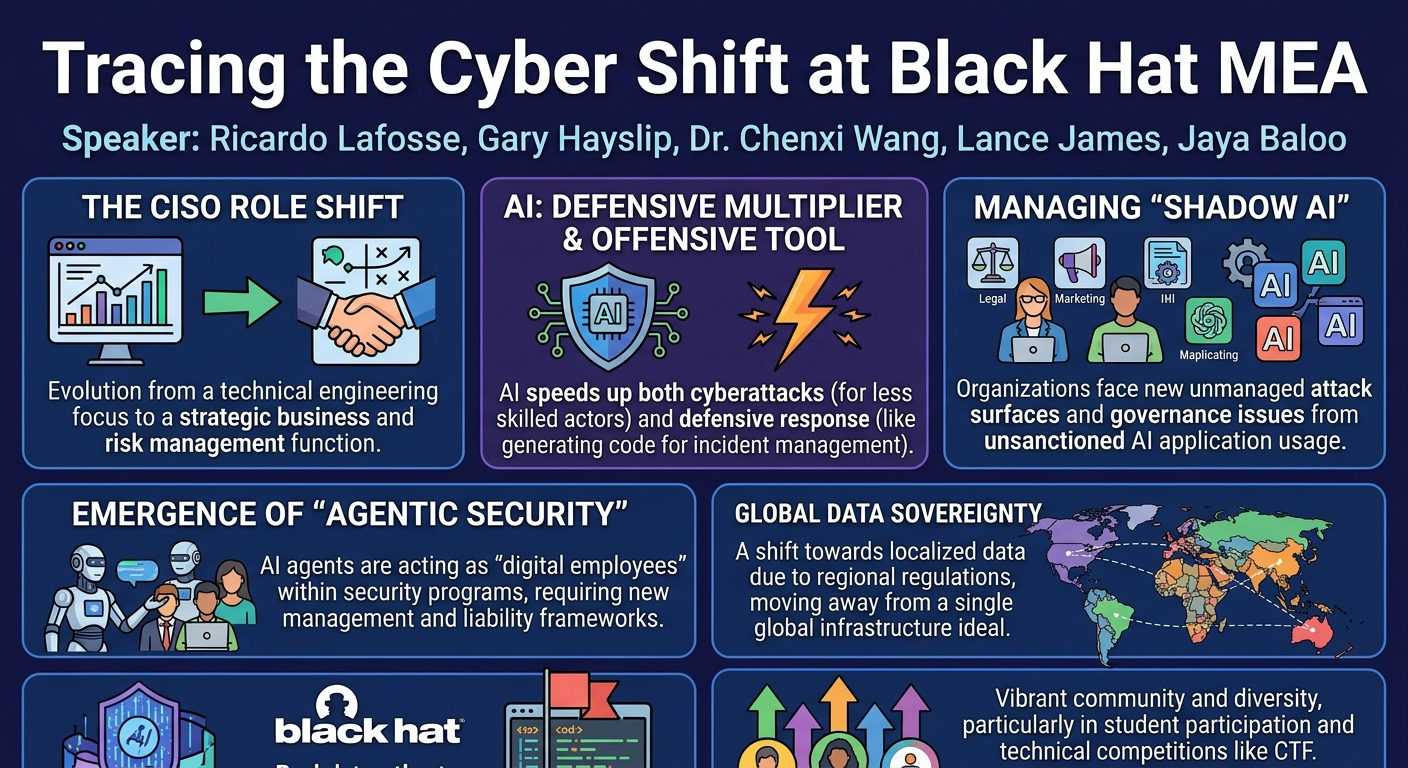
This panel discussion, "Tracing the Cyber Shift at Black Hat MEA," brought together a distinguished group of cybersecurity leaders to explore the most significant transformations in the industry over recent years. Moderated by Jaya Baloo, the discussion featured Ricardo Lafosse, Gary Hayslip, Dr. Chenxi Wang, and Lance James, who collectively offered a comprehensive look at how the CISO role has evolved, the escalating sophistication of cyber threats, the disruptive impact of Artificial Intelligence (AI), and the unique dynamics of the Black Hat MEA conference itself. The panel delved into critical shifts from purely technical security concerns to strategic business risk management, highlighting the challenges and opportunities presented by a rapidly changing threat landscape.
Key moments
- 0:30 CISO role shift: from technical to business strategy
- 3:15 Nation-state enabling teenagers: new threat actor dynamics
- 5:40 AI: the "great equalizer" for dangerous script kiddies
- 12:15 Post-SolarWinds landscape: predicting AI vs AI conflict
- 13:45 CISO paranoia and liability post-SolarWinds prosecution
- 17:00 Continuous board education on evolving, never-ending cyber risk
- 24:30 Anticipating "agentic security" and digital employees in teams
- 30:50 Global shift to sovereign tech stacks: a segregated world
Tracing the Cyber Shift at Black Hat MEA
Speakers: Ricardo Lafosse (CISO, Kraft Heinz), Gary Hayslip (CISO-in-Residence, Halcyon), Dr. Chenxi Wang (Managing General Partner, Rain Capital), Lance James (Founder and Chief Innovations Officer, Unit 221B), Jaya Baloo (COO & CISO, Stealth Startup)
Conference: Black Hat MEA
YouTube: https://www.youtube.com/watch?v=xB45MvraIGw
Overview
This panel discussion, "Tracing the Cyber Shift at Black Hat MEA," brought together a distinguished group of cybersecurity leaders to explore the most significant transformations in the industry over recent years. Moderated by Jaya Baloo, the discussion featured Ricardo Lafosse, Gary Hayslip, Dr. Chenxi Wang, and Lance James, who collectively offered a comprehensive look at how the CISO role has evolved, the escalating sophistication of cyber threats, the disruptive impact of Artificial Intelligence (AI), and the unique dynamics of the Black Hat MEA conference itself. The panel delved into critical shifts from purely technical security concerns to strategic business risk management, highlighting the challenges and opportunities presented by a rapidly changing threat landscape.
The talk underscored the profound redefinition of the cybersecurity professional's mandate, particularly for the CISO (Chief Information Security Officer). What was once primarily an engineering and technical role has matured into a strategic business function, requiring CISOs to effectively communicate risk to executive teams and boards. The discussion also emphasized the game-changing influence of AI, not only in empowering attackers but also in offering unprecedented capabilities for defense, while simultaneously introducing new complexities like "shadow AI" and the emerging concept of "agentic security."
Beyond the technological shifts, the panel reflected on the evolving community and educational landscape, specifically noting the vibrant enthusiasm and impressive diversity at Black Hat MEA, particularly in student participation and the high percentage of women in technical competitions like CTF (Capture The Flag). The conversation served as a vital pulse check on the state of global cybersecurity, offering insights into the present challenges and future trajectories for defenders, executives, and the broader security community.
Background
▶ Watch: CISO role shift: from technical to business strategy (0:30)
The cybersecurity landscape has undergone a dramatic metamorphosis, moving far beyond its nascent stages as a purely technical discipline. Historically, the CISO role was deeply embedded in IT operations, focused on building and securing infrastructure with a heavy emphasis on engineering. However, as organizations grew and digital transformation accelerated, this technical focus proved insufficient for managing the broader spectrum of business risks. The panel highlighted this fundamental shift, with speakers like Ricardo Lafosse noting his personal journey from an engineering-centric CISO to viewing the role as a business executive managing risk through technology, people, frameworks, and policy. Gary Hayslip echoed this, emphasizing the critical need for cybersecurity expertise at the governance level, particularly within boards of directors, to bridge the communication gap between technical realities and business implications.
The evolution of threats has paralleled this organizational shift. Lance James pointed to a significant disruption when "the comm" (a group of teenagers) collaborated with Russia on ransomware, marking a turning point where nation-state capabilities began empowering less sophisticated actors. This blurring of lines between organized crime and state-sponsored activity has only intensified, with the advent of LLMs (Large Language Models) and AI now enabling "script kiddies" to execute highly dangerous and sophisticated attacks without fully grasping their destructive potential. This democratization of offensive capabilities necessitates a corresponding evolution in defensive strategies and a deeper understanding of the adversarial mindset.
Furthermore, the panel reflected on the unique environment of Black Hat MEA. Speakers noted a palpable excitement around the CTF and Arsenal Hall, particularly among students, showcasing a strong community spirit and a forward-looking approach to cybersecurity education. Dr. Chenxi Wang specifically praised the region's impressive diversity, observing a significantly higher percentage of women participating in CTFs (30-40%) compared to traditional Western conferences (around 10%). This vibrant, inclusive atmosphere underscores the region's commitment to fostering the next generation of cybersecurity talent, providing a distinct backdrop against which these global shifts are discussed and addressed. The persistent challenge of educating boards on the "never-done" nature of security and the continuous need for investment, despite years of discussion, remains a core theme, highlighting the ongoing struggle to align security programs with business objectives and risk tolerance.
Key Findings
▶ Watch: AI: the "great equalizer" for dangerous script kiddies (5:40)
The panel discussion illuminated several critical findings that underscore the current state and future trajectory of cybersecurity:
- CISO Role Transformation: The most significant shift identified was the evolution of the CISO from a purely technical, engineering-focused position to a strategic business executive primarily responsible for managing risk. This requires a profound ability to communicate cybersecurity risks and benefits in business terms, moving beyond technical jargon to engage with CFOs, CEOs, and boards effectively.
- AI as the Great Equalizer: AI and LLMs were consistently identified as the most disruptive force in recent years. While they enable "script kiddies" to conduct highly sophisticated attacks by rapidly generating malicious code and tools, they also offer powerful defensive capabilities, such as automating incident response and emulating threat actors. This dual nature means AI is fundamentally reshaping both offensive and defensive landscapes.
- Emergence of "Shadow AI": Organizations are increasingly grappling with "shadow IT" for AI. Departments are adopting AI applications (e.g., legal for contracts, procurement) without central oversight, creating new unmanaged attack surfaces and governance challenges. This necessitates new policies, guardrails, and monitoring capabilities to track and secure unsanctioned AI usage.
- Escalating Threat Sophistication: The panel pointed to incidents like SolarWinds as a watershed moment, demonstrating the devastating impact of supply chain attacks that poison trusted third-party vendors. The discussion posited that AI-to-AI conflicts, akin to a "Skynet type of battle," represent the next "extinction-level event," where autonomous AI systems could engage in cyber warfare.
- Increased CISO Liability and Paranoia: The legal scrutiny faced by the CISO of SolarWinds, Tim Brown, despite the eventual dropping of charges by the SEC (Securities and Exchange Commission), has profoundly impacted CISOs. It has instilled a heightened sense of personal liability, leading to increased paranoia and a greater emphasis on documenting all risk discussions and decisions, even when backed by D&O insurance.
- Continuous Board Education is Paramount: Despite years of effort, educating boards of directors on the continuous, "never-done" nature of cybersecurity remains a persistent challenge. CISOs must continuously adapt their communication to explain evolving threats (like ransomware and AI) and the necessity of ongoing investment, framing security as a continuous care and feeding process akin to car maintenance.
- Rise of Agentic Security: The concept of "agentic security" – where AI agents act as "digital employees" within security teams – is rapidly emerging. These agents can emulate entire teams for incident response or perform complex tasks like forensic data collection. While promising, this also introduces new risks related to "agentic misalignment" and questions of liability when AI agents make mistakes.
- Global Data Segregation: The world is moving towards a more fragmented digital landscape driven by data sovereignty and regional regulations. Countries and blocs (e.g., China, India, Europe) are developing their own tech stacks, clouds, and models, forcing multinational corporations to adopt localized data storage and operational processes, moving away from the ideal of a "single pane of glass" security management.
Technical Deep Dive
▶ Watch: CISO paranoia and liability post-SolarWinds prosecution (13:45)
The discussion offered a comprehensive look into the technical intricacies of the evolving cyber landscape, particularly focusing on the dual-edged sword of AI and the complexities of global operations.
AI and LLMs: Offensive and Defensive Capabilities
The panel extensively detailed the transformative impact of AI and LLMs on both attack and defense. Lance James highlighted how these technologies act as a "great equalizer," enabling less skilled adversaries, often referred to as "script kiddies," to perform "extremely dangerous things" without full comprehension. He cited a recent Anthropic incident involving an 80% AI, 20% human-driven attack, demonstrating the immediate threat. LLMs can rapidly generate malicious code and tools, significantly accelerating the development and deployment of sophisticated exploits.
However, the panel also emphasized AI's immense potential for defense. Lance James, from Unit 221B, shared practical examples:
- Rapid Code Generation for Incident Response: His team has used AI agents to "write code versus spending $10,000 on some piece of software," enabling quick scans of 80 systems with stealthy PowerShell scripts during an emergency.
- Insider Threat Emulation and Forensics: In another case, AI was used to emulate script code that mimicked legitimate software, facilitating the stealthy transfer of an entire drive across a network for forensic analysis in an insider threat investigation.
- Emulating Security Teams: AI agents can effectively "emulate an entire team as you need," providing crucial support when human resources are scarce, such as during weekend emergencies.
Dr. Chenxi Wang underscored a critical challenge for effective AI defense: the prerequisite of well-structured security data. She noted that "security data isn't quite set up natively for AI," requiring significant ETL (Extract, Transform, Load) pipelines to clean and transform data for AI to be truly effective.
Shadow AI and Governance
Ricardo Lafosse introduced the concept of "shadow AI," drawing parallels to the long-standing problem of "shadow IT." This refers to the unsanctioned use of AI applications by various business departments (e.g., legal teams using AI for contract review, procurement for analysis) without the security team's knowledge or oversight. This proliferation creates new unmanaged attack surfaces and governance challenges. Lafosse stressed the need for CISOs to get comfortable with AI themselves, as it impacts everything from policy and frameworks to vendor management and data storage. He shared an anecdote about a CISO friend who discovered "hundreds of MCP servers" (likely referring to Microsoft Cognitive Services or similar AI/ML platform instances) on their network, some exposed to the public internet and connected to backend data.
To combat this, Lafosse detailed a tabletop exercise at SoftBank focusing on a "shadow AI issue" that escalated into a business continuity crisis. The scenario involved a Reddit post exposing financial data linked to an unapproved AI app used by a deals team. This exercise revealed the necessity for new playbooks and workflows to address AI-driven threats, emphasizing the need for proactive preparation.
Agentic Security: Digital Employees
A forward-looking technical area discussed was "agentic security," where AI agents function as "digital employees" within security programs. Ricardo Lafosse predicted that most CISOs would have these agents operating within their teams within 6 to 12 months. He described looking at tools that could "see the agents, see how they were provisioned, see what permissions they had, and be able to see them across the enterprise, what they were doing, what data that they were touching to make sure that they were provisioned correctly." This highlights the technical challenge of monitoring and managing autonomous AI entities within an enterprise environment.
The panel also touched upon the inherent risks, likening "agentic misalignment" to human errors or even insider threats. Lance James raised the provocative question of liability: "who owns that employee Anthropic, OpenAI?" if an AI agent, given credentials, makes a mistake and causes damage. This points to a nascent but critical area of technical and legal governance. He also mentioned an open-source project called Private AI, which uses a Docker box and a Presidio model to ensure data privacy and transparency, preventing sensitive data (credentials, PII, customer data) from being sent to external LLM providers like Google, Anthropic, or OpenAI. The goal is to synthetically change data or ensure absolute transparency about data flow. Dr. Chenxi Wang, however, questioned the long-term viability of simple "proxy boxes" in a mesh of agents, indicating a more complex architectural challenge.
Data Sovereignty and Fragmented Infrastructure
Ricardo Lafosse addressed the technical implications of data sovereignty for multinational corporations like Kraft Heinz. He explained the necessity of "extreme data localization," citing examples like China's cybersecurity law and India's regulations. This forces organizations to work with SaaS providers to ensure regional data access and processing. For instance, in China, Kraft Heinz uses Azure through China Telecom, adapting processes to local requirements. This signifies a departure from the "single pane of glass" ideal, where policies transcend globally. While infrastructure as code makes managing these fragmented systems easier, Lafosse conceded that the "archaic view" of a unified global infrastructure is "gone and just give it up." Dr. Chenxi Wang confirmed this global trend, noting that Europe is building its own tech stack (e.g., using Mistral), and other regions like Saudi Arabia are aiming to become tech centers, leading to a "segregated world."
Demo / Proof of Concept
▶ Watch: Continuous board education on evolving, never-ending cyber risk (17:00)
While the panel discussion did not feature a live technical demonstration or a traditional proof of concept in the conference sense, the speakers extensively elaborated on real-world applications and practical scenarios of the technologies they discussed, particularly concerning AI and agentic security.
Lance James, representing Unit 221B, provided concrete examples of how his organization leverages AI in their "special ops" for clients under attack. He described using AI to rapidly generate PowerShell scripts for stealthy system scans and to emulate malicious code for forensic analysis in insider threat investigations. He also highlighted the capability of AI agents to "emulate an entire team" during critical incidents, showcasing a practical, albeit internal, application of advanced AI for defensive purposes.
Furthermore, Dr. Chenxi Wang mentioned her own upcoming technical talk, which would delve into an "AI versus AI war game," suggesting a more direct demonstration of AI capabilities in a simulated combat environment. While not part of this specific panel, it points to the active development and exploration of AI's practical applications within the security community.
The discussion, therefore, served as a conceptual demonstration through detailed anecdotal evidence and expert insights into how these cutting-edge technologies are being applied in the field, rather than a live, on-stage product showcase.
Defensive Implications
▶ Watch: Global shift to sovereign tech stacks: a segregated world (30:50)
The insights from the panel provide a robust framework for defenders to navigate the current and future cybersecurity landscape. The implications span strategic shifts in the CISO role, proactive AI governance, and adaptation to a globally fragmented digital world.
- Elevate the CISO Role to a Business Executive: CISOs must fully embrace their role as strategic business and risk managers. This means moving beyond technical jargon and effectively communicating cybersecurity risks, investments, and outcomes in the language of business – focusing on risk tolerance, risk appetite, and alignment with organizational objectives. As Gary Hayslip noted, CISOs need to "talk the business to get the respect we need at the table." This includes continuously educating the board on the "never-done" nature of security and the necessity of ongoing care and feeding for security programs, akin to continuous maintenance for a car.
- Proactive AI Integration and Governance: Organizations must develop a comprehensive strategy for AI. This involves:
- Adopting AI for Defense: Actively research and integrate AI-powered security tools and practices. As Lance James demonstrated, AI can rapidly generate defensive code (e.g., PowerShell for stealth scans) and emulate threat actors for enhanced incident response.
- Addressing Shadow AI: Implement robust monitoring and governance frameworks to detect and manage unsanctioned AI application usage within the organization. This requires clear policies, guardrails, and potentially new startup solutions for AI monitoring, as Ricardo Lafosse highlighted.
- Tabletop AI Incidents: Conduct regular tabletop exercises specifically for AI-related threats, such as data leaks via shadow AI, to develop new playbooks and response workflows. Involve the board in these exercises to ensure their awareness and buy-in.
- Prepare for Agentic Security: As AI agents become "digital employees," organizations must develop systems for provisioning, permission management, data access monitoring, and accountability for these agents. This requires anticipating "agentic misalignment" and establishing clear liability frameworks.
- Strengthen Foundational Security: While dynamic threats like AI demand new approaches, the panel emphasized the enduring importance of traditional security foundations. Organizations should maintain a strong risk register, align security controls with business objectives, and focus 80-85% of their budget on tried-and-true methods. Red teaming should be leveraged not just to identify vulnerabilities, but to justify resource allocation and demonstrate program maturity, as Lance James advocated.
- Invest in Data Readiness for AI: For AI to be effective in defense, security data must be clean and well-structured. Organizations need to invest in ETL pipelines and data transformation initiatives to prepare their vast stores of event data for AI analysis and utilization.
- Adapt to Global Data Sovereignty: Multinational corporations must acknowledge and adapt to a fragmented global regulatory landscape. This involves implementing "extreme data localization" where required (e.g., China's cybersecurity law), working closely with SaaS providers to ensure regional data access and processing, and moving away from a "single pane of glass" management ideal towards managing localized, interconnected systems, potentially facilitated by infrastructure as code.
- Continuous Learning and Community Engagement: The vibrant environment of Black Hat MEA, with its emphasis on student participation and diversity, serves as a reminder for organizations to foster continuous learning, embrace new talent, and engage with the broader security community to stay ahead of evolving threats.
By embracing these defensive implications, organizations can transform their security posture from reactive to proactive, strategically leveraging emerging technologies like AI while maintaining strong foundational controls and adapting to the complex geopolitical realities of the digital world.
Key Takeaways
- The CISO role has fundamentally shifted from a purely technical function to a strategic business and risk management position, demanding strong communication skills to engage with executive teams and boards.
- AI and LLMs are the most disruptive forces, simultaneously empowering sophisticated attacks for less skilled adversaries and offering unprecedented capabilities for defense, necessitating rapid adoption and robust governance.
- Organizations must proactively address the challenge of "shadow AI" by implementing new policies, monitoring tools, and guardrails for unsanctioned AI usage across departments.
- The concept of "agentic security" is emerging, where AI agents act as "digital employees" within security teams, requiring new frameworks for provisioning, management, and liability to mitigate risks like "agentic misalignment."
- Effective board communication and continuous education on evolving threats (especially AI) are crucial for securing necessary resources, aligning security programs with business objectives, and managing risk tolerance.
- The global cybersecurity landscape is fragmenting due to data sovereignty and regional tech stacks, forcing multinational organizations to adopt localized data strategies and embrace the management of distributed, interconnected systems.
About the Speaker(s)
The panel comprised a diverse group of seasoned cybersecurity professionals, each bringing a unique perspective to the discussion:
- Ricardo Lafosse: As the CISO at Kraft Heinz, Ricardo shared his journey from a technical-focused security leader to a business executive managing risk. His insights highlighted the practical challenges of securing a multinational corporation, particularly regarding shadow AI and data sovereignty.
- Gary Hayslip: Serving as CISO-in-Residence at Halcyon, Gary emphasized the critical need for cybersecurity expertise at the board level. He frequently advises boards on evolving threats like ransomware and AI, stressing the importance of continuous education and effective risk communication.
- Dr. Chenxi Wang: A Managing General Partner at Rain Capital, Dr. Wang provided an investor's perspective on the cybersecurity market. Her focus areas include AI security and the burgeoning field of agentic security, identifying key investment gaps and emerging companies. She also noted the unique diversity and enthusiasm at Black Hat MEA.
- Lance James: As the Founder and Chief Innovations Officer of Unit 221B, Lance offered a threat-centric view. He detailed the evolution of attack capabilities, the impact of AI on "script kiddies," and how his team leverages AI for advanced defensive operations, including red teaming and incident response.
- Jaya Baloo: The COO & CISO of a Stealth Startup, Jaya expertly moderated the panel, guiding the discussion through complex topics and drawing out key insights from her fellow panelists with her own CISO background.
Reviews
Dr. Zero (Offensive Security Researcher) — SOLID
A competent CISO panel that hits the expected beats—AI disruption, board communication, shadow IT-but-for-AI—without saying much you couldn't have predicted from the speaker bios. Watchable if you're new to the executive security conversation; skippable if you've sat through three of these already.
Heather Calloway (CISO) — WEAK
A panel of senior CISOs discussing genuine topics — role evolution, AI governance, board communication — but delivering almost nothing actionable. Lots of surface-level observations dressed up as insights. Not worth your leadership team's time unless they've never attended a security conference.
→ Top-rated talks at Black Hat Middle East & Africa 2025 (Executive Summit)
All talks from Black Hat Middle East & Africa 2025 (Executive Summit)