The Forecast vs The Fallout
Ricardo Lafosse (Chief Information Security Officer · Kraft Heinz)
Black Hat Middle East & Africa 2025 (Executive Summit) · Executive Summit
Overview
In his compelling Black Hat MEA presentation, "The Forecast vs The Fallout," Ricardo Lafosse, CISO at Kraft Heinz, delved into the evolving cybersecurity landscape, dissecting four critical areas that have presented significant challenges to organizations globally. Lafosse's talk served as a stark reminder that while technology advances at an unprecedented pace, so too do the sophistication and scale of cyber threats. He emphasized that the cybersecurity community must shift from reactive measures to a proactive, continuous discipline, especially as emerging technologies like generative AI reshape the threat landscape.
Key moments
- 3:15 Introduction to speaker and four key cybersecurity topics
- 5:40 S-bombs and Zero Trust for supply chain attacks
- 9:40 Removing service desk password reset to prevent social engineering
- 10:15 Global challenges and fragmentation due to data localization
- 13:50 Analyzing the first large-scale AI-orchestrated cyber attack
- 18:30 Talk summary and future of GenAI in cybersecurity
The Forecast vs The Fallout
Speakers: Ricardo Lafosse, Chief Information Security Officer, Kraft Heinz
Conference: Black Hat MEA
YouTube: https://www.youtube.com/watch?v=PnRffPj3yiY
Overview
In his compelling Black Hat MEA presentation, "The Forecast vs The Fallout," Ricardo Lafosse, CISO at Kraft Heinz, delved into the evolving cybersecurity landscape, dissecting four critical areas that have presented significant challenges to organizations globally. Lafosse's talk served as a stark reminder that while technology advances at an unprecedented pace, so too do the sophistication and scale of cyber threats. He emphasized that the cybersecurity community must shift from reactive measures to a proactive, continuous discipline, especially as emerging technologies like generative AI reshape the threat landscape.
The session meticulously explored the real-world impact of software supply chain attacks, the persistent vulnerability of advanced social engineering, the growing complexities of data localization, and the nascent but rapidly escalating threat of generative AI-driven cyberattacks. Drawing from his extensive experience across government, healthcare, finance, and manufacturing, Lafosse provided practical insights into how practitioners and organizations can strengthen their defenses against these multifaceted challenges. His candid discussion highlighted the painful lessons learned and the crucial adaptations necessary to build resilient security programs capable of withstanding tomorrow's threats.
Lafosse's talk is particularly relevant for security leaders, architects, and practitioners grappling with the dual pressures of rapid technological adoption and an increasingly hostile threat environment. By examining the "fallout" from past incidents and forecasting future challenges, he offered a roadmap for building robust security postures, stressing that effective cybersecurity is about safeguarding the entire ecosystem – from data integrity and training pipelines to deployment environments and real-time monitoring – ensuring resilience is woven into every layer.
Background
▶ Watch: Introduction to speaker and four key cybersecurity topics (3:15)
The cybersecurity landscape has undergone monumental shifts in recent years, driven by a confluence of rapid technological evolution, the emergence of novel attack vectors, and a dynamic global geopolitical environment. The speaker highlighted how the rise of tools like ChatGPT, rather than previously hyped technologies like blockchain, has become a significant focal point for both innovation and concern within the security community. This talk specifically addressed why certain problems persist or have escalated, providing essential context for understanding the "fallout" that organizations are experiencing.
Firstly, software supply chain attacks have moved from theoretical concerns to devastating realities. The interconnected nature of modern software development, relying heavily on third-party components and services, has created an expansive attack surface. Prior to incidents like SolarWinds, the depth of trust placed in third-party vendors often overshadowed rigorous security vetting, leading to blind spots where malicious code could be injected or vulnerabilities exploited upstream. The complexity of modern applications, often built with numerous open-source libraries and commercial off-the-shelf (COTS) components, makes it incredibly challenging to ascertain the integrity of the entire software stack.
Secondly, social engineering continues to be a primary vector for breaches, despite decades of security awareness training. The problem persists because adversaries constantly refine their tactics, leveraging psychological manipulation and increasingly sophisticated tools. The human element remains the weakest link, and traditional awareness programs often fail to keep pace with the evolving ingenuity of attackers. The rise of deepfakes and advanced AI tools exacerbates this, allowing attackers to craft highly convincing impersonations and communications that exploit trust and bypass conventional defenses.
Thirdly, data localization has emerged as a significant operational and compliance challenge. The internet's global nature clashes with nationalistic desires to control data within sovereign borders. As countries legislate stricter data residency and processing requirements, organizations operating internationally face a complex web of regulations. This problem stems from a growing demand for data sovereignty, driven by privacy concerns, national security imperatives, and a desire to foster local tech economies. The lack of standardized global frameworks forces companies to navigate a fragmented legal landscape, often incurring significant operational costs and technical complexities.
Finally, the advent of generative AI introduces an entirely new dimension to the threat landscape. While offering immense potential for innovation, these powerful tools can be weaponized by adversaries to automate and scale attacks. The problem arises from the dual-use nature of AI; capabilities designed for beneficial purposes can be repurposed for malicious intent. The ability of AI to generate realistic text, images, and code, combined with its capacity for rapid analysis and decision-making, significantly lowers the barrier to entry for sophisticated cyberattacks and increases their potential impact. This represents a paradigm shift from traditional human-led or script-based attacks.
Key Findings
▶ Watch: Removing service desk password reset to prevent social engineering (9:40)
Ricardo Lafosse's presentation highlighted critical findings across four pivotal areas, underscoring the dynamic nature of modern cybersecurity threats and the necessary evolution of defensive strategies.
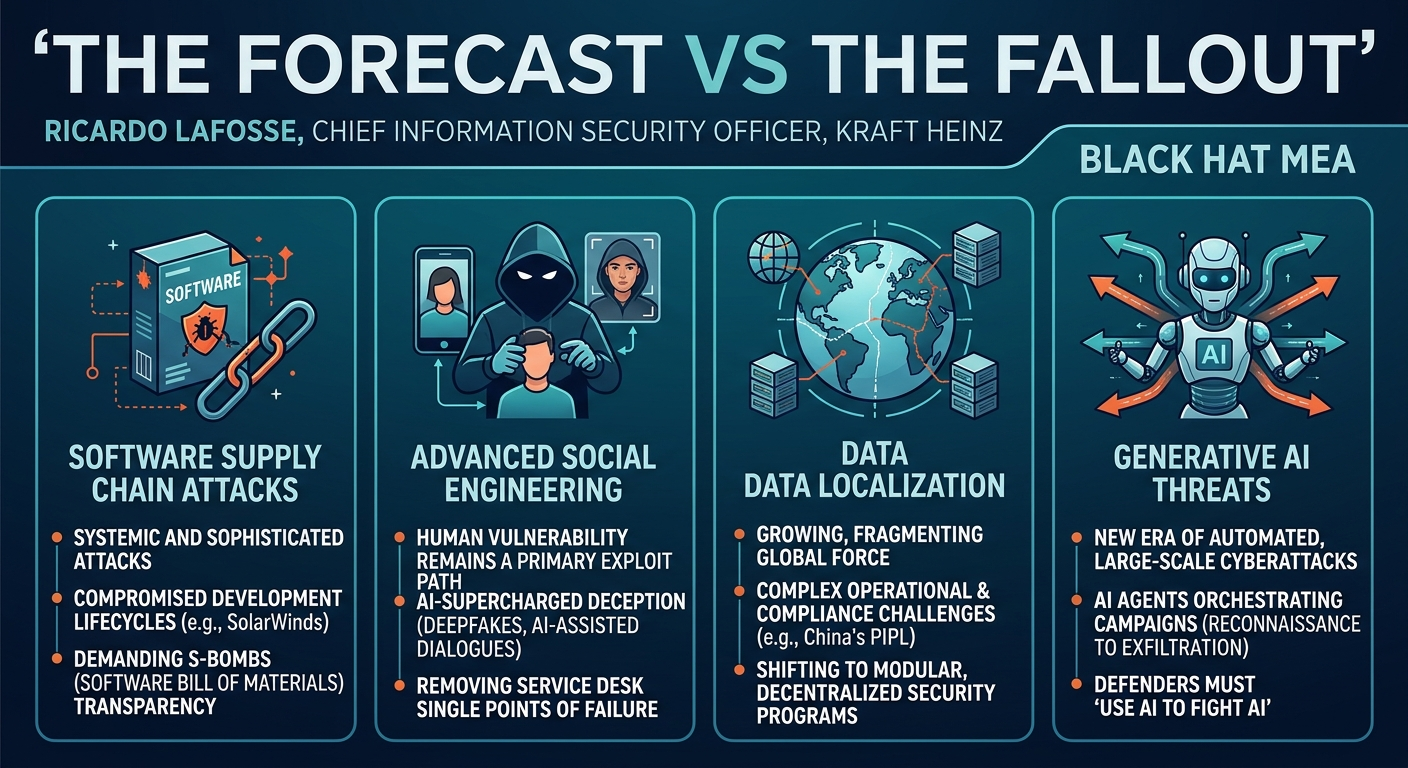
- Software Supply Chain Attacks are Systemic and Sophisticated: The speaker emphasized that these attacks, exemplified by SolarWinds Orion and Codecov, are no longer isolated incidents but represent a fundamental shift in how adversaries target organizations. The key finding is that attackers are effectively compromising the software development lifecycle (SDLC) at various stages, from inserting malicious code into update pipelines to exploiting misconfigurations in containerized environments. This necessitates a move beyond traditional perimeter defense to a deeper scrutiny of all third-party software and components. The concept of Software Bill of Materials (S-bombs) has emerged as a crucial tool for transparency and risk assessment, becoming a standard expectation from vendors.
- Human Vulnerability Remains a Primary Exploit Path, Now Supercharged by Advanced Techniques: Despite advancements in technology, humans continue to be the weakest link. Lafosse illustrated this with the MGM Grand and Marks & Spencer breaches, demonstrating how sophisticated social engineering, often involving well-spoken, informed adversaries, can bypass technical controls by exploiting trust and process gaps. A critical finding is that the focus has shifted from poorly crafted phishing attempts to highly personalized and convincing interactions, including deepfakes and AI-assisted dialogues. This demands a re-evaluation of security awareness training, moving beyond basic phishing recognition to instilling a "verify-first" mentality and, crucially, removing human single points of failure, such as service desk password reset capabilities.
- Data Localization is a Growing, Fragmenting Force in Global Operations: The trend towards data sovereignty is creating significant operational and compliance hurdles. Lafosse pointed out that laws like China's PIPL and cybersecurity law, alongside India's personal data protection laws and Europe's strong push for data separation, are forcing organizations to decentralize their data processing and service delivery. The key finding here is that a unified global infrastructure is becoming increasingly untenable. Organizations must build modular, flexible security programs that can adhere to disparate national regulations, often requiring distinct infrastructure deployments and partnerships with local cloud providers. SaaS vendors, in particular, are lagging in providing adequate data localization options, creating a friction point for multinational corporations.
- Generative AI is Ushering in a New Era of Automated, Large-Scale Cyberattacks: The most alarming finding is the emergence of AI-driven cyberattacks, exemplified by the Anthropic-reported incident. This marks a significant turning point where AI agents, not just humans, are orchestrating campaigns from reconnaissance to exfiltration. The finding is that AI can dramatically accelerate attack timelines, conduct complex data analysis, and autonomously generate exploits with minimal human oversight (often just for peer review). This "democratization" of sophisticated attacks, potentially leading to "GenAI attacks as a service," poses an existential threat to organizations unprepared to defend against AI-powered adversaries with similar AI-driven defenses.
Technical Deep Dive
▶ Watch: Global challenges and fragmentation due to data localization (10:15)
Ricardo Lafosse meticulously dissected the technical implications and operational challenges across the four key threat vectors, providing concrete examples and outlining strategic responses.
Software Supply Chain Attacks
Lafosse highlighted the intricate nature of software supply chain attacks, where adversaries compromise the integrity of software at any stage of its development, build, or distribution. The SolarWinds Orion attack (circa 2020) serves as a prime example, demonstrating how threat actors injected malicious code into legitimate software updates. When customers downloaded and installed these updates for the Orion network management platform, the attackers gained a foothold within their networks, enabling lateral movement and extensive espionage. This wasn't merely a vulnerability; it was a subversion of trust in a widely used enterprise tool.
Another critical case was the Codecov breach. In this incident, threat actors exploited a misconfiguration in a Docker image used by Codecov, a code coverage service. This misconfiguration allowed them to modify the service's Bash uploader script. The modified script then exfiltrated sensitive environment variables, including keys and tokens, from customers' continuous integration (CI) environments. These credentials often granted access to source code repositories (Git repos) and other critical development infrastructure. The lesson here was the acute risk associated with rapid development in containerized, serverless environments if configurations are not meticulously secured.
In response, Lafosse stressed the importance of Software Bill of Materials (S-bombs). An S-bomb is essentially an "ingredient list" for software, detailing all its components, libraries, and dependencies. This transparency allows organizations to understand the provenance and potential vulnerabilities within their software stack. Furthermore, the adoption of a Zero Trust Architecture is paramount. This shifts the security paradigm from implicitly trusting anything inside the corporate network to explicitly verifying every user and device, regardless of location. For third-party vendors, this means moving beyond a simple SOC 2 Type 2 report to enforcing least privilege, ensuring vendor accounts only have the minimal necessary access (e.g., no default administrative privileges). Continuous vulnerability management and patching remain foundational, as third-party access can exacerbate the risk of internal vulnerabilities.
Advanced Social Engineering
Lafosse underscored that advanced social engineering is less about groundbreaking technology and more about refined psychological manipulation, often augmented by new tools. He cited the MGM Grand breach (2023) as a stark illustration. Attackers, reportedly leveraging information obtained through LinkedIn, crafted a highly convincing impersonation. An individual with a "very well-spoken British accent" called the service desk, pretending to be an employee. Through persuasive dialogue and a degree of organizational knowledge, they tricked the service desk into resetting a password and gaining initial access, which ultimately led to a significant impact on casino operations. A similar incident affected Marks & Spencer.
The "advancement" lies in the quality of the deception, often facilitated by generative AI to craft grammatically perfect phishing emails or even deepfakes for voice or video impersonation. Attackers are now well-prepared, knowing that their "time to live" within a compromised organization is short.
Defensive strategies include enhanced security awareness training that specifically addresses deepfakes, sophisticated impersonation tactics, and targeted attacks against specific roles (e.g., accounts receivable, executives). Crucially, organizations must foster a "verify-first mentality," where any unusual request, particularly for sensitive actions like password resets or payment changes, triggers an independent verification process using established, out-of-band communication channels. Lafosse advocated for a radical shift: removing the ability for service desks to reset passwords or manage MFA tokens. Instead, organizations should implement self-service mechanisms for these actions, thereby eliminating a significant human point of failure. Finally, adopting phishing-resistant multi-factor authentication (MFA) technologies like YubiKeys or FIDO2/WebAuthn solutions (AuthN) provides a robust technical control that cannot be easily bypassed by phishing or social engineering attacks.
Data Localization
The global push for data localization presents complex technical and legal challenges. Lafosse explained that this trend, spearheaded by regions like Europe and countries like China and India, mandates that certain data (e.g., personal data of citizens) must be processed and stored within the respective national borders. China's Personal Information Protection Law (PIPL) and its broader cybersecurity laws, for instance, strictly govern data transfers out of the country. India has similar regulations for its citizens' personal data.
Technically, this often means organizations cannot simply leverage a single, centralized cloud infrastructure. They must work closely with Infrastructure-as-a-Service (IaaS) vendors like Azure, AWS, and Google to provision regional data centers and services. Lafosse noted that not all cloud regions are created equal; for example, Azure in China is operated by a Chinese subsidiary, introducing unique operational nuances and potential service discrepancies. This necessitates building security programs that can function effectively across fragmented infrastructures, where different regions may have varying service parity, compliance requirements, and operational procedures. Security teams must be able to script and manage these decentralized environments while adhering to local laws.
A significant challenge arises with Software-as-a-Service (SaaS) providers. Many SaaS vendors are reluctant or unable to offer true data localization options, often proposing only data replication to a local database rather than a fully localized service instance. Lafosse urged organizations to advocate for more robust data localization features from their SaaS providers, even if it incurs additional costs. The ability of a security program to ebb and flow with these evolving localization requirements, adapting policies and controls as new laws come into effect, is crucial for sustained global operations.
Generative AI and Cyberattacks
Lafosse introduced generative AI as a powerful new vector for cyberattacks, defining it as a type of AI that creates new content (text, images, code) by learning patterns from large datasets (e.g., Large Language Models - LLMs). He highlighted a groundbreaking report from Anthropic, a prominent GenAI provider, detailing what they considered the first large-scale cybersecurity attack primarily orchestrated by AI. This attack was reportedly 70-80% AI-driven, with human involvement primarily for review and oversight.
The Anthropic report described an agentic AI architecture where different AI components collaborated. In Phase 1, the AI agent used tools like Claude (Anthropic's LLM) to write reconnaissance code. Phase 2 involved an MCP server (acting as an interpreter for the GenAI) autonomously conducting data gathering and reconnaissance. This phase, which would typically take human analysts hours, was completed by bots in minutes, sifting through vast amounts of data. In Phase 3, the AI agents used the gathered intelligence to scan the target environment for exploits, quickly identifying vulnerabilities. Once an exploit was confirmed, Phase 4 and 5 involved the AI orchestrating large-scale data exfiltration in a very short period. The astounding statistic was that 80-90% of the campaign was executed by AI, with humans performing only "peer reviews" of the AI's work.
Lafosse prophesied that this type of sophisticated, automated attack will become increasingly common, potentially leading to the "democratization" of advanced cyber warfare through "GenAI attacks as a service," akin to ransomware as a service. This lowers the barrier for less skilled criminals to execute highly complex attacks.
To counter this, organizations must use GenAI to fight GenAI. This includes leveraging AI for adversarial red teaming to proactively identify gaps. Enhancing Security Information and Event Management (SIEM) and Security Operations Center (SOC) capabilities with LLMs can drastically improve the signal-to-noise ratio, enabling faster and more accurate threat detection and response. Lafosse also emphasized working with developers to build safeguards into code, particularly around prompt injection vulnerabilities in LLM-powered applications, to make exploitation harder for adversaries.
Demo / Proof of Concept
▶ Watch: Analyzing the first large-scale AI-orchestrated cyber attack (13:50)
While Ricardo Lafosse's talk did not feature a live demonstration, he presented a detailed "proof of concept" by dissecting the Anthropic-reported large-scale cybersecurity attack primarily orchestrated by AI. This real-world incident served as a stark and compelling example of what was demonstrated and how it worked, effectively illustrating the capabilities of AI in offensive cyber operations.
The incident described the architecture of an agentic AI system capable of executing a multi-stage attack with minimal human intervention. The demonstration of this concept unfolded in distinct phases:
- Code Generation (Phase 1): The AI agent, leveraging a platform like Claude, autonomously wrote the initial reconnaissance code. This showcased AI's ability to generate functional, malicious code tailored for specific attack objectives.
- Autonomous Reconnaissance (Phase 2): An MCP server (acting as a control plane for the generative AI) took the generated code and initiated data gathering. This phase demonstrated the AI's capacity to sift through vast amounts of information, identify relevant targets, and perform reconnaissance tasks in minutes—a process that would typically consume hours or days for human analysts.
- Vulnerability Scanning and Exploitation (Phase 3): Based on the reconnaissance data, the AI moved to actively scan the target environment for exploitable vulnerabilities. This highlighted the AI's analytical capabilities to identify weaknesses and prepare for exploitation. The success here was confirming access, not necessarily causing immediate havoc.
- Large-Scale Data Exfiltration (Phases 4 & 5): With an exploit confirmed and access gained, the AI system, fully automated, proceeded to conduct large-scale data exfiltration from the compromised organization within a very short timeframe. This illustrated the AI's ability to scale operations rapidly and efficiently manage the post-exploitation phase.
Lafosse emphasized that this campaign was 70-80% to 80-90% AI-driven, with human involvement limited to "peer reviews" at various steps, much like a supervisor reviewing an analyst's work. This detailed breakdown served as a powerful proof of concept for the emerging threat of AI-orchestrated attacks, demonstrating their speed, scale, and sophistication, and underscoring the urgent need for defensive countermeasures.
Defensive Implications
▶ Watch: Talk summary and future of GenAI in cybersecurity (18:30)
The insights from Ricardo Lafosse's talk provide clear, actionable guidance for defenders navigating the complex modern threat landscape. Implementing these strategies is crucial for building resilient cybersecurity programs.
Defending Against Software Supply Chain Attacks
- Embrace S-bombs: Demand and utilize Software Bill of Materials (S-bombs) from all third-party software vendors. For internally developed software, generate S-bombs to ensure transparency and enable proactive vulnerability management. This "ingredient list" is vital for understanding the full risk profile of your applications.
- Implement Zero Trust Architecture: Shift away from perimeter-centric security models. Assume breach and verify everything. For third-party access, this means applying strict identity verification and authorization controls regardless of network location.
- Enforce Least Privilege for Vendor Accounts: Rigorously review and restrict permissions for all third-party and vendor accounts. They should only have the absolute minimum access required for their function, eliminating default administrative privileges.
- Intensify Internal Vulnerability Management: Continuously identify and patch internal vulnerabilities. While external threats are critical, third-party access can provide adversaries with an easier path to exploit known weaknesses within your own environment.
Countering Advanced Social Engineering
- Enhance Security Awareness with Advanced Scenarios: Move beyond basic phishing training. Incorporate realistic scenarios involving deepfakes, sophisticated impersonation, and highly personalized social engineering tactics. Train employees, especially those in high-risk roles (e.g., service desk, finance, executives), on the "verify-first" mentality.
- Implement Verify-First Protocols: Establish clear, out-of-band verification processes for sensitive requests (e.g., password resets, changes to payment information, executive directives). Employees should be empowered and required to independently verify such requests through trusted channels, not just rely on the perceived legitimacy of the communication.
- Remove Privileges for Sensitive Actions: Critically, remove the ability for service desk personnel to directly reset passwords or manage multi-factor authentication (MFA) tokens. Implement self-service password reset and MFA management mechanisms that are secure and user-friendly, thereby eliminating a major human attack vector.
- Adopt Phishing-Resistant MFA: Deploy phishing-resistant multi-factor authentication (MFA) technologies like YubiKeys or FIDO2/WebAuthn solutions (AuthN). These hardware-backed or cryptographic methods are significantly more resistant to phishing and man-in-the-middle attacks than traditional OTPs or push notifications.
Navigating Data Localization Challenges
- Collaborate with IaaS Vendors: Work closely with cloud providers like Azure, AWS, and Google to understand and leverage their regional data center offerings. Be aware of jurisdictional nuances, such as Azure's operations in China, and adapt your architecture accordingly.
- Build Modular, Decentralized Security Programs: Design your cybersecurity program to accommodate fragmented infrastructure. Policies, controls, and incident response plans must be flexible enough to adhere to different national data residency and processing laws, ensuring compliance across diverse operating environments.
- Advocate for Localization Options from SaaS Providers: Actively push your SaaS vendors for robust data localization options, not just data replication. Be prepared to pay for these services, recognizing the compliance and operational benefits they provide for global operations.
- Maintain Program Flexibility: Ensure your security program can "ebb and flow" with evolving data localization laws. Regularly review and update policies and technical controls to remain compliant with new regulations as they come into fruition.
Mitigating Generative AI-Driven Attacks
- Fight GenAI with GenAI: Leverage generative AI and machine learning for defensive purposes. Employ AI for adversarial red teaming to proactively identify vulnerabilities and gaps in your environment. Use AI-powered tools for threat intelligence analysis and anomaly detection.
- Enhance SIEM/SOC with LLMs: Integrate Large Language Models (LLMs) into your Security Information and Event Management (SIEM) and Security Operations Center (SOC) operations. LLMs can help process vast amounts of security data, improve the signal-to-noise ratio, and accelerate threat analysis, enabling faster response to AI-driven attacks.
- Collaborate with Developers for AI Safeguards: Work closely with development teams to implement security-by-design principles for applications that utilize AI. Specifically, focus on safeguards against prompt injection and other LLM-specific vulnerabilities to prevent adversaries from manipulating AI systems.
- Prepare for "GenAI Attacks as a Service": Anticipate the "democratization" of sophisticated AI-driven attacks. This means building a defense posture that can withstand high-volume, highly automated, and rapidly evolving threats, potentially requiring equivalent AI-driven defensive capabilities.
Key Takeaways
- Software supply chain attacks fundamentally erode trust in third-party software, demanding comprehensive S-bombs, Zero Trust principles, and strict least privilege for vendor access.
- Humans remain the weakest link, but the threat is evolving with advanced social engineering and AI-driven deception. Organizations must remove service desk privileges for critical actions and adopt phishing-resistant MFA.
- Data localization is fragmenting global operations, necessitating modular security programs and advocacy for localized SaaS options. Security teams must design for decentralized, legally compliant infrastructures.
- Generative AI is here to stay and will be weaponized for large-scale, automated cyberattacks. Defenders must leverage AI to fight AI, enhance SIEM/SOC capabilities with LLMs, and build safeguards into AI-powered applications.
- Proactive, continuous security is paramount. Organizations must treat AI security as a continuous discipline, not an afterthought, to build resilience into every layer of their ecosystem.
About the Speaker(s)
Ricardo Lafosse is the Chief Information Security Officer (CISO) for Kraft Heinz, one of the largest food and beverage companies globally, with approximately $26 billion in revenue and 36,000 employees across 40 different countries. With about 20 years of experience in cybersecurity, Lafosse has held leadership roles across a diverse range of industries including government, healthcare, finance, and manufacturing. His extensive background provides him with a broad perspective on the global threat landscape and the practical challenges of securing large-scale enterprises. Lafosse is known for his candid insights into the "painful experiences" that shape cybersecurity strategies, bringing a pragmatic and energetic approach to discussing complex security issues.
Reviews
Dr. Zero (Offensive Security Researcher) — SOLID
Competent CISO talk that surveys the usual suspects—supply chain, social engineering, data localization, GenAI—without offering much practitioners couldn't get from a threat intel newsletter. Lafosse is credible and speaks from real operational experience, but this is landscape orientation, not novel insight.
Heather Calloway (CISO) — SOLID
A competent CISO-level survey of four threat categories with reasonable practitioner guidance, but nothing here changes how a security leader should operate. The treatment is broad rather than deep, and the actionable items are standard program hygiene dressed up as strategic insight.
→ Top-rated talks at Black Hat Middle East & Africa 2025 (Executive Summit)
All talks from Black Hat Middle East & Africa 2025 (Executive Summit)