How AI Unlocks Cybersecurity's Most Transformative Decade
Anne Marie Zettlemoyer
Black Hat Middle East & Africa 2025 (Executive Summit) · Executive Summit
Overview
In an insightful and forward-looking presentation at Black Hat MEA, Anne Marie Zettlemoyer illuminated the profound and irreversible impact of artificial intelligence on the cybersecurity landscape. Titled "How AI Unlocks Cybersecurity's Most Transformative Decade," her talk underscored that AI is no longer an emerging technology but has rapidly ascended to the status of critical infrastructure, deeply embedded within national policies, enterprise strategies, and daily operations. Zettlemoyer compellingly argued that the cybersecurity community stands at a pivotal juncture, tasked with not only adapting to this shift but actively shaping a secure and trustworthy AI-driven future.
Key moments
- 0:00 AI is now critical infrastructure, a global policy priority.
- 6:00 AI adoption feels like a roller coaster ride for enterprises.
- 8:00 Cybersecurity: the harness for safe, responsible AI acceleration.
- 8:40 Security's dual role: using and defending AI systems.
- 13:00 Attackers use AI for faster, more precise attacks.
- 16:40 AI empowers defenders with unprecedented leverage and speed.
- 21:00 AI elevates cybersecurity from defense to strategic advantage.
How AI Unlocks Cybersecurity's Most Transformative Decade
Speakers: Anne Marie Zettlemoyer
Conference: Black Hat MEA
YouTube: https://www.youtube.com/watch?v=5mY5YBKXP0Y
Overview
In an insightful and forward-looking presentation at Black Hat MEA, Anne Marie Zettlemoyer illuminated the profound and irreversible impact of artificial intelligence on the cybersecurity landscape. Titled "How AI Unlocks Cybersecurity's Most Transformative Decade," her talk underscored that AI is no longer an emerging technology but has rapidly ascended to the status of critical infrastructure, deeply embedded within national policies, enterprise strategies, and daily operations. Zettlemoyer compellingly argued that the cybersecurity community stands at a pivotal juncture, tasked with not only adapting to this shift but actively shaping a secure and trustworthy AI-driven future.
The core message of the presentation revolved around a dual imperative for cybersecurity professionals: to strategically leverage AI for defense and to rigorously defend the AI systems being deployed. Zettlemoyer challenged the traditional perception of security as a bottleneck, advocating instead for its role as a "Sherpa" – a guide that enables responsible acceleration rather than impeding progress. By reframing security as a strategic enabler, she highlighted its potential to contribute directly to business objectives, moving from a position of "no" to "yes, if," thus becoming an integral co-architect of innovation and efficiency in the AI era.
This talk is particularly significant because it addresses the rapid, global adoption of AI across governments and industries, acknowledging both the immense opportunities and the inherent risks. It provides a pragmatic roadmap for defenders to navigate this complex terrain, emphasizing that while AI may introduce new attack surfaces and operational risks, it also offers unprecedented leverage to counter sophisticated threats. Zettlemoyer's vision positions cybersecurity not merely as a reactive function but as a proactive force, essential for stabilizing high-velocity innovation and ensuring the safe, ethical, and defensible deployment of AI on a global scale.
Background
▶ Watch: AI is now critical infrastructure, a global policy priority. (0:00)
The acceleration of AI adoption is a global phenomenon, moving with a velocity that has redefined industry and national priorities. Zettlemoyer highlighted that over 70 countries across diverse economic landscapes have initiated national AI safety and security programs. This includes landmark legislation like the EU AI Act, Singapore's AI Verify framework, national AI strategies across the Middle East, and China's regulations on generative AI and deepfakes. Most recently, the United States launched its own national AI safety and security initiative, focusing on critical areas such as testing, transparency, and adversarial evaluation. This unified global response underscores the consensus that AI has transitioned from an experimental technology to a fundamental component of critical infrastructure, now integral to national policy, risk assessments, and strategic planning.
Within the business sector, AI's integration is equally undeniable and even more rapid. Microsoft reports that a staggering 85% of Fortune 500 companies are already utilizing its AI solutions in production environments. Echoing this sentiment, surveys from the "big four" consulting firms reveal that most CIOs and CEOs now consider AI a core business priority, directly linking it to revenue generation, operational efficiency, market velocity, and profit margins. This shift signifies that AI is no longer viewed as "innovation theater" but as a board-mandmandated lever for tangible business outcomes.
Despite this aggressive adoption, public sentiment reflects a significant degree of caution and concern. Pew Research indicates a growing belief that unchecked AI could cause more harm than good. Prosper Insights and Analytics found that nearly 60% of individuals are deeply worried about AI infringing on their privacy, while global polls suggest approximately 70% of adults harbor anxieties about AI's impact on employment and social stability. Zettlemoyer acknowledged this pervasive skepticism, framing it as the "defender's instinct" – a natural caution that, rather than halting progress, should serve to guide and shape it, transforming "reckless optimism into responsible acceleration." The underlying driver for this rapid integration, despite public apprehension, is simple: organizations can no longer compete effectively at human speed. AI offers unparalleled acceleration, efficiency, innovation capacity, resilience, and a direct, material impact on the bottom line, making it an indispensable engine for modern business.
Key Findings
▶ Watch: Cybersecurity: the harness for safe, responsible AI acceleration. (8:00)
Anne Marie Zettlemoyer's talk revealed several pivotal findings regarding AI's current and future impact on cybersecurity, emphasizing both the amplified threats and the unprecedented defensive opportunities.
Firstly, a core finding is the dual mandate for cybersecurity professionals: they must both use AI to enhance their defensive capabilities and defend the AI systems that are increasingly embedded within their organizations. AI is no longer merely a tool but a critical dependency, a new component of the software supply chain, and an expanded attack surface, introducing novel forms of operational risk.
Secondly, the presentation highlighted that attackers are already leveraging AI to amplify existing threats with terrifying precision and speed. Microsoft data revealed a dramatic increase in password attacks, from 4,000 per second last year to 7 per second this year – equating to 6 million attacks daily, nearly double the previous year. Concurrently, the number of tracked threat actors surged fivefold, from 300 to 1500 in just one year. Attackers are employing AI for:
- Nation-state grade reconnaissance, performing comprehensive and relentless searches for intelligence, organizational structures, vulnerabilities, and infrastructure details.
- Malware generation, specifically creating the scaffolding of malware, such as sandbox evasion snippets, VM detection logic, and C++ boilerplate, at superhuman speeds, accelerating development of sophisticated attacks.
- Hyper-realistic social engineering, where generative AI crafts phishing campaigns with perfect local dialects, correct honorifics, cultural nuances, and corporate tones, making them indistinguishable from legitimate communications. Google observed this trend, noting how AI bypasses traditional indicators like spelling errors. Microsoft estimates that once a user clicks a malicious link, attackers can gain full data access in an average of 72 minutes.
Conversely, Zettlemoyer underscored that AI is a powerful "defender multiplier," offering cybersecurity professionals leverage they've never had before. Key areas of defensive augmentation include:
- Fuzzing: Google reported that using Large Language Models (LLMs) to generate new fuzzing harnesses has doubled code coverage from an average of 30% to 60%. In some studies, this increase reached an astonishing 7,000%, directly leading to the discovery of previously unknown vulnerabilities in extensively tested code.
- Vulnerability Discovery: Google's Big Sleep AI agent, a collaborative effort between DeepMind and Project Zero, has identified real-world exploitable vulnerabilities, including a previously unseen flaw in SQLite. AI agents can compress the vulnerability hunting cycle from months to mere days, with human oversight.
- Malware Analysis: An experiment from Gemini demonstrated that a comprehensive malware analysis report for a never-seen-before sample could be generated in just 27 seconds, a task that would typically consume hours for a highly specialized human analyst.
- Incident Response Workflows: AI significantly cuts incident summary times by roughly half, correlating hours of log data into seconds. This enables rapid triage of phishing campaigns at massive scale, automated recommendations for containment, and concise summaries of complex investigations for C-suite executives.
Finally, the talk highlighted the emergence of Generative AI for active defense, referring to systems that can take autonomous actions within defined boundaries. Examples include agents that scan cloud environments for drift and automatically remediate misconfigurations, detect suspicious identity behaviors to trigger step-up authentication or lockouts, monitor software supply chains to prevent risky changes from reaching production, and rapidly isolate compromised hosts or block users under strict guardrails. This represents the future of the Security Operations Center (SOC), where AI handles speed and automation, freeing human analysts for critical insight and strategic decision-making.
Technical Deep Dive
▶ Watch: Security's dual role: using and defending AI systems. (8:40)
The technical exposition of the talk centered on the profound implications of AI's integration into the software supply chain and the specific strategies required for its defense. Zettlemoyer emphasized that AI components—including models, agents, pipelines, embeddings, and fine-tuning datasets—are now integral parts of this critical chain. This expanded scope introduces new attack surfaces and necessitates a re-evaluation of traditional security paradigms.
A significant technical focus was placed on the risks inherent in AI systems, particularly model poisoning, manipulation, extraction, and coercion. However, Zettlemoyer stressed that the most dangerous risks often reside not within the model itself, but in the data decisions surrounding it. She consistently advocated for rigorous data hygiene, asserting that simply having "more data" does not equate to "more insight." In fact, providing models with access to entire data lakes for narrow tasks dramatically inflates the attack surface, creating more avenues for poisoning, extraction, regulatory exposure, privacy breaches, instability, and noise, alongside increased cloud infrastructure costs. Conversely, disciplined data practices effectively shrink the attack surface, reduce fragility and liability, and stabilize innovation, directly contributing to an organization's bottom line.
To mitigate these risks and prevent AI from becoming a liability, Zettlemoyer outlined several critical areas for security leaders to prioritize:
- Strong Identity Boundaries: Every AI model and agent must possess its own unique identity. This necessitates dev scope permissions, auditable actions, and crucially, human override capabilities. The era of shared service accounts or inherited trust chains for AI systems must end to prevent unchecked operations.
- Vigorous Data Governance: Organizations must implement robust mechanisms to track data origin, how it is shared, and what it transforms into throughout its lifecycle. This includes preventing "stage environments" from inadvertently becoming production environments, a common pitfall that inflates risk.
- Continuous Monitoring and Drift Correction: AI models, prompts, and policies are dynamic and subject to drift or degradation over time. Automated systems are essential to continuously monitor for anomalies and facilitate corrections or escalations within minutes, rather than quarters.
- Secure by Default and Adversarial Testing: AI systems must be treated and shipped like any other critical software. This mandates secure endpoints, hardened integrations, and template-driven deployments to eliminate "rogue science projects" entering production. These guardrails must be designed to enable velocity, striking a balance between security and operational speed.
On the offensive side, the talk detailed how adversaries are technically leveraging AI:
- Reconnaissance: Attackers employ AI to conduct nation-state-grade "Google it" searches, rapidly compiling comprehensive intelligence on organizations, infrastructure, intellectual property, and even military systems. This process is characterized by its speed, organization, completeness, and relentless nature.
- Malware Scaffolding: Instead of generating entire malware payloads, AI is used to produce the time-consuming and annoying components, such as sandbox evasion snippets, virtual machine detection logic, and C++ boilerplate code. This elevates the speed and sophistication of malware development far beyond traditional copy-pasting from sources like Stack Overflow.
- Social Engineering: Generative AI's prowess in crafting highly believable phishing campaigns is a significant concern. It enables attackers to generate messages with perfect local dialects, honorifics, cultural nuances, and corporate tones, effectively bypassing typical indicators of malicious intent. This capability allows them to mimic trusted figures—colleagues, bosses, even family members—making phishing emails pass the "vibe check" and drastically increasing their success rate.
For defenders, AI offers transformative technical capabilities:
- LLM-powered Fuzzing: The use of Large Language Models to generate novel fuzzing harnesses significantly enhances code coverage, leading to the discovery of previously unknown vulnerabilities.
- AI Agents for Vulnerability Discovery: Tools like Google's Big Sleep AI agent demonstrate how AI can augment human expertise, compressing the vulnerability hunting cycle from months to days by identifying exploitable flaws in complex codebases.
- Automated Malware Analysis: AI can produce comprehensive malware analysis reports for novel samples in seconds, a task traditionally requiring hours of specialized human effort, thereby drastically reducing response times.
- SOC Automation: AI streamlines incident response by correlating logs, triaging phishing incidents at scale, recommending containment actions, and summarizing complex investigations for executive consumption, all within seconds or minutes.
Finally, the concept of Genetic AI (a term used interchangeably with generative AI in the context of taking action) was introduced as the new frontier. These are systems designed to take autonomous actions within defined boundaries. Examples include AI agents that can automatically fix cloud misconfigurations, trigger step-up authentication or lockouts based on suspicious identity behavior, prevent risky changes in software supply chains, or rapidly isolate compromised hosts and block users. The critical technical component here is the implementation of strict guardrails to ensure these agents operate safely and within ethical parameters, positioning humans in the "insight loop" and AI in the "speed loop" of the SOC.
Demo / Proof of Concept
▶ Watch: AI empowers defenders with unprecedented leverage and speed. (16:40)
While the presentation did not feature a live, explicit demonstration or a specific proof-of-concept developed by the speaker, Anne Marie Zettlemoyer extensively referenced and quantified numerous "real-world experiments" and "production reality" examples to illustrate AI's impact. She cited concrete figures and outcomes from major technology companies like Google and Microsoft, providing empirical evidence for both offensive and defensive AI capabilities. For instance, the discussion of LLMs doubling fuzzing coverage (with one study showing a 7,000% increase) or the Big Sleep AI agent discovering a SQLite flaw served as powerful, albeit recounted, proofs of concept. Similarly, the Gemini experiment demonstrating a full malware analysis report in 27 seconds for a never-seen-before sample highlighted the practical application of AI in accelerating critical security tasks. These examples, drawn from industry leaders, collectively functioned as a robust "demonstration" of AI's current capabilities and future potential, grounding the talk in tangible, verifiable achievements rather than theoretical speculation.
Defensive Implications
▶ Watch: AI elevates cybersecurity from defense to strategic advantage. (21:00)
The defensive implications of AI's rise are profound, demanding a fundamental shift in how cybersecurity is approached. Zettlemoyer asserted that AI is not just a threat multiplier but, crucially, a defender multiplier, offering unprecedented leverage to enhance security posture. The core message for defenders is to embrace AI as a strategic asset rather than viewing it solely as a source of risk.
Firstly, defenders must adopt AI for their own operations to reduce "toil and alert fatigue," collapse detection timelines, eliminate entire classes of misconfigurations, and modernize legacy security processes. This means integrating AI into every facet of the security lifecycle, from proactive threat intelligence to automated incident response. By doing so, cybersecurity can stabilize high-velocity innovation and become a co-architect of business capability, moving beyond the role of a mere gatekeeper.
Secondly, the presentation emphasized the critical need to secure AI systems themselves. This requires implementing robust AI security standards that mirror and extend existing software security best practices. Key recommendations include:
- Establishing strong identity boundaries for every AI model and agent, ensuring granular permissions, auditable actions, and human oversight. This prevents the unchecked operation of AI systems and limits the blast radius in case of compromise.
- Implementing rigorous data governance throughout the entire AI lifecycle, from data ingestion to model deployment and retirement. Understanding data provenance, usage, and transformation is paramount to preventing data poisoning, leakage, and regulatory non-compliance.
- Deploying continuous monitoring and drift correction mechanisms for AI models, prompts, and policies. This proactive approach ensures that models remain accurate, fair, and secure, adapting to evolving threats and operational contexts in real-time.
- Adopting a "secure by default" posture for all AI system development and deployment, coupled with comprehensive adversarial testing. This means integrating security considerations from the design phase, using hardened integrations and template-driven deployments, and actively probing AI systems for vulnerabilities through techniques like red-teaming.
Furthermore, Zettlemoyer highlighted the necessity for security teams to prepare for the advent of generative AI in the SOC, specifically systems that can take autonomous actions. This introduces new questions that defenders must address: What specific actions should these agents be permitted to take? What are their identity boundaries and data access privileges? What types of content or actions can they generate, and where can these outputs go? Answering these questions requires careful design of strict guardrails to ensure that AI-driven automation remains safe, accountable, and aligned with organizational policies.
Ultimately, the defensive implications call for a mindset shift from being the "land of no" to the "land of yes, if." Cybersecurity professionals are encouraged to move from being perceived as bottlenecks to becoming strategic enablers, guiding responsible AI acceleration. This involves engaging with the broader community, challenging existing assumptions, building new connections, and actively shaping the guardrails and automated workflows that will define the next decade of cybersecurity. The challenge is not merely to react to the future but to actively build it, ensuring that AI's transformative power is harnessed securely and ethically.
Key Takeaways
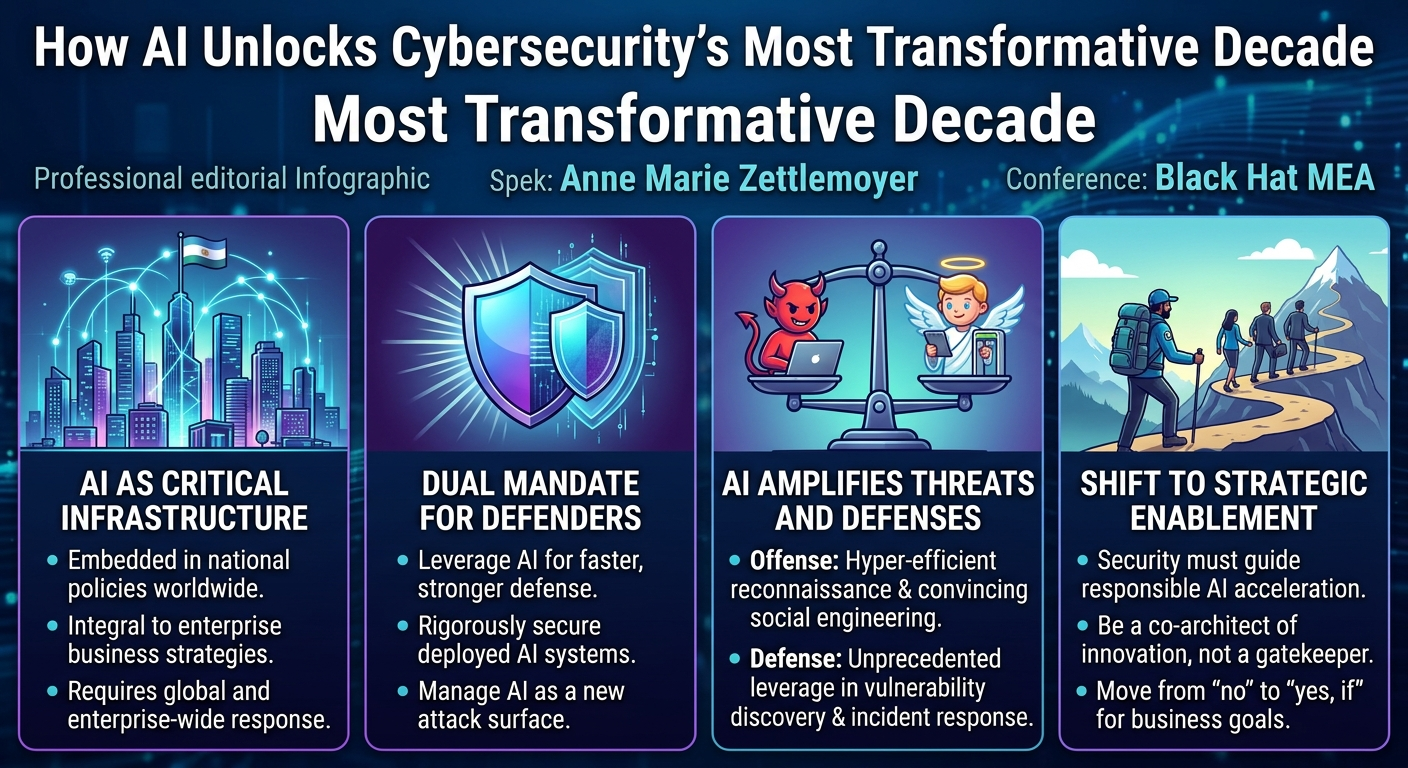
- AI as Critical Infrastructure: AI is no longer emerging but has become critical infrastructure, embedded in national policies and business strategies, requiring a global and enterprise-wide cybersecurity response.
- Dual Mandate for Defenders: Cybersecurity professionals must simultaneously leverage AI to enhance defensive capabilities and rigorously secure the AI systems (models, agents, data) they deploy.
- AI Amplifies Both Offense and Defense: Attackers are using AI for hyper-efficient reconnaissance, automated malware scaffolding, and highly convincing social engineering, while defenders gain unprecedented leverage in areas like fuzzing, vulnerability discovery, malware analysis, and incident response.
- Prioritize Foundational AI Security: Implementing strong identity boundaries for AI agents, rigorous data governance, continuous monitoring for model and policy drift, and secure-by-default development with adversarial testing are essential for managing AI risk.
- Shift to Strategic Enablement: Security must evolve from a gatekeeping function to a strategic enabler, guiding responsible AI acceleration and becoming co-architects of business innovation by reducing toil and enhancing operational velocity.
- Prepare for Autonomous AI Action: The rise of generative AI that can take actions (e.g., auto-remediate misconfigurations, block threats) necessitates careful design of guardrails, identity boundaries, and data access controls, with humans in the insight loop and AI in the speed loop.
About the Speaker(s)
Anne Marie Zettlemoyer is a distinguished and influential voice in the cybersecurity community, known for her strategic insights into the intersection of technology, business, and national security. Throughout her Black Hat MEA presentation, she demonstrated a deep understanding of both the technical intricacies of AI and its broader implications for enterprise risk, revenue, and operational efficiency. Her ability to articulate the C-suite's perspective, particularly the concerns of CFOs and CEOs regarding profit margins and operational risk, highlights her experience in bridging the gap between technical security challenges and executive-level decision-making. Zettlemoyer consistently advocates for data hygiene as a foundational element of defense and champions a proactive, strategic role for cybersecurity professionals, urging them to be "Sherpas" and "co-architects" of innovation rather than mere gatekeepers. Her confident and analytical prose, coupled with a clear vision for the future, positions her as a leader dedicated to guiding the industry through AI's transformative decade.
Reviews
Dr. Zero (Offensive Security Researcher) — WEAK
A vendor-adjacent keynote that stitches together publicly available stats from Microsoft, Google, and Pew Research into a 'transformative decade' narrative without offering a single insight the audience couldn't get from reading those companies' blogs. The framing is polished, the substance is hollow.
Heather Calloway (CISO) — WEAK
High-altitude thought leadership that names the right themes — AI as attack surface, AI as defender tool, data governance — but delivers no specificity a security leader could act on. The claims are broad, the evidence is borrowed, and the operational guidance is generic. Not worth leadership time.
→ Top-rated talks at Black Hat Middle East & Africa 2025 (Executive Summit)
All talks from Black Hat Middle East & Africa 2025 (Executive Summit)