Know Thy Network, Know Thy Weakness
Devon Bryan (5 time global CISO)
Black Hat Middle East & Africa 2025 (Executive Summit) · Executive Summit
Overview
In "Know Thy Network, Know Thy Weakness," Devon Bryan, a seasoned 5-time global CISO, delivers a compelling address rooted in Sun Tzu's timeless military principle: "Know thy enemy, but first know thyself." This talk transcends a mere discussion of security tools, instead advocating for a fundamental shift in the CISO mindset, urging practitioners to gain an intimate understanding of their organization's internal landscape before confronting external threats. Bryan masterfully uses real-world geopolitical and cyber incidents to underscore the critical importance of internal visibility, contextual understanding, and adaptive defense strategies in today's increasingly volatile and sophisticated threat landscape.
Key moments
- 1:45 Welcome and military strategy application to cyber defense
- 2:00 Ukraine convoy case study: knowing your environment is key
- 5:45 AI multi-tools (Worm GPT) lowering attack skill barrier
- 6:50 Bangladesh bank heist: defense in depth needs context
- 9:45 Core principle: know thyself, internal visibility, asset prioritization
- 14:10 Investing in the human firewall is crucial for defense
- 15:05 Engaging board, third parties, regulators for holistic defense
- 17:15 Call to action: build dynamic, adaptive defense strategies
Know Thy Network, Know Thy Weakness
Speakers: Devon Bryan, 5-time Global CISO
Conference: Black Hat MEA
YouTube: https://www.youtube.com/watch?v=SdDKfu1_zP8
Overview
In "Know Thy Network, Know Thy Weakness," Devon Bryan, a seasoned 5-time global CISO, delivers a compelling address rooted in Sun Tzu's timeless military principle: "Know thy enemy, but first know thyself." This talk transcends a mere discussion of security tools, instead advocating for a fundamental shift in the CISO mindset, urging practitioners to gain an intimate understanding of their organization's internal landscape before confronting external threats. Bryan masterfully uses real-world geopolitical and cyber incidents to underscore the critical importance of internal visibility, contextual understanding, and adaptive defense strategies in today's increasingly volatile and sophisticated threat landscape.
Bryan argues that while defense in depth remains a vital strategy, its effectiveness is severely hampered without deep contextual knowledge of the assets being protected and the business processes they support. He highlights the exploding attack surface, the weaponization of artificial intelligence, and the growing sophistication of adversaries as urgent motivators for this introspective approach. The presentation is a call to action for cyber defenders to move beyond static checklists and embrace dynamic, data-informed security postures that prioritize asset criticality, threat intelligence integration, and the often-overlooked human element.
This talk is particularly crucial for security leaders and practitioners grappling with the complexities of modern cyber defense. It provides actionable strategies that begin with foundational knowledge—enumerating and understanding every aspect of one's network—and extends to integrating this knowledge with dynamic threat intelligence and robust stakeholder engagement. Bryan's insights offer a strategic blueprint for building resilient defenses that are not only technologically sound but also deeply aligned with an organization's operational realities and business objectives.
Background
▶ Watch: Welcome and military strategy application to cyber defense (1:45)
Devon Bryan opens his talk by drawing a powerful parallel between military strategy and cyber defense, referencing Sun Tzu's axiom: "If you know your enemy and you know yourself, you need not fear the results of a thousand battles." He illustrates this with a poignant example from the early days of the 2022 conflict in Ukraine. A Russian convoy of 7,000 armored vehicles and 9,000 soldiers, intended for a rapid "decapitation strike" in Kyiv, was halted by a small group of Ukrainian drone operators. These defenders, leveraging commercial drones customized with explosives, destroyed leading vehicles and a critical bridge, leveraging their intimate knowledge of the local terrain—specifically, the marshy conditions surrounding the single-lane road—which rendered the heavy armor immobile. This singular act, born of deep environmental understanding, transformed a projected three-day operation into a protracted conflict, demonstrating the asymmetric power of knowing one's own environment.
Translating this to the cyber realm, Bryan emphasizes that the adversaries faced by cyber defenders are "growing a lot more sophisticated, a lot more automated, and certainly far more adaptive than in the past." He points to the "exploded" and ever-expanding attack surface, which now encompasses not just traditional network perimeters but also identities, APIs, supply chains (citing recent compromises of NPM packages), and increasingly, AI models. A decade ago, creating malware or sophisticated ransomware required specialized coding skills; today, tools like Worm GPT and Kawaii GPT lower the barrier significantly, offering "AI multi-tools" for as little as $50 a month, enabling less skilled actors to launch potentially massive attacks. This democratization of offensive capabilities necessitates a corresponding evolution in defensive strategies.
Bryan, a staunch advocate for defense in depth, acknowledges its continued relevance but critically notes that "defense in depth without context is certainly not a good thing." He recounts a harrowing experience from his time as CISO for the US Federal Reserve system. Just a week into his role, the Central Bank of Bangladesh was compromised. Attackers, embedded deep within the bank's financial systems, spent months learning the intricate business context of SWIFT network transfers. They understood when these transactions typically occurred, even exploiting a bank holiday to gain an extra day for their operations. Their attempt to exfiltrate a billion dollars was foiled only by a typo; nevertheless, $81 million was successfully stolen, marking one of the largest cyber heists in history. This incident, Bryan explains, was a stark lesson in the profound consequences of a lack of business context, even when layered security controls are ostensibly in place. The attackers knew the target's operational context better than the defenders.
Key Findings
▶ Watch: AI multi-tools (Worm GPT) lowering attack skill barrier (5:45)
The central thesis of Devon Bryan's talk is that internal visibility and asset prioritization are core to cyber defense. He unequivocally states, "You can't defend what you can't see. You can't protect what you don't know about." This isn't merely about having an inventory; Bryan highlights the critical distinction: "Inventory does not mean visibility." An inventory might list assets, but true visibility provides an understanding of "what those assets are, what their criticality might be, and how they support the go-to-market strategies of your company." This full-scope asset criticality is absolutely vital, linking technical assets directly to business functions and revenue generation.
Another key finding is the often-overlooked, yet crucial, role of threat intelligence. Bryan champions the sports adage, "offense informs defense," applying it directly to cyber security. He cites the example of the "remote IT worker scam," where North Korean threat actors pose as job applicants. Early threat intelligence providers shared Indicators of Compromise (IoCs), enabling companies to proactively detect and block these sophisticated infiltration attempts. He stresses the need to ingest threat intelligence not just from one's own industry vertical, but also from adjacent verticals, as attackers frequently exploit targets of opportunity and adapt techniques across different sectors.
Bryan also redefines modern defense in depth. While he continues to advocate for layering controls (identity, data, application, network, cloud, resilience, recovery), he emphasizes that "it's not just what you layer in, but how you connect it all." Each layer must be dynamic and data-informed, and the overall defense strategy must strike a "harmony between automation and human judgment." This implies a move away from static, checklist-based security towards an adaptive, continuously optimizing posture.
Finally, Bryan identifies the human firewall as a critically underinvested area. Despite multi-million dollar investments in technological controls, the human element can easily render them useless. He also underscores the importance of actively engaging key stakeholders—boards of directors, third-party vendors (as natural extensions of the perimeter), and regulators—stressing that building credibility and strong relationships with these groups is essential for sustained defensive success and operational flexibility, especially in regulated industries.
Technical Deep Dive
▶ Watch: Core principle: know thyself, internal visibility, asset prioritization (9:45)
The technical deep dive into "knowing thy network" begins with a foundational premise: instrumenting and enumerating what we have on our connected wires. This goes beyond a simple list of IP addresses or device names. It demands a granular understanding of the "state of our application estate, the state of our AI estate, API estate, [and] data repositories," including their respective levels of sensitivities. This intricate mapping forms the bedrock upon which effective defense is built.
Achieving this level of internal visibility requires sophisticated tooling and processes. It encompasses:
- Continuous Asset Discovery and Inventory: Beyond traditional CMDBs, organizations need real-time asset discovery tools that can identify all connected devices, applications, cloud resources, and shadow IT. This includes ephemeral assets in dynamic cloud environments, containers, and serverless functions.
- Configuration and Vulnerability Management: Understanding the "state it's in" means knowing the configurations of all assets, their patch levels, and any identified vulnerabilities. This requires regular, automated scanning and analysis, correlating vulnerability data with asset criticality.
- Network Flow and Endpoint Telemetry: Gaining true visibility necessitates monitoring network traffic patterns (North-South and East-West), understanding inter-asset communication, and collecting endpoint telemetry. This data feeds into Security Information and Event Management (SIEM) and Extended Detection and Response (XDR) platforms to detect anomalous behavior.
- Data Classification and Governance: For data repositories, technical understanding means not just knowing where data resides, but its classification (e.g., PII, PHI, intellectual property) and the access controls protecting it. This informs data loss prevention (DLP) strategies.
- API and AI Model Inventory: As the attack surface expands, organizations must catalog all APIs (internal, external, third-party) and AI/ML models in production, understanding their inputs, outputs, data flows, and potential vulnerabilities (e.g., prompt injection, model poisoning).
Bryan advocates for modern defense in depth that is "dynamic" and "data-informed." This means:
- Automated Policy Enforcement: Security controls across layers (e.g., identity, network, application) should not operate in silos but be interconnected. For instance, an identity management system detecting a compromised credential might trigger an automated network segmentation policy or an application-level block.
- Behavioral Analytics: Leveraging machine learning and AI to analyze user and entity behavior (UEBA) can detect deviations from baselines that indicate compromise, moving beyond signature-based detection.
- Orchestration and Automation: Security operations should be orchestrated to respond rapidly. This involves Security Orchestration, Automation, and Response (SOAR) platforms that integrate various security tools to automate incident response workflows.
- Threat Intelligence Integration: Threat intelligence feeds (IoCs, TTPs) must be continuously ingested and applied across all security layers—from firewalls blocking malicious IPs to endpoint detection systems identifying known malware hashes, and even to identity systems flagging suspicious login attempts from known attacker regions (as seen in the DPRK scam). This makes the defense adaptive to evolving threats.
The integration of threat intelligence is not just about consuming feeds; it's about making them actionable and contextual. This involves:
- Contextualization: IoCs should be enriched with information about the threat actor, their motivations, and the targeted industries. This allows defenders to prioritize and apply relevant protections.
- Proactive Hunting: Threat intelligence enables threat hunting, where security analysts actively search for signs of compromise that automated tools might miss, based on known adversary tactics.
- Cross-Vertical Analysis: Understanding threats in adjacent industries allows organizations to anticipate attacks and implement controls before they become direct targets.
Ultimately, the technical deep dive revolves around transforming raw inventory data into actionable intelligence, enabling a defense posture that is not just reactive but predictive, adaptive, and intelligently orchestrated across all technological layers. This requires a robust security architecture that prioritizes data flow, integration, and automation to achieve a comprehensive and dynamic view of the enterprise's attack surface and its corresponding defenses.
Demo / Proof of Concept
▶ Watch: Investing in the human firewall is crucial for defense (14:10)
Devon Bryan's presentation "Know Thy Network, Know Thy Weakness" is a strategic and analytical talk that leverages real-world case studies and personal anecdotes to illustrate its core principles. The session does not include a live demonstration or a technical proof of concept of specific tools or methods. Instead, the speaker relies on compelling examples, such as the Ukrainian military's strategic use of terrain knowledge, the sophisticated Bangladesh Central Bank heist, and the Equifax Struts 2 breach, to underscore the critical importance of internal visibility, contextual understanding, and adaptive defense strategies. These narratives serve as powerful illustrations of the concepts discussed, providing practical context for the theoretical frameworks presented.
Defensive Implications
▶ Watch: Call to action: build dynamic, adaptive defense strategies (17:15)
The insights shared by Devon Bryan carry profound defensive implications for any organization seeking to bolster its cybersecurity posture. The call to "know thyself" translates into several actionable strategies for defenders:
- Prioritize and Invest in Comprehensive Asset Visibility: Organizations must move beyond basic asset inventories. Implement robust Asset Discovery and Management (ADM) solutions that provide real-time, granular visibility into all connected assets—physical, virtual, cloud-based, containers, serverless functions, IoT devices, and even shadow IT. This includes not just devices but also applications, APIs, AI models, and data repositories. Tools like Continuous Attack Surface Management (CASM) are crucial for external visibility, while internal network mapping and endpoint telemetry are vital for internal understanding.
- Contextualize Security Controls with Business Operations: Security decisions must be informed by business context. Map every asset and data set to its criticality for business operations and revenue generation. Understand the business processes that assets support, the data flows, and the potential impact of compromise. This enables risk-based prioritization, ensuring that the most critical assets receive the highest level of protection and that security investments are aligned with business objectives, as demonstrated by the Bangladesh Central Bank heist.
- Enhance Threat Intelligence Integration and Actionability: Establish a robust threat intelligence program that goes beyond simply subscribing to feeds. Actively ingest, analyze, and contextualize IoCs and TTPs from various sources, including industry-specific and adjacent vertical intelligence. Integrate this intelligence directly into security controls (e.g., SIEM, XDR, firewalls, IPS/IDS) to enable proactive detection and blocking. Develop capabilities for threat hunting based on intelligence, and share relevant IoCs within industry groups.
- Build a Dynamic and Adaptive Defense-in-Depth Architecture: Move away from static, checklist-based defense. Design security layers (identity, data, application, network, cloud, resilience) to be interconnected, data-informed, and capable of adapting to changing threat landscapes. Implement Security Orchestration, Automation, and Response (SOAR) platforms to automate incident response workflows and enable rapid, consistent reactions to threats. Leverage behavioral analytics (UEBA) and machine learning for anomaly detection that can identify novel attack patterns.
- Strengthen the Human Firewall through Continuous Investment: Recognize that human error remains a primary attack vector. Significantly increase investment in security awareness training programs that are continuous, engaging, and relevant to employee roles. Conduct regular phishing simulations and other social engineering exercises to build resilience. Foster a culture where security is everyone's responsibility, and employees feel empowered to report suspicious activities.
- Extend Security Governance to Third Parties and Regulators: Acknowledge that third-party vendors are a natural extension of the organization's perimeter. Implement robust third-party risk management programs, including due diligence, contractual security requirements, continuous monitoring, and regular assessments. For organizations in regulated industries, proactively build strong, credible relationships with regulators, ensuring transparent communication and demonstrating adherence to compliance requirements. This proactive engagement can significantly influence regulatory outcomes.
- Embrace an Adaptive Mindset: The threat landscape is constantly evolving, with adversaries becoming more sophisticated and adaptive. Organizations must adopt a corresponding mindset of continuous improvement and adaptation in their defensive strategies. This means regularly reviewing and updating security policies, technologies, and processes, ensuring they remain relevant and effective against emerging threats.
Key Takeaways
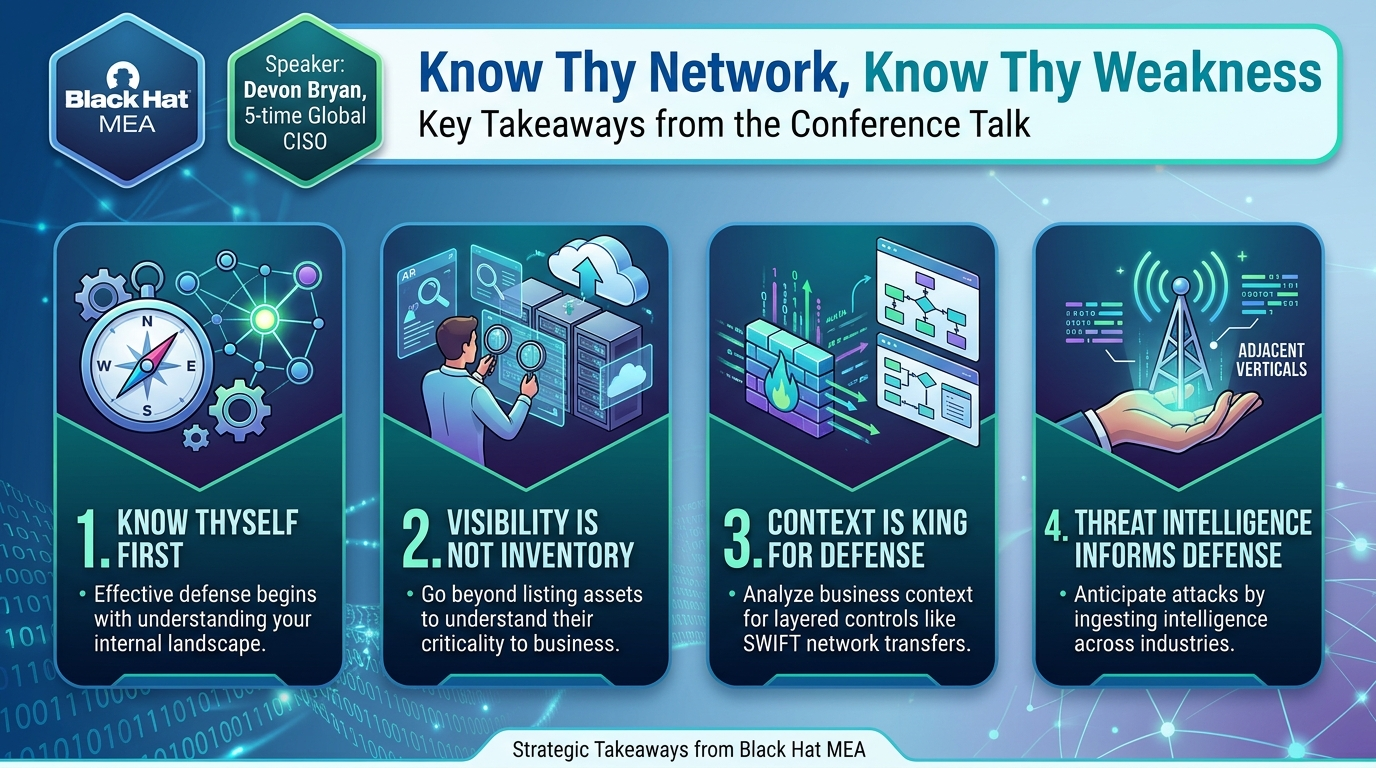
- Know Thyself First: Effective cyber defense fundamentally begins with an intimate understanding of your own network, assets, and business context, rather than solely focusing on external threats.
- Visibility is Not Inventory: Simply listing assets is insufficient; true visibility requires understanding their criticality to business operations, their current state, and the protections in place.
- Context is King for Defense in Depth: While layered security controls are essential, their effectiveness is severely diminished without deep business context regarding data flows, transaction processes, and asset interdependencies.
- Threat Intelligence Informs Proactive Defense: Consistently ingesting and acting upon threat intelligence, including insights from adjacent industry verticals, is crucial for anticipating and blocking sophisticated attacks.
- The Human Firewall Demands Investment: The human element remains the most vulnerable layer; significant and continuous investment in security awareness and training is critical to shore up this often-overlooked defense.
- Security Must Be Dynamic and Adaptive: Static, checklist-based security approaches are insufficient against adaptive adversaries. Defense strategies must be dynamic, data-informed, and continuously evolving, balancing automation with human judgment.
About the Speaker(s)
Devon Bryan is a highly accomplished and respected figure in the cybersecurity industry, known for his extensive experience as a 5-time global CISO. His career highlights include serving as the Chief Information Security Officer for the US Federal Reserve system, the central bank of the United States, for approximately five years. In this pivotal role, he was responsible for safeguarding the nation's critical financial infrastructure. Bryan's expertise spans strategic leadership in cybersecurity, risk management, and regulatory compliance across complex, regulated environments. His insights are drawn from a career dedicated to protecting large-scale enterprises against sophisticated and evolving cyber threats.
Reviews
Dr. Zero (Offensive Security Researcher) — SOLID
Competent CISO-track keynote that packages Sun Tzu, asset visibility, and threat-intel integration into a coherent strategic narrative. Nothing here is wrong, but nothing here is new either—experienced practitioners will recognize every beat. Devon Bryan's Fed background lends credibility, but the talk delivers framework-level advice rather than insider signal or hard operational detail.
Heather Calloway (CISO) — SOLID
A competent articulation of foundational CISO principles—asset visibility, business context, threat intelligence integration—but it's the talk you give to a room that hasn't internalized these ideas yet. For experienced security leaders, there's no new insight here, just well-delivered fundamentals.
→ Top-rated talks at Black Hat Middle East & Africa 2025 (Executive Summit)
All talks from Black Hat Middle East & Africa 2025 (Executive Summit)