Lean Strategy for Modern Security
Margarita Rivera (Global CISO · Carnival Corporation)
Black Hat Middle East & Africa 2025 (Executive Summit) · Executive Summit
Overview
In an era defined by relentless digital transformation and the accelerating pace of technological change, modern security teams face an unprecedented challenge: defending more assets, making faster decisions, and operating with fewer resources. Margarita Rivera, Global Chief Information Security Officer for Carnival Corporation, addresses this critical dilemma in her Black Hat MEA talk, "Lean Strategy for Modern Security." Rivera posits that traditional, rigid security methodologies are no longer fit for purpose, advocating instead for a lean security strategy – a paradigm shift designed to simplify complexity, focus on high-impact initiatives, and build agile, efficient security programs capable of delivering genuine resilience.
Key moments
- 0:38 Why lean security strategy is essential
- 4:10 Why traditional strategic roadmaps fail today
- 6:20 Lean strategy: Real-time GPS vs. outdated map
- 8:10 Iconic brands that failed without lean strategy
- 10:30 Applying lean principles to cybersecurity pillars (identity, ops, arch)
- 14:00 Case study: Siemens' global lean transformation
- 15:30 Case study: Carnival Corp's lean security implementation
- 18:05 Actionable lean principles for immediate implementation
Lean Strategy for Modern Security
Speakers: Margarita Rivera, Global CISO, Carnival Corporation
Conference: Black Hat MEA
YouTube: https://www.youtube.com/watch?v=y0W3Kf3jNZI
Overview
In an era defined by relentless digital transformation and the accelerating pace of technological change, modern security teams face an unprecedented challenge: defending more assets, making faster decisions, and operating with fewer resources. Margarita Rivera, Global Chief Information Security Officer for Carnival Corporation, addresses this critical dilemma in her Black Hat MEA talk, "Lean Strategy for Modern Security." Rivera posits that traditional, rigid security methodologies are no longer fit for purpose, advocating instead for a lean security strategy – a paradigm shift designed to simplify complexity, focus on high-impact initiatives, and build agile, efficient security programs capable of delivering genuine resilience.
This talk is not merely a technical discussion but a strategic blueprint for survival and success in the contemporary threat landscape. Rivera contends that the principles of lean strategy, born from manufacturing and now widely adopted in agile development, are essential for cybersecurity professionals, developers, investors, and any organization striving for sustainable growth. By embracing continuous feedback, rapid iteration, and a value-focused approach, organizations can overcome the inherent limitations of static planning and respond effectively to an ever-evolving array of threats, ultimately securing their digital future without compromising trust or innovation.
The core message resonates across industries: the ability to adapt with speed and agility is paramount. Rivera emphasizes that the blueprint for such velocity is already unfolding in regions like Saudi Arabia, with its Vision 2030 emphasizing innovation and rapid digital transformation. The talk serves as a call to action for security leaders to re-evaluate their operational models, move beyond outdated playbooks, and adopt a dynamic, responsive posture that aligns security with the breakneck speed of modern business and technological advancement.
Background
▶ Watch: Why lean security strategy is essential (0:38)
The premise of Margarita Rivera's talk is rooted in a stark reality: 70% of strategic roadmaps today implicitly fail. This alarming statistic highlights a fundamental disconnect between traditional planning methodologies and the dynamic nature of modern business and technology. Rivera attributes this high failure rate to the overwhelming complexity embedded in contemporary planning and execution, which far exceeds the pace of change and transformation. Traditional strategies, characterized by long planning cycles, rigid milestones, and slow approval processes, are rendered obsolete almost as soon as they are conceived. The rapid evolution of technology, further accelerated by artificial intelligence, means that by the time a control is deployed or a technology implemented, the threat landscape has already shifted.
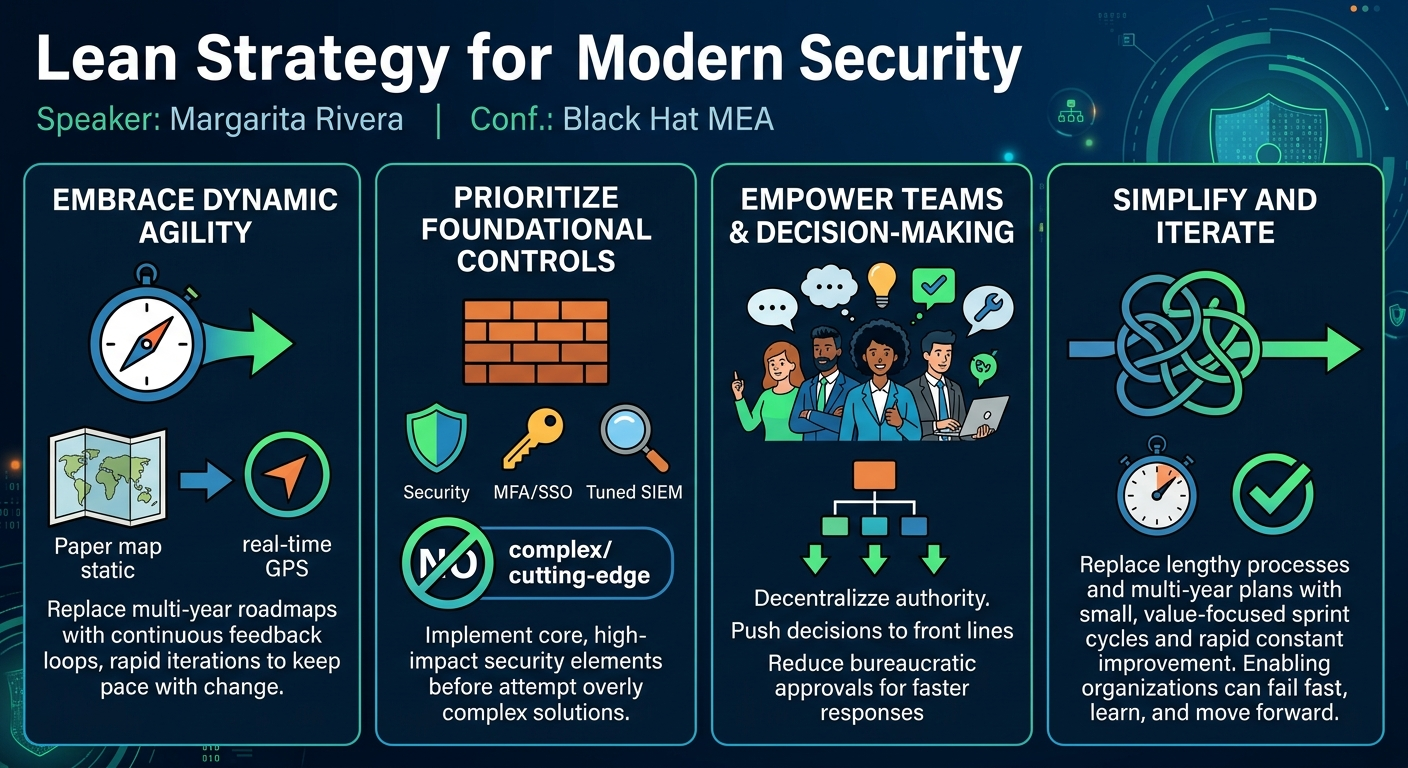
Rivera vividly illustrates this obsolescence with the analogy of an old paper map versus a real-time GPS. The traditional map, a snapshot from a single point in time, cannot guide an organization through a constantly changing environment. In contrast, a real-time GPS continuously processes information, recalculates routes, and provides immediate course corrections, mirroring the agility required for modern security. Decades-old assumptions and rigid plans resist necessary corrections, leading to inevitable failure. Attackers, Rivera notes, are already employing lean strategies, innovating at a pace that traditional cybersecurity approaches simply cannot match.
The consequences of failing to adapt are evident in the downfall of once-iconic brands. Companies like BlackBerry, which dismissed the iPhone as a "toy" and refused to embrace technological change, lost their market dominance. Sony, despite possessing vast resources in entertainment, music, and technology, failed to leverage its potential due to fragmented silos and an adherence to old playbooks, missing the opportunity to develop an iPod-like device long before Apple. Similar fates befell Nokia and Kodak, all victims of rigid mindsets and an inability to lean into agile, responsive strategies. These examples underscore that operating under an old strategy in a new world guarantees being left behind. The problem, therefore, is not just a technical challenge but a strategic imperative to redefine how security is planned, executed, and managed.
Key Findings
▶ Watch: Lean strategy: Real-time GPS vs. outdated map (6:20)
The central finding of Rivera's talk is that lean strategy is synonymous with speed, a non-negotiable attribute for success in modern cybersecurity. It offers a paradigm shift from static, long-term planning to a dynamic, iterative approach. Key tenets of this lean strategy include:
- Continuous Feedback Loops: Unlike traditional models that rely on infrequent reviews, lean strategy embraces constant feedback, allowing for immediate adjustments based on new information and evolving conditions. This enables organizations to shift direction without losing focus.
- Dynamic Leadership: Leaders must be adaptable, capable of making quick course corrections. Decisions made today are based on current information, but tomorrow's landscape will undoubtedly change, necessitating an agile leadership style.
- Customer Value Focus: Every initiative and investment must be evaluated through the lens of the value it delivers to the customer, whether internal or external. This ensures that resources are directed towards what truly matters.
- Simplification and Integration: Complexity is the enemy of speed. Lean strategy advocates for simplifying processes, integrating efforts into shorter cycles, and breaking down silos. The goal is to "fail fast, learn, and move forward."
- Empowered Teams: Decentralizing decision-making is crucial. By empowering teams and pushing decisions down to those closest to the action, organizations can drastically reduce bureaucratic approvals and accelerate response times.
- Agile Execution: Replacing multi-year roadmaps with small sprints and iterative delivery models allows for real-time feedback and continuous improvement. This approach acknowledges that the environment is constantly changing, making rigid, long-term plans impractical.
- Lean Metrics: Focus on measuring what truly matters and can be clearly articulated to stakeholders, from business leaders to board members. This avoids collecting data for data's sake and ensures metrics drive valuable insights.
- Minimum Viable Controls: Instead of attempting to "boil the ocean" with comprehensive, all-encompassing security programs, lean strategy emphasizes deploying foundational, core initiatives that provide the most significant risk reduction at a foundational level.
- People and Culture: Investing in people, fostering trust, and embracing diverse perspectives are critical. An empowered, knowledgeable workforce operating within a culture of agility is the bedrock of a successful lean security program.
These findings collectively point towards a security posture that is inherently more responsive, efficient, and resilient, enabling organizations to achieve more with less without overwhelming their teams.
Technical Deep Dive
▶ Watch: Applying lean principles to cybersecurity pillars (identity, ops, arch) (10:30)
While Rivera's talk is primarily strategic, its "technical deep dive" lies in the application of lean principles to specific cybersecurity domains, fundamentally altering how security is architected, operated, and managed. The core challenge is to move from theoretical, complex frameworks to practical, value-driven implementations.
Identity Management:
Rivera highlights the common pitfall of aiming for advanced identity management solutions without first establishing foundational controls. Instead of attempting to "boil the ocean" with ambitious, all-encompassing identity projects, a lean approach prioritizes basics like Multi-Factor Authentication (MFA) and Single Sign-On (SSO). Crucially, it emphasizes the establishment of a core source of information for identity, ensuring accuracy and consistency across the enterprise. Without these fundamental building blocks, pursuing cutting-edge concepts like passwordless authentication is premature and likely to fail. The technical implication is a focus on robust, widely adopted, and easily manageable identity primitives before layering on complexity.
Security Operations (SecOps):
In Security Operations, the lean strategy directly addresses the inefficiency of poorly configured Security Information and Event Management (SIEM) systems. Many organizations collect vast amounts of log data without effectively extracting actionable intelligence. A lean approach dictates that SIEMs must be tuned specifically to identify unique threats and those that are "most critical" to the organization. This means moving beyond generic alert rules to context-aware detection, reducing noise, and focusing analyst efforts on high-fidelity alerts that deliver real value in threat detection and response. The technical challenge here is intelligent rule tuning, correlation, and continuous refinement of detection logic.
Security Architecture:
The application of lean principles to security architecture focuses on clarity and adoption. Rivera criticizes the "20 diagrams and a support animal" approach to explaining complex architectures. Instead, she advocates for reference diagrams that are simple, clear, and easily understandable. The goal is to reduce friction in the adoption of secure design patterns and controls. This implies an architectural practice that prioritizes modularity, clear interfaces, and documentation that facilitates rapid understanding and implementation, rather than creating intricate, opaque systems.
Dynamic Control Deployment and Roadmaps:
The most significant shift from a technical perspective is the rejection of the traditional five-year security roadmap. Rivera asserts that such roadmaps are "already outdated by the time it is memorialized." Instead, lean security embraces the concept of a "constantly moving castle," where the "doors that matter" to defend are continuously changing. This necessitates a dynamic approach to control deployment, where risk assessments are ongoing, and controls are prioritized and adapted based on real-time threat intelligence and asset criticality. This translates to an agile security program that leverages iterative sprints for control implementation, continuous vulnerability management, and adaptive threat modeling.
Framework Adaptation:
Rivera also addresses the use of established security frameworks like ISO 27000 and NIST. While valuable, she warns against rigid adherence when they don't fit an organization's unique complexity. For example, Carnival Corporation, with "eight different IT teams from eight different brands with eight different tech stacks and one security stack," cannot apply a monolithic framework without adaptation. The technical implication is the need for flexibility: to "iterate as quickly as we can" and "pivot" when a framework or control doesn't work. This requires a deep understanding of the framework's intent, rather than its prescriptive details, and the ability to tailor it to specific operational realities, focusing on minimum viable controls like Zero Trust, OT segmentation, or Active Directory (AD) modernization as foundational initiatives.
In essence, the technical deep dive in a lean security context is about smart, focused implementation: prioritizing foundational elements, tuning systems for value, simplifying designs for adoption, and adapting controls dynamically rather than following static, long-term plans.
Demo / Proof of Concept
▶ Watch: Case study: Siemens' global lean transformation (14:00)
This talk focused on strategic organizational principles and their application to cybersecurity management rather than demonstrating a specific technical tool or proof of concept. Margarita Rivera illustrated the benefits of a lean strategy through real-world corporate examples, particularly Siemens and Carnival Corporation, and provided actionable principles for organizational change and operational improvement. The emphasis was on methodology and mindset rather than a live technical demonstration.
Defensive Implications
▶ Watch: Actionable lean principles for immediate implementation (18:05)
The lean strategy articulated by Margarita Rivera provides a powerful framework for defenders to enhance their posture and effectiveness in the face of escalating threats and resource constraints. The implications are profound, guiding security teams to operate with greater agility, focus, and impact:
- Prioritize Clarity Over Complexity: Defenders must strive for extreme clarity in their objectives. Rivera advises stating what an initiative aims to accomplish in "one sentence." This means identifying and focusing energy on a limited number of focused initiatives that promise the greatest reduction of risk in the environment, rather than pursuing "150 projects."
- Decentralize Decision-Making: A critical shift involves pushing decisions down to the lowest appropriate level. Global CISOs, like Rivera, should empower their leadership teams and individual contributors to make decisions, reducing handoffs and bureaucratic approval cycles. This not only speeds up response times but also fosters a sense of ownership and accountability among the team.
- Measure What Truly Matters: Security metrics must evolve beyond technical indicators to communicate value effectively to the business and the board. Defenders should focus on lean metrics that articulate risk reduction, efficiency gains, and business impact, enabling stakeholders to understand the "what" and "why" behind security investments.
- Embrace Rapid Iteration and Pivoting: The security landscape is too dynamic for static plans. Defenders must adopt a mindset of iterating incredibly fast and being prepared to pivot when a strategy, control, or framework (e.g., ISO 27000, NIST) proves ineffective or unsuitable for their unique environment. This requires continuous feedback loops and a willingness to learn from failures quickly.
- Cultivate Customer-Focused Security: Even within cybersecurity, the "customer" (whether internal business units or end-users) should be paramount. Defenders need to understand business needs, reduce friction in security processes, and partner effectively with other departments to deliver security that enables, rather than hinders, business operations.
- Streamline Processes and Eliminate Waste: Practical steps include replacing lengthy "60-minute meetings with 15-minute stand-ups," identifying and making "one process leaner," and actively removing "unnecessary approvals." The guiding question for every process should be: "What would this look like if this was simple?" Simplicity becomes a superpower.
- Dynamic Asset Protection: The concept of defending "the doors that matter to defend a constantly moving castle" is crucial. Defenders must continuously assess and reassess which assets are most valuable and which threats are most pertinent, dynamically shifting their focus and resources to protect the highest-risk areas. This requires robust asset inventory, continuous risk assessment, and adaptive control mechanisms.
By integrating these lean principles, defenders can transform their security programs from reactive, resource-intensive operations into agile, efficient, and highly effective engines of resilience, capable of adapting to the unpredictable nature of modern cyber threats.
Key Takeaways
- Traditional security strategies and multi-year roadmaps are failing at an alarming rate (70%) due to increasing complexity and the rapid pace of technological change, including AI.
- Lean strategy prioritizes speed, continuous feedback, dynamic leadership, and quick course correction, enabling organizations to adapt rapidly to evolving threats and conditions.
- Focus on foundational security elements like MFA, SSO, and properly tuned SIEMs before attempting to implement complex or cutting-edge solutions, ensuring a solid security baseline.
- Empower teams by decentralizing decision-making and reducing bureaucratic approvals, fostering agility and faster response times in a dynamic threat landscape.
- Measure what truly matters to the business, iterate rapidly, and simplify processes to achieve greater security outcomes with fewer resources, making simplicity a "superpower."
- Security programs must be customer-focused, adaptable to unique organizational complexities, and willing to pivot from rigid frameworks when they don't align with operational realities.
About the Speaker(s)
Margarita Rivera is the Global Chief Information Security Officer for Carnival Corporation, a prominent role overseeing the cybersecurity posture for eight distinct global cruise lines. With 23 years of experience in the industry, Rivera brings a wealth of practical knowledge and strategic insight to her position. Her academic background, including studies at Harvard University, underpins her analytical approach to security challenges. Rivera is a strong advocate for modernizing security strategies, emphasizing the importance of lean principles to build agile, efficient, and resilient security programs that can keep pace with rapid digital transformation and evolving threats. Her talk reflects her commitment to empowering security professionals and fostering a culture of continuous improvement and adaptation.
Reviews
Dr. Zero (Offensive Security Researcher) — WEAK
Standard CISO keynote recycling lean/agile buzzwords from 2015 with zero novel insight for security practitioners. The Kodak/Nokia/BlackBerry examples are management consulting clichés from a decade ago. Nothing here you couldn't get from a Harvard Business Review article and a security podcast.
Heather Calloway (CISO) — SOLID
Competent articulation of agile principles applied to security program management, but nothing here a seasoned CISO hasn't already internalized. Useful framing for mid-career leaders building their first enterprise program; less valuable for practitioners who've already learned these lessons the hard way.
→ Top-rated talks at Black Hat Middle East & Africa 2025 (Executive Summit)
All talks from Black Hat Middle East & Africa 2025 (Executive Summit)