Cybereconomy
Dr. Chenxi Wang (Managing General Partner · Rain Capital), Marcos Marrero (CISO · H.I.G. Capital), Anne Marie Zettlemoyer (Fellow · National Security Institute), Anshu Gupta (Investor · Silicon Valley CISO Investments (SVCI)), David Cass (CISO · Keyrock)
Black Hat Middle East & Africa 2025 (Executive Summit) · Executive Summit
Overview
The "Cybereconomy" panel at Black Hat MEA brought together a distinguished group of cybersecurity investors and practitioners to dissect the intricate and often tense relationship between capital and cyber defense. Moderated by David Cass, CISO for Keyrock, the discussion explored how the accelerating pace of innovation, coupled with an equally rapid adaptation by attackers, shapes investment decisions and security strategies. The panel, featuring Dr. Chenxi Wang, Marcos Marrero, Anne Marie Zettlemoyer, and Anshu Gupta, offered an honest look at the economic forces behind the next era of cyber, emphasizing the critical need for alignment between those funding technological advancements and those tasked with securing them.
Key moments
- 2:30 Over/undercapitalized areas in cybersecurity market
- 3:50 Macroeconomic pressures sharpen security spending priorities
- 7:00 Balancing investment in tools vs. human talent
- 10:15 Agentic AI and HBOM too early for enterprise adoption
- 15:00 Evaluating startups: solving real problems vs. compelling narratives
- 22:00 Evaluating total cost of ownership and tool stickiness
- 30:00 Panelists' predictions for future shifts in cyber economy
Cybereconomy
Speakers: Dr. Chenxi Wang (Managing General Partner, Rain Capital), Marcos Marrero (CISO, H.I.G. Capital), Anne Marie Zettlemoyer (Fellow, National Security Institute), Anshu Gupta (Investor, Silicon Valley CISO Investments (SVCI)), David Cass (CISO, Keyrock)
Conference: Black Hat MEA
YouTube: https://www.youtube.com/watch?v=riL5uV73QIk
Overview
The "Cybereconomy" panel at Black Hat MEA brought together a distinguished group of cybersecurity investors and practitioners to dissect the intricate and often tense relationship between capital and cyber defense. Moderated by David Cass, CISO for Keyrock, the discussion explored how the accelerating pace of innovation, coupled with an equally rapid adaptation by attackers, shapes investment decisions and security strategies. The panel, featuring Dr. Chenxi Wang, Marcos Marrero, Anne Marie Zettlemoyer, and Anshu Gupta, offered an honest look at the economic forces behind the next era of cyber, emphasizing the critical need for alignment between those funding technological advancements and those tasked with securing them.
This session delved into pressing questions concerning over- and under-capitalized areas within the cybersecurity market, the impact of macroeconomic pressures on CISO priorities, and the evolving balance between investing in tools versus talent in an AI-driven threat landscape. The experts provided invaluable insights into evaluating emerging technologies, the true cost of security solutions, and the strategic role CISOs play in shaping the future of cybersecurity investments. Their collective experience illuminated the challenges and opportunities in building a secure digital future amidst constant change and increasing complexity.
Background
▶ Watch: Over/undercapitalized areas in cybersecurity market (2:30)
The cybersecurity landscape is in a state of perpetual flux, characterized by unprecedented innovation, increasingly sophisticated threat actors, and significant financial investment. As digital transformation accelerates across all industries, the attack surface expands, and the imperative for robust security becomes paramount. This dynamic environment has attracted record funding into the cybersecurity sector, yet questions persist about the efficiency and strategic allocation of this capital. The panel's discussion is set against this backdrop, acknowledging that while innovation charges forward, security must keep pace, or the growth will outpace protection.
Several foundational issues underpin the "Cybereconomy" dialogue. Firstly, the rapid development of technologies like Artificial Intelligence (AI) and automation has created a double-edged sword: powerful tools for defense but also potent weapons for attackers. This necessitates a re-evaluation of traditional security paradigms and investment strategies. Secondly, global macroeconomic pressures, including fluctuating interest rates and tightening budgets, compel security leaders to make sharper, more outcome-driven investment decisions. Finally, the inherent complexity of modern enterprise environments—characterized by chaotic networks and immature data governance—often creates a chasm between innovative solutions conceived in labs and their practical, effective implementation in real-world operational settings. Understanding these forces is crucial to navigating the economic currents shaping the future of cybersecurity.
Key Findings
▶ Watch: Balancing investment in tools vs. human talent (7:00)
The panel identified several critical areas where the cyber economy is experiencing both rapid growth and significant challenges:
- Over- and Under-Capitalized Areas: Dr. Chenxi Wang and Marcos Marrero both pointed to AI security as an over-capitalized sector, noting an abundance of "narrow sliced" startups (40-50 companies) with more investment than current budget allocation can support. This suggests the market is "ripe for consolidation." Conversely, Anshu Gupta highlighted Hardware Bill of Materials (HBOM) as a significantly underserved area, lacking standardization in reporting and supply chain visibility, particularly crucial with the proliferation of IoT devices.
- Impact of Macroeconomic Pressures: Anne Marie Zettlemoyer explained that constricted capital markets don't halt security spending but "sharpen it," shifting focus from broad categories to investments that yield operational impact and measurable outcomes. CISOs are now prioritizing solutions that reduce operational risk, materially decrease workflow times, and align explicitly with CFO objectives. Anshu Gupta added that despite budget cuts, risk remains constant, pushing CISOs to innovate internally through automation and internal training to "do more with less."
- Tools vs. Talent in the AI Era: The panel debated the optimal balance between investing in new tools and human capital. Marcos Marrero advocated for a 60% talent to 40% technology ratio in his organization, emphasizing the indispensable "human in the loop" for contextual understanding and incident response, as current technology cannot yet fully automate detection and stopping of malicious activity. Anne Marie Zettlemoyer, a data scientist herself, stressed the importance of embedding data science capabilities and AI experts within security teams to effectively train models, craft prompts, and ensure tools are truly effective, citing Microsoft Security Copilot as an example of an LLM specifically trained on security telemetry. However, a friend's CISO experience noted the need to hire more people to validate AI output, indicating a potential shift in talent focus.
- Premature Innovations for Enterprise Adoption: Dr. Chenxi Wang identified agentic AI as too early for responsible enterprise adoption. While offering significant potential benefits through autonomy, the current lack of trust in autonomous outcomes makes it problematic. Marcos Marrero concurred, stating AI "is still not there" and will require human oversight for the foreseeable future.
- Stalling Innovation and Real-World Applicability: Anne Marie Zettlemoyer expressed frustration with solutions that are not "tested in the realities of an actual enterprise." She stressed that innovative ideas often "don't work on implementation" within messy, chaotic networks with immature data governance. She specifically criticized generative AI for code (vibe coding), noting it often produces "demo quality code" that lacks the scalability, robustness, and security required for production environments.
- Evaluating Cybersecurity Startups:
- Investor Perspective (Chenxi Wang, Anshu Gupta): Focus on the team's operational experience and whether they solve a "real problem" versus a "compelling narrative." Key criteria include whether a solution is a "painkiller problem or a vitamin," a "product platform or a feature," and offers "net new innovation" or simply does the "same thing faster, more efficient, or cheaper."
- CISO Perspective (Marcos Marrero, Anne Marie Zettlemoyer): Marcos Marrero values startups that prioritize understanding his organization's problems before pitching a product. Anne Marie Zettlemoyer asserted that CISOs "don't buy innovation; we buy solutions that work," emphasizing effectiveness, measurable outcomes, risk reduction, team usability, and environmental fit. She highlighted the importance of a successful Proof of Value (POV) and demonstrable implementation within 90 days.
- Misconceptions of Founders: Founders often mistakenly believe CISOs are interested in "shiny objects" rather than solutions to specific problems. The disconnect arises when products are designed without deep operational insight into customer pain points. Anshu Gupta added that successful implementation requires involving all stakeholders (engineering, IT) and ensuring a robust post-implementation process to support "land and expand" strategies.
- True Cost of Ownership (TCO) and ROI:
- TCO: Anne Marie Zettlemoyer, with a CFO background, stated that the total contract cost is the "least interesting thing." More crucial factors include the time to value (ideally under 90 days), the reduction in analyst/team time, and importantly, exit costs if a solution needs to be abandoned.
- Solution Stickiness: Dr. Chenxi Wang introduced a framework: "hat solution" (easily changed), "haircut solution" (reversible over time), and "tattoo solution" (permanent, high stickiness). Investors prefer "tattoo solutions" due to their inherent stickiness, despite the potential pain for the customer in changing them.
- ROI Justification: Marcos Marrero emphasized driving down cyber risk as the primary ROI driver for his organization, although he acknowledged that many others are driven by compliance ("check the box"). Anshu Gupta detailed the complexity of calculating ROI for security, involving quantifying brand value, asset replacement costs, downtime losses, and even customer notification expenses in a breach.
- CISO's Role in Investment: The panel agreed CISOs should play multiple roles: early adopters, advisors, and even angel investors. Marcos Marrero participates in investment and due diligence, translating cyber risk for finance experts. Dr. Chenxi Wang relies on practitioners for insights into relevant and compelling solutions. Anshu Gupta highlighted the role of innovation centers in larger organizations, allowing startups to mature solutions before enterprise-wide deployment. Anne Marie Zettlemoyer advised vendors to engage with operators "a couple levels down," not just CISOs, as they are often the ones identifying and proposing solutions.
- Future Shifts in Cybereconomy:
- Threat Landscape: Dr. Chenxi Wang believes the threat landscape will be the most significant shift, with AI handling compliance.
- Consolidation & Quantum Computing: Marcos Marrero predicted market consolidation and highlighted quantum computing as a fundamental future shift that will redefine protection.
- Efficiency & Effectiveness: Anne Marie Zettlemoyer focused on solutions that enable teams to work "fast, efficiently, and effectively within the chaos," compressing timelines in material ways.
- Human-AI Augmentation: Anshu Gupta foresees significant investment in making humans use AI better, alongside continued consolidation.
Technical Deep Dive
▶ Watch: Agentic AI and HBOM too early for enterprise adoption (10:15)
The panel's discussion, while broad, touched upon several critical technical domains and their implications for cybersecurity investment and strategy. A central theme was the double-edged nature of Artificial Intelligence (AI), simultaneously a powerful enabler and a formidable threat.
In the realm of AI security, Dr. Chenxi Wang and Marcos Marrero observed an overcapitalization, with numerous "narrow sliced" startups vying for attention. This fragmentation highlights a technical challenge: developing comprehensive security for AI systems, rather than isolated point solutions. Anshu Gupta further elaborated on the evolving attack surface, noting the shift from DevSecOps to MLSecOps pipelines. This implies a need for entirely new tooling and upskilling at every stage of the machine learning lifecycle, from testing and staging to production, to secure the unique vulnerabilities introduced by AI models and data.
A significant technical concern raised was the maturity of Agentic AI. Chenxi Wang deemed it "too early" for responsible enterprise adoption, primarily due to the current lack of inherent trust in fully autonomous outcomes. Marcos Marrero reinforced this, stating that AI "is still not there" and will necessitate a "human in the loop" for the foreseeable future. This underscores a fundamental technical limitation: current AI, while capable of automating basic tasks, often lacks the contextual reasoning and critical judgment required for independent, high-stakes security operations. The observation that some organizations are hiring more staff to validate AI outputs rather than replace human effort further illustrates this technical immaturity.
Anne Marie Zettlemoyer, with her background as a data scientist, advocated for the direct integration of data science capabilities into security teams. This is a technical strategy aimed at leveraging advanced analytical methods to enhance security posture. By having experts within the team, organizations can better train AI models, develop effective prompts for Large Language Models (LLMs), and ensure these tools perform optimally. The example of Microsoft Security Copilot, an LLM specifically trained on Microsoft's vast threat intelligence and security telemetry, demonstrates the technical power of domain-specific AI training, contrasting sharply with the limitations of general-purpose LLMs in security contexts.
Anshu Gupta identified Hardware Bill of Materials (HBOM) as a critical, yet underserved, technical area. Unlike Software Bill of Materials (SBOM), which has seen significant standardization efforts, HBOM lacks consistent reporting and supply chain visibility from the chip level to the end product. This technical gap is becoming increasingly critical with the proliferation of IoT devices, where the provenance and integrity of hardware components are paramount for overall security. Standardization in HBOM reporting is a necessary technical step to address this supply chain vulnerability.
The panel also addressed the technical limitations of generative AI for code, often referred to as "vibe coding." Anne Marie Zettlemoyer critically noted that such tools frequently produce "demo quality code" but fail to address the core technical requirements of scalability, robustness, and security for enterprise applications. This highlights a significant technical deficit where AI-generated code, while syntactically correct, may introduce security vulnerabilities or lack the architectural resilience needed for production systems, demanding extensive human oversight and refactoring.
In terms of evaluating solutions, Marcos Marrero's internal checklist for vendors includes technical considerations like reducing complexity by simplifying architecture. Anne Marie Zettlemoyer's emphasis on time to value (ideally within 90 days) and exit costs for tools speaks to the technical overhead and integration challenges associated with complex security deployments. Dr. Chenxi Wang's "hat, haircut, tattoo" framework, while metaphorical, reflects the technical stickiness of solutions. A "tattoo solution" implies deep integration into an organization's technical fabric, making it difficult and costly to remove, which is a desirable characteristic from an investor's perspective but a significant technical commitment for an enterprise.
Finally, the future impact of quantum computing was briefly raised by Marcos Marrero. This represents a profound technical shift that could fundamentally break existing cryptographic protections, necessitating an entirely new paradigm for data security and secure communications, a challenge that will require immense technical innovation and investment in the coming years.
Demo / Proof of Concept
▶ Watch: Evaluating total cost of ownership and tool stickiness (22:00)
As a panel discussion focused on strategic insights and economic trends in cybersecurity, this session did not include a technical demonstration or a proof of concept of any specific tool or vulnerability. The content was entirely discussion-based, drawing on the speakers' extensive industry experience and perspectives.
Defensive Implications
▶ Watch: Panelists' predictions for future shifts in cyber economy (30:00)
The insights shared by the panel offer several critical implications for cybersecurity defenders looking to optimize their strategies and investments:
- Strategic Budget Allocation: Defenders must sharpen their spending, moving beyond generic category funding to prioritize solutions that deliver demonstrable operational impact and measurable outcomes. This means focusing on tools that genuinely reduce operational risk, streamline workflows, and directly contribute to the organization's security posture. CISOs should be "best friends with their CFOs," articulating the specific outcomes and ROI of security investments.
- Embrace Automation with Human Oversight: While AI security is overcapitalized, automation remains a key strategy for "doing more with less." Defenders should invest in tools that incorporate automation to handle routine tasks, but always maintain a "human in the loop" for critical decision-making, contextual analysis, and incident response. General-purpose AI models are not ready for fully autonomous security operations; human expertise is indispensable for validating outputs and handling complex scenarios.
- Invest in Talent and Upskilling: The emphasis on a 60/40 talent-to-tech ratio highlights the enduring value of human expertise. Organizations should actively invest in upskilling existing security teams, embedding data science capabilities, and fostering AI expertise internally. This ensures that security personnel can effectively leverage and manage advanced security tools, train models, and interpret AI-driven insights.
- Demand Real-World Tested Solutions: When evaluating new technologies, defenders must insist on solutions proven to work in "messy, chaotic networks" rather than pristine vendor demo environments. Prioritize vendors willing to conduct thorough Proofs of Value (POVs) that demonstrate tangible benefits and successful integration within the organization's specific operational context, ideally within a 90-day timeframe.
- Address Supply Chain Security Gaps: The lack of standardization in Hardware Bill of Materials (HBOM) presents a significant blind spot. Defenders should advocate for greater transparency and standardization in hardware supply chains, especially given the proliferation of IoT devices. Understanding the provenance and components of hardware is crucial for mitigating risks at a foundational level.
- Exercise Caution with Generative AI for Code: While generative AI can rapidly produce code, defenders must recognize its current limitations in generating production-ready, secure, scalable, and robust applications. Rigorous security testing, code reviews, and architectural oversight are essential when incorporating AI-generated code to prevent the introduction of vulnerabilities.
- Holistic Total Cost of Ownership (TCO) Evaluation: Beyond initial licensing fees, defenders must evaluate the true TCO, considering factors like time to value, integration efforts, ongoing operational overhead, and crucially, exit costs. Understanding the "tattoo" nature of some solutions means assessing the long-term commitment and potential pain of disentanglement.
- Involve Operational Teams in Tool Selection: CISOs should empower and involve their operational teams (e.g., GRC, SecOps, vulnerability management) in the evaluation and selection of new security tools. These teams are on the front lines, possess intimate knowledge of pain points, and are best positioned to assess usability, adoption likelihood, and practical effectiveness.
- Prepare for Quantum Computing: Although a future threat, the potential impact of quantum computing on existing cryptographic infrastructures is immense. Defenders should begin monitoring advancements in post-quantum cryptography and developing long-term strategies to transition to quantum-resistant algorithms to safeguard critical data and communications.
Key Takeaways
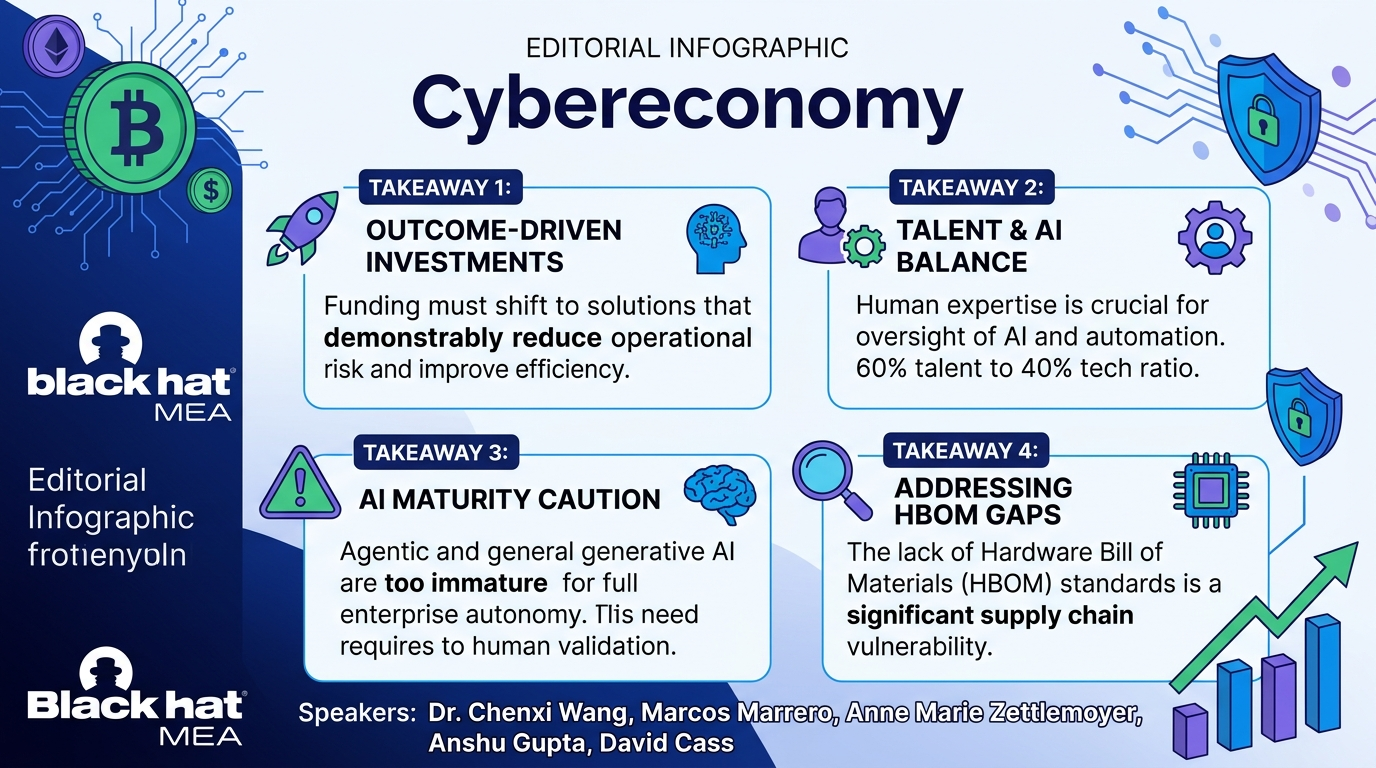
- Strategic Investment Focus: Cybersecurity funding needs to shift from broad category spending to outcome-driven investments that demonstrably reduce operational risk and improve efficiency, especially under macroeconomic pressure.
- Balance of Talent and Tools: While AI and automation are critical, human expertise remains indispensable. Organizations should aim for a healthy balance, potentially a 60/40 ratio favoring talent, to provide the necessary contextual understanding and oversight for advanced security technologies.
- Maturity of AI for Security: Agentic AI and general-purpose generative AI for code are still too immature for fully autonomous enterprise adoption. Human validation and specialized training (like Microsoft Security Copilot) are crucial for effective and responsible deployment.
- Addressing Underserved Areas: The lack of standardization and visibility in Hardware Bill of Materials (HBOM) represents a significant and growing supply chain security vulnerability that requires urgent attention and investment.
- CISO-Led Solution Evaluation: CISOs prioritize solutions that solve real-world problems, integrate into existing "messy" environments, and demonstrate measurable value within a short timeframe (e.g., 90 days), considering factors beyond initial cost, including exit costs.
- Future Shifts: The cyber economy will be shaped by ongoing market consolidation, the evolving threat landscape driven by AI, and the looming foundational shift posed by quantum computing.
About the Speaker(s)
- Dr. Chenxi Wang: Managing General Partner at Rain Capital, an early-stage investment firm specializing in cybersecurity and AI. She brings an investor's perspective to the discussion, evaluating startups based on their operational insight and ability to solve real problems.
- Marcos Marrero: Chief Information Security Officer (CISO) for H.I.G. Capital, a global private equity firm. His insights come from a practitioner's standpoint, focusing on driving down cyber risk, evaluating tools for practical adoption, and participating in investment due diligence.
- Anne Marie Zettlemoyer: A Fellow at the National Security Institute and CISO in Residence at Point. With a background as a data scientist and former CFO/controller, she emphasizes data-driven security, embedding data science capabilities, and evaluating solutions based on measurable operational impact and total cost of ownership, including exit costs.
- Anshu Gupta: An investor with Silicon Valley CISO Investments (SVCI) and a former CISO. He provides a blended perspective, evaluating startups on their innovation, market fit, and the challenges of implementing solutions in diverse organizational contexts, while also highlighting underserved areas like HBOM.
- David Cass: CISO for Keyrock, served as the moderator for this panel discussion. His role involved guiding the conversation and posing key questions to the panelists, drawing out their expertise on the intersection of investment and cybersecurity.
Reviews
Dr. Zero (Offensive Security Researcher) — WEAK
A panel of investors and CISOs talking about cybersecurity economics that never gets past surface-level observations anyone in the industry already knows. Thirty minutes of 'AI is overhyped,' 'do more with less,' and 'we need humans in the loop' — none of it specific enough to act on.
Heather Calloway (CISO) — SOLID
Competent panel on security investment dynamics with experienced voices, but stays surface-level. You'll hear familiar complaints about vendor pitches and AI hype without much you can act on Monday morning.
→ Top-rated talks at Black Hat Middle East & Africa 2025 (Executive Summit)
All talks from Black Hat Middle East & Africa 2025 (Executive Summit)