Decoding Dyslexia: Thriving in Cybersecurity with a Different Brain
Caleb Grossnickle
Blue Team Con Online 2026 · Day 1 · Blue Team Con Online
Overview
In a compelling presentation at Blue Team Con Online, Caleb Grossnickle, a Cyber Security Analyst II at StoneX, delivered an insightful talk titled "Decoding Dyslexia: Thriving in Cybersecurity with a Different Brain." Grossnickle’s talk challenges conventional perceptions of dyslexia, reframing it not as a disability to be overcome, but as a neurobiological difference that can confer unique strengths within the demanding field of cybersecurity. He shares his personal journey with dyslexia, the struggles he faced, and the pivotal moments that led him to embrace his neurodiversity as an asset.
Key moments
- 4:00 Introduction and reframing dyslexia positively
- 7:00 Defining dyslexia and debunking intelligence myths
- 8:00 Key strengths: pattern recognition, big picture, creativity
- 8:40 Personal challenges as a dyslexic SOC analyst
- 10:00 Overcoming burnout and seeking vulnerability and support
- 11:15 Separating identity from work, recognizing dyslexic strengths
- 12:00 Strategies for thriving in cybersecurity with dyslexia
Decoding Dyslexia: Thriving in Cybersecurity with a Different Brain
Speakers: Caleb Grossnickle
Conference: Blue Team Con Online
YouTube: https://www.youtube.com/watch?v=i6jKUI8qgDk
Overview
In a compelling presentation at Blue Team Con Online, Caleb Grossnickle, a Cyber Security Analyst II at StoneX, delivered an insightful talk titled "Decoding Dyslexia: Thriving in Cybersecurity with a Different Brain." Grossnickle’s talk challenges conventional perceptions of dyslexia, reframing it not as a disability to be overcome, but as a neurobiological difference that can confer unique strengths within the demanding field of cybersecurity. He shares his personal journey with dyslexia, the struggles he faced, and the pivotal moments that led him to embrace his neurodiversity as an asset.
The core of Grossnickle's message is an empowering call to action for dyslexic individuals and a practical guide for managers and organizations. He advocates for self-advocacy, the strategic use of assistive technologies and adaptive communication methods, and a profound shift in mindset towards self-worth beyond one's professional role. By highlighting the inherent strengths often associated with dyslexia—such as pattern recognition, big-picture thinking, and creativity—Grossnickle illustrates how these attributes are not merely compatible with cybersecurity, but can significantly enhance critical functions like incident response and strategic planning.
This article delves into Grossnickle's comprehensive framework for thriving with dyslexia in cybersecurity, offering a detailed exploration of the challenges, solutions, and profound implications for fostering a more inclusive and effective security workforce. It emphasizes the importance of understanding and leveraging neurodiversity to build resilient teams capable of navigating the complex and ever-evolving threat landscape.
Background
▶ Watch: Introduction and reframing dyslexia positively (4:00)
Dyslexia, as defined by the International Dyslexia Association (IDA), is a specific learning disability of neurobiological origin. It is characterized by difficulties with accurate and/or fluent word recognition, poor spelling, and decoding abilities. These challenges typically stem from a deficit in the phonological component of language and often occur unexpectedly relative to cognitive strengths and adequate instruction. While secondary effects can include reading comprehension issues and reduced reading experience, which may hinder vocabulary and background knowledge development, the IDA explicitly states that dyslexia is not connected to intelligence. In fact, it often manifests as an unexpected difficulty in reading and spelling in individuals who otherwise demonstrate average or above-average intelligence and strong problem-solving abilities. Grossnickle emphasizes this crucial distinction: "It's not about intelligence. It's a different brain wiring."
Grossnickle’s personal narrative provides critical context for understanding the challenges faced by dyslexic individuals in professional environments, particularly in cybersecurity. Diagnosed in the fifth grade, he describes school as "super hard" and admits to a naive belief that his struggles with dyslexia would simply "graduate" with him. However, dyslexia followed him into the working world, presenting significant hurdles in his aspiration to become a cybersecurity professional. As a Security Operations Center (SOC) analyst, Grossnickle confronted the reality of a text-heavy role, where tasks like "reading raw log files" became exceptionally difficult. This led to a period of intense effort to mask his dyslexia, taking on more work, and trying to "prove myself through just working harder."
This strenuous approach ultimately led to burnout and an identity crisis. During a particularly demanding period with multiple high-priority incidents, Grossnickle felt overwhelmed by the constant influx of chats and emails, unable to read or type as fast as his colleagues. This experience forced him to confront the question of whether he truly belonged in cybersecurity. Through a candid conversation with his manager and a period of deep self-reflection, he realized the importance of separating his identity from his career and acknowledging both his weaknesses and the often-overlooked strengths of being dyslexic. This journey underscores why the problem exists in a field heavily reliant on rapid information processing and text analysis, and sets the stage for the solutions he proposes.
Key Findings
▶ Watch: Key strengths: pattern recognition, big picture, creativity (8:00)
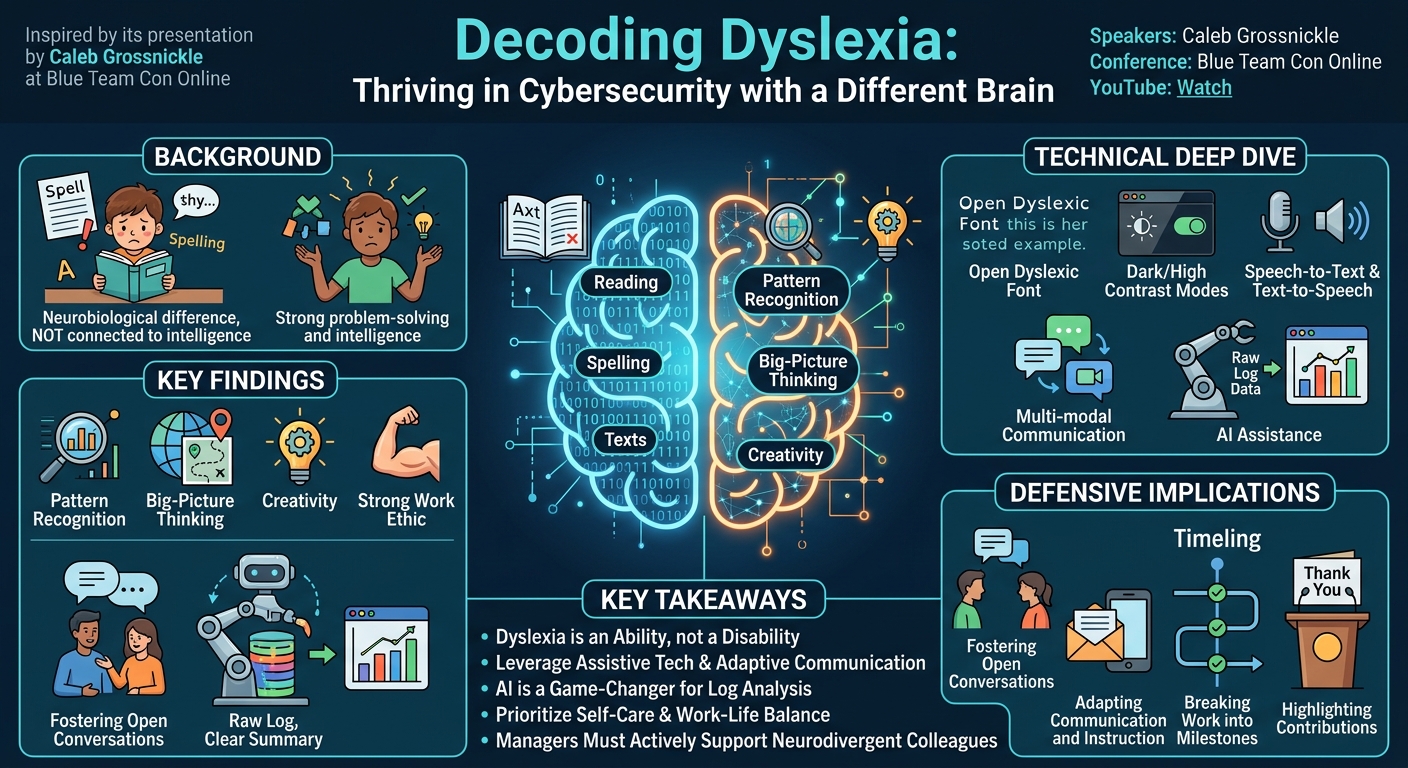
Caleb Grossnickle's talk presents several key findings, not in the traditional sense of scientific discoveries, but as profound insights and actionable strategies for individuals with dyslexia and the organizations that employ them. The overarching finding is the reframe of dyslexia as an ability, not a disability. This shift in perspective is foundational to unlocking the unique potential of neurodivergent individuals in cybersecurity.
Grossnickle identifies several inherent strengths often associated with dyslexia:
- Pattern recognition: A highly valuable skill in cybersecurity for identifying anomalies and threat indicators.
- Big-picture thinking: The ability to grasp overarching concepts and strategic visions, crucial for architectural design, long-term planning, and incident impact assessment.
- Creativity: Essential for thinking "outside the box" to devise novel solutions to complex problems and anticipate unconventional attack vectors.
- Strong work ethic: Developed through years of overcoming academic challenges, leading to persistence and dedication.
- Deep analysis and critical thinking skills: Born from the necessity to process information differently and question assumptions.
Beyond these inherent strengths, Grossnickle outlines a multi-faceted approach to thriving, which constitutes the practical findings of his talk:
- The power of self-advocacy: This involves cultivating humility, not taking oneself too seriously, and most importantly, having the confidence to speak up and ask for help from managers and teammates.
- Strategic use of assistive technologies and adaptive communication: Specific tools and methods can significantly mitigate challenges.
- Prioritizing self-care and work-life balance: Recognizing that rest is preparation, not laziness, and deriving self-worth from sources beyond one's job.
- Managerial best practices for supporting neurodivergent employees: Fostering open conversations, providing information in multiple formats, breaking down complex tasks, and recognizing contributions.
These findings collectively highlight that by understanding and intentionally leveraging these strengths and adopting adaptive strategies, dyslexic individuals can not only succeed but excel in cybersecurity, making unique and valuable contributions to their teams and the broader industry.
Technical Deep Dive
▶ Watch: Personal challenges as a dyslexic SOC analyst (8:40)
While Caleb Grossnickle's talk isn't a deep dive into code or network protocols, it offers a crucial technical deep dive into the tools, methodologies, and communication strategies that can significantly enhance the effectiveness of dyslexic individuals in a cybersecurity role. These "technical" aspects are about optimizing the human-computer interface and team dynamics for neurodivergent brains.
One of the primary tools Grossnickle highlights is the Open Dyslexic font. Created by Abby Gonzalez, a dyslexic developer, this font is specifically designed to improve readability for dyslexic readers. While not visible in the online presentation due to format conversions, Grossnickle used it in his in-person talk, demonstrating its practical application. He notes that while it's "not 100%," it "does help a little bit," indicating that even marginal gains in readability can accumulate to significant improvements in efficiency and reduced cognitive load over time. This falls into the realm of user interface (UI) accessibility, a critical but often overlooked "technical" consideration in security tools and platforms.
Beyond specialized fonts, Grossnickle discusses other UI and display settings:
- Dark mode: A popular choice in the cybersecurity community, dark mode reduces screen glare and can improve text contrast, which may benefit some dyslexic individuals by making text less overwhelming.
- High contrast mode: This setting specifically aids in distinguishing text from background, which Grossnickle finds particularly useful when working with scripting or code, where precise character recognition is vital.
Communication is another area where technical adaptations are crucial. Grossnickle champions the use of speech-to-text for rapid message creation (e.g., Teams messages) and text-to-speech (like audiobooks or screen readers) to reinforce learning. The latter is particularly effective for dyslexic individuals, as hearing the information while reading it engages multiple sensory pathways, improving comprehension and retention. He stresses the importance of switching from purely text-based chats to virtual meetings when needed, especially during incidents. This allows for verbal explanations and real-time clarification, which he finds significantly aids in processing information and understanding complex situations. He notes, "I can process way better when I'm hearing what's going on and then so and then I'm able to reference it later in the chat." This highlights the importance of multi-modal communication in a team setting.
The most cutting-edge "technical" adaptation Grossnickle discusses is the use of AI assistance, specifically mentioning tools like ChatGPT, Copilot, and Gemini. He provides a powerful example: taking a raw, difficult-to-read log file and feeding it into an AI. The AI can then "spit it out in a really awesome format that and it has pretty, you know, emojis and all that stuff in it, right, to make it all pretty." This transformation allows him to "find the information that I need really really quick." This application of AI is a game-changer for dyslexic analysts, effectively acting as a cognitive offload mechanism, translating complex, unstructured data into a more digestible format. He issues a critical caveat, however: always use a corporate instance or private instance of these AI tools, emphatically warning against posting sensitive company data onto public chatbots, underscoring the importance of data privacy and security even when leveraging assistive technologies. This demonstrates a sophisticated understanding of both the utility and the inherent risks of emerging AI tools in a security context.
Demo / Proof of Concept
▶ Watch: Separating identity from work, recognizing dyslexic strengths (11:15)
While Caleb Grossnickle's talk did not feature a live, interactive technical demonstration in the traditional sense of exploiting a vulnerability or showcasing a new tool in action, he effectively presented several proofs of concept through his own practices and the visual elements of his presentation.
The most direct "demonstration" was his use of the Open Dyslexic font for his in-person presentation slides. He explicitly mentions, "if you were at the presentation in person, you actually saw this font." This serves as a tangible example of how a specialized font can be integrated into daily professional life to aid readability. Although the online stream converted the presentation to a standard format, his acknowledgment of its prior use underscores its practical utility for him.
Furthermore, Grossnickle provided a compelling conceptual demonstration of AI's power in a cybersecurity context. He vividly described taking "that log, right, that I talked about earlier," which for a dyslexic person presents as a daunting "uh, what, right?" and throwing it "into AI." The outcome, he explains, is the AI spitting it out "in a really awesome format that and it has pretty, you know, emojis and all that stuff in it, right, to make it all pretty." This narrative powerfully illustrates how AI acts as an interpretive layer, transforming raw, often overwhelming data into an easily parsable format that allows him to "find the information that I need really really quick." This use case, while not a live coding demo, serves as a clear proof of concept for how AI can directly mitigate a significant challenge for dyslexic analysts, showcasing a practical application of advanced technology to enhance accessibility and efficiency in log analysis.
Defensive Implications
▶ Watch: Strategies for thriving in cybersecurity with dyslexia (12:00)
Caleb Grossnickle's talk offers crucial defensive implications for organizations and managers seeking to build more robust, inclusive, and effective cybersecurity teams. The core message is that by understanding and proactively supporting neurodivergent employees, particularly those with dyslexia, organizations can unlock unique strengths that enhance their overall defensive posture.
Firstly, fostering open and vulnerable conversations is paramount. Managers must create an environment where team members feel safe to discuss their neurodiversity without fear of judgment or career repercussions. Grossnickle stresses, "if you want them to be vulnerable, you have to be vulnerable first." This builds trust, allowing individuals to self-advocate and managers to understand specific needs, leading to tailored support rather than generic assumptions.
Secondly, adapting communication and instruction methods is a direct defensive measure. For dyslexic individuals, Grossnickle recommends giving instructions in multiple formats. His preference is "verbally in a meeting and then write it down for me to reference later." This multi-modal approach reinforces learning, reduces misinterpretation, and ensures critical instructions are absorbed, especially during high-stress incidents where clarity is vital. Similarly, encouraging the use of virtual meetings over text-only chats for complex discussions or incident coordination ensures better information processing and reduces the risk of missed details due to rapid, text-based communication.
Thirdly, structuring work to leverage dyslexic strengths directly contributes to defensive capabilities:
- Breaking work into milestones: While dyslexic individuals often excel at "big picture thinking" and vision casting, managers should help them break down complex projects into manageable steps. This pragmatic approach ensures progress and prevents overwhelm, channeling big-picture ideation into actionable plans.
- Highlighting contributions: Recognizing and complimenting team members, especially for their unique contributions, motivates them to "work harder" and feel "seen and known." This boosts morale, engagement, and retention, which are critical for maintaining a stable and experienced security workforce.
Finally, consciously utilizing dyslexic strengths can directly improve defensive operations:
- Pattern recognition: Dyslexic individuals often possess a natural aptitude for pattern recognition, making them excellent candidates for roles in incident response and threat hunting, where identifying subtle anomalies in vast datasets is key.
- Big-picture thinking: This strength is invaluable for vision casting within a cyber department, helping to define long-term security strategies, anticipate future threats, and build resilient architectures.
- Deep analysis and critical thinking: The ability to "think outside the box" and critically analyze situations is crucial for problem-solving complex security challenges, developing innovative defensive strategies, and understanding attacker motivations.
By implementing these practices, organizations can move beyond mere accommodation to actively integrate and optimize neurodiverse talent. This not only creates a more inclusive workplace but also strengthens the organization's overall cybersecurity posture by tapping into diverse cognitive approaches that can identify threats and develop solutions that might be missed by more uniform thinking patterns.
Key Takeaways
- Dyslexia is an ability, not a disability: It represents a different brain wiring that often confers unique strengths like pattern recognition, big-picture thinking, and creativity, which are highly valuable in cybersecurity.
- Self-advocacy is crucial for dyslexic professionals: This involves embracing humility, not taking oneself too seriously, and confidently speaking up to managers and teammates to ask for necessary support and accommodations.
- Leverage assistive technologies and adaptive communication: Tools like Open Dyslexic font, dark/high contrast modes, speech-to-text, text-to-speech, and virtual meetings over chats can significantly mitigate challenges and enhance productivity.
- AI assistance is a game-changer for log analysis: AI tools (e.g., ChatGPT, Copilot) can transform raw, complex log data into easily digestible formats, but always prioritize corporate or private instances for sensitive information.
- Prioritize self-care and work-life balance: Regular breaks, PTO, and unplugging moments are essential for preventing burnout and maintaining mental well-being; remember, "rest equals preparation, not laziness."
- Managers must actively support neurodivergent colleagues: This includes fostering open conversations, providing instructions in multiple formats, breaking work into milestones, highlighting contributions, and strategically leveraging dyslexic strengths for team benefit.
About the Speaker(s)
Caleb Grossnickle is a Cyber Security Analyst II at StoneX, bringing approximately four years of experience in the cybersecurity industry to his role. Diagnosed with dyslexia in the fifth grade, Grossnickle has a deep personal understanding of the challenges and unique perspectives associated with neurodiversity. His journey through academia and into the demanding world of cybersecurity, particularly as a SOC analyst, has shaped his advocacy for embracing dyslexia as a strength. He is passionate about sharing his experiences and insights to help other dyslexic individuals thrive and to educate organizations on how to better support their neurodivergent talent. Caleb is an active participant in the cybersecurity community, demonstrating a commitment to fostering a more inclusive and understanding professional environment.
Reviews
Dr. Zero (Offensive Security Researcher) — SOLID
A sincere personal narrative about navigating dyslexia in a SOC role. Grossnickle is genuine and the topic matters for inclusion, but the talk is light on cybersecurity substance — it's workplace self-help with a security backdrop rather than security content with a neurodiversity angle.
Heather Calloway (CISO) — SOLID
A sincere workforce inclusion talk that addresses a real gap in how security organizations support neurodivergent analysts. Useful for managers building diverse SOC teams, but doesn't reach the level of programmatic rigor or measurement that would make it actionable at scale.