Keynote - When Do We Get to Play On Easy Mode?
Wendy Nather (Senior Research Initiatives Director · 1Password)
BruCON 0x11 · Day 2 · Gouden Carolus
Overview
Wendy Nather, Senior Research Initiatives Director at 1Password, delivered a thought-provoking keynote at BruCON titled "When Do We Get to Play On Easy Mode?", directly confronting the enduring difficulty of cybersecurity. With over 30 years of experience in the field, including roles as a CISO, Nather cuts through conventional wisdom to expose why security remains perpetually challenging, asserting that "easy mode" is an illusion we may never achieve. Her talk is a critical examination of the industry's ingrained habits, flawed assumptions, and the systemic barriers preventing genuine progress.
Key moments
- 0:00 Introduction: We don't ever get to play on easy mode
- 6:00 Why awareness training fails and users aren't weakest link
- 10:00 Security 'spackle': Building tools instead of fixing software
- 15:00 The Latama analogy: Security built by non-practitioners
- 22:00 The 'security poverty line': Budget, expertise, capability, influence
- 40:00 No talent shortage, just bad job requirements
- 50:00 Q&A: The need for KPIs to justify security spending
- 54:00 Q&A: Industry self-regulation versus government intervention
Keynote - When Do We Get to Play On Easy Mode?
Speakers: Wendy Nather, Senior Research Initiatives Director, 1Password
Conference: BruCON
YouTube: https://www.youtube.com/watch?v=MDo6Z0BAqlA
Overview
Wendy Nather, Senior Research Initiatives Director at 1Password, delivered a thought-provoking keynote at BruCON titled "When Do We Get to Play On Easy Mode?", directly confronting the enduring difficulty of cybersecurity. With over 30 years of experience in the field, including roles as a CISO, Nather cuts through conventional wisdom to expose why security remains perpetually challenging, asserting that "easy mode" is an illusion we may never achieve. Her talk is a critical examination of the industry's ingrained habits, flawed assumptions, and the systemic barriers preventing genuine progress.
The core of Nather's argument centers on the idea that despite decades of effort and the proliferation of security tools, the fundamental problems persist, and new complexities are constantly emerging. She challenges the audience to question deeply held beliefs, from the efficacy of awareness training to the nature of vulnerability management, and proposes a radical shift in how we approach security—moving away from merely patching symptoms towards addressing root causes through better design, collective responsibility, and meaningful incentives. This keynote serves as a clarion call for introspection and a demand for transformative action across the cybersecurity landscape.
Background
▶ Watch: Introduction: We don't ever get to play on easy mode (0:00)
Nather began by highlighting a sobering reality: many of the "hard problems" in security identified by a US National Academy of Sciences committee in 2006—such as identity management, insider threat, critical systems, information provenance, security and privacy, and security metrics—remain unsolved today. In fact, a similar committee in 2025 (on which Nather served) started with all these problems and added approximately 50 more, underscoring a significant increase in complexity rather than resolution.
The reasons for this escalating difficulty are manifold. Nather pointed to the continued reliance on legacy technologies like mainframes, 10-year-old CT scanners, and even ATMs running Windows 95, which are often unpatchable due to cost or functional constraints. The scope of technology use has broadened from IT specialists to "everyone"—consumers, doctors, farmers, artists—leading to wider attack surfaces. Breaches now have far-reaching ripple effects, impacting not just the directly attacked organization but potentially thousands of others, as exemplified by the Blackbod ransomware event which affected 1,000 organizations, with a quarter of them bearing breach costs despite not being directly compromised. The monetization of data, ransomware and extortion, and cyberattacks with kinetic effects further exacerbate the threat landscape. New challenges include secure composition of software from diverse sources (open source, Stack Overflow, AI-generated code), deeper supply chains, and the pervasive issues of social media and disinformation, alongside the burgeoning impact of Artificial Intelligence (AI).
Nather also critiqued prevalent, yet often ineffective, security practices. She lambasted the cyclical "year of X509" and the futility of traditional awareness training. Recounting an anecdote from her time as a CISO, she shared how optional security training sessions, while popular, inadvertently led to more susceptibility to phishing among attendees, who, eager to help, fell for lures requesting password verification. This led to her assertion that users are not the "weakest link" but rather invaluable assets for threat intelligence, and that systems should be designed to be resilient even if a user clicks a wrong link.
A significant portion of Nather's background discussion revolved around the concept of "security spackle"—the industry's tendency to layer separate tools and virtual patches over existing vulnerabilities rather than fixing the underlying software. She attributed the genesis of this problem to the invention of antivirus software, which addressed the symptom (a virus) rather than the root cause (a software vulnerability). This approach, she argued, has spawned a multi-billion dollar industry focused on external protection rather than internal resilience. Similarly, she differentiated vulnerability management from actual defense, noting that merely identifying problems is far easier than implementing fixes, especially given the constraints of legacy systems and the economic disincentives to replace working, albeit insecure, infrastructure.
Finally, Nather highlighted that a significant portion of security products are "built by non-practitioners"—investors driven by sales potential rather than what truly works for defenders. Using the analogy of a German latama (roofing hammer), she explained that product developers often lack the deep, practical understanding of how security tools are used in the field, leading to designs that miss critical user needs and operational realities. This disconnect is a major factor in the continued struggle for effective security.
Key Findings
▶ Watch: Security 'spackle': Building tools instead of fixing software (10:00)
Wendy Nather’s keynote delivered several critical findings that challenge the fundamental assumptions of the cybersecurity industry:
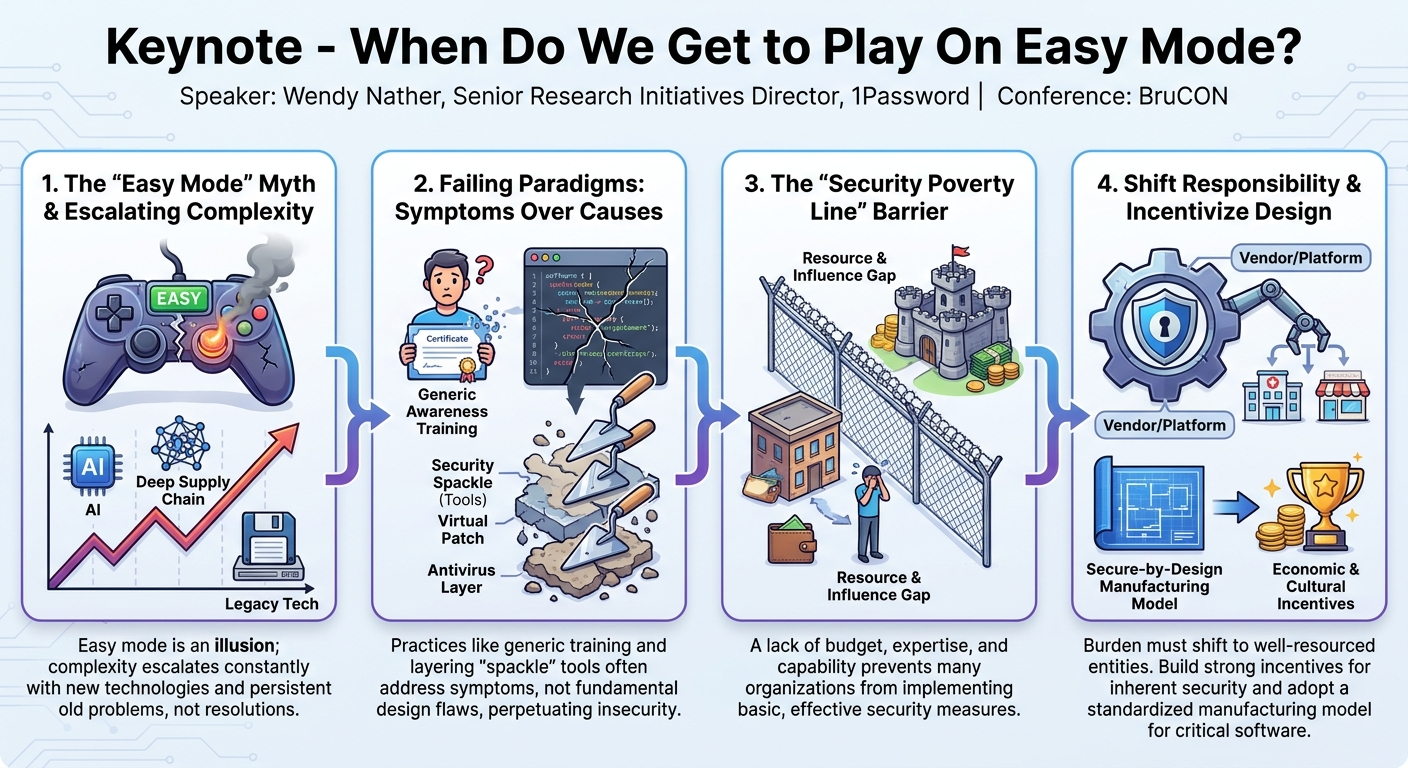
- The "Easy Mode" is a Myth, and Complexity is Escalating: Despite decades of effort, security problems identified in 2006 are still hard, and a new wave of complexities (AI, deep supply chains, secure composition) has made the landscape even more challenging. The idea that security will eventually become simple is unfounded.
- Current Security Paradigms Are Failing: Practices like generic awareness training are largely ineffective, and in some cases, counterproductive. The reliance on "security spackle"—adding layers of tools to patch symptoms rather than fixing root causes—has created a multi-billion dollar industry that perpetuates, rather than solves, the problem of insecure software.
- Users are Assets, Not the Weakest Link: Shifting the blame to users as the "weakest link" is a flawed and harmful narrative. Users can be invaluable sources of threat intelligence, and systems should be designed to be resilient regardless of individual user actions.
- The "Security Poverty Line" is a Major Barrier: Many organizations lack the fundamental resources (budget, expertise, capability, influence) to implement effective security. This "security poverty line" is a systemic issue, not a reflection of laziness or stupidity, and is exacerbated by the high cost of tools and competition for skilled personnel.
- Conventional Security Wisdom Often Collides with Reality: Principles like "segregation of duties" or "fail-closed" systems are often impractical in real-world contexts, particularly in the public sector (due to budget constraints) or critical services like healthcare (where patient access outweighs privacy in emergencies) and aviation (where patching cannot happen mid-flight).
- We Lack Effective Metrics for What Actually Works: The industry struggles to measure the true effectiveness of security investments. Common metrics are often chosen for ease of collection rather than utility, leading to flawed assessments (e.g., "peanut butter times jet engine equals shiny" for multiplying ordinal numbers in risk calculations). Peer benchmarking is also unreliable if peers have poor security.
- Individual Responsibility is an Unsustainable Model: Expecting every organization to secure itself is unrealistic. The burden of security needs to shift to those who can afford it—typically larger entities, vendors, or government-backed initiatives—moving away from a purely individualistic approach.
Technical Deep Dive
▶ Watch: The 'security poverty line': Budget, expertise, capability, influence (22:00)
While Nather's keynote was primarily strategic and philosophical, it delved into the systemic and design-related technical challenges that underpin the industry's struggles. Her critique wasn't about specific exploits but rather the fundamental approaches to building and securing technology.
A core technical issue highlighted was the persistent failure of foundational security mechanisms, exemplified by the recurring "year of X509" certificates. This phrase points to the ongoing difficulties with public key infrastructure, certificate management, and trust models that, despite being established technologies, continue to be sources of vulnerability and operational headaches. The implication is that even mature technical controls are not being effectively implemented or managed at scale.
Nather's concept of "security spackle" is a direct technical critique. She traced this approach back to the invention of antivirus software, which, rather than fixing vulnerabilities in core operating systems or applications, provided a separate layer of protection against known threats. This set a precedent for an industry that prioritizes reactive, layered security tools over proactive, secure-by-design software development. The result is a complex, multi-billion dollar ecosystem of tools (firewalls, intrusion detection systems, virtual patching solutions, etc.) that attempt to catch or mitigate attacks after they exploit underlying, unaddressed flaws. This layering introduces its own complexities, potential misconfigurations, and performance overhead, often without truly resolving the root insecurity.
The challenge of vulnerability management was presented not as an invalid activity, but as an incomplete form of defense. Nather emphasized the practical impossibilities of "just patching faster" in many real-world scenarios. She cited examples like 10-year-old CT scanners in hospitals, legacy industrial control systems, end-of-life edge devices (routers, IoT), and even ATMs still running Windows 95. These systems, while functional and critical, are often unpatchable due to lack of vendor support, prohibitive replacement costs (e.g., a million-dollar CT scanner), or operational constraints (e.g., American Airlines requiring multiple personnel and grounding a plane to apply a patch). For these systems, conventional vulnerability management advice is technically unfeasible, leaving them as prime targets for sophisticated threat actors, including nation-states.
The talk also touched on the evolving technical landscape of software development. Nather noted that modern software is rarely built from scratch but rather assembled from components sourced from open-source repositories, Stack Overflow, and increasingly, AI-generated code. This "secure composition" problem vastly complicates the software supply chain, making it many more levels deep and introducing unknown vulnerabilities from third-party or AI-generated components. Her proposed solution, a shift from a "literary model" (where every developer wants to "reinvent things" and "roll their own crypto") to a manufacturing model, suggests a need for standardized, rigorously tested, and approved components for critical applications, even at the expense of individual developer innovation for essential functions.
During the Q&A, a question about password managers (specifically 1Password vs. KeyPass) brought up the fundamental cryptographic challenge: "If you can see the password, I as an attacker can see the password." Nather clarified that with 1Password, the user does not necessarily have to see the password in clear text, implying secure handling of credentials within the manager itself, mitigating this specific risk. This brief exchange highlighted the ongoing struggle to balance usability with strong cryptographic principles in user-facing security tools.
Finally, Nather pointed to regulatory frameworks like GDPR and PCIDSS as examples of how non-technical incentives can drive technical change. GDPR, for instance, forced organizations to inventory their data, a fundamental step in data security that many had previously neglected. PCIDSS provides a prescriptive list of technical controls to secure credit card data, which, while narrowly scoped, effectively manages a specific risk. These examples illustrate that while technical solutions exist, their widespread adoption and effective implementation often depend on external, non-technical drivers like compliance and audit requirements, which management is more likely to believe in than abstract probabilities of attack.
Demo / Proof of Concept
▶ Watch: No talent shortage, just bad job requirements (40:00)
As a keynote address, Wendy Nather's presentation focused on high-level strategic analysis and critical commentary on the state of cybersecurity rather than technical demonstrations. Therefore, no live demo or proof of concept was included in the talk.
Defensive Implications
▶ Watch: Q&A: Industry self-regulation versus government intervention (54:00)
Nather's keynote provided a roadmap for defenders to move beyond the current state of perpetual difficulty by advocating for fundamental shifts in mindset and strategy:
- Question All Assumptions: Defenders must critically evaluate long-standing practices and conventional wisdom. If something has been tried repeatedly for years without significant improvement (e.g., awareness training, X509 issues), it's time to ask "Can we do something different now?" This includes challenging metrics that are easy to count but not useful.
- Shift the Burden of Security: The expectation that every organization, regardless of size or resources, should be solely responsible for its own security is unsustainable. Defenders should advocate for transferring the burden of securing things onto organizations that can afford it—larger vendors, platform providers, and potentially government-backed shared infrastructure (like Estonia's model). This includes advocating for collective bargaining power for smaller organizations to demand security fixes from suppliers.
- Build Better Incentives: The industry needs to move beyond compliance-as-a-hammer and develop robust economic, cultural, and political incentives for secure design and practices. This means creating environments where doing the right thing for security is inherently rewarded, rather than just avoiding penalties. Mitigating "externalities" of breaches (where victims bear costs for others' failures, like in the Blackbod case) is crucial.
- Adopt a Manufacturing Model for Software Development: For critical use cases, the "literary model" of software development—where every developer reinvents components—must give way to a "manufacturing model." This entails using standardized, proven, and rigorously tested components, even if it curtails individual innovation in essential security functions. "Do not roll your own crypto" should extend to many more critical software components.
- Stop Blaming the Victims and Prioritize Design: The narrative of "users are the weakest link" or blaming individuals for clicking links is unproductive. Instead, defenders should focus on advocating for and implementing better system design that is resilient to human error and inherently secure. Security should be a service function, not a control function, designed to empower users, not restrict them.
- Democratize Security: Security should not be an esoteric "wizardry" understood only by a select few. Systems must be designed so that "muggles" (non-technical users) can operate them securely without needing deep technical knowledge. This involves making security intuitive, accessible, and user-centric, empowering individuals to use security to serve their own needs (like Nather's daughter using parental controls for study time).
- Develop Meaningful Metrics: Defenders need to push for metrics that actually indicate success and effectiveness, rather than just what's easy to collect. Nather cited Jay Healey's work on "Are we winning?" metrics, which focus on adversarial disruption (e.g., frequent retooling of adversary infrastructure, smaller groups driven out of business, difficulty in recruiting talent). These provide a more holistic view of defensive success.
- Broaden the Talent Pool and Promote Diverse Leadership: The perceived "talent shortage" in security is often a result of narrow job requirements. Defenders should recognize that many individuals without traditional security or technical backgrounds can contribute significantly. Actively hiring from diverse areas and providing opportunities for leadership to everyone, not just managers, is essential to foster new ideas and approaches.
Key Takeaways
- Security's "Easy Mode" is a Myth: Despite decades of effort, cybersecurity remains profoundly difficult, with old problems persisting and new complexities like AI and deep supply chains continually emerging.
- Ineffective Strategies Persist: Traditional approaches like generic awareness training and layering "security spackle" (e.g., antivirus) merely address symptoms rather than fixing fundamental design flaws, creating an expensive and often ineffective industry.
- Systemic Barriers Impede Progress: Many organizations are constrained by a "security poverty line" (lack of budget, expertise, capability, and influence), preventing them from implementing basic security, while conventional wisdom often clashes with real-world operational realities.
- Shift Responsibility and Incentivize Better Design: The burden of security must shift from individual victims to those with the resources and capability (vendors, large organizations, government). This requires building stronger economic, cultural, and political incentives for secure design and adopting a "manufacturing model" for software in critical use cases.
- Democratize Security and Redefine Talent: Security should be designed as an accessible service function, not an esoteric "wizardry." The industry must broaden its definition of talent, recognizing that individuals from diverse backgrounds can contribute significantly, and foster leadership opportunities for all.
- Focus on Outcome-Based Metrics: Current security metrics are often flawed and uninformative. The industry needs to develop and adopt meaningful metrics that measure actual defensive success and adversarial disruption, rather than just easily quantifiable but often useless figures.
About the Speaker(s)
Wendy Nather is a highly respected and influential figure in the cybersecurity community, boasting over 30 years of experience in the field. Currently serving as the Senior Research Initiatives Director at 1Password, she brings a wealth of practical and strategic knowledge to her role. Nather has held various CISO positions, including at the Texas Education Agency, where she gained firsthand experience navigating the challenges of securing organizations with limited resources. Her extensive background includes working across both public and private sectors.
Nather is recognized for her analytical prowess and critical perspective, evidenced by her participation in a committee for the US National Academy of Sciences, Engineering, and Medicine, tasked with identifying the enduring "hard problems" in cybersecurity. She is listed as a "power player" in the Hall of Fame, a testament to her significant contributions and thought leadership. Throughout her career, Wendy Nather has consistently challenged conventional wisdom and advocated for more effective, systemic approaches to cybersecurity.
Reviews
Dr. Zero (Offensive Security Researcher) — SOLID
Nather brings the hammer down on 30 years of industry failures. There are no zero-days here, but her dissection of 'security spackle' and the poverty line is mandatory listening for anyone building a defense program instead of just buying one.
Heather Calloway (CISO) — MUST SEE
Wendy Nather delivers a masterclass in institutional realism, dismantling the illusion that security will ever be 'solved' by stacking more point solutions. She correctly diagnoses that our primary failures are economic and structural, not technical. Every CISO and board member should watch this to understand why our budgets keep growing while our systemic risk remains the same.