Our Time in a Product Review Cabal: And All the Malware and Backdoors That Came With It
Adam Schaal (AWS Security), Matt Virus (IoT Architect)
BruCON 0x11 · Day 2 · Gouden Carolus
Overview
In their BruCON talk, "Our Time in a Product Review Cabal: And All the Malware and Backdoors That Came With It," Adam Schaal and Matt Virus exposed the dark underbelly of online retail and the significant security and privacy risks embedded in a vast array of inexpensive consumer electronics. What began as an innocent pursuit of free products through a product review cabal during the COVID-19 pandemic quickly evolved into a deep technical investigation, uncovering widespread vulnerabilities, intentional backdoors, and questionable data exfiltration practices in devices ranging from smart home gadgets to security cameras and mesh routers.
Key moments
- 2:30 How we got started and scaled the product review cabal
- 8:15 Tuya platform: plaintext data, forced firmware, FCC issues
- 17:00 Peer-to-peer camera networks: Calculated IDs and super nodes
- 24:00 Programmer malware and GPU-cracked camera root password
- 30:00 Cautionary tale: Hidden Wi-Fi in a Tempur-Pedic bed
- 36:00 How to spot fake online reviews and white label products
- 41:00 Future vision: Making firmware analysis accessible to all
- 52:50 Q&A: Minimal equipment for starting hardware hacking
Our Time in a Product Review Cabal: And All the Malware and Backdoors That Came With It
Speakers: Adam Schaal (AWS Security); Matt Virus (IoT Architect)
Conference: BruCON
YouTube: https://www.youtube.com/watch?v=aBsf75c1zqw
Overview
In their BruCON talk, "Our Time in a Product Review Cabal: And All the Malware and Backdoors That Came With It," Adam Schaal and Matt Virus exposed the dark underbelly of online retail and the significant security and privacy risks embedded in a vast array of inexpensive consumer electronics. What began as an innocent pursuit of free products through a product review cabal during the COVID-19 pandemic quickly evolved into a deep technical investigation, uncovering widespread vulnerabilities, intentional backdoors, and questionable data exfiltration practices in devices ranging from smart home gadgets to security cameras and mesh routers.
The speakers, both seasoned security professionals, detailed their journey from casually accepting free items to systematically dissecting hundreds of devices. Their research revealed a disturbing trend: many "white label" products, often from Chinese manufacturers leveraging platforms like Tuya, are designed with glaring security flaws, unchangeable default passwords, and hidden mechanisms that send sensitive user data to untrusted servers. This talk serves as a critical warning about the often-overlooked supply chain risks inherent in cheap, mass-produced IoT devices, highlighting how convenience and low cost can come at the steep price of personal security and privacy.
The implications of their findings extend far beyond individual consumers. The proliferation of these vulnerable devices in public spaces, businesses, and even government facilities presents a systemic risk, creating potential surveillance opportunities and entry points for malicious actors. Schaal and Virus not only cataloged these issues but also demonstrated advanced techniques, including AI-assisted firmware analysis and GPU-accelerated password cracking, to extract hidden secrets and advocate for open-source alternatives and local control. Their work underscores the urgent need for greater consumer awareness, robust device security standards, and the "right to repair" to empower users to truly own and secure their digital environments.
Background
▶ Watch: How we got started and scaled the product review cabal (2:30)
The genesis of this extensive research project was rooted in an innocuous marketing tactic during the COVID-19 pandemic. As online shopping surged, Matt Virus received a promotional postcard in a product box offering a free item in exchange for an email. This initial offer quickly escalated: unable to provide the promised item, the vendor instead offered a four-pack of smart switches, requiring Matt to purchase them from an online retailer (e.g., Amazon, AliExpress, Walmart) and submit the receipt for a full PayPal reimbursement. This "free stuff" model, where the vendor pays for the product and often doesn't initially request a review, proved highly scalable.
Recognizing the pattern, Matt and Adam, thinking "like a hacker," began to experiment. They used multiple email addresses and retailer accounts, discovering that vendors did not track reviewer identities. This allowed them to "scale the cabal," inviting friends and community members to participate. The cabal became a network for sharing product offers, ranging from mundane household items like kitchen knives and bread makers to more intriguing electronics. While some items were of poor quality (e.g., knife coatings flaking into food), the primary focus quickly shifted to the electronics, particularly those from brands like Tekken, Treat Life, and Apeman, which frequently messaged them with offers.
As the volume of free electronics grew, skepticism naturally arose. The ease with which these products were acquired, combined with the vendors' apparent indifference to reviewer identity or even basic communication protocols, raised red flags. This "too good to be true" scenario prompted the speakers to question the true cost of these seemingly free devices. Their suspicion was further fueled by the sheer number of different brands (dozens daily) all funneling through similar reimbursement schemes, suggesting a systemic, underlying issue rather than isolated promotions. This led them to transition from mere recipients of free goods to diligent security researchers, embarking on a deep dive into the hardware and software of these ubiquitous consumer products.
Key Findings
▶ Watch: Peer-to-peer camera networks: Calculated IDs and super nodes (17:00)
The research uncovered a litany of concerning findings across various device categories:
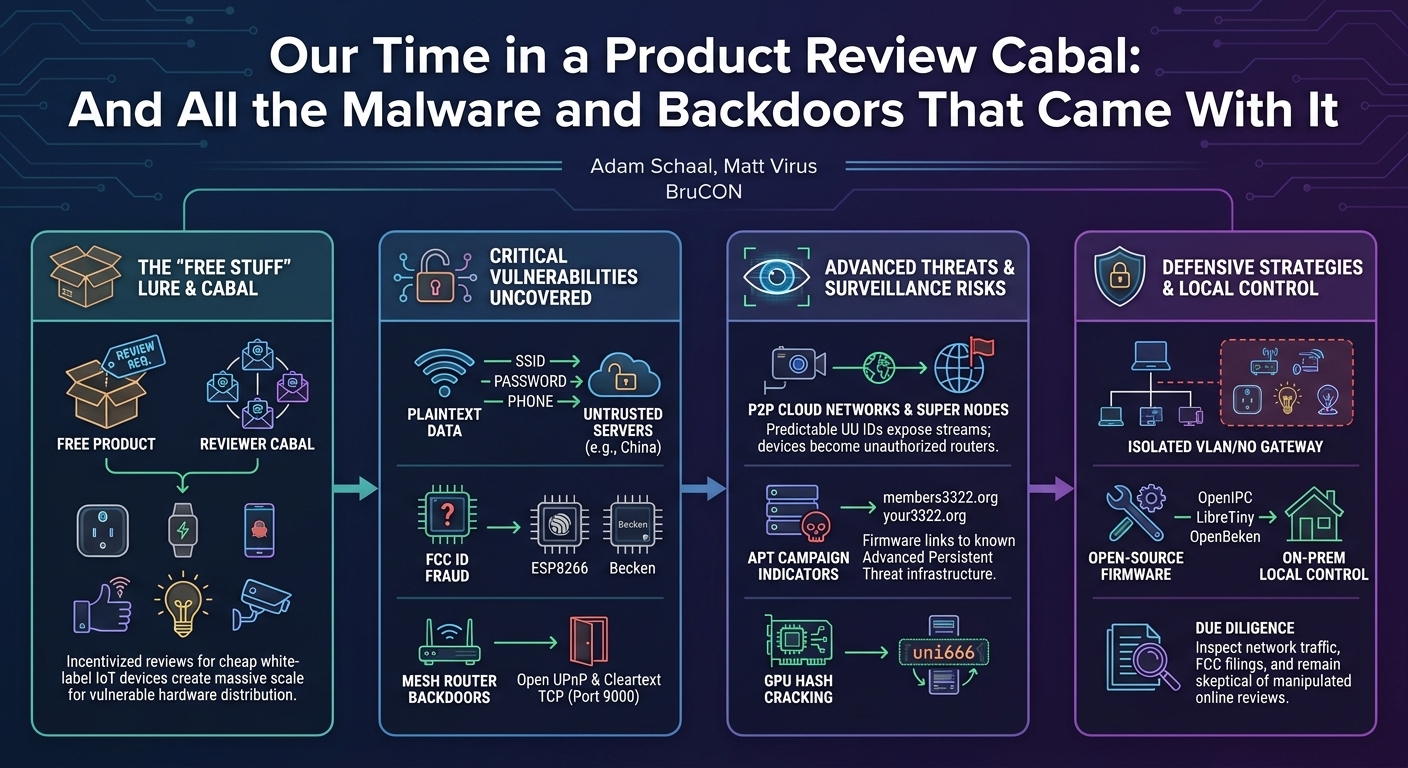
- Tuya Platform Vulnerabilities: Many smart home devices relied on the Tuya platform, a backend service for IoT vendors. During device onboarding, sensitive data including phone numbers, SSIDs, and Wi-Fi passwords were observed being transmitted in plaintext to servers, often located in China. Furthermore, device manufacturers retained the ability to force firmware updates at will, without user consent or control.
- FCC ID Fraud and Hardware Changes: Devices often shipped with the same FCC ID despite having substantial internal hardware changes, such as switching from ESP8266 to Becken chipsets. This practice circumvents regulatory review processes, as significant hardware alterations should trigger new FCC evaluations and require updated internal pictures on FCC.io.
- Mesh Router Backdoors: A mesh router received by Adam exhibited multiple security flaws. It lacked a web interface, requiring a phone app for setup. Scanning revealed UPnP (port 5500) wide open by default, and an auto-configuration port (9000) using cleartext TCP to receive the device's serial number, which served as an unchangeable password. The Android app was found to beacon out to Facebook and a suspicious IP address in China. Further investigation hinted at a "Lucy admin data manager possible tender backdoor."
- Camera Surveillance Risks: Dozens of cameras from brands like Victor, Boger, and SAM presented serious issues. Many had poor default software and were observed undergoing automatic firmware updates that pivoted their beaconing activity from China to AWS or Oracle servers. A critical finding related to a peer-to-peer cloud network (as detailed in a Defcon talk by Polymer PC), where cameras connect to a swarm using a calculated, guessable UU ID (Unique User ID). This system could turn user cameras into super nodes, routing other users' video streams through them, and allowed unauthorized access to streams if a UU ID was known or guessed. The SAM camera, in particular, enabled P2P networking by default with no in-app option to disable it in later app versions, although a hidden web interface still provided control. Some cameras, like a Foscam, ran critically vulnerable RTSP encoding servers with known exploits.
- Malware in Programming Tools: Even the tools acquired for research were compromised. The installer for an X Gecko firmware programmer, purchased from Amazon, contained unwanted executable files, highlighting the pervasive nature of supply chain risks.
- "UNI 666" Root Password Discovery: Leveraging a powerful GPU-accelerated Hashcat instance on "The Kernel" (a 192-core AMD Genoa server with 1.5TB DDR5 and 128GB GPU memory), the researchers successfully cracked a hash found in camera firmware, revealing the root password to be
uni666. This password, roughly translating to "free as a cloud," was a crucial discovery for gaining full control over the devices. - APT Campaign Indicators: Deepseek (a large language model) assisted in analyzing firmware binaries, identifying references to suspicious domains like DVR163.com and, more critically, members3322.org and your3322.org. The domain 3322.org is historically associated with numerous APT campaigns, raising significant red flags about potential state-sponsored surveillance capabilities embedded within these devices.
- Undocumented Functionality: Personal cautionary tales included a seemingly standard Tempropedic bed that clandestinely broadcast Wi-Fi SSIDs for an undocumented, adjustable Wi-Fi feature not listed in manuals or FCC filings, and a baby monitor using an open Wi-Fi signal for unauthenticated access.
Technical Deep Dive
▶ Watch: Cautionary tale: Hidden Wi-Fi in a Tempur-Pedic bed (30:00)
The technical investigations conducted by Schaal and Virus delved into the hardware and software architectures of the compromised devices, revealing systemic vulnerabilities and design choices that prioritize cost and convenience over security.
At the core of many smart home devices was the Tuya platform. This ecosystem provides a ready-made backend for vendors, allowing them to rapidly bring hardware to market without developing their own control software. However, this convenience came with significant privacy costs. During device onboarding, a WireShark capture clearly showed the transmission of sensitive user data—including phone numbers, Wi-Fi SSIDs, and even Wi-Fi passwords—in plaintext to Tuya's servers, which were initially located in China. The platform also enabled manufacturers to push forced firmware updates, meaning a vendor could unilaterally change device behavior without user consent.
Early iterations of these devices frequently incorporated the ESP8266 processor, a popular and easy-to-flash microcontroller. This commonality led to the development of Tuya Convert, a widely used exploit that allowed users to over-the-air flash Tuya devices with open-source firmware like ESPHome or Tasmota, thereby liberating them from the proprietary cloud. However, manufacturers eventually patched this vulnerability by moving the key derivation method to the server side.
Subsequent hardware revisions saw a shift from ESP8266 to Becken chips. These new chips, while sharing a similar form factor, utilized a completely different architecture, rendering existing ESP8266-compatible open-source firmware incompatible. Initially, the researchers resorted to a hardware-intensive workaround: using a hot air station to desolder the Becken chip and replace it with an ESP32 or ESP12F, pre-flashed with custom code. This demonstrated the lengths required to regain control over the hardware. A later exploit, Tuya Cloud Cutter, provided a more elegant solution by enabling the writing of new keys to Becken chips, allowing users to emulate the Tuya cloud locally. This effectively severed the device's connection to the public Tuya cloud. The community further developed open-source firmwares like LibreTiny (based on ESPHome) and OpenBeken (similar to Tasmota), which could be flashed via UART tools, offering auditable and controllable alternatives.
Mesh routers presented a different set of dangers. One router required a phone app for setup, lacking any web interface. Network scans revealed UPnP (Universal Plug and Play) on port 5500 wide open, a dangerous default configuration that exposes internal network services. Furthermore, another port (9000) used cleartext TCP to transmit the device's serial number, which functioned as an unchangeable password during Wi-Fi repeater auto-configuration. Packet captures of the Android app showed it beaconing out to Facebook and a hardcoded IP address in China, raising concerns about data exfiltration and potential surveillance. Researchers also found references to "Lucy admin data manager possible tender backdoor" in the router's firmware, indicating known vulnerabilities in similar devices at the time.
Security cameras were particularly problematic. Accessing the UART interface during boot revealed debugging messages such as "can't create directory" errors, indicating poor software quality. Some cameras performed automatic firmware upgrades, dynamically changing their beaconing destinations from Chinese servers to AWS or Oracle. A major vulnerability stemmed from their reliance on peer-to-peer cloud networks. These networks, designed to facilitate remote access without complex port forwarding, used a calculated UU ID for connection. Critically, this UU ID was not truly unique or secure, allowing for potential brute-forcing or guessing to access other users' camera streams. Moreover, some cameras could become super nodes, inadvertently routing other users' video traffic through the local network, which could be easily captured. The SAM camera exemplified this, enabling P2P networking by default with no user-friendly option to disable it in its companion PS6 light app. Although a hidden web interface remained accessible via the camera's broadcasted SSID, its existence was obscured. Additionally, Foscam cameras were found running unpatched, vulnerable RTSP encoding servers, known to be exploited in the wild. Mitigation strategies included DHCP reservations without a default gateway, Layer 3 ACLs, static IP configurations in isolated VLANs, or, ideally, replacing the firmware with open-source alternatives like OpenIPC.
To scale their analysis, the researchers turned to AI. After physically dumping firmware chips using a hot air station and an X Gecko programmer (which itself contained unwanted software during installation), they fed the binary images to ChatGPT and later to a local Deepseek instance running on "The Kernel," a custom-built, high-performance server featuring an AMD Genoa CPU, 1.5 terabytes of DDR5 RAM, and 128 gigabytes of GPU memory. Initial prompts to the LLM involved extracting file system information, carving for magic numbers, and identifying interesting blobs. The AI successfully identified hashes, ONVIF libraries, and cloud references. Most notably, "The Kernel" was used for GPU-accelerated Hashcat against a discovered hash, cracking it in a few hours to reveal the root password uni666. Deepseek also uncovered specific callouts to DVR163.com and, more alarmingly, members3322.org and your3322.org. The domain 3322.org has a well-documented history of use in various APT campaigns, suggesting a potential link to state-sponsored activities.
Demo / Proof of Concept
▶ Watch: How to spot fake online reviews and white label products (36:00)
While the talk did not feature a live, real-time exploit demonstration in the traditional sense, the speakers effectively presented a powerful proof of concept through their detailed technical findings and the innovative application of advanced analysis tools. The core of their "demo" was the process of extracting, analyzing, and ultimately compromising the firmware of a vulnerable camera.
This demonstration began with the physical firmware dumping process, which involved using a hot air station to remove the memory chip from a camera's PCB and then employing an X Gecko programmer to extract the binary image. This crucial first step provided the raw data for subsequent analysis.
The true highlight of their proof of concept was the AI-assisted firmware analysis and GPU-accelerated password cracking. They showcased how a large language model like Deepseek, running locally on their custom-built "The Kernel" server (a formidable machine equipped with a 192-core AMD Genoa CPU and 128GB of GPU memory), could process and identify interesting patterns, hashes, and domain references within the firmware binary. This demonstrated the scalability and efficacy of AI in rapidly sifting through vast amounts of code.
Following the AI's identification of a specific hash, the team then leveraged "The Kernel's" immense computational power to run Hashcat, a leading password recovery tool, against the hash. In a compelling reveal, they presented the successful cracking of the hash within a few hours, uncovering the root password uni666 for the camera. This concrete finding not only proved a critical vulnerability but also provided a clear pathway for anyone to gain unauthorized administrative access to these devices, bypassing their intended security mechanisms.
Further elements of their "demo" were the numerous WireShark captures illustrating plaintext data transmission, the comparison of different chipsets under identical FCC IDs (demonstrating regulatory circumvention), and the use of UART interfaces to observe device boot processes and expose internal errors. The detailed explanation of the peer-to-peer cloud network and the calculated UU ID for cameras, coupled with the revelation that the SAM camera's P2P feature was on by default with no in-app disable option, served as a powerful conceptual demonstration of pervasive privacy risks. These combined methods provided compelling evidence of the widespread security deficiencies and potential for exploitation in the devices they investigated.
Defensive Implications
▶ Watch: Q&A: Minimal equipment for starting hardware hacking (52:50)
The findings presented by Schaal and Virus carry critical implications for consumers, businesses, and security professionals, urging a proactive and skeptical approach to ubiquitous IoT devices.
- Beware of White Labels and Fake Reviews: Consumers must be highly skeptical of products promoted through aggressive online marketing, especially those with blurred branding in promotional images or frequent name changes. These white label products are often mass-produced, rebranded, and frequently harbor the same underlying vulnerabilities. Online reviews are heavily manipulated; look for patterns like consistently five-star ratings, generic or overly enthusiastic comments, or reviews that are clearly unrelated to the product (e.g., a dimmer switch review discussing a Bluetooth thermometer). Such reviews are often generated to artificially inflate product visibility and sales, not to provide genuine feedback.
- Isolate Untrusted Hardware: Any new or untrusted IoT device should be treated as potentially malicious. Never connect it directly to your main home or corporate network. Instead, deploy it in a safe, isolated environment. This can be achieved through dedicated VLANs (Virtual Local Area Networks), Layer 3 ACLs (Access Control Lists) to restrict outbound traffic, or by configuring devices with a static IP address but without a default gateway if they only need local network access (e.g., for RTSP video streams to a local DVR). This prevents devices from beaconing out to unknown servers or acting as an entry point for network compromise.
- Prioritize Open-Source Firmware and Local Control: Whenever possible, replace proprietary firmware with open-source alternatives. Projects like OpenIPC, LibreTiny, and OpenBeken offer auditable and controllable codebases, allowing users to understand and manage device behavior. Tools like Tuya Convert and Tuya Cloud Cutter facilitate this process, even for chips previously thought to be locked down. The goal should be to run services locally (on-prem), decoupling devices from untrusted cloud providers and forced updates. This eliminates risks associated with data exfiltration to foreign servers and ensures users maintain full control over their own data and devices.
- Practice Due Diligence for All Devices: Even seemingly reputable or established devices can harbor hidden risks. The cautionary tale of the Tempropedic bed with undocumented Wi-Fi functionality highlights the need to inspect every device entering your environment. This includes reviewing FCC filings for internal photos (via FCC.io), inspecting network traffic with tools like WireShark, and scanning for open ports. Assume that any device with network capabilities will try to connect out and potentially expose data.
- Advocate for Right to Repair and Device Transparency: The difficulties encountered in analyzing and securing these devices underscore the importance of movements like Right to Repair. Laws that empower consumers to repair, modify, and understand their purchased electronics are crucial for security. Furthermore, greater transparency from manufacturers regarding hardware revisions, firmware updates, and data handling practices is desperately needed to build trust and accountability in the IoT ecosystem.
- Support Community-Driven Security Efforts: The work presented by Schaal and Virus, including their open-sourcing of firmware analysis scripts and plans for a community firmware analysis and inspection MCP server, demonstrates the power of collaborative security. Engaging with and contributing to such projects can lower the barrier to entry for device analysis, enabling more individuals to identify and mitigate risks for themselves and their communities.
Key Takeaways
- Ubiquitous Security Risks: Cheap, "white label" IoT devices from online retailers are rife with security vulnerabilities, including plaintext data transmission, unchangeable default passwords, and hidden backdoors.
- Data Exfiltration and Surveillance: Many devices are designed to beacon sensitive user data (SSID, Wi-Fi password, phone number) to untrusted foreign servers, with some firmware containing references to domains linked to known APT campaigns.
- Manipulated Online Reviews: The online review ecosystem is heavily gamed, with fake reviews artificially boosting product visibility and obscuring legitimate security concerns. Consumers must exercise extreme skepticism.
- The Need for Local Control: Relying on proprietary cloud platforms for IoT devices relinquishes control and introduces significant privacy and security risks. Prioritize open-source firmware and on-premise solutions to maintain data sovereignty.
- Advanced Analysis is Possible: Even complex, proprietary firmware can be analyzed and understood through techniques like firmware dumping, static/dynamic analysis, and leveraging AI tools like Deepseek and GPU-accelerated hash cracking.
- Proactive Defense is Essential: Isolate untrusted devices on dedicated VLANs, restrict their internet access, and consider replacing proprietary firmware with auditable open-source alternatives to protect your network and privacy.
About the Speaker(s)
Adam Schaal is the Head of AWS Shine, a passionate home lab enthusiast, and deeply involved in his local community in the United States. He is known for his work on projects like the O.MG Cable and is the founder of Kernelcon, a security conference held in Omaha, Nebraska. Adam's expertise spans hardware, software, and community building within the security space.
Matt Virus is an IoT Architect at Cisco, bringing extensive experience in IoT hackery and device security. With a background in malware reverse engineering from his time at the Department of Defense, Matt applies his skills to understanding and securing the vast array of connected devices, including those found on his farm in Nebraska. He is a prominent figure in the security community, running hackspace.io and leading the hardware hacking village at Kernelcon.
Reviews
Dr. Zero (Offensive Security Researcher) — STRONG ACCEPT
Schaal and Virus weaponized an Amazon review scam to source a mountain of white-label IoT garbage, then systematically ripped the hardware apart. It is a highly entertaining, technically robust masterclass in hardware reverse engineering and firmware analysis. You come for the funny premise, but you stay for the UART dumps and local LLM binary carving.
Heather Calloway (CISO) — SOLID
This talk maps the severe supply chain risks embedded in cheap, white-label IoT devices. While presented as a hardware hacking adventure, it is a highly effective briefing on the realities of remote work exposure and shadow IT.