# I'm in Your Logs Now, Deceiving Your Analysts and Blinding Your EDR
Olaf Hartong (Defensive Specialist · FalconForce)
BruCON 0x11 · Day 2 · Gouden Carolus
Overview
In this compelling talk at BruCON, Olaf Hartong, a defensive specialist and security researcher at FalconForce, unveiled critical vulnerabilities within Windows' Event Tracing for Windows (ETW) mechanism, demonstrating how attackers can leverage it to deceive security analysts and even blind enterprise detection and response (EDR) solutions like Microsoft Defender for Endpoint. Hartong, a veteran of blue and purple team operations, initially sought to use ETW for safely simulating attacks to validate detection rules. However, his research uncovered a Pandora's Box of offensive capabilities, revealing that carefully crafted ETW events can mislead analysts, trigger event capping, and effectively obscure malicious activities from cloud-based EDR visibility.
Key moments
- 0:00 Introduction to ETW and talk overview
- 9:40 EDR reliance on ETW and event capping
- 25:30 Successfully spoofing events to cloud EDR
- 27:20 Blinding EDR by exceeding event caps
- 32:00 Microsoft's response and partial fixes
- 41:00 Buffer flooding to blind all ETW telemetry
- 45:00 Attacker capabilities and defender recommendations
- 52:00 Buffer flooding impacts non-cloud EDRs (Sysmon)
I'm in Your Logs Now, Deceiving Your Analysts and Blinding Your EDR
Speakers: Olaf Hartong, Defensive Specialist, FalconForce
Conference: BruCON
YouTube: https://www.youtube.com/watch?v=0XLiFU83VP0
Overview
In this compelling talk at BruCON, Olaf Hartong, a defensive specialist and security researcher at FalconForce, unveiled critical vulnerabilities within Windows' Event Tracing for Windows (ETW) mechanism, demonstrating how attackers can leverage it to deceive security analysts and even blind enterprise detection and response (EDR) solutions like Microsoft Defender for Endpoint. Hartong, a veteran of blue and purple team operations, initially sought to use ETW for safely simulating attacks to validate detection rules. However, his research uncovered a Pandora's Box of offensive capabilities, revealing that carefully crafted ETW events can mislead analysts, trigger event capping, and effectively obscure malicious activities from cloud-based EDR visibility.
The core of Hartong's findings centers on the ability to spoof ETW events from an unprivileged user context, a capability that directly challenges the integrity of telemetry relied upon by modern EDRs. This talk is particularly significant because ETW, while not designed with security in mind, has become an indispensable source of high-fidelity telemetry for security products due to its performance, flexibility, and comprehensive coverage. By exposing how attackers can manipulate this fundamental data stream, Hartong highlights a widespread blind spot in current defensive strategies, urging a critical re-evaluation of trust placed in EDR logs and a fundamental shift in how ETW is secured by operating system vendors.
Background
▶ Watch: Introduction to ETW and talk overview (0:00)
Event Tracing for Windows (ETW) is a high-performance, kernel-level telemetry mechanism deeply integrated into the Windows operating system. As Hartong points out, its original design was for "performance monitoring and debugging" – never explicitly for security. This foundational design choice is crucial to understanding its vulnerabilities. ETW operates through several key components: Event Providers (applications or kernel drivers generating telemetry), Trace Sessions (configured by consumers to collect specific events), and Consumers (programs like eventlog.exe or EDR agents that request and process events). The ETW kernel orchestrates the logistics, connecting providers to consumers via trace sessions.
ETW supports various session types, including real-time sessions (which EDRs primarily use for immediate data), file logging sessions, and private sessions (often used for internal application monitoring). Crucially, these sessions often utilize buffer pools to manage event flow, a detail that becomes central to one of Hartong's most impactful attack techniques. Previous offensive research into ETW largely focused on kernel-level attacks, such as patching kernel memory, tampering with on-disk files, or disabling trace sessions, all of which typically require high privileges (e.g., local administrator access or vulnerable drivers). Hartong's unique contribution was to explore how ETW could be abused from an unelevated user mode, making it accessible to attackers post-initial access without requiring privilege escalation.
Security tools, particularly EDRs, heavily rely on ETW for several reasons: its stability (no code injection needed), performance (low-level kernel integration, buffered memory), dynamic control (config-driven telemetry changes), and unparalleled coverage breadth compared to limited kernel callbacks. For instance, Microsoft Defender for Endpoint (MDE) utilizes a vast array of ETW providers in addition to kernel callbacks, underscoring its dependency on this telemetry source. However, cloud-based EDRs also implement capping mechanisms on ETW events to manage bandwidth and storage costs. These caps, often set at 1,000 events per specific type (e.g., LDAP queries), represent another significant vulnerability that Hartong exploited.
Key Findings
▶ Watch: Successfully spoofing events to cloud EDR (25:30)
Olaf Hartong's research uncovered several critical vulnerabilities and attack vectors related to ETW, demonstrating how attackers can achieve stealth and deception within EDR-monitored environments:
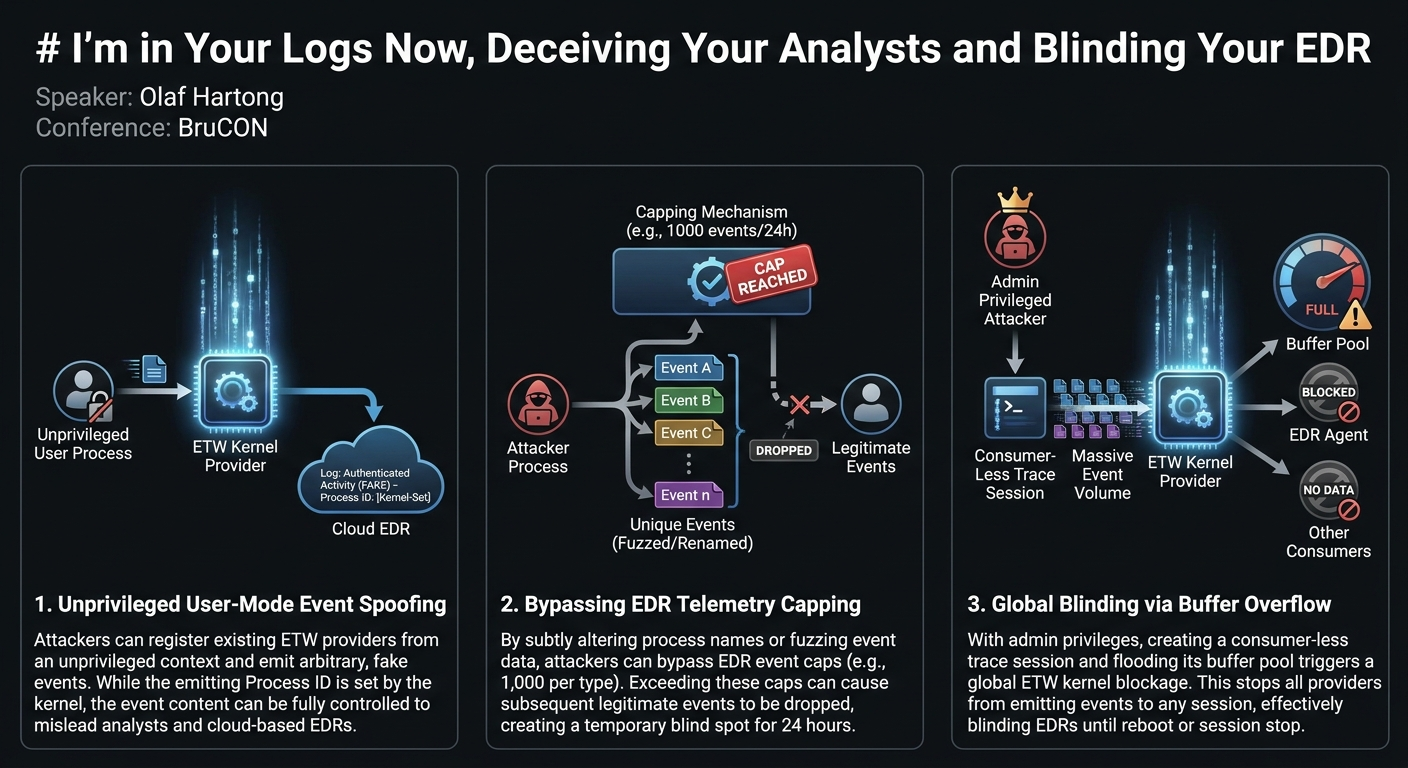
- User-Mode ETW Event Spoofing: Hartong successfully demonstrated the ability to register an existing ETW provider from an unprivileged user process and emit arbitrary, fake events that are indistinguishable from legitimate ones by the ETW kernel. These spoofed events are then consumed by EDRs and sent to the cloud, making them appear as authentic telemetry. While the Process ID (PID) of the emitting process cannot be spoofed (the kernel overwrites it), the content of the event itself can be fully controlled.
- Bypassing EDR Telemetry Capping: Cloud-based EDRs, including Microsoft Defender for Endpoint, implement aggressive capping on certain ETW event types (e.g., LDAP queries, network connections) to manage data volume and cost. Hartong found that these caps, often set at 1,000 events per unique combination (e.g., process, search filter, distinguished name) per 24 hours, can be easily bypassed. By slightly altering the process name or fuzzing specific data fields within the event (e.g., the LDAP search filter), an attacker can generate an entirely new "unique" event, circumventing the cap and ensuring their malicious activity is logged. More importantly, by exceeding the cap (e.g., sending 1,337 events when the cap is 1,000), subsequent legitimate events of that type from any process on the system are simply dropped and never reach the EDR cloud, creating a temporary blind spot for 24 hours.
- Blinding EDRs via ETW Buffer Overflow (Denial of Service): This is arguably the most impactful finding. ETW real-time sessions are assigned buffer pools. Hartong discovered that if an attacker, with local administrative privileges, creates a real-time trace session for an ETW provider (e.g., the LDAP provider) but does not connect a consumer to it, and then floods that session with a massive volume of events, the buffer pool will eventually fill up. Critically, when this occurs, the ETW kernel stops all providers from emitting events not just to that specific session, but to any session. This effectively blinds EDRs that rely on those providers for telemetry, as they will receive no further events until the system is rebooted or the offending trace session is unregistered. This attack impacts both cloud-based and local EDRs relying on ETW.
- Influencing Conditional Access Policies and Analyst Behavior: By generating fake alerts (e.g., 1,300 fake malware detections, fake ransomware alerts, fake real-time protection toggles), attackers can potentially:
- Trigger conditional access policies that block user access based on device compliance or risk scores.
- Overwhelm security operations centers (SOCs) with noise, distracting them from actual malicious activity.
- Obscure legitimate malicious activity by making it appear as part of a larger, fabricated incident.
- Microsoft's Partial and Delayed Response: Hartong reported these findings to Microsoft Security Response Center (MSRC). Initial responses dismissed the issues as "not really raising the bar for immediate searching." However, after the research was presented, Microsoft implemented some fixes, but these were largely reactive and incomplete. For instance, they blocked fake ransomware event generation (by preventing registration of that specific provider) but left many other providers vulnerable to spoofing and capping bypass. The fundamental ETW buffer overflow vulnerability remains unaddressed, as it requires significant kernel-level architectural changes.
Technical Deep Dive
▶ Watch: Microsoft's response and partial fixes (32:00)
The ability to manipulate ETW events hinges on understanding its internal mechanisms, particularly how providers register and how events are structured.
ETW Providers and Registration:
An ETW provider is identified by a Globally Unique ID (GUID). Any process on a system can register a user-mode provider, even if one with the same GUID already exists. The EventRegister function, when called for an existing provider, simply returns a handle to that existing provider. This means an attacker's process can gain the ability to emit events through an already established, legitimate provider.
Providers come in different forms:
- MOF-based providers: Older, less common.
- Manifest-based providers: Introduced in Windows Vista, these are the most prevalent. Their definitions are stored in XML manifests within the
system32directory. These manifests define the structure of events, including event IDs and templates. A template specifies the data fields (e.g.,scope,search filter,distinguished namefor an LDAP event) that an event of a particular ID must contain. - Trace Logging providers: Primarily for in-application analysis, not requiring external manifests. Less relevant for these specific attacks.
The ETW kernel validates incoming events against these manifest templates. Hartong's initial challenge in spoofing events was correctly reverse-engineering these templates and ensuring the emitted data conformed to the expected structure, including nuances like little-endian byte ordering. Tools like ETW Explorer by Pavle can aid in this reverse engineering.
Event Emission and Spoofing:
Once a process obtains a handle to an existing provider, it can use functions like EventWrite to emit events. The ETW kernel receives these events and directs them to any active trace sessions listening to that provider. From the perspective of a consumer (e.g., an EDR), the event appears to originate from the legitimate provider. The only non-spoofable field at the user-mode level is the Process ID (PID), which the kernel automatically populates with the PID of the emitting process, not necessarily the process that the event claims to be about. This prevents an attacker from making a legitimate EDR process "kill itself" by spoofing self-incriminating events. However, the content of the event – what it describes – is entirely controllable.
ETW Security Mechanisms:
ETW does have security mechanisms, primarily focused on controlling consumer access to trace sessions, not provider registration or event emission.
- SDDLs (Security Descriptor Definition Language): Providers can register an SDDL in the registry, defining an Access Control List (ACL) that specifies which users or groups can start trace sessions for that provider. Most providers require local administrator privileges to start a trace session.
GetDisallowList: For provider registration, the ETW kernel consults an undocumented internal "disallow list." If a provider's GUID is on this list, user-mode processes are blocked from registering it. This is how Microsoft eventually patched the fake ransomware event generation: they added the anti-malware provider to this disallow list.
Crucially, the SDDLs and disallow lists do not prevent an unprivileged user from registering most existing providers and emitting events, as long as that provider is not on the disallow list and an active trace session for it already exists (which is often the case with EDRs).
The Buffer Overflow (Blinding) Mechanism:
Real-time trace sessions are allocated a buffer pool in non-paged kernel memory. The size of this pool and the number of buffers can be configured by the consumer (typically between 64KB and 1MB).
- Event Flow: Events from providers are written into this buffer pool.
- Consumer Retrieval: The EDR (consumer) regularly reads events from the pool, flushing it.
- The Attack: An attacker, with administrative privileges, creates a new real-time trace session for a target provider (e.g., LDAP, network activity) but does not attach a consumer.
- Flooding: The attacker then blasts this new session with a massive volume of fake events.
- Kernel Reaction: When this buffer pool fills up, the ETW kernel's performance-oriented design kicks in. Instead of simply dropping events for that specific session, it globally signals all providers that they cannot emit any more events – to any session – because memory is unavailable.
- Impact: The EDR's legitimate trace session, which does have a consumer, suddenly stops receiving events from the affected providers, even though its own buffer pool might be empty. This effectively blinds the EDR from receiving critical telemetry from those providers. This state persists until the system is rebooted or the attacker's rogue trace session is manually stopped.
Demo / Proof of Concept
▶ Watch: Buffer flooding to blind all ETW telemetry (41:00)
Olaf Hartong developed several proof-of-concept (POC) tools, primarily in Go, to demonstrate his findings. His initial attempts at spoofing events failed due to incorrect event header structures and endianness issues (Windows uses little-endian). After implementing custom syscalls and ensuring correct data formatting, he successfully spoofed an LDAP search event, which appeared in the Microsoft Defender for Endpoint cloud portal as a legitimate event.
Key demonstrations included:
- Capping Bypass: Hartong showed that by running a process named
bamboozle.exeto emit an LDAP query, and then renaming it tocanary.exeand emitting the same query, both events would be logged. This demonstrated that the capping logic was tied to the process name. He further showed that by fuzzing thesearch filterfield with random data, each new event was considered unique, allowing him to bypass the "one unique event per 24 hours" cap. - Global Cap Exceedance: He emitted 1,337 fake LDAP events when the global cap was 1,000. Only 1,000 events arrived in the cloud, and subsequent legitimate LDAP queries from a "real canary" process on the same machine were completely dropped, demonstrating the creation of a blind spot for 24 hours.
- Fake Alerts for Distraction/Impact:
- Fake AV Detections: Emitting 1,300 fake anti-malware events, resulting in 1,000 logged events, could create a significant alert storm.
- Fake Ransomware Detections: Initially, he could generate fake ransomware alerts, which would trigger high-severity alerts in MDE. Microsoft later patched this specific vector by adding the anti-malware service provider to the disallow list, preventing user-mode registration.
- Fake Real-Time Protection Toggles: Demonstrating the ability to log events indicating that real-time protection was re-enabled, even if it wasn't, potentially allowing an attacker to disable it, perform actions, and then "log" its re-enablement to cover tracks.
- ETWmon Tool: A custom monitoring tool was developed to visualize dropped events, highlighting the impact of buffer flooding.
etw-blindingTool (GitHub): Hartong released a tool that encapsulates these techniques, allowing users to:- Emit fake events into various providers.
- Hit capping limits for specific event types.
- Simulate attack tools (e.g., SharpHound for LDAP queries).
- Crucially, it includes a feature to start a consumer-less trace session for MDE-reliant providers and flood it, effectively blocking all telemetry from those providers.
Defensive Implications
▶ Watch: Buffer flooding impacts non-cloud EDRs (Sysmon) (52:00)
The revelations from Olaf Hartong's talk necessitate a critical re-evaluation of how organizations approach EDR telemetry and threat detection:
- Do Not Solely Trust ETW Logs: Defenders must understand that ETW-derived logs, while valuable, can be manipulated, spoofed, or suppressed. Relying solely on these logs for critical security decisions creates a significant blind spot.
- Implement Multi-Source Telemetry: Enhance detection capabilities by correlating ETW data with other telemetry sources, such as Sysmon (which primarily uses kernel callbacks and its own minifilter driver, though its DNS events can use ETW), network logs, authentication logs, and endpoint API hooking. A lack of correlation or conflicting data should raise immediate suspicion.
- Monitor for Anomalous Provider Registrations: Develop detections for processes registering ETW providers that they have no legitimate reason to access. For example, a non-Defender process attempting to register the anti-malware service provider is highly suspicious. While this is challenging for ubiquitous providers like TCP, it's feasible for highly sensitive ones.
- Detect Telemetry Spikes Followed by Drops: A sudden, massive influx of a specific event type (e.g., thousands of LDAP queries) immediately followed by a complete cessation of those events could indicate an attacker attempting to hit capping limits or flood buffers. This anomaly should trigger an alert, even if the "malicious" events themselves are capped.
- Be Wary of Conditional Access Policies: Organizations that tie conditional access policies to EDR alerts (e.g., blocking access for high-risk devices) must be aware that these policies can be maliciously triggered by fake alerts, potentially leading to widespread denial of service or disruption.
- Pressure Microsoft for Fundamental Fixes: The core ETW buffer overflow vulnerability is an architectural flaw that Microsoft must address. Defenders should advocate for kernel-level changes to segregate buffer pools or modify the global blocking mechanism.
- Understand EDR Limitations: Recognize that even with sophisticated EDRs, there are inherent limitations in the underlying telemetry infrastructure. Local AV components might still detect threats, but the cloud-based EDR intelligence and analysis can be significantly hampered by these ETW abuses.
- Regularly Validate Detections: Use tools like Hartong's
etw-blinding(in a controlled, ethical hacking environment) to simulate these attacks and validate if existing detection rules can identify the spoofed events, the capping bypasses, or the buffer flooding attempts. This purple teaming approach is crucial.
Key Takeaways
- ETW is a Critical, Yet Vulnerable, Telemetry Source: While essential for EDRs, ETW was not designed with security in mind, making it susceptible to exploitation from unprivileged user mode.
- Event Spoofing and Capping Bypass are Achievable: Attackers can emit fake ETW events and bypass EDR telemetry capping mechanisms by subtly altering event data or process names, creating temporary blind spots.
- ETW Buffer Flooding Blinds EDRs: With administrative privileges, an attacker can create a consumer-less trace session and flood its buffers, causing the ETW kernel to globally stop all providers from emitting events, effectively blinding EDRs until a system reboot.
- Microsoft's Response is Partial and Reactive: Despite reporting, core architectural issues remain unaddressed, with Microsoft implementing limited, specific fixes rather than comprehensive solutions.
- Logs Cannot Be Fully Trusted: The integrity of ETW-derived logs cannot be guaranteed, requiring defenders to adopt a skeptical approach and integrate multi-source telemetry for robust detection.
- Architectural Changes are Necessary: True remediation requires fundamental changes to the ETW kernel, emphasizing the need for industry pressure on Microsoft to prioritize these security enhancements.
About the Speaker(s)
Olaf Hartong is a Defensive Specialist and Security Researcher at FalconForce. With a rich background spanning blue and purple team operations, Olaf is known for his deep technical insights and contributions to the security community, having shared his research at numerous conferences worldwide. He is also the creator of popular security tools used by many practitioners. Interestingly, Olaf's journey into cybersecurity followed an unconventional path, as he initially pursued a career in art, working as a documentary photographer before transitioning into the security domain. His diverse background likely contributes to his creative approach to security research, as evidenced by his innovative work on ETW vulnerabilities.
Reviews
Dr. Zero (Offensive Security Researcher) — MUST SEE
Olaf Hartong completely dismantles the telemetry pipeline that every modern EDR relies on. This isn't theoretical bullshit; it's a structural flaw in Windows kernel event tracing combined with MDE's cheap cloud capping logic. If you trust your ETW logs after watching this, you're not paying attention.
Heather Calloway (CISO) — MUST SEE
Hartong dismantles the assumption that our EDR telemetry is an unassailable source of truth. By demonstrating how attackers can spoof ETW events to trigger fake alerts or blind the EDR entirely, this research challenges the foundation of modern SOC operations and requires immediate attention from security leadership.