Remote Exploitation of Honda Cars
Mohammed Shine (AppSec Engineer)
Car Hacking Village @ DEF CON 30 · Day 1 · Car Hacking Village
Overview
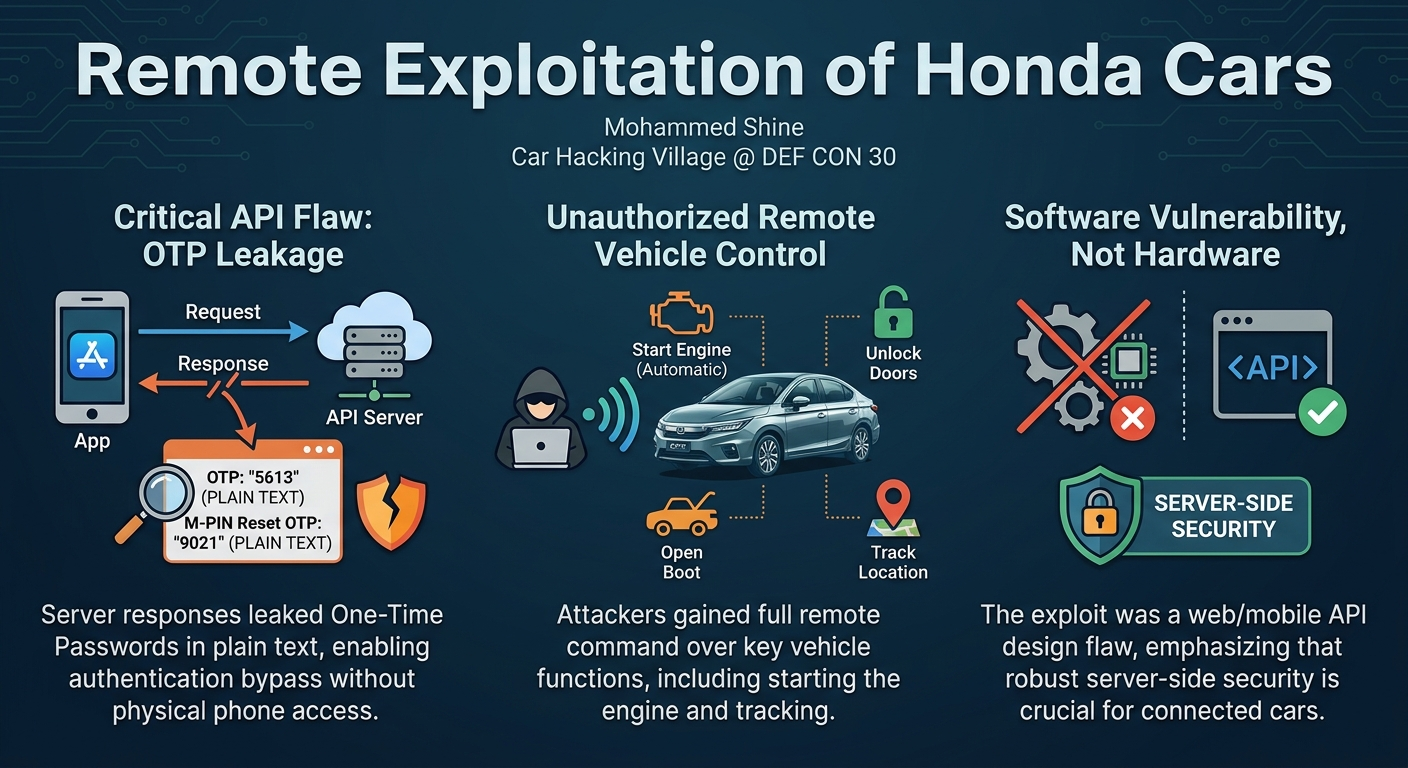
In this compelling talk at DEF CON 30's Car Hacking Village, Mohammed Shine, an Application Security Engineer, unveiled a critical vulnerability he discovered in the Honda Connect mobile application, which controls the Honda City Fifth Generation (2020 model). Titled "Remote Exploitation of Honda Cars," Shine detailed how a seemingly simple API flaw – the leakage of One-Time Passwords (OTPs) in API responses – allowed him to remotely gain full control over connected Honda vehicles. This included the ability to start the engine, unlock doors, open the boot, and track the car's location, all without physical access or prior authentication.
Key moments
- 0:00 Introduction to remote Honda car exploitation
- 4:00 Inspiration from Josh Corman's truck hacking research
- 16:00 Identifying Honda City 5th Gen as connected car target
- 19:00 Bypassing root detection and SSL pinning
- 22:00 Discovering OTP leakage vulnerability in API response
- 23:00 Gaining remote control of the car via exploit
- 25:00 Responsible disclosure and Honda's quick fix
Remote Exploitation of Honda Cars
Speakers: Mohammed Shine (AppSec Engineer)
Conference: Car Hacking Village @ DEF CON 30
YouTube: https://www.youtube.com/watch?v=y4Uzm-CTa0I
Overview
In this compelling talk at DEF CON 30's Car Hacking Village, Mohammed Shine, an Application Security Engineer, unveiled a critical vulnerability he discovered in the Honda Connect mobile application, which controls the Honda City Fifth Generation (2020 model). Titled "Remote Exploitation of Honda Cars," Shine detailed how a seemingly simple API flaw – the leakage of One-Time Passwords (OTPs) in API responses – allowed him to remotely gain full control over connected Honda vehicles. This included the ability to start the engine, unlock doors, open the boot, and track the car's location, all without physical access or prior authentication.
Shine's research highlights the significant security risks inherent in the rapidly expanding ecosystem of connected cars. As vehicles increasingly integrate with mobile applications and cloud services, they inherit vulnerabilities traditionally associated with web and mobile platforms. This talk serves as a stark reminder that even well-intentioned security measures like root detection and SSL pinning can be bypassed if fundamental API security principles are overlooked, underscoring the need for rigorous security testing and robust threat modeling in the automotive industry. The discovery, made by a researcher primarily focused on web and mobile application security, demonstrates that the attack surface of modern vehicles extends far beyond traditional hardware-level exploits, drawing attention to the critical importance of secure software development throughout the entire automotive supply chain.
The vulnerability, a software-related issue rather than a hardware flaw, has since been responsibly disclosed to Honda Engineering and fully remediated. Shine’s journey from being an "occasional bug bounty hunter" to uncovering such a high-impact automotive flaw provides valuable insights into the methodologies applicable to discovering vulnerabilities in connected vehicle systems, even for those without a specialized automotive security background. His findings resonate deeply within the cybersecurity community, urging both manufacturers and consumers to recognize the profound implications of insecure connected car features.
Background
▶ Watch: Introduction to remote Honda car exploitation (0:00)
Mohammed Shine's foray into automotive cybersecurity was, by his own admission, somewhat accidental. As an Application Security Engineer with a strong background in web and mobile application vulnerabilities, and a track record as an "occasional bug bounty hunter" with Hall of Fames at major tech companies like Google and Apple, his primary expertise lay outside the traditional automotive domain. However, a personal interest in automotive security led him to explore this evolving field. He is also the chapter lead for ASRG Kerala, the Automotive Security Research Group, which further demonstrates his commitment to the sector.
His initial inspiration stemmed from a research article by Josh Carlos, who demonstrated the ability to hack into internet-connected trucks. Carlos's method involved using Shodan, a search engine for internet-connected devices, to locate vulnerable Telematics Gateway Units (TGUs) that were exposed via an unauthenticated Telnet protocol. This revelation, showcasing how a relatively simple network vulnerability could grant remote control over heavy vehicles, deeply fascinated Shine and shifted his research focus towards telematics systems and mobile applications.
Shine explains the distinction between a Telematics Gateway Unit (TGU) and a Telematics Control Unit (TCU). While TGUs are higher-performance units, the TCU is the embedded hardware responsible for connecting a car to the internet, enabling features like remote control and tracking. Recognizing the challenges in acquiring specialized hardware for Bluetooth or Wi-Fi-related car hacks in his region, Shine naturally gravitated towards investigating vulnerabilities in the software layer, particularly mobile applications and their associated APIs. This strategic shift proved fruitful, aligning with his existing skill set in application security.
The pivotal moment in Shine's research came unexpectedly. After recreating some of Josh Carlos's Shodan-based attacks and confirming their feasibility, he received a targeted Google advertisement for the Honda City Fifth Generation. This particular model was significant as it was marketed as the "first connected car in India," equipped with a companion mobile application offering over 30 remote control features. This ad immediately sparked his interest, posing the question: "What if I hack the mobile application? If I hack the mobile application, I could hack into the car." This serendipitous advertisement effectively narrowed his focus to a specific, highly relevant target, setting the stage for his subsequent discovery.
Key Findings
▶ Watch: Identifying Honda City 5th Gen as connected car target (16:00)
The central and most critical finding of Mohammed Shine's research was the discovery of a severe One-Time Password (OTP) leakage vulnerability within the API responses of the Honda Connect mobile application. This flaw allowed an attacker to bypass critical authentication mechanisms and gain complete, unauthorized remote control over a connected Honda City Fifth Generation (2020 model) vehicle.
Shine identified two distinct instances of this OTP leakage, both of which were chained together to achieve full account compromise:
- Initial Login OTP Bypass: When a user attempted to log into the Honda Connect application by entering their registered mobile number, the system was designed to send an OTP to that number. However, the API response for this request explicitly included the generated OTP in plain text. This meant an attacker, by simply intercepting the API traffic, could immediately retrieve the OTP without needing access to the victim's phone.
- M-Pin Reset OTP Bypass: The application employed a second layer of security in the form of an M-pin, a four-digit personal identification number or biometric authentication. If a user forgot their M-pin, the application offered a "forgotten pin" option, which again required entering the registered mobile number. Crucially, the API response for this M-pin reset request also leaked the OTP required to reset the M-pin, similar to the initial login process.
By chaining these two vulnerabilities, Shine could:
- Intercept the login OTP to gain initial access to a user's account.
- Utilize the M-pin reset functionality, intercepting the second leaked OTP to set a new, attacker-controlled M-pin.
- Once both authentication layers were bypassed, the attacker would have full, persistent access to all remote control features of the connected vehicle.
The impact of this vulnerability was profound, granting an attacker the ability to perform highly sensitive actions remotely, including:
- Starting the car engine (specifically in automatic variants).
- Unlocking the car doors.
- Opening the boot (trunk).
- Tracking the car's location.
Shine emphasized that this was a software-related vulnerability, specifically an API design flaw, and not an issue with the car's hardware. This distinction is crucial, as it highlights that the expanding attack surface of connected cars increasingly includes traditional software and web application vulnerabilities. The vulnerability was responsibly disclosed to Honda Engineering and was fixed within a few hours, demonstrating the critical nature and ease of remediation once identified.
Technical Deep Dive
▶ Watch: Bypassing root detection and SSL pinning (19:00)
The technical core of Mohammed Shine's exploitation lay in dissecting the communication flow between the Honda Connect mobile application and the vehicle's Telematics Control Unit (TCU), mediated by a cloud server. The attack surface primarily targeted was the application's API endpoints, which were responsible for relaying commands from the user's phone to the car.
Shine's methodology began with reconnaissance and static analysis. He downloaded the official "Honda Connect" application from both app stores. His initial attempts involved reverse engineering and decompiling the mobile application binaries. While he successfully extracted API endpoints, his static analysis did not immediately reveal any exploitable vulnerabilities or useful API keys. This led him to pivot to dynamic analysis, which involves interacting with the running application and observing its behavior.
A significant hurdle in dynamic analysis of mobile applications is the presence of client-side security controls. The Honda Connect app implemented two such controls:
- Root Detection: The application was designed to prevent execution on rooted or jailbroken devices, a common tactic to deter security researchers and attackers who often use such environments for testing.
- SSL Pinning: This mechanism ensures that the application only communicates with servers whose certificates match a predefined set of trusted certificates embedded within the app. This prevents Man-in-the-Middle (MitM) attacks, where an attacker intercepts and modifies network traffic by presenting a forged certificate.
To proceed with dynamic analysis, Shine needed to bypass these controls. He utilized standard tools and techniques:
- Emulator/Rooted Device: He used an Android emulator (or a rooted physical device) to run the application in a controlled environment.
- Frida: This dynamic instrumentation toolkit was employed to inject custom scripts into the running application. Specifically, Frida scripts were used to effectively bypass both root detection and SSL pinning, allowing the application to run on a rooted environment and permitting traffic interception.
- Burp Suite/HTTP Toolkit: With SSL pinning bypassed, network traffic could be intercepted and analyzed using a proxy tool like Burp Suite or HTTP Toolkit. These tools allowed Shine to observe, modify, and replay HTTP requests and responses between the app and the Honda cloud server.
Once the security controls were circumvented, Shine focused on understanding the application's authentication flow. The process was as follows:
- The user enters their mobile number into the app.
- An OTP (One-Time Password) is supposed to be sent to the user's registered mobile number for verification.
- Upon successful OTP verification, the user proceeds to set or enter an M-pin, which serves as a secondary authentication layer, often involving biometrics or a 4-digit code.
The critical vulnerability emerged during the interception of these authentication requests. When Shine entered a mobile number for login, he observed that the API response, intended for the mobile application to process, contained the generated OTP in plain text. For example, if the API was expecting an OTP like 5613, this exact string would be present in the server's response to the mobile app's initial login request. This meant an attacker could simply read the OTP from the intercepted traffic without needing access to the victim's SMS messages.
Shine then proceeded to the M-pin setup/reset process. If an attacker used the "forgotten pin" option, the application would again request the user's mobile number. Analogous to the initial login, the API response for this M-pin reset request also leaked the corresponding OTP. By capturing this second OTP, the attacker could then successfully reset the M-pin to a value of their choosing (e.g., 1234).
With both the initial login and the M-pin successfully bypassed and controlled by the attacker, full unauthorized access to the connected car's features was achieved. Shine even developed Python scripts to automate this entire exploitation process, demonstrating that complex mobile emulators or rooted devices were not strictly necessary for the final attack. An attacker, knowing only the victim's phone number, could execute these scripts to remotely start the engine, unlock doors, or open the boot of the targeted Honda City vehicle. This highlights how a seemingly minor API flaw can be chained with other application logic to yield catastrophic real-world consequences.
Demo / Proof of Concept
▶ Watch: Gaining remote control of the car via exploit (23:00)
While the talk did not feature a live, real-time demonstration during the presentation, Mohammed Shine explicitly stated that he had conducted a thorough Proof of Concept (PoC) and demonstrated the exploit to Honda Engineering. His research involved gaining access to a friend's Honda City Fifth Generation (2020 model), which was a connected car, to safely test the discovered vulnerability.
The PoC effectively showcased the end-to-end exploitation chain:
- Bypassing Mobile App Security: Shine successfully bypassed the app's root detection and SSL pinning using Frida scripts on an emulator or a rooted device. This allowed him to run the application in a controlled environment and intercept its network traffic.
- Intercepting OTPs: Using a proxy tool like Burp Suite, he demonstrated how the login OTP and subsequently the M-pin reset OTP were leaked directly in the API responses. This was the core of the vulnerability.
- Gaining Access: By using the leaked OTPs, he was able to complete the authentication flow, reset the M-pin to a known value (e.g.,
1234), and thereby gain full control over the connected car's features through the Honda Connect application interface. - Automated Exploitation: To further illustrate the severity and ease of exploitation, Shine developed Python scripts. These scripts automated the entire process, requiring only the victim's registered phone number as input. With a single command, an attacker could remotely initiate actions like starting the car's engine (for automatic variants), unlocking the doors, or opening the boot. This demonstrated that sophisticated manual interaction with the app or interception tools was not required for a determined attacker, turning a multi-step process into a one-click exploit.
The demonstration to Honda Engineering involved showing "everything that I found," which likely included walking them through the intercepted traffic, the leaked OTPs, and the Python scripts' capabilities. This direct and comprehensive demonstration was crucial for validating the vulnerability and facilitating its rapid remediation. The ability to remotely control critical vehicle functions without any physical proximity or prior access underscores the potent impact of this API-level flaw.
Defensive Implications
▶ Watch: Responsible disclosure and Honda's quick fix (25:00)
Mohammed Shine's research into the remote exploitation of Honda cars offers several critical defensive implications for automotive manufacturers, security engineers, and consumers alike. The vulnerability, though fixed, serves as a powerful case study for enhancing the security posture of connected vehicles.
- Prioritize API Security: The most significant takeaway is the absolute necessity of robust API security. The core of this exploit was the leakage of sensitive data (OTPs) in API responses. Manufacturers must adopt a "never trust the client" mentality, ensuring that all sensitive operations, especially authentication and authorization, are validated and handled securely on the server-side. OTPs should never be reflected in API responses; they should only be sent to the intended recipient through a secure out-of-band channel (e.g., SMS, email). Thorough API penetration testing and code reviews are essential.
- Implement Secure Authentication Flows: The multi-layered authentication (OTP + M-pin) was conceptually sound, but its implementation was flawed. Each step of an authentication process must be independently secure. Even if one layer is compromised, subsequent layers should ideally prevent full access. This requires careful design, rigorous testing, and avoiding common pitfalls like predictable token generation, weak rate limiting, or, as seen here, data leakage.
- Strengthen Mobile Application Hardening: While the Honda Connect app included root detection and SSL pinning, these client-side controls were bypassed using readily available tools like Frida. This highlights that client-side security measures, while valuable as a deterrent, should never be the sole line of defense. They can delay but rarely prevent a determined attacker. Developers should aim for more sophisticated anti-tampering techniques and always assume that client-side controls can be circumvented. The ultimate security must reside on the server.
- Adopt Comprehensive Threat Modeling: The proliferation of connected car features—from remote start to door unlock—introduces a vast and complex attack surface. Automotive companies must perform detailed threat modeling for every feature, considering how an attacker might abuse it, what data is involved, and what the potential impact of compromise would be. This process should involve cross-functional teams, including security experts, from the earliest stages of design.
- Establish Clear Responsible Disclosure Programs: Shine highlighted the difficulty in reporting the vulnerability, initially contacting Auto ISAC before directly reaching out to Honda Engineering. The automotive industry, like other critical infrastructure sectors, needs clear, accessible, and responsive responsible disclosure programs. Providing security researchers with a defined channel to report vulnerabilities fosters trust, accelerates remediation, and ultimately makes products safer. Lack of such programs can lead to delayed fixes or, worse, vulnerabilities being exploited in the wild.
- Embrace IoT Security Best Practices: Connected cars are essentially sophisticated IoT devices. Their security should be approached with the same rigor applied to other critical IoT systems. This includes secure boot processes, secure over-the-air (OTA) updates, robust network segmentation, and continuous monitoring for anomalous behavior, in addition to strong application and API security.
- Continuous Security Testing and Monitoring: The dynamic nature of software development means new vulnerabilities can be introduced with updates. Automotive manufacturers must implement a continuous security testing regimen, including regular penetration tests, vulnerability assessments, and bug bounty programs. Furthermore, monitoring connected car systems for unusual activity can help detect exploitation attempts in real-time.
By addressing these defensive implications, the automotive industry can significantly enhance the security of connected vehicles, protecting both customer safety and privacy in an increasingly interconnected world.
Key Takeaways
- API Vulnerabilities are Critical for Connected Cars: Simple API flaws, such as OTP leakage in server responses, can lead to severe real-world consequences, enabling unauthorized remote control of vehicles.
- Client-Side Security is Insufficient: While mobile app hardening techniques like root detection and SSL pinning are valuable, they can be bypassed. Core security must reside on the server-side with robust validation and secure API design.
- Connected Cars Expand the Attack Surface: Modern vehicles, acting as IoT devices, inherit vulnerabilities from web and mobile application domains, requiring automotive security to encompass traditional software security expertise.
- Secure Authentication is Paramount: Multi-factor authentication mechanisms must be implemented securely at every step. OTPs and sensitive tokens should never be reflected in API responses or handled insecurely.
- Responsible Disclosure is Essential: The lack of clear channels for security researchers (as initially experienced by Shine) can impede timely vulnerability remediation. Automotive companies must establish and promote accessible responsible disclosure programs.
- Cross-Domain Security Research is Valuable: This case demonstrates that security researchers from non-automotive backgrounds (e.g., AppSec, bug bounty) can bring fresh perspectives and discover critical vulnerabilities in the evolving connected car landscape.
About the Speaker(s)
Mohammed Shine is an Application Security Engineer from India. He is also recognized as an occasional bug bounty hunter, having earned Hall of Fames from prominent technology companies such as Google and Apple. Shine is deeply involved in the automotive cybersecurity community, serving as the Chapter Lead for ASRG Kerala (Automotive Security Research Group), an organization dedicated to automotive security research and vulnerabilities. Additionally, he volunteers at DEF CON Trivandrum and is an automotive photographer, with his work showcased on his Instagram profile. This talk at DEF CON 30 marked his first public presentation related to automotive security research, a field he initially approached from an application security perspective rather than as a dedicated automotive security engineer.
Reviews
Dr. Zero (Offensive Security Researcher) — SOLID
Mohammed Shine got full remote execution on a Honda City, but he didn't do it by popping the TCU or reversing baseband firmware. He did it because Honda's mobile API literally returns the login OTP in plain text. It's a solid village talk that proves automotive OEMs are still failing Web AppSec 101, even if the exploitation chain is trivial.
Heather Calloway (CISO) — SOLID
This is a clean, practical demonstration of how fundamental web API failures—specifically, leaking OTPs in server responses—can lead to total physical compromise of connected vehicles. It is a stark reminder that the 'automotive' attack surface is increasingly just a mobile AppSec problem, worth your product security and procurement teams' time.