RFCommotion - Invisible Serial Ports Flying Through the Air
Kamel Ghali (Automotive Cybersecurity Technology Architect · White Motion (Marelli))
Car Hacking Village @ DEF CON 30 · Day 1 · Car Hacking Village
Overview
In the rapidly evolving landscape of automotive technology, Bluetooth remains a ubiquitous, yet often misunderstood, communication vector. Kamel Ghali, an Automotive Cybersecurity Technology Architect at White Motion (Marelli), took the stage at Car Hacking Village @ DEF CON 30 to shed light on the complexities and overlooked security implications of the Radio Frequency Communication (RFCOMM) protocol. Titled "RFCommotion - Invisible Serial Ports Flying Through the Air," his talk aimed not just to introduce RFCOMM but to foster a deeper appreciation for the intricate, layered nature of the Bluetooth specification itself, particularly from a security perspective.
Key moments
- 0:00 Introduction to RFCommotion and speaker
- 9:30 Tesla passive keyless entry relay attack
- 14:00 Understanding Bluetooth's host and controller layers
- 20:00 RFComm: Emulating RS-232 serial ports wirelessly
- 28:30 Introducing RFComrade: a Bluetooth RFComm testing tool
- 32:30 Reliably crashing Bluetooth stacks with RFComrade
- 36:30 Car Hacking Village Bluetooth CTF challenges
RFCommotion - Invisible Serial Ports Flying Through the Air
Speakers: Kamel Ghali (Automotive Cybersecurity Technology Architect, White Motion (Marelli))
Conference: Car Hacking Village @ DEF CON 30
YouTube: https://www.youtube.com/watch?v=VwM3sUYGIBk
Overview
In the rapidly evolving landscape of automotive technology, Bluetooth remains a ubiquitous, yet often misunderstood, communication vector. Kamel Ghali, an Automotive Cybersecurity Technology Architect at White Motion (Marelli), took the stage at Car Hacking Village @ DEF CON 30 to shed light on the complexities and overlooked security implications of the Radio Frequency Communication (RFCOMM) protocol. Titled "RFCommotion - Invisible Serial Ports Flying Through the Air," his talk aimed not just to introduce RFCOMM but to foster a deeper appreciation for the intricate, layered nature of the Bluetooth specification itself, particularly from a security perspective.
The presentation highlighted how Bluetooth, despite its seemingly simple user experience, is an aggregation of numerous smaller protocols, each with its own specification and potential vulnerabilities. Kamel’s core message underscored the critical importance of scrutinizing these underlying protocols, demonstrating how a protocol designed to emulate a legacy serial port can become an unexpected attack surface in modern vehicles and IoT devices. His research, culminating in a custom tool called rf-comrade, revealed how a basic denial-of-service (DoS) attack targeting RFCOMM channels could reliably crash a vehicle's Bluetooth stack, exposing a fundamental flaw in input handling.
This talk is highly relevant for anyone involved in automotive security, IoT device development, or general Bluetooth security research. It serves as a potent reminder that even mature, widely adopted protocols with seemingly stable specifications can harbor significant security weaknesses if their implementations are not rigorously tested for resilience against unexpected inputs. Kamel's work encourages a shift from abstract Bluetooth security concerns to practical, protocol-specific penetration testing, emphasizing the need for robust defensive measures at every layer of the communication stack.
Background
▶ Watch: Introduction to RFCommotion and speaker (0:00)
Bluetooth, defined as a common cable replacement technology, operates in the 2.4 GHz frequency range and is designed to simplify short-range wireless communications. Its pervasive nature means it’s found in virtually all smartphones, computers, and a vast array of IoT devices, including, crucially, modern vehicles. In automotive contexts, Bluetooth is primarily integrated into the infotainment system or head unit, facilitating hands-free phone calls, phonebook synchronization, and even text message management. More recently, with the advent of Bluetooth Low Energy (BLE), its applications have expanded to include critical functions like key fob firmware updates and passive keyless entry (PKE) systems, elevating its security profile considerably.
The history of Bluetooth security in vehicles is punctuated by notable research demonstrating its exploitability. In 2020, Tencent Keen Labs disclosed research where they achieved a full compromise of a Lexus vehicle's head unit. Their initial compromise vector was a Bluetooth vulnerability that granted remote code execution (RCE). From this foothold, they expanded their influence, establishing a Wi-Fi-based backdoor and, critically, bypassing CAN bus access controls by flashing unauthorized firmware due to a lack of proper firmware checks. This demonstrated a complete chain of exploitation originating from a Bluetooth flaw. More recently, in May 2022, the NCC Group revealed a relay attack against the PKE system in Tesla Models 3 and Y. This attack leveraged BLE to relay cryptographic key exchange information over an IP network, bypassing the latency bounding designed to prevent such attacks. By performing the necessary cryptographic checks within the tight time window, attackers could unlock and even drive off with a vehicle without physical possession of the key fob. These examples underscore Bluetooth's role as a potent initial access vector and a critical component in vehicle security.
Understanding Bluetooth's security requires dissecting its complex, layered architecture. As Kamel explained, Bluetooth is not a single protocol but a "bunch of smaller protocols standing on one another's shoulders." These protocols are managed by the Bluetooth Special Interest Group (SIG), but their actual implementations vary significantly across different chip vendors like Broadcom, Qualcomm, Cambridge, and Intel. The architecture is broadly divided into three layers:
- Controller Layer: This lowest layer comprises protocols like Baseband, Radio, and Link Management Protocol (LMP). These functions are controlled by the firmware on the Bluetooth chip itself, offering minimal visibility to the operating system. This vendor-specific firmware makes low-level analysis challenging.
- Host Controller Interface (HCI) Layer: Acting as the bridge between the host (operating system) and the controller (chip), HCI provides a standardized command and event interface. While there's some standardization, vendor-specific instructions are common. Tools like
hci configandhci toolon Linux allow interaction with this layer. - Host Layer: These protocols are managed by the operating system. On Linux, the BlueZ stack is the de facto standard. Key protocols at this layer include:
- Logical Link Control and Adaptation Protocol (L2CAP): The base protocol of the host stack, L2CAP provides generic multiplexing for higher-layer protocols and supports both connection-oriented and connectionless communication.
- Service Discovery Protocol (SDP): Crucial for device interaction, SDP allows Bluetooth devices to discover each other's capabilities and available services. Importantly, SDP communications are always unencrypted, providing an open window into a device's potential attack surface, including which RFCOMM channels are in use.
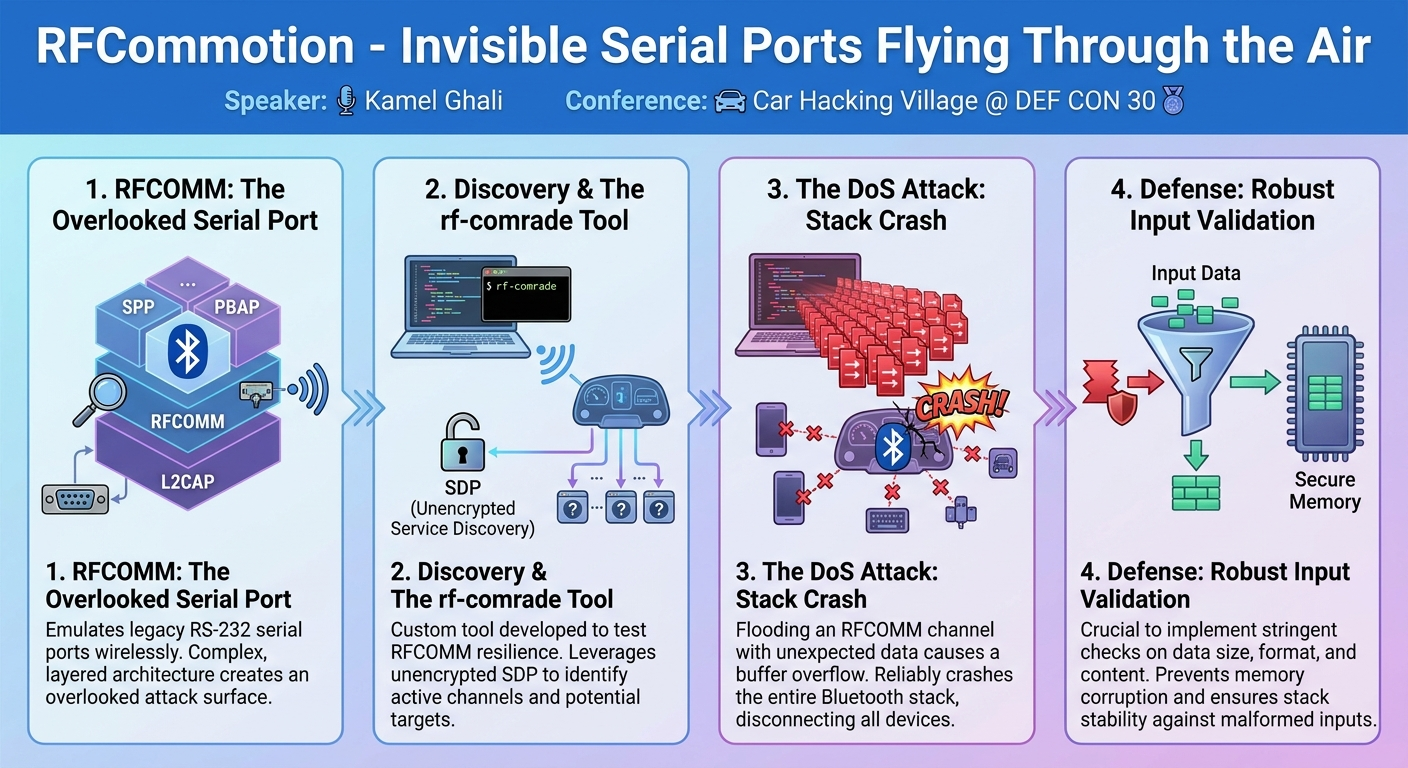
- Radio Frequency Communication (RFCOMM): The star of Kamel's talk, RFCOMM is designed to emulate an RS-232 serial port over L2CAP as literally as possible, even emulating all nine pins of a serial port. Its specification references the GSM 07.10 standard, highlighting its purpose of enabling easy porting of existing serial port applications to wireless environments. RFCOMM provides basic reliability guarantees and point-to-point connections, akin to TCP, but with a much smaller channel space: only 30 channels are supported, compared to TCP's 65,000 ports. Various application-level profiles are built on top of RFCOMM, such as the Serial Port Profile (SPP), Phone Book Access Profile (PBAP), and Object Exchange (OBEX), which, interestingly, was originally developed for infrared communications but widely adopted by Bluetooth. The RFCOMM specification itself has remained unchanged since November 2012, making it a mature, yet potentially overlooked, target for security research.
Key Findings
▶ Watch: Understanding Bluetooth's host and controller layers (14:00)
Kamel's primary contribution was the development of rf-comrade, a specialized tool designed to test the resilience of RFCOMM implementations on remote Bluetooth devices. Using this tool, he made a significant discovery: a buffer overflow vulnerability within the Bluetooth stack of an automotive navigation unit. This vulnerability allowed for a straightforward and highly effective denial-of-service (DoS) attack.
Specifically, Kamel was able to reliably crash the target device's entire Bluetooth stack by connecting to one of its active RFCOMM services and flooding it with a relatively simple, user-defined payload. This process took approximately five seconds. The impact of this crash was immediate and severe: the target device would display an error message, indicating that its Bluetooth functionality had completely halted and needed to restart from scratch. All currently connected Bluetooth devices, including test phones or other peripherals, would be abruptly disconnected, interrupting any ongoing operations.
Subsequent analysis of the affected application running on the RFCOMM channel confirmed that the crash was indeed caused by improper handling of large volumes of unexpected input data. This led directly to a buffer overflow condition, which in turn caused the application to fail and forced a restart of the entire Bluetooth stack. While Kamel's research focused on demonstrating the DoS capability, he highlighted the significant potential for further exploitation. A more sophisticated, crafted payload, beyond simple flooding, could potentially leverage this buffer overflow to achieve more profound impacts, such as arbitrary code execution or manipulation of the device's state. This finding underscores a critical vulnerability in how some Bluetooth RFCOMM implementations process incoming data, presenting a clear and present danger to the availability and integrity of in-vehicle systems.
Technical Deep Dive
▶ Watch: RFComm: Emulating RS-232 serial ports wirelessly (20:00)
The core of Kamel's talk delved into the intricacies of the Bluetooth protocol stack, emphasizing its layered complexity, which he metaphorically described as "a bunch of smaller protocols standing on one another's shoulders." Understanding this architecture is paramount for identifying potential attack surfaces.
At the lowest level resides the Controller Layer, encompassing the Baseband and Radio protocols, which manage the physical radio interface and the establishment of physical links. Above this, the Link Management Protocol (LMP) handles link setup, control, and security features like authentication and encryption. These protocols are largely implemented in the Bluetooth chip's firmware, making them opaque to the host operating system and challenging to analyze without specialized tools or reverse engineering. Different chip manufacturers (e.g., Broadcom, Qualcomm) implement these layers uniquely, adding to the complexity.
Bridging the controller and host layers is the Host Controller Interface (HCI). This crucial layer provides a standardized way for the host to send commands to the controller and receive events back. While HCI offers a degree of standardization, vendors often include proprietary commands, which can be a source of implementation-specific vulnerabilities. Tools like hci config and hci tool in Linux, which interact directly with the HCI layer, demonstrate its role in managing Bluetooth adapters and performing basic operations like device scanning.
The Host Layer is where the operating system takes primary control. The foundational protocol here is the Logical Link Control and Adaptation Protocol (L2CAP). L2CAP serves as a generic multiplexing layer, allowing multiple higher-level protocols to share the same underlying link. It handles segmentation and reassembly of data packets and supports both connection-oriented and connectionless data transfers. All higher-level protocols, including RFCOMM, build upon L2CAP.
Critical for device interaction is the Service Discovery Protocol (SDP). SDP allows Bluetooth devices to query each other's capabilities and determine which services are available and on which channels. Kamel stressed that SDP is always unencrypted, a design choice to allow any connecting device to discover services freely. This provides an attacker with invaluable reconnaissance information, akin to a port scan on an IP network. Tools like sdptool on Linux can be used to browse remote SDP servers, revealing active services and their associated RFCOMM channel numbers. For instance, a phone might expose a "Phone Book Access Profile" (PBAP) on a specific RFCOMM channel, indicating its readiness to share contacts.
The star of the presentation, RFCOMM, sits atop L2CAP. Its explicit design goal is to emulate an RS-232 serial port as literally as possible over a wireless medium. This emulation is so thorough that it includes features to mimic all nine pins of a physical serial port, directly referencing the GSM 07.10 standard. This design choice allowed developers to easily port existing serial applications to Bluetooth without significant code changes. From a practical standpoint, RFCOMM channels function similarly to TCP ports, providing a reliable, point-to-point connection. However, a key distinction lies in the number of available channels: RFCOMM only supports 30 channels (though up to 60 simultaneous connections between two devices are possible with careful allocation), a stark contrast to the 65,535 ports available in TCP. This limited channel space means applications must be judicious in their RFCOMM channel assignments.
Numerous application-level profiles are built upon RFCOMM, leveraging its serial port emulation. These include:
- Serial Port Profile (SPP): The most direct application, providing a virtual serial cable.
- Phone Book Access Profile (PBAP): Used for transferring phonebook objects between devices.
- Object Exchange (OBEX): A versatile protocol for exchanging objects (like files, contacts, calendar entries). Interestingly, OBEX originated in infrared communications but was adopted by the Bluetooth SIG.
- File Transfer Protocol (FTP) Profile and vCard Profile: Often built on top of OBEX, these facilitate specific data exchanges.
Kamel illustrated the concept of a "Bluetooth socket" as an analogy to an IP address and port number. Just as one might connect to 192.168.1.10:21 for FTP, a Bluetooth connection targets a specific Bluetooth Device Address (BD_ADDR) and an RFCOMM channel (e.g., 12:34:56:78:AB:CD:03 for channel 3). A notable observation was that the RFCOMM specification has not been updated since November 2012. While this might suggest stability, it also means that any design flaws or assumptions from a decade ago persist, making it a potentially ripe target for security researchers.
Demo / Proof of Concept
▶ Watch: Reliably crashing Bluetooth stacks with RFComrade (32:30)
Kamel’s presentation culminated in the introduction of rf-comrade, a custom tool developed to demonstrate and test the security of RFCOMM implementations. rf-comrade is a Python-based script that leverages the pybluez library, a Python implementation of the BlueZ software stack for Linux, making it easily deployable on most Linux systems.
The primary feature of rf-comrade is its ability to connect to a specified RFCOMM channel on a remote Bluetooth device and flood it with a user-defined payload. This functionality allows security researchers to simulate a denial-of-service (DoS) attack by overwhelming the target application with unexpected volumes of data. Kamel clarified that rf-comrade is not a sophisticated fuzzer; rather, it’s a straightforward flooding tool designed for targeted stress testing.
A secondary, but highly practical, feature of rf-comrade is its basic service discovery capability. If a user provides only a target Bluetooth address without specifying an RFCOMM channel, the tool will automatically perform a service discovery (similar to sdptool) to identify active RFCOMM channels and the applications tied to them. This allows testers to quickly enumerate potential targets without needing to run separate reconnaissance tools.
Kamel's motivation for creating rf-comrade stemmed from a gap he identified during a penetration test of an automotive navigation unit. He sought a tool to test the device's Bluetooth implementation's resilience against large, unexpected data inputs specifically at the RFCOMM layer. Existing tools, such as l2ping (which targets the L2CAP layer and offers limited payload control) or the "Bluetooth stack smasher" (which also focuses on L2CAP and lacks modern fuzzing features), did not meet his specific requirements for directly interacting with and flooding RFCOMM channels with custom data. This forced him, despite self-professed programming reluctance, to develop his own solution.
In practice, rf-comrade proved effective. Kamel successfully demonstrated its ability to reliably crash the Bluetooth stack on the automotive navigation unit. By connecting to one of the device's RFCOMM services and sending a simple payload for approximately five seconds, the target device would display an error, indicating a complete Bluetooth stack restart. This action disconnected all connected Bluetooth devices and interrupted any ongoing operations. Subsequent analysis revealed that the underlying cause was a buffer overflow in the application handling the RFCOMM channel, failing to properly manage the large, unexpected influx of data. While the current implementation focuses on DoS, Kamel noted the potential for further exploitation with a more carefully crafted payload, potentially leading to arbitrary code execution.
Kamel has made rf-comrade publicly available on GitHub, encouraging other researchers to use it, provide feedback, and contribute to its development. Future improvements are planned, including incorporating more meaningful fuzzing capabilities, potentially leveraging frameworks like Scapy, and expanding its scope to test other Bluetooth protocols beyond RFCOMM.
Defensive Implications
▶ Watch: Car Hacking Village Bluetooth CTF challenges (36:30)
The findings presented by Kamel regarding RFCOMM vulnerabilities carry significant defensive implications for automotive manufacturers, IoT device developers, and security practitioners. The ability to reliably crash a Bluetooth stack via a simple DoS attack underscores fundamental weaknesses that must be addressed:
- Robust Input Validation and Error Handling: The most immediate defensive measure is to implement stringent input validation and comprehensive error handling for all applications processing data over RFCOMM channels. This includes checking data size, format, and content to prevent buffer overflows, heap overflows, and other memory corruption vulnerabilities when unexpected or malformed inputs are received. Applications should gracefully handle errors and recover without crashing the entire Bluetooth stack.
- Secure Bluetooth Stack Implementations: Device manufacturers and their Bluetooth chip vendors must ensure their Bluetooth stack implementations are resilient to various attack vectors, including DoS. This requires thorough testing, potentially using tools like
rf-comrade, to identify and patch vulnerabilities at the protocol level, not just the application layer. Regular security audits and penetration testing specifically targeting Bluetooth functionality are crucial. - Minimize Exposed Services and Channels: Devices should only enable necessary Bluetooth services and close any unused RFCOMM channels. Reducing the attack surface by disabling superfluous functionality limits the entry points for potential attackers. Service discovery (SDP) should be carefully reviewed to ensure it doesn't leak sensitive information or expose services that are not strictly required for operation.
- Firmware Update Security: As demonstrated by the Tencent Keen Labs research, a compromised Bluetooth stack can be a stepping stone to flashing unauthorized firmware. Automotive systems must implement robust firmware integrity checks, cryptographic signatures, and secure boot mechanisms to prevent unauthorized code execution or persistence.
- Strengthen Keyless Entry Systems: The NCC Group's research on Tesla's PKE system highlights the need for advanced countermeasures against relay attacks. This includes implementing more sophisticated latency bounding, rolling codes, and multi-factor authentication for critical functions like vehicle unlocking and starting, especially when leveraging BLE.
- Isolation and Least Privilege: Critical vehicle systems, such as the CAN bus, should be rigorously isolated from infotainment systems and other potentially vulnerable components. Implementations should adhere to the principle of least privilege, ensuring that even if a Bluetooth-enabled component is compromised, its access to safety-critical networks is severely restricted and heavily filtered.
- Monitoring and Logging: Implement comprehensive logging and monitoring of Bluetooth activity to detect unusual behavior, repeated connection attempts to specific RFCOMM channels, or DoS-like patterns. Anomalous activity should trigger alerts for further investigation.
- Educate Developers: Promote awareness among developers about the complexities and potential pitfalls of Bluetooth protocol implementations. Training on secure coding practices, especially for embedded systems, is essential to prevent common vulnerabilities like buffer overflows.
By adopting these defensive strategies, manufacturers can significantly enhance the security posture of Bluetooth-enabled devices, mitigating the risks posed by vulnerabilities in protocols like RFCOMM and protecting users from potential vehicle compromise or data theft.
Key Takeaways
- Bluetooth is a Complex Attack Surface: Beyond simple pairing, Bluetooth is a layered technology composed of numerous intricate protocols. Each layer, from the physical Baseband to application-level profiles like RFCOMM, presents a potential attack surface that requires dedicated security scrutiny.
- RFCOMM: The Overlooked Serial Port: The RFCOMM protocol, designed to emulate legacy RS-232 serial ports, is widely used in automotive and IoT devices. Despite its age (last specification update in 2012), its fundamental role means vulnerabilities here can have significant impact.
- Simple DoS Can Be Devastating: As demonstrated by
rf-comrade, even a basic denial-of-service attack, achieved by flooding an RFCOMM channel with unexpected data, can reliably crash an entire Bluetooth stack, leading to disconnection of all devices and interruption of critical services. - Input Validation is Paramount: The root cause of the demonstrated DoS was a buffer overflow due to inadequate input validation. Robust input handling, including checks for size, format, and content, is critical for all applications and protocols processing external data to prevent memory corruption vulnerabilities.
- SDP Aids Attackers: The Service Discovery Protocol (SDP) is always unencrypted, providing attackers with a clear, unauthenticated view into a device's capabilities and active RFCOMM channels. This reconnaissance information is invaluable for identifying potential targets.
- Beyond DoS: Potential for Deeper Exploitation: While the
rf-comradedemo focused on DoS, the underlying buffer overflow vulnerability could potentially be leveraged with a crafted payload to achieve more severe outcomes, such as remote code execution or unauthorized access, as seen in prior Bluetooth research.
About the Speaker(s)
Kamel Ghali is an Automotive Cybersecurity Technology Architect at White Motion, a specialized team within the international automotive Tier 1 supplier, Marelli. His role at White Motion involves conducting penetration tests for both parent and external companies, as well as contributing to the broader automotive security industry through training and compliance with legislation and standards.
Beyond his professional duties, Kamel is an active member of the Automotive Security Research Group (ASRG) and frequently participates in car hacking communities. His recent areas of security interest include Bluetooth (the subject of this talk), USB protocol, general RF (Radio Frequency) technologies, and reverse engineering firmware update processes for obscure microcontrollers. Outside of his technical pursuits, Kamel enjoys playing fighting games, cooking, and exploring new places, often getting intentionally lost to discover new areas.
Reviews
Dr. Zero (Offensive Security Researcher) — WEAK
Kamel looked at RFCOMM—Bluetooth's ancient serial port emulator—and built a Python script to spam it until a target infotainment unit fell over. It proves parsing legacy protocols is still a nightmare, but stopping at a basic denial-of-service means the actual exploitation is left as an exercise for the reader.
Heather Calloway (CISO) — WEAK
This is a competent, highly technical teardown of Bluetooth’s legacy RFCOMM protocol and how a simple flooding tool can crash automotive infotainment systems. While it executes well in the offensive research lane, it is targeted strictly at automotive OEMs and IoT builders. Unless your company manufactures connected hardware or manages a high-threat executive vehicle fleet, this doesn't require leadership attention.