Integrating Mileage Clocking and Other Hacking Equipment Into a Vehicle Simulator Rig
David Rogers (Copper Horse)
Car Hacking Village @ DEF CON 30 · Day 1 · Car Hacking Village
Overview
In this compelling talk at DEF CON 30's Car Hacking Village, David Rogers, owner of Copper Horse, presents an innovative approach to automotive security research: a highly realistic vehicle simulator rig integrated with real-world hacking tools. Born out of the necessity imposed by the pandemic, this rig allows researchers to safely and effectively explore vulnerabilities, demonstrate attack vectors, and test defensive mechanisms without compromising actual vehicles or requiring physical access to restricted facilities. Rogers highlights the critical gap between the rapid evolution of connected vehicle technology and the automotive industry's often nascent security practices.
Key moments
- 0:00 Introduction to the project and speaker
- 2:00 Building the realistic vehicle simulator rig
- 5:30 Security risks of aftermarket Android head units
- 10:30 Analyzing criminal mileage correction devices
- 16:00 Remote testing and automated fuzzing setup
- 20:00 Enhancing rig realism with hardware modifications
- 30:00 Live demo: Mileage corrector and working lights
- 32:30 Future of automotive security and industry challenges
Integrating Mileage Clocking and Other Hacking Equipment Into a Vehicle Simulator Rig
Speakers: David Rogers (Copper Horse)
Conference: Car Hacking Village @ DEF CON 30
YouTube: https://www.youtube.com/watch?v=GsNoctPDjNU
Overview
In this compelling talk at DEF CON 30's Car Hacking Village, David Rogers, owner of Copper Horse, presents an innovative approach to automotive security research: a highly realistic vehicle simulator rig integrated with real-world hacking tools. Born out of the necessity imposed by the pandemic, this rig allows researchers to safely and effectively explore vulnerabilities, demonstrate attack vectors, and test defensive mechanisms without compromising actual vehicles or requiring physical access to restricted facilities. Rogers highlights the critical gap between the rapid evolution of connected vehicle technology and the automotive industry's often nascent security practices.
The core of Rogers' presentation revolves around the practical application of this simulator rig to investigate prevalent criminal modifications, specifically focusing on mileage correction devices and the inherent security risks posed by cheap, aftermarket Android head units. By bridging the immersive experience of high-end sim racing with authentic vehicle components and hacking tools, the rig provides a unique platform for understanding how malicious actors manipulate vehicle systems. This work not only exposes existing weaknesses in vehicle architectures, particularly the unauthenticated CAN bus, but also underscores the urgent need for the automotive industry to adopt more mature security postures, drawing lessons from sectors like mobile and IoT.
The significance of this research extends beyond mere vulnerability discovery. It offers a tangible, repeatable, and safe environment for security professionals to educate stakeholders, test new security solutions, and foster a deeper understanding of the adversarial landscape in vehicle cybersecurity. Rogers' initiative demonstrates how readily available gaming and esports technology can be repurposed into a powerful tool for serious security analysis, providing a crucial bridge between theoretical threats and practical exploitation.
Background
▶ Watch: Introduction to the project and speaker (0:00)
The genesis of this elaborate vehicle simulator rig lies in a consortium named Secure CAV, a collaborative project involving Copper Horse, Siemens, and several universities. The consortium's objective was to investigate security for future connected and autonomous vehicles, focusing on hardware-level detection and prevention of security issues, alongside exploring machine learning applications. However, the onset of the COVID-19 pandemic severely hampered progress, as university partners lost access to their facilities, rendering planned demonstrators inaccessible. This unforeseen challenge forced Copper Horse to pivot, leading them to build an in-house, comprehensive security research platform.
Rogers and his team drew inspiration from existing community projects that utilized Arduinos, CAN bus hats, and readily available vehicle components. They also recognized the potential of leveraging data from vehicle simulators, particularly from the expansive gaming and esports communities. While academic simulators like Carla exist, their support communities are relatively small. In contrast, the gaming world offers a vast ecosystem of hardware manufacturers, software developers, and highly realistic simulation environments. This insight led to the integration of a Dof Reality 3-DOF motion simulator from Ukraine, providing a highly immersive and realistic experience, complete with traction loss and physical feedback from crashes, making the simulated environment feel genuinely like a real vehicle.
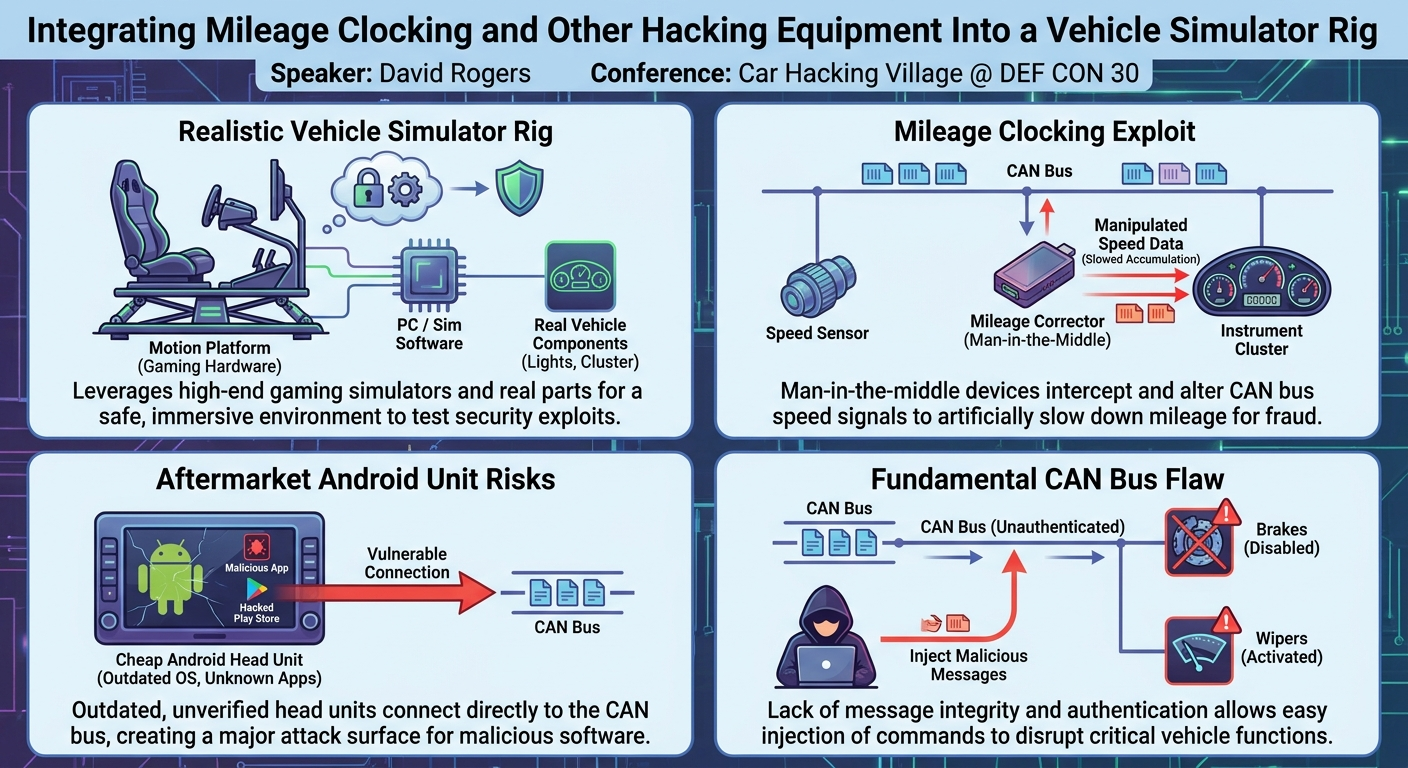
The rig was designed to connect various in-vehicle components to a straightforward CAN bus setup. Initial challenges included sourcing components during pandemic lockdowns, leading them to explore third-party units. This included cheap, open-source Android head units found on Amazon and eBay. These units, often designed for legacy vehicles, presented immediate security concerns: outdated Android versions, pre-installed apps with unknown origins (e.g., hacked Play Store, Google Maps, Chrome browser), and the critical question of whether malicious apps could cross over into the vehicle's CAN bus. This became a significant area of research, exploring the proprietary serial protocols and pre-selected CAN dictionaries used by these units' CAN bus converter boxes. The team also built in hardware hacks to demonstrate the impact of disabling critical vehicle functions like brakes, clutch, or accelerator, or even low-level functions like wipers and hazards, showcasing how disruptions can profoundly affect a driver.
Key Findings
▶ Watch: Security risks of aftermarket Android head units (5:30)
The research conducted with the vehicle simulator rig yielded several critical findings, primarily centered on real-world criminal exploits and the inherent vulnerabilities within vehicle systems and aftermarket components.
A significant focus was placed on mileage correction devices, which are prevalent in the criminal underground. Rogers demonstrated that these are essentially man-in-the-middle devices that can be purchased online for around 300 euros. Rather than outright stopping the odometer, these devices subtly manipulate the vehicle's speedometer data on the CAN bus, causing the mileage to accumulate more slowly. This subtlety is crucial because official vehicle service records often log mileage, and a sudden halt would be immediately obvious. By slowing it down, the alteration is harder to detect, especially in modern classics where owners might naturally drive fewer miles. The primary motivation for using these devices is to artificially inflate a vehicle's resale value, for instance, keeping a Porsche 911 below 100,000 miles to command a premium. Rogers noted that while buying such a device might not be illegal in some countries (like the UK), failing to declare its use to a new owner is.
Another key area of investigation was the security posture of third-party Android head units. These cheap, often Chinese-manufactured, open-source units are designed to integrate into legacy vehicles by connecting directly to the CAN bus via dedicated converter boxes. The research revealed several alarming issues: these units often run significantly outdated versions of Android, lack consistent security updates, and frequently come with pre-installed apps that may have been "hacked in" (e.g., Google Play Store, Chrome browser). The fundamental question explored was the potential for a malicious Android application on these head units to gain unauthorized access to the CAN bus, given the proprietary serial protocols and pre-programmed CAN dictionaries used by the converter boxes. This represents a significant attack surface for vehicles, as these units can introduce a vulnerable, internet-connected endpoint directly into the car's internal network.
Furthermore, the project highlighted the broader implications of OBD2 dongles, distinguishing between legitimate diagnostic tools and more nefarious tracking devices or spoofers. An example cited was a dongle designed to spoof the AdBlue check for lorry drivers, tricking the vehicle into believing its AdBlue tank is full, thus avoiding expensive refills. Such devices demonstrate a clear market for tools that bypass vehicle safety or regulatory systems, which the rig can be used to explore.
Finally, the pandemic-driven necessity of remote collaboration led to the development of an advanced remote testing system. This setup allowed researchers to operate the rig from anywhere in the world, utilizing camera setups, Switchbots for physical hardware control, and virtual machines for tasks like fuzzing. A particularly innovative aspect was the use of OCR (Optical Character Recognition) on screen output combined with auto-typing to automate subsequent steps in fuzzing processes, eliminating the need for manual intervention during overnight tests or crashes. This system proved invaluable for continuous, distributed security research on physical hardware.
Technical Deep Dive
▶ Watch: Remote testing and automated fuzzing setup (16:00)
The technical foundation of the Copper Horse vehicle simulator rig is a sophisticated blend of high-end gaming hardware, custom electronics, and specialized software, all integrated to create a realistic and hackable automotive environment.
At its heart, the rig leverages popular driving simulators and games, such as Euro Truck Simulator 2 and Assetto Corsa Competizione, chosen for their realistic physics and active modding communities. To bridge the gap between game telemetry and physical hardware, a crucial tool is SimHub, which translates in-game data (often via UDP or memory scraping) into actionable signals for the rig's components. This data then feeds into a Dof Reality 3-DOF motion simulator, which provides pitch, roll, and heave movements, alongside a unique traction loss feature on the rear axis, enhancing immersion by simulating wheel slip.
The core of the vehicle's internal network simulation is an Arduino board equipped with a CAN bus hat. This setup allows for the creation of a functional CAN bus where various components can interact. For driver controls, the rig started with Logitech G29 pedals and steering wheel, but these have been extensively modified and upgraded. The G29 pedals were enhanced with a Leo Bodnar cable, increasing their resolution from 8-bit (256 steps) to 10-bit (1024 steps), providing much smoother input. Furthermore, a load cell-style spring mechanism was added to emulate the feel of real racing brakes. The steering wheel has been upgraded to a Fanatec DD Pro direct drive system, offering significantly more realistic force feedback (over 8 Nm compared to less than 2 Nm from the Logitech wheel), immersing the driver more deeply into the simulated vehicle's behavior. Other controls include a Thrustmaster TH8A shifter and a handbrake.
For visual realism and audience engagement, the rig employs triple screens with custom bezel removers, giving a panoramic view. Real vehicle components and indicators are preferred over virtual reality to display authentic data and needle movements. Additional realism features include working lights (indicators, running lights) driven by 12V relays connected to motorcycle lights, and a repurposed Android head unit serving as a rear-view camera display, mimicking modern GT3 cars. A Stream Deck is integrated for quick control of various simulator functions and hacking tool activations.
The integration of hacking equipment is central to the rig's purpose. The mileage corrector device is physically plugged into the back of a real instrument cluster, which is itself connected to the rig's CAN bus. The device is activated by flashing the high beam headlights four times, and it provides feedback via flashing hazard lights. The demo clearly showed the speedometer dropping and misreporting, illustrating its manipulation of CAN bus speed signals.
For demonstrating disruptive attacks, a custom hacking box was built. This box houses an Arduino with a CAN bus hat, a 12V relay board (initially considered MOSFETs but opted for simpler relays for compatibility with off-the-shelf lights), and an OBD2 connector for monitoring CAN data and interfacing with other tools. This setup allows researchers to physically toggle switches that cut off functions like brakes, clutch, or accelerator, or activate wipers and hazards, directly influencing the simulated driving experience via CAN bus commands.
The problematic Android head units are also integrated. These units, often accompanied by proprietary CAN bus decoder boxes, connect to the rig's CAN bus. The research delves into their internal software (outdated Android versions, pre-installed apps) and the proprietary serial protocols used by the decoders, which contain pre-programmed CAN dictionaries for specific vehicle platforms. This allows for direct observation of their CAN bus interaction and analysis of their security posture.
The remote testing capabilities developed during the pandemic are a technical highlight. This system incorporates camera setups for visual monitoring, Switchbots to physically operate hardware switches, and a network of virtual machines for running fuzzing tools and other analysis software. A key innovation is the use of OCR to read screen output from the VMs, combined with automated typing to trigger subsequent actions or resume fuzzing after a crash, enabling continuous, unattended research.
Software tools like Sim Racing Studio manage the motion platform, while SimHub handles telemetry translation. Sim Dashboard, an Android client, allows for the creation of custom visual dashboards, further extending the rig's data display capabilities. The entire system is designed to be transportable, fitting into a Ford Transit van without disassembly.
Demo / Proof of Concept
▶ Watch: Enhancing rig realism with hardware modifications (20:00)
David Rogers provided a live demonstration of the vehicle simulator rig, showcasing its capabilities and the integration of real-world hacking tools. The demonstration commenced with Rogers in the driver's seat of the rig, navigating a virtual truck in Euro Truck Simulator 2. This immediate immersion highlighted the realism provided by the Dof Reality motion platform, although the motion was initially turned off for the introduction. The rig's working lights, such as indicators and hazard lights, were shown to function in sync with the simulator, controlled by the custom 12V relay board.
The core of the demo focused on the mileage corrector device. Rogers explained its operation and then proceeded to activate it within the simulated environment. He flashed the full beam headlights four times, a specific sequence required by the device. After a slight delay, the rig's hazard lights flashed as feedback, indicating that the mileage corrector had switched modes. Crucially, the speedometer on the instrument cluster was observed to visibly drop and misreport, demonstrating the device's manipulation of speed data on the CAN bus, thereby slowing down the perceived mileage accumulation. Rogers then repeated the process, showing the device cycling through different modes, each indicated by a different number of hazard light flashes and a corresponding effect on the speedometer. This live, observable effect powerfully illustrated how such a device operates in practice.
While the talk mentioned previous demonstrations at events like BSides London, where external operators could disrupt the driver's experience by activating wipers, turning off brakes, or causing other disturbances, the DEF CON 30 demo primarily focused on the mileage corrector and the functional lights. The demonstration effectively conveyed the rig's ability to integrate criminal hacking tools and observe their impact on vehicle systems in a controlled, realistic environment, validating its utility as a security research platform.
Defensive Implications
▶ Watch: Future of automotive security and industry challenges (32:30)
The detailed exploration of vehicle hacking through David Rogers' simulator rig presents several critical defensive implications for the automotive industry and cybersecurity professionals.
Firstly, the repeated demonstration of attacks leveraging the CAN bus—specifically the mileage corrector and the ability to cut off critical functions—reaffirms the fundamental insecurity of this ubiquitous in-vehicle network. The lack of integrity protection and authentication on the CAN bus means that any component gaining access can inject or alter messages with potentially catastrophic results. Defenders must prioritize the adoption of more secure in-vehicle network architectures, such as CAN FD with robust security extensions or automotive Ethernet with appropriate security protocols, ensuring message authentication and integrity.
Secondly, the findings regarding third-party Android head units highlight a significant supply chain vulnerability. These devices introduce outdated software, unknown firmware, and potentially malicious applications directly into the vehicle's network. OEMs and consumers must exercise extreme caution with aftermarket components. Defenders should advocate for rigorous vetting processes for all third-party hardware and software, demanding transparency regarding software bills of materials (S-BOMs), regular security updates, and secure boot mechanisms. Consumers should be educated on the risks of installing unverified devices.
Thirdly, the talk underscores the immaturity of the automotive industry's security posture compared to sectors like mobile or IoT. OEMs are grappling with implementing fundamental security principles like Trusted Execution Environments (TEEs), secure boot, and comprehensive vulnerability disclosure programs (CVD). Defenders need to push for a rapid acceleration of security maturity, adopting a secure-by-design approach throughout the entire vehicle lifecycle. This includes robust threat modeling, secure coding practices, and continuous security testing.
Furthermore, Rogers' skepticism about purely onboard detection mechanisms for sophisticated attacks is a vital point. Attackers, as demonstrated by the mileage corrector's subtle manipulation, will actively seek to bypass or disrupt detection systems. This necessitates a proactive, adversarial mindset in designing defenses. Instead of solely focusing on detecting known attack patterns, security architects must anticipate how attackers will react to and attempt to circumvent security controls, designing systems that are resilient to such evasions. This means going beyond simple anomaly detection to more robust cryptographic measures and hardware-rooted trust.
Finally, the development of the remote testing system offers a blueprint for more efficient and scalable security research. Defenders can leverage similar automated, distributed platforms to continuously test vehicle components, conduct fuzzing, and validate security patches across diverse hardware configurations without requiring researchers to be physically present. This model is particularly valuable for complex, multi-vendor automotive ecosystems.
In summary, defensive strategies must include:
- Upgrading in-vehicle network security: Implementing authentication and integrity checks on critical networks.
- Rigorously vetting third-party components: Ensuring secure software, regular updates, and transparent S-BOMs for all aftermarket devices.
- Accelerating OEM security maturity: Adopting secure development lifecycles, TEEs, secure boot, and robust vulnerability disclosure programs.
- Embracing an adversarial mindset: Designing defenses that anticipate and counter attacker evasion tactics.
- Leveraging automated and remote testing: Building scalable platforms for continuous security validation.
Key Takeaways
- Vehicle simulators are powerful security research tools: High-fidelity simulation rigs, especially those leveraging the vast esports community's hardware and software, provide a safe, repeatable, and immersive environment for automotive cybersecurity research, bridging the gap between theoretical threats and practical exploitation.
- Real-world criminal hacks exploit fundamental weaknesses: Devices like mileage correctors demonstrate how criminals exploit the lack of integrity protection and authentication on the ubiquitous CAN bus, highlighting a critical, unaddressed vulnerability in many vehicles.
- Aftermarket components introduce significant risks: Cheap Android head units, often running outdated software and lacking security updates, connect directly to the vehicle's CAN bus via proprietary decoders, creating a vulnerable attack surface for malicious apps to potentially cross into vehicle controls.
- Automotive industry security maturity needs acceleration: Compared to mobile and IoT, the automotive sector lags in adopting essential security practices like hardware-rooted trust, secure boot, TEEs, and comprehensive vulnerability disclosure, leaving vehicles exposed to rapidly evolving threats.
- Defenses must anticipate attacker evasion: Simple detection mechanisms are insufficient as attackers will actively seek to bypass them. A proactive, adversarial approach is required, designing resilient security architectures that are one or two steps ahead of potential exploits.
- Remote and automated testing is crucial for scale: The pandemic-driven development of remote testing systems, utilizing cameras, hardware bots, OCR, and automated fuzzing, offers a highly efficient model for distributed and continuous security research on complex physical hardware setups.
About the Speaker(s)
David Rogers is the owner of Copper Horse, a UK-based company specializing in security. With a background rooted in semiconductors and over 20 years of experience in the mobile industry, David is a prominent figure in the security landscape. He is the author of the UK's Code of Practice on IoT security and chairs the mobile industry's global fraud and security group. Beyond his professional endeavors, David is an enthusiast of cars and cats, even driving cars named after felines. His work with Copper Horse, particularly on the Secure CAV consortium, reflects his deep commitment to advancing security in connected and autonomous vehicles. He is also an active participant in the sim racing community, which has further informed his research into vehicle simulation and security.
Reviews
Dr. Zero (Offensive Security Researcher) — SOLID
Rogers built a Frankenstein testbench out of sim-racing gear and scrap yard controllers to keep fuzzing car hardware during COVID lockdowns. It’s a fantastic engineering blueprint for building a safe automotive lab, even if the actual vulnerabilities showcased are ancient history.
Heather Calloway (CISO) — SOLID
David Rogers demonstrates how to build a high-fidelity vehicle simulator rig to test automotive exploits like mileage clocking and CAN bus manipulation. While highly niche for most enterprises, it highlights critical supply-chain risks in aftermarket IoT devices and offers a practical blueprint for remote hardware testing. If your organization operates a physical fleet or conducts embedded device research, this is worth your team's time.